3eb7988a1663
6 hours ago
My favorite bit about this is how none of the execs want to take ownership of the change, but instead trying to put someone else in the hot seat and/or start a Committee.
This feels like an email that should have been blasted to the entire company. Top-down, empower employees to think of a more unified experience. Then again, all of the external jokes about Microsoft indicate that every department is fighting for their lives against the others, so that kind of kumbaya togetherness was never going to happen.
matja
2 hours ago
> every department is fighting for their lives against the others
https://bonkersworld.net/img/2011-06-27_organizational_chart...
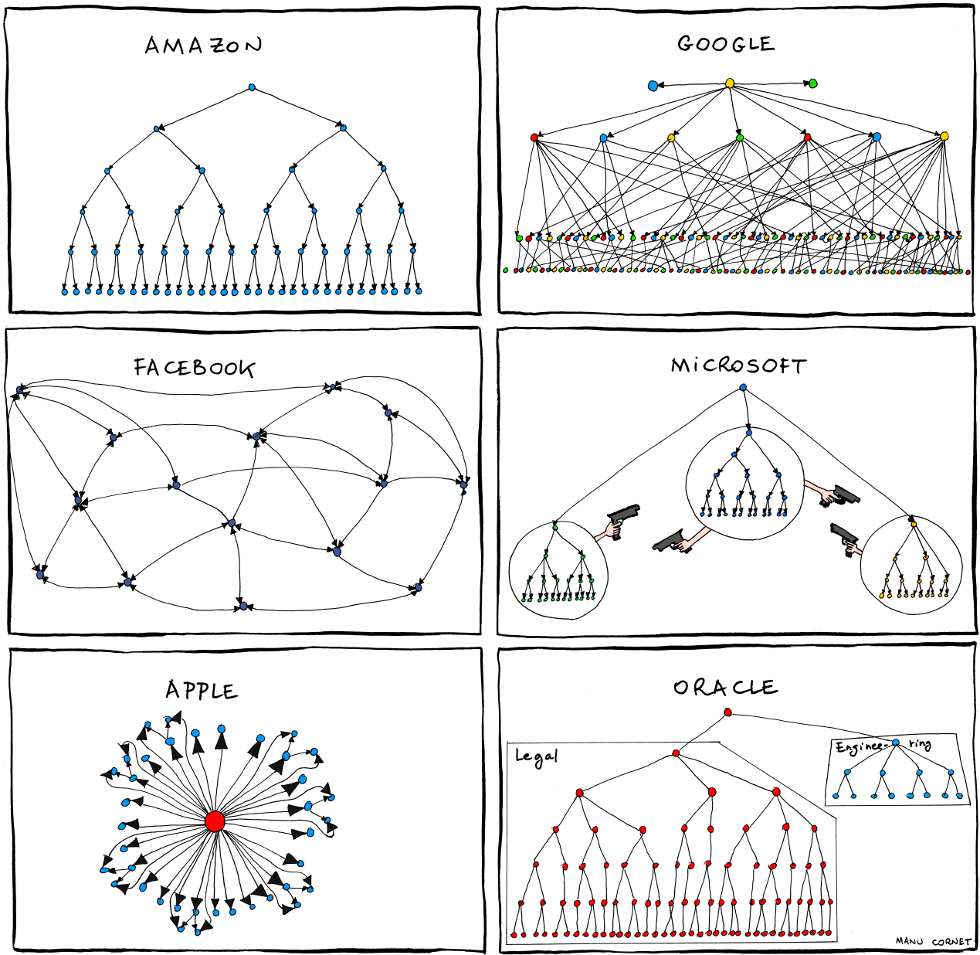
CamperBob2
39 minutes ago
I love how Google looks like an MLP. I suspect their leadership would agree with that portrayal. You can imagine the activation functions: "Will this get me promoted?" "Will this get us bad press?"
LennyWhiteJr
5 hours ago
This is unfortunately par for the course at many big companies. I have re-lived this exact same thread so many times I've lost count
1. Leader escalates issue to his team 2. The team scrambles to come up with a solution 3. No one wants to take ownership. #NotMyProblem 4. weeks or months are spent on 'developing a plan' 5. nothinghappens.jpg
eddythompson80
3 hours ago
I have seen that too many times too in big companies, but I wouldn't say that it results in nothinghappens.jpg
It results in the equivalent of treating an infection with Tylenol rather than antibiotics. The exact symptom reported by a "Leader" will usually get fixed, but in a more of a "KPI hacking" rather than a fundamental fix to the problem. I have seen a "Leader" point to the staggering number of support tickets as a problem then have teams make it incredibility difficult to open a support ticket. The number of support tickets plummets and the first report to instruct their team to do so gets rewarded and all other teams follow suit. Have a leader point to complexity of the sign up process, and have teams "simplify" the signup process by just taking an email to create the account, then make the experience of doing anything post sign up a broken mess because you forgot to go into settings and filling up all the required details. Or have a leader complain about the install process like in this example, and have teams just bundle massive dependencies or make wide horrific modifications to the users machine to "simplify" the install process. Now suddenly installing a video editing software also modifies your default video player, your HDR or scaling settings, your audio device setup, and your keyboard layout (because why not?)
procarch2019
2 hours ago
I drown in support tickets daily that used to go nowhere. Then people started realizing that I knew what I was talking about and not some standard business user. Now I still have to open tickets, but get visibility of the people who know what they’re doing on their end (having been moved up from lowly support to oversee some ticket filling company that doesn’t know crap). We get tom complain to one another how shit is broken, wait mandatory change periods and then get something working by exploiting loopholes because some process was developed and someone put a lot of money behind it.
Large companies are why large companies are large (in IT/OT at least)
MichaelZuo
2 hours ago
The more interesting question is why would so many thousands of people in a big firm seemingly be fine with frustrating customers and giving the appearance of a gaggle of clowns?
Standard psychology says they should be highly sensitive to status loss, but it almost seems the opposite.
ThrowawayB7
36 minutes ago
Ask anyone at a FAANG and they will tell you that large corporations get flak every day for a lot of things, some justified and some unjustified. As an IC, you need to tune it all out and let the people whose full time job is to deal with that sort of thing handle it.
ramesh31
2 hours ago
>"The more interesting question is why would so many thousands of people in a big firm seemingly be fine with frustrating customers and giving the appearance of a gaggle of clowns?"
Existing in a large org over the long term becomes a game of survival. It's very much similar to the "dark forest" or the Eye of Sauron. Your number one goal as an IC is to complete the tasks directly assigned to you by a supervisor and avoid at all costs any kind of "hey you" assignments that have zero upside and plenty of possibility for downside. It would be wonderful if we lived in a world where individual initiative mattered and was rewarded, but it doesn't. It becomes "why haven't you delivered XYZ", and the vague ephemeral reasoning of "well A, B and C for team D needed fixing" is not an excuse, and now you can't pay your mortgage anymore.
duxup
2 hours ago
I’ve had “Boss I can fix this in one line of code.” situations, but nobody of 6 people wanted to make the call despite involving themselves excessively.
So nothing got done.
So the temperature on the issue went up.
So management whose failure was their own could only think of engaging more managers and processes….
Never ended.
I work at small companies now, less money but I enjoy it more. I just fix things and everyone is happy.
Razengan
2 hours ago
The Soviet Union didn't fall, it got merged into Microsoft
jryle70
41 minutes ago
Capitalism at its finest! Or wait, never mind
bestouff
3 hours ago
My fav is this :
> Someone decided to trash the one part of Windows that was usable? The file system is no longer usable. The registry is not usable. This program listing was one sane place but now it is all crapped up.
This is so true, and not only under Windows. Install any modern program under any modern OS and have a look at the filesystem, it's a flaming mess. Nowadays the only solution "smart people" have found is to install a complete system, complete with libraries and frameworks, for each program.
I miss the days of simple executables.
torginus
3 hours ago
> I miss the days of simple executables.
One of my "santa's not real" moments of computing was realizing how much static and dynamic libraries fucking suck. This cannot be overstated, and is illustrated perfectly by the heroic efforts of software vendors to get away from them.
Okay, a few functions like fopen are fine - but even those are syscall wrappers IRL. But every OS seems to have concluded, that in the place of API calls, one should rather have streams of text (UNIX) or binary messages (Windows, also a bunch of Linux desktop stuff, like Wayland), or File I/O.
Basically a major motivation behind JIT langauges (C#/.NET certainly) was an effort to get away from dynamically linked libraries,
Even DOS didn't really have libraries, you had peripherals mapped to memory at certain addresses, and a set of interrupts, and that was it.
These single file Go and Rust programs read and write stdio and/or network, which is a reasonable solution to a lot of problems, but certainly not all of them, especially in the interactive space.
1718627440
15 minutes ago
> Even DOS didn't really have libraries, you had peripherals mapped to memory at certain addresses,
And linked libraries are interfaces mapped into memory at certain names. I think that's an awesome improvement.
1718627440
18 minutes ago
That's why I like the "managed" model Debian uses. Programs are enforced to comply to the OS standards. If they don't, they either get changed by the Debian maintainers or just not included into the distribution. That's why I can know where things are in my filesystem.
Seattle3503
3 hours ago
Rust and Go can create a single statically linked executable and they are very popular. It could become a thing.
brianwawok
3 hours ago
The difference in complexity between my go and my Python docker image is actually hilarious. 100s of files and package managers and npm and whatever else.. vs 1 file.
Seattle3503
2 hours ago
Where does NPM play in to the build?
kristianp
an hour ago
Npm always finds its way in, usually for building web artifacts.
anal_reactor
3 hours ago
I don't think I'll ever learn what the folder structure on Linux actually means
computerfriend
2 hours ago
man hier (https://man.archlinux.org/man/hier.7.en).
knollimar
5 hours ago
"I don't know what it means to "own website issues""
made me irate. It was very clear! Read the issues and be accountable for fixing them?
TulliusCicero
5 hours ago
From what I know about MS, I can understand what they mean. Microsoft famously had teams at odds with each other, so if you "own" something across multiple teams and can't get them to actually work together or take a particular issue seriously, then you just have the shit end of responsibility without the authority to make stuff happen.
hylaride
4 hours ago
For awhile under Balmer, Microsoft implemented a lot of Jack Welsh management philosophies. This included stack ranking, but also encouraging "internal competition" under the idea that it'll drive people to excel. In real life that caused friction, politics, sandbagging, and other problems that were not in the company's best interests. It's fine to be competitive, but in some competitive situations (team sports, companies, etc), the whole point is for the team to win, not individuals.
Sadly, even though most of these philosophies have been discredited over the long term (stack ranking can be fine if you do actually need to do layoffs, so long as you realized there are exceptions to the rule), other bad management practices have also taken over. We're now squarely in the depths of all the worst aspects of "product driven" development, where nebulous metrics are measured for success (such as the bad VSCode decision to append copilot in commit messages, which makes it look like copilot is more heavily used than it is).
marcosdumay
an hour ago
Ironically, they could have learned from Jack Welsh to separate the product divisions and make redundant teams on each one to solve the ownership issues.
When people compete internally on Microsoft, what are they competing on if everybody works in a different horizontal?
gigatree
3 hours ago
Exactly. Jack Welsh’s management philosophy just further incentivizes doing what you can to bring everyone else (ie the company) down to make yourself look better.
ayewo
3 hours ago
> Microsoft famously had teams at odds with each other, ...
Instantly reminded me of this especially apt comic:
https://pbs.twimg.com/media/EyJfRwHWYAI0_yt?format=jpg
[1] Also available here: https://www.reddit.com/r/ProgrammerHumor/comments/6jw33z/int...
motoboi
5 hours ago
Given that the way the company worked was the cause of the problem, sending the email company wide would have caused more confusion that solve the problem.
georgemcbay
4 hours ago
> My favorite bit about this is how none of the execs want to take ownership of the change, but instead trying to put someone else in the hot seat and/or start a Committee.
And with the exception of John Martin's reply (which recognizes that there are deeper problems they should think about, but seems resigned to the fact that that won't happen) the focus is pretty much entirely: "let's fix the exact issues Bill Gates ran into trying to download this one product we produce" (out of many hundreds/thousands) rather than "let's fix the root causes that caused us to arrive in this place to begin with".
I haven't worked at any companies as large and siloed as Microsoft, but I'd assume this is pretty common for them, at least if they don't have a Steve Jobs-like tyrant who both has all the power and is singularly product focused.
Twirrim
4 hours ago
There was nothing surprising in that email chain at all, looking at it as someone with lots of experience in large companies.
In a twisted kind of way, the replies were reasonable and logical. They're not dumb, they can see it was crap. No one org can actually own this fix, so in that kind of situation it realistically requires someone like Bill to choose someone to drive it, and demand updates to ensure that everyone gets aligned. Telling his execs, especially in a company so notoriously political and "empire" oriented as it was, isn't going to work.
I actually liked that in Amazon, Jeff Bezos used to send out the infamous "question mark" emails on such a regular basis that they built an exec commitee specifically for the purposes of driving direct action on problems. Didn't matter where you were, or what you were working on, if that question mark email came you dropped everything to work on it.
whstl
2 hours ago
Yeah. In context the answers make a lot of sense: it’s a dysfunctional company where ownership is non-existent and getting shit done is hard.
This is how learned helplessness looks like when you’re a high level executive.
ValentineC
2 hours ago
> This is how learned helplessness looks like when you’re a high level executive.
Must be nice being so useless, yet getting paid so much.
Though I guess these people must have been good at politicking to rise so high.
whstl
an hour ago
I mean, you're 100% right, but what's the alternative? They wanna keep the salary. The machine rewards political people, not people who pick fights to improve the product. It's a perfect pair. :/
mike_hearn
an hour ago
I think they also suspect/know that Gates won't revisit the issue. The email is a flame as the subject line admits. Gates wasn't going to go back every week for the next six months to track progress.
stackghost
27 minutes ago
>In a twisted kind of way, the replies were reasonable and logical. They're not dumb, they can see it was crap. No one org can actually own this fix, so in that kind of situation it realistically requires someone like Bill to choose someone to drive it, and demand updates to ensure that everyone gets aligned. Telling his execs, especially in a company so notoriously political and "empire" oriented as it was, isn't going to work.
This goes right back to the leadership failure on Bill's part. If your company is structurally incapable of producing good products (which Microsoft assuredly is and still was) then it's on you as the CEO to implement the correct structures.
That's literally the purpose of upper management: you create the conditions for success to happen.
vjvjvjvjghv
4 hours ago
It's very common. From a certain level up, execs rarely use the products they are responsible for. It's all about strategy, committees, meetings, plans and reports. For them the product is just an abstract thing. When I rented a Buick car, I thought to myself that there is no way any decision maker ever tried the car and thought that this is ok.
I think one of the strengths of Apple during the Jobs days was that Jobs actually sometimes seemed to use the products himself and gave feedback. When I look at the blatant bugs MacOS and iOS had in the last years, I also think that the current Apple big shots never use their stuff or they would have noticed.
baud147258
3 hours ago
> I also think that the current Apple big shots never use their stuff or they would have noticed.
Or they do and they don't think it's worth their time and energy to get them fixed. I think they just don't care about their products, unlike Jobs.
pino83
2 hours ago
If you'd take the Gates email and give them to my colleagues, saying "this was some random guy complaining about Windows", they'd all react along the lines of "Well, that's just an idiot who makes things up because he's bored and hates Windows. There are good reasons for everything he complained about. He just reports it in a quite dramatized way."
ValentineC
2 hours ago
> When I look at the blatant bugs MacOS and iOS had in the last years, I also think that the current Apple big shots never use their stuff or they would have noticed.
The crazy thing is that it's more likely that most people in Apple are using their own products, versus any of the Android phone manufacturers or within Google, where it's likely a few of them would be using the Apple ecosystem instead.
Many of them are definitely dogfooding it, but it's possible that there are communication or empowerment issues.
vjvjvjvjghv
44 minutes ago
One thing that drives me nuts for example is the indicator for remaining disk space. I have this icon on my desktop that says "Macintosh HD | 995 GB, 273 GB free". This used to work great until a few years ago. Copy 1 GB onto the disk and it displays 1 GB less free disk space.
But since a few years it goes up and down daily by 100 GB or more. Sometimes I have 350 GB, sometimes I have 100 GB. I think it has to do with Time Machine snapshots and purgeable space (whatever that means) but it's totally useless now. I can't tell for sure if I can copy 250 GB to my disk or not. It may fail now but work 2 hours later. How come nobody notices such a fundamental thing not working? Somehow the dogfooding doesn't seem to work. Or maybe the Apple people all have 8 TB disks so they don't care.
noir_lord
3 hours ago
> I haven't worked at any companies as large and siloed as Microsoft, but I'd assume this is pretty common for them.
Doesn't need to be that large, I worked for a company that ~4500 employees with about 1000 at HQ, that entire email chain looks exactly like what would ensue every time someone at the C-level flagged an issue.
I suspect the reason is much the same, no one wants to be in the hot seat to fix a problem they have no faith they can fix so everyone plays hot potato with the flaming sack of shit until it bursts and lands on someone.
> Fish begins to stink at the head, not the tail. (13th Century Persian Proverb)
whstl
2 hours ago
I have worked at MS-sized orgs that are like this, but have also worked at 100 employee startups that are exactly the same.
Once bad culture gets to your company, it doesn’t matter the size.
12_throw_away
2 hours ago
Also I suspect that there's no real teeth in that angry email.
If the big boss is frustrated by the UX, they might send an angry email or even yell at you in person. If your division doesn't meet its sales projection for the quarter, you might get fired.
If BillG had wanted a company that made good user experiences, he'd have hired (and fired) for that. Sending a pissy email is what you do when you're annoyed but don't actually care enough to do anything about it.
andai
2 hours ago
Somebody really oughta do something about this mess!
dmitriy_ko
2 hours ago
Microsoft is a company where you get promoted for playing politics, not taking ownership, improving things, fixing bugs.
stackghost
4 hours ago
Agreed. From the comments, lots of people down-thread who clearly haven't worked in large orgs.
They are arguing about not wanting to take ownership because they know the organizational structure is going to be an impediment. The problems Bill describes could not have been solved by Microsoft without a massive internal restructuring. We know this because Microsoft's UX is still abysmal.
Nobody wants to have the inevitable failure hung around their necks by "owning" something that depends on the cooperation and coordination of departments that don't report to them.