saagarjha
2 days ago
> Interior Secretary Doug Burgum said in a statement posted on X that Americans deserve an energy system built on common sense and not one dependent on "costly subsidies".
I agree. This is why we are building offshore wind and not subsidizing fossil fuels, right?
Kim_Bruning
2 days ago
> not one dependent on "costly subsidies".
While paying out 1.2 billion dollars.
est31
2 days ago
Mostly this is just about giving back the money RWE paid for the leases from the US government to build those turbines. Plus various fees. They could have went for suing for total profits too.
> RWE U.S. Offshore secured these leases from the U.S. government with a long-term commitment to develop offshore wind capacity in American waters and invested more than $1 billion toward the leases and the development of these projects. These leases provided legal rights to develop offshore projects and represented years of planning, investment, and partnership with federal agencies.
> After careful consideration, it was determined there is no path forward to permit these projects in the U.S. for the foreseeable future. The settlement resolves RWE U.S. Offshore’s legal claims and provides $1.22 billion in settlement funds.
https://www.rwe.com/en/investor-relations/financial-calendar...
timacles
2 days ago
Out country is ran by bunch of Lionel Hutz clones
fatnoah
2 days ago
Art of the deal: Pay $1.2B in exchange for a $900M investment elsewhere.
ratelimitsteve
2 days ago
> > not one dependent on "costly subsidies".
> While paying out 1.2 billion dollars.
for nothing. to literally replace some energy with no energy.
andrei_says_
2 days ago
Narrative is defined by ideology and the media machinery able to sustain it. Facts are woven in only when serving the desired reality.
If you and I listened to the propaganda on the regular basis, our intuitive knowledge would associate clean energy with isolated from reality snowflake liberals, hippies, abortion, subsidies, as opposed to fossil fuel energy associated with manliness, strength, common sense, “good old values”, military strength, and freedom.
Just like beef (“it’s what’s for dinner”) and a delicious juicy rare steak. See?
I recommend checking out George Lakoff’s work on the power of identity and metaphors. Look up his “moral politics” lecture on YouTube.
imglorp
2 days ago
Oh that's not nearly the amount of fossil subsidies. Some say it's $31b/yr direct. If you factor in indirect costs like climate damage, health expenses, oil wars, etc, it's much higher. Renewables are much, much cheaper regardless of a little incentive, if there are any left.
https://www.theguardian.com/environment/2025/sep/09/fossil-f...
TheOtherHobbes
2 days ago
Globally, fossil tax breaks and implicit subsidies are at least $6tn.
The entire sector is a catastrophic, institutionally corrupt scam.
https://www.imf.org/en/topics/climate-change/energy-subsidie...
winter_blue
2 days ago
It’s kind of amazing and horrifying at the same time that a democratic country like the U.S. is doing all these shenanigans like blocking clean zero carbon energy, while a communist authoritarian country is massively moving towards clean energy.
Based on what our media and our education system teaches us, one would have assumed that common sense and sound logic would prevail in a democracy, but rather what we see is insane nonsense, paranoia, and misinformation (including about vaccines) prevail in the U.S., to the point of burning piles of money (including the 1.2B in this case) just to satisfy a childish and bully like need to spite and trigger the progressive side (like talking about causing more pollution with the goal of “owning the libs” or triggering “delicious liberal tears”). And we’re talking about massive negative externalities with increased pollution. This kind of childish bully behavior is as though you had a neighbor who cared about not littering in public and the streets being clean, and you just threw garbage on the streets to upset her. A ridiculous level of immaturity, truly.
Meanwhile, we have totalitarian dictatorships (like the Emirates which has heavily moved toward zero carbon electricity sources like solar and nuclear) behaving far more logically, rationally, and soundly with a view towards the long-term rather than the short-term.
tedggh
2 days ago
I work in renewables in the US. The current picture is actually a lot more positive than people believe. But good news are usually boring at not good for click bait, so they aren’t covered by the media. There’s a lot of work on solar energy currently and the forecast is VERY good. We do have some issues like grid connectivity and shifting policies but the market economics are working extremely well. The fact is solar is too cheap and, unlike wind, very easy to deploy, so it doesn’t matter what your political views are, you will eventually support it. Texas for example, the conservative oil and gas hub of the US, is already outpacing California in total capacity additions because 1) they have tons of land and 2) no BS, quick local permits. So if you are a solar builder, you go to Texas not California. And yes, Texas is still pro fossil fuels, but the laws of supply and demand will continue favoring solar so that’s where the money will flow to.
dathinab
2 days ago
> fact is solar is too cheap and, unlike wind, very easy to deploy, so it doesn’t matter what your political views are, you will eventually support it
this is my point, too
renewables, especially solar, just have gotten very competitive to a point they will gain ground even if not subsidized
and I believe we will see (and in some niches have already seen) this happening for electric cars, too. They are plain simple just better technology which for now is still in the earlier stages.
How much relevance wind will have we have to see, it's less advantages then solar and less easy to deploy. It's pretty good in some very windy northern (i.e. also less solar efficient) places and often iff it's extremely windy it's not extremely sunny and if extremely sunny it's often not extremely windy. This makes them complement each other quite nicely. So I still see a future for it even outside of the more northern regions.
Animats
2 days ago
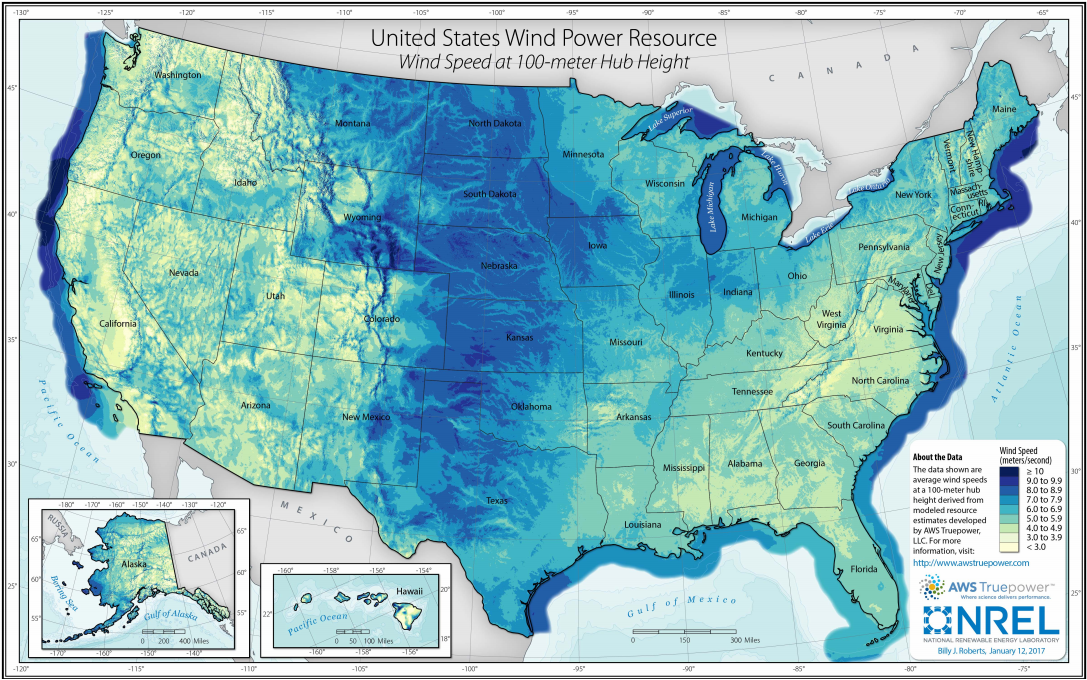
California has only four really good wind sites, and they already have wind farms on them. The real US wind belt is from the Texas panhandle northward to Canada. Look at a wind map of the US.[1]
Grid-scale battery storage just keeps getting installed at an increasing rate.[1] 9.7 gigawatt-hours installed in Q1 2026.[2] It's not very visible. It's just shipping containers laid out on cement pads. It doesn't take up that much space. It can be placed anywhere there's good access to transmission lines. It's profitable if you can buy cheap solar power in the daytime and sell it at night. It's safe now that it uses lithium-iron phosphate batteries.
88 days to the midterm elections. Trump will still be in office for a while longer, but with less power to make trouble.
[1] https://energy.maryland.gov/SiteAssets/Pages/Info/renewable/...
[2] https://gcn.com/america-s-grid-batteries-strongest-first/204...
newyankee
2 days ago
all the US needs is Australia like pricing and combine it with individual energy independence branding + clean long term financing like mortgage and there is no better place in the world to harness the urban sprawl and single family homes for rooftop solar. This assumes utilities and their business models can be quietly upended which is probably the biggest bottleneck
johnnyanmac
5 hours ago
I do perfectly believe that there's a lot of progress in renewables and am happy about it. I also think of how much farther we would have come if it wasn't in spite of 40-50 years of obstruction by governments to satisfy coporate entities stuck in the old world.
So I still appreciate knowing the bad news.
jhoechtl
2 days ago
The sweet spot is representative democracy with a tendency of socialism, to mildly distribute welath and assure social coherence. A voting system which results in a division of force, representing the voters will.
The current US administration calls such things comunism.
winter_blue
a day ago
> The sweet spot is representative democracy with a tendency of socialism, to mildly distribute wealth and assure social coherence.
This would be perfect.
OroPla
2 days ago
The thing we have called "democracy" for the past three hundred or so years is basically just shadow government by whoever has the deepest pockets to influence public opinion with propaganda and pay politicians to do what they want. The politicians get blamed and cycled out while everything continues as before.
dathinab
2 days ago
no
this way of thinking, is not very useful and can be pretty harmful, just because something is imperfect doesn't mean it's fully broken. Just because people have always manipulated democracy doesn't mean it "basically just shadow government".
And sure, the US is a very bad case, _especially_ in recent years. But also let's not forgot that for most of it's history just one of the countless scandals of Trump would have been enough to highly risk impeachment for a president and be equal to political suicide. I.e. there has been quite a bit of limits on corruption and influences from behind the scene. It's just that the US went and broke itself. And yes a two party system was never truly democratic, it's still better then a one party system nor the same as a full shadow government.
Which brings us to another point, there never was "the" shadow government, just many different people which had way to much influence behind the scene in not so democratic ways. A shadow government implies some form of organization/structure which actually governs and then puppets in front, but that was never really the case in the US AFIK. Even today it isn't as a lot of the escalating corruption is just pretty much out in the open by the governing people, instead of in any shadow, by people not in a official position.
parineum
2 days ago
If that were true Hillary Clinton would have been president.
waffletower
2 days ago
Money is deep on both "sides". It didn't help Harris to have the most either. But you can't deny that some political steerage toward donor agendas occurs.
imglorp
2 days ago
She won the popular vote by a mile, he won the electoral vote. Some would say she should have been.
nomel
2 days ago
Nobody with cursory knowledge of the US voting system would though.
Edit: to the downvotes, our system doesn't care about popular vote, and neither do the most democratic/left left leaning states, who don't care to use proportional voting.
DANmode
2 days ago
> Meanwhile, we have totalitarian dictatorships (like the Emirates which has heavily moved toward zero carbon electricity sources like solar and nuclear) behaving far more logically, rationally, and soundly with a view towards the long-term rather than the short-term.
The difference you’re spotting is the leaders of those nations have some remaining incentive to care about the wealth and wellbeing of the country they’re leading beyond the expiration date of a 4 or 8 year term.
For better and for worse, they have that, the US doesn’t.
bryanlarsen
2 days ago
It's been a common saying for a long time that a benevolent dictatorship is the best form of government and a tyrannical dictatorship the worst. Democracy exists primarily to avoid the latter, not that it's better than the former.
Neither China nor the UAE can be said to have a purely benevolent dictatorship but it's not purely tyrannical either. So not surprisingly they're better than democracies in some aspects and worse in others.
basilgohar
2 days ago
It's almost like we've been sold a lie about good guys and bad guys, us vs them, and so on.
prmoustache
a day ago
It has always been about where you lived and not how the guys really were.
winter_blue
2 days ago
I do think authoritarianism on its own is bad. I want the freedom to criticize my government, and I want the freedom to run for elections or to advocate for changes I want to see. I think democracy and logical long-term thinking shouldn't be mutually exclusive. I feel democracy and sensible behavior are two not connected things.
You can have idiotic authoritarian governments that ruin the economy. China and Vietnam were exceptions among communist countries, who switched to a form of market economy, when they saw that central planning was poverty-inducing and nigh impossible to do.
The problems we're seeing in democracies might lie with the level of disinformation for electioneering purposes that is permitted under free speech today.
dzhiurgis
2 days ago
Oh please. You wouldn’t survive in the regime 15seconds.
TitaRusell
2 days ago
As an atheist I wouldn't survive in Texas for 15 seconds lol. I think I'll stick to my little Euro socialist country where politicians don't swear on a bible.
parineum
2 days ago
That's a funny thing to say about a place you've obviously not been for 15 seconds.
Also, you can swear on whatever you want here. It's the person's choice. You could swear on a copy of hitchiker's guide to the galaxy if you wanted.
pineaux
2 days ago
Its because democracies werent and arent really democracies. But that aside. Corruption is rampant, the oil sector has politians in their pocket for a long long time and since the cold war, a counter narrative doesnt really put any weight in the scale. The billionaires arent afraid anymore.
throw1234567891
2 days ago
That communist country is sitting on a year’s worth of oil reserves, and rolls out a ton of coal for when they run out of oil. Makes you wonder why… almost looks like they know they’re going to be under complete sanctions sometime soon!
That communist country also likes the current war in Iran. They get all that oil cheap for their reserves stockpile.
kelseyfrog
2 days ago
The enemy is both weak and powerful.
WalterBright
2 days ago
> Oh that's not nearly the amount of fossil subsidies.
Consider the taxes on gasoline.
jsiepkes
2 days ago
Since this is about energy; Power companies don't pay taxes on gas and diesel used in power plants.
jeltz
2 days ago
All kinds of power generation are typically heavily subdized in some way. I do not think this "common sense" strategy exists.
i5heu
2 days ago
"common sense" is common sense because it is not "specialised sense" or "expert sense"
So if politicians base their decisions on "common sense", they confess to not being able to use experts that refine their knowledge and position about a topic.
A "common sense" strategy is therefore what is most popular and on the basis of the understanding of laymen without deeper understanding or knowledge.
blaze33
2 days ago
For at least a few years, "common sense" has been hijacked by populist politicians, now it just means whatever simplistic idea that fits their worldview, even when it's not complicated to see that said idea is clearly misguided. The original meaning seems lost to me.
bitmasher9
2 days ago
Furthermore, using the phrase “common sense” to describe an idea inherently dismisses any individual that will argue against it. They either are too dumb to have common sense, or too much of an elite to have common sense.
reactordev
2 days ago
This is the word smithing they are known for. By labeling “common sense” means anyone who argues against it is against “common sense” because every argument is a strawman argument.
RobotToaster
2 days ago
It's basically become a thought terminating cliche https://en.wikipedia.org/wiki/Thought-terminating_clich%C3%A...
icantevenhold
2 days ago
It is what it is
jakeydus
2 days ago
I think you care way too much about this topic.
throwaway27448
2 days ago
That was the original meaning dating back at least to thomas paine (bless his heart). It is a term impossible to deploy in good faith.
ben_w
2 days ago
Always meant that, so far as I can see.
smolder
2 days ago
"Common sense" might also mean "do the simple thing" which, given how cheap it is to invest in renewable energy sources like solar farms, and how much room we have to build daytime capacity that way without large scale storage, might mean installing a lot more solar.
Don't pretend the current US admin is anything but corrupt and stupid.
throwaway173738
2 days ago
Don’t overthink it. Burgum means “don’t disagree with me I’m always right” when he says it.
perpetuallunch
2 days ago
Day time.
And what of the night?
Freeze in the dark.
freeone3000
2 days ago
Batteries.
Or pumped storage. Or lifting a really heavy thing and letting it fall slowly.
Or retaining an amount of fossil fuel capacity to be turned on during peak consumption and sun and wind dips while still focusing on renewables and storage with the goal to reduce the duty cycle of peaker plants to zero.
perpetuallunch
a day ago
> Or lifting a really heavy thing and letting it fall slowly.
I challenge you to run the numbers on this.
Or at least read or watch someone who has.
Whenever you’re certain you know the answer, it behooves to try to prove yourself wrong.
Unsurprisingly, gravity is an extraordinarily weak force. It merely appears otherwise because the total mass of the Earth is literally astronomical at around the 5.9722×10^24 kg mark. Concrete blocks hanging from a crane, much less so.
Don’t believe me.
BIY - Believe It Yourself here:
https://youtu.be/iGGOjD_OtAM?si=FXjjxz4NLbA-oj7U
Pumped hydro is a nonstarter: do you see any suitable geography anywhere? Yep, they’ve already been dammed damn it. So approximately no one^ can have their existing hydro upgraded to pumped hydro retro fitted to pumped, and have the surrounding landscape covered in solar and wind.
How helpful!
Chemical batteries? South Australia has a decent sized one. I think it can power some of the state for about 12 seconds.^^
^okay, not no one: Hydropower accounts for approximately 15%, but you have to choose pumped hydro sites where it also makes sense for wind and / or solar, so it’s clearly not an answer for everyone everywhere. Not even close.
^^hyperbole! I know. Look, it’s actually around 1–1.5 hours, which is statistically closer to my estimate of 12 seconds than anything actually useful like a day or a week.
defrost
a day ago
Mini hydropower on gentle farm hills are sufficient to store and stabilise small town power - such topography is relatively widespread.
eg: (old page, project is now complete and working as planned): https://www.westernpower.com.au/resources-education/network-...
raisedbyninjas
2 days ago
Wind or solar + batteries have similar cost to natural gas and hydro. They are much cheaper than coal or nuclear.
bryanlarsen
2 days ago
Night can be handled by whatever currently handles day time generation, be it nuclear, natural gas, hydro, whatever.
benj111
2 days ago
Wind, hydro, some kind of storage?
Nuclear? Gas and coal peaked plants?
We can at least plan for an eventuality that is likely to happen. How much planning is/was there when gas suddenly gets cut off?
andrecarini
2 days ago
> And what of the night?
Nuclear.
latch
2 days ago
"common sense" is common sense because it is the "sound and prudent judgment based on a simple perception of the situation or facts" (1).
Maybe what you meant to say is that the position isn't, in fact, "common sense", that it is neither sound or prudent?
(1) https://www.merriam-webster.com/dictionary/common%20sense
LodeOfCode
2 days ago
Keyword being "simple". The common sense solution often turns out to be unsound based on a more detailed perception of the situation
XorNot
2 days ago
i.e. "every complicated problem has a solution which is simple, elegant and wrong"
fuzzfactor
2 days ago
Oh yes, "sound" and "prudent" haven't been in the ballpark nearly as often as they used to be :(
The dictionary definition is in spite of the fact that the phrase "common sense" is more often than ever being used to rebrand what was formerly known as "common lack of sense".
They wouldn't say it if it wasn't false :\
StilesCrisis
2 days ago
In politics, "common sense" just means that they don't have a real justification. You can just apply it to anything and your base will accept it.
jp191919
2 days ago
I see this all the time with "common sense" gun control.
StilesCrisis
2 days ago
Anytime I see "common sense" adjacent to politics, it's a dodge. It's for issues that pander to their base or where they're just getting bribed. If there's a better reason, they'd say it.
einpoklum
2 days ago
> don't have a real justification.
Oh, but the ju$tifi¢ation is all too real for having that kind of "common sense".
gadders
2 days ago
There will always be a place for common sense - the Greeks used to call it phronesis or "practical wisdom".
You also need to distinguish between expert opinion and elite opinion. The two are not the same.
pibaker
2 days ago
In practice "common sense" just means "things I learned from public TV when I was ten and never bothered to learn more about." Renewable used to be more expensive but that hasn't been the case for almost a decade. But you still see people, even on this "news" site for technologically curious people, claim that fossil fuel is the "obvious" cheap option.
scotty79
2 days ago
Common sense is the sense of commoners. The entirity of science if a fight against common sense.
In Poland the closest phrase to "common sense" is "na chłopski rozum" which means "according to villager's mind/smarts".
dspillett
2 days ago
A significant part of science is plucking the true bits from common sense. A fair chunk of what we call medicine is folk remedies that stood up to rigorous testing.
teamonkey
2 days ago
Yes, but the testing bit is what makes it a scientifically-proven method and not a folk remedy.
There are also a lot of folk remedies that have been disproven as medicine. They too were ‘common sense.’
ToucanLoucan
2 days ago
> There are also a lot of folk remedies that have been disproven as medicine. They too were ‘common sense.’
"You know what they call alternative medicine that works? Medicine." - Tim Minchin
wavemode
2 days ago
Curious what you mean by this. There is very, very little medical knowledge today that aligns with historical folk wisdom.
(Even simple things like "an apple a day" - apples are fine, but foods like berries, kiwis and avocados tend to have both lower sugar and much higher nutritional content.)
perpetuallunch
2 days ago
Modern medicine is dominated by very new ideas and technologies.
Gene therapies, targeted cancer treatments, blood pressure medication, antibiotics, surgery, joint replacements, sterile practices, vaccines, hormone replacement therapies.
xtiansimon
2 days ago
> “… without deeper understanding or knowledge.”
Ha! Like the common sense to dam migratory river systems to make hydroelectric power. Good idea at the time, and who cares about salmon. I have a toaster, and a percolator, and a new fangled “ice” box (formerly chilled by ice, now a maker of ice).
S/ My common sense says 1.2B compensation to not do something we otherwise need is bananas as opposed to the common sense—pound salt response. Good thing I’m not in government, yeah. /s
u02sgb
2 days ago
We have a hydroelectric dam near us with a salmon leap next to it. Good visitor attraction too.
It'll provide power for decades with little maintenance and not much further in the way of environmental issues now that it's built.
perpetuallunch
2 days ago
Dams are subject to silt buildup up, which requires maintenance.
They’re so destructive to local ecosystems that environmental groups have blocked any new hydroelectric dams being built in Australia for over 40 years.
All modern concrete eventually fails, and dams are notoriously difficult to remove and replace.
Fortunately they last long enough that if you paint them pink and plug a torch battery in to them they can remain somebody else’s problem for quite some time.
perpetuallunch
2 days ago
But it’s not $1.2 billion people to do the thing.
It’s only $1.2 billion to not do the thing.
To do the thing would require paying the original contracted amount.
Whatever that might have been.
Melbourne, well Victoria the whole state, is looking at a similar scenario for rail tunnels many believe serve little purpose.
Around $1.2 billion to stop the work now and pay the early termination penalty. Plus maybe another billion (estimated, who really knows) to bury the tunnel boring machines and remediation work.
Or something like $200 billion to complete the work and operate the rail network over some number of probably too many decades. Although this number seems to increase at a regular cadence.
A new road tunnel was recently completed and people who use it often report they are the only vehicle in the tunnel.
Meanwhile our roads haven’t been maintained in a decade and are literally falling apart. It’s not uncommon to hear reports of multiple cars being recovered after suspension and wheel damage from the same section of poorly maintained road in one day.
All of this in a political and economic setting so corrupt the now former state Labor Premier came out and admitted knowledge of a criminal element having infiltrated the union that represents the workers on the projects. She was recently replaced with her deputy. As if that helps.
Electricity prices have also increased by something like 150 to 200 percent more than inflation over the past 20 years but mostly the past 6 years (so this decade) because state and federal governments seem to want to insist on ramming Net Zero down our power lines, yet we export around the same amount of gas as Qatar. And we have the worlds largest know uranium deposit and yet we have a ban on nuclear power reactors.
Please explain?
dathinab
2 days ago
> on ramming Net Zero down our power lines
except this is AFIK just plain wrong
much more relevant factors seem
- spikes in energy need, mainly AI in recent years
- extremely badly handling of power grids in a high multitude of ways not related to net zero (like seriously, the German grid is pretty bad compared to an optimal grid. But compared to the nonsense many parts of the US have, it looks like a pristine optimal solution.)
- health/environmental protections _not to be confused with climate protection_!! Not wanting your citizens to have massive health issues due to air pollution, acid rains etc. has _nothing_ to do with net zero. People tend to somehow always conflate it. But a lot of the policies the US ended up doing (compared to the ones they say they want to do) where more about that then anything climate related.
- inflation statistics being... badly done. Like if most relevant daily use products have price increases noticeable above inflation then your way to measure inflation is the problem.
And a lot of the net zero things, tend to actually produce relatively cheap energy, even if you include cost for e.g. some gravity energy store and similar buffers. Just if you don't properly modernize, then you can run into troubles. As part of the US has never been in favor of renewables at all you can guess what happens there wrt. making decisions to which make things work compared to decisions which hinder things and then blame the technology instead of your bad politics.
perpetuallunch
a day ago
Modern coal fired power plants are much cleaner than those that contributed to acid rain.
You seriously believe coal fired power hasn’t evolved in the last 40 years?
You’re saying that renewables are cheap but only if you include gravity storage.
What gravity storage? The only useful one is pumped hydro, and that works approximately nowhere because of a lack of suitable geography.
Australia’s Snowy 2.0 pumped hydro is on track to cost an infinite amount and / or be finished never.
dathinab
6 hours ago
> You seriously believe coal fired power hasn’t evolved in the last 40 years?
no but even with evolution it still is way worse then literally every other (practical used/usable) alternative
e.g. the quality of German brown coal is so bad that there is a saying that burning plastic wast gives you both more and cleaner energy
> approximately nowhere
you mean no where except everywhere where you have decent sized hills or mountains (and even in flat land under some circumstances) and is already build and in use in Germany in multiple case (and also not just Germany)
anenefan
a day ago
> "Electricity prices have also increased by something like 150 to 200 percent more than inflation over the past 20 years but mostly the past 6 years (so this decade) because state and federal governments seem to want ... "
There's a few factors.
The main one from what I hear / read from those I know down that way was private industry getting their hands on the energy grid ... from what I have heard read it's a royal shit show at times and pricing just kept on leaping upwards with what looks like fly by night to the public retailers that aim to just maximise the amount people are willing to pay. Pricing is my locale is spared electricity customers somewhat, from dealing with the same profit based clowns [1] down southern end of Australia getting any sort of market share here.
Almost getting the top spot for higher jump in costs, is the increase of infrastructure spending on the network. Some of that has to do with population growth and increase of grid demand due to urban sprawl and higher energy demands from the average customer. But the jump you see down in your state has been that much of the network down that way has not seen much investment in its upkeep and the rise of weather events affecting the various electricity grids that were not specifically designed for high winds in mind. The southern states high winds especially during dry periods is linked to wild fire events, so there's additional pressure to perform. This costs money and private companies are once again going to recoup that cost harder than what a govt governed entity would do, but then again in my locale being without power for half a day to days while a transmission line is repaired that failed isn't that uncommon.
>" And we have the worlds largest know uranium deposit and yet we have a ban on nuclear power reactors."
The public indirectly voted three or so decades ago, it from that assumed a mandate against uranium ... the dolts tried again last election, again no dice. Done and dusted, public no want. Some people will persist it's a good idea, thorium is with its safe waste is, uranium is not. The uranium nuclear path involves not millions but billions for studies, the companies like Deloitte are waiting in the wings. Soil studies, site locations, blah blah paid think tanks - lots of tax payer money. Going forward then there's design - Australia will pay again billions to some international company that's part of the old uranium crowd ... building I'd guess once more another international company will get the cream though yes some local employment will be touted and finally a waste facility and where to put it. If and when it got that far it might finally occur that uranium waste makes for good dirty bombs and the security around moving the waste each year will cost millions along with storage security, which isn't going to be some small depot with a six foot fence around it and a couple of security guards ... people that would want to make dirty bombs are not going to be waiting for it to fall into their laps. Of course at the end, it such a plant ever got up and running, the power is now centralised around one or more nuclear power plants and rather than resilience, this future grid had introduced large points of failure.
[1] cheapfwits Co with typically no phone support
Edit on last sentence for clarity.
bs38
2 days ago
You dont need deeper understanding of knowledge for everything. Ask Grandma whether she needs a chemical engineering degree to bake apple pie.
Then there is the Theory of Bounded Rationality which tells us expertise may exist but resources, time, energy, info, attention etc etc may not therefore bounds and limits of expertise alone must be recognized and solutions reached are satisficable rather than optimal. Aiming for optima when other factors havent been sorted just creates new problems.
PurpleRamen
2 days ago
> Ask Grandma whether she needs a chemical engineering degree to bake apple pie.
Grandma doesn't bake with "common sense", she is using the specialized knowledge of cooking & baking.
polytely
2 days ago
grandma's baking knowledge isn't common sense but expertise.
ToucanLoucan
2 days ago
> You dont need deeper understanding of knowledge for everything. Ask Grandma whether she needs a chemical engineering degree to bake apple pie.
You've clearly never baked before. Baking is a chemical science. You have to adjust temperatures for your freaking elevation relative to sea level. Granted some recipes are pretty forgiving, sure, but far from all, and some are downright merciless in terms of complexity and effort required.
Even people who do it constantly have items that just don't turn out because it's legitimately hard shit.
Eldt
2 days ago
You seem to have conflated a chemical engineering degree with the concept of baking being a chemical process
halostatue
2 days ago
No, but baking is still a process that requires skill — and that skill is not 'common sense'.
If making sourdough were 'common sense' then _everyone could do it correctly on their first try_. They don't. Most fail and never try again because the skill level required for sourdough is too high.
I'm an _expert_ cook, but I'm still having to go through the frequent failures of learning how to pickle with brine (fortunately, my failures have been mostly edible and have not turned moldy). Even vinegar pickling requires a certain level of expertise before you can do it successfully, even though that level of expertise is _roughly_ "knowing how to boil water".
PowerElectronix
2 days ago
There are too many interested parties involved in the energy sector. The only common sense I can think of is solar+storage at the single building level and interconnected through smart grids with neighbours.
But that leaves out the government and all those interested parties so we're never ever getting that.
jtbayly
2 days ago
And in the winter in the North people are just supposed to freeze?
whizzter
2 days ago
The energy mix for electricity in Sweden, Norway and Finland is mostly made up of hydro+nuclear+wind, especially wind and hydro complements each other very well since hydro is very much on-demand and can cover for most temporary wind shortfalls.
Driving through my childhood area up north a few weeks back I was also surprised by the amount of solar going up, for comparison this is an area _north of_ Anchorage/Alaska with less than 3 hours of sun around Christmas, but already by late January (usually the coldest period of the year) there is over 6 hours of sun a day (so with high pressure cold peaks with less wind, the 6 hours probably eases the power bill quite a bit).
An interesting fact about those solar installations was that the panels were mounted almost vertically (probably to avoid being snowed over but also useful in the winter since the sun mostly just shines from the south anyhow).
PowerElectronix
2 days ago
Solar would produce enough power in winter. Germany is europe's top solar energy producer and is at a latitude similar to Alaska.
eigenspace
2 days ago
The very very northern tip of Germany reaches almost as far north as the southernmost tip of the Alaskan panhandle, but most of Germany is more like mid-south Canada on a latitude basis.
Northern Germany is much more specialized into wind power, and the south is more solar intensive (though solar is more evenly spread throughout the country than Wind, thanks to ease of installation, and the fact that it still produces tonnes of electricity in the summer).
Solar should be built in Alaska, but wind and hydro is what should be actively subsidized and supported by the government. The market can take care of solar penetration in Alaska if you let it.
cycomanic
2 days ago
One additional tidbit of info. While the northern coast in Germany has certainly more wind, a reason why wind falls off so strongly towards the south, are the policies of the CSU party in Bavaria, which though not quite as bad as trump has been running Anti-Wind policies and making wind installations extremely difficult to build.
perpetuallunch
2 days ago
At what cost?
Doesn’t Germany now have some of the most costly electricity in the OECD?
For a while there we kept hearing about plug in balcony solar in Germany.
Electricity generation used to be a solved problem, now it’s so bad people want to connect solar on their apartment balcony.
And we’re supposed to believe this is progress?
bryanlarsen
2 days ago
Germany's high electricity prices are set by the cost of imported LNG.
mapontosevenths
2 days ago
North Americans mostly do not use electricity for heat in the winter. Around 60% use natural gas with forced air furnaces. Something closer to 80% have the option, but 20% don't bother to use it.
Some of the deep south get by with electric heat, but they aren't in places where the cold is a typically a legitimate danger to health and safety.
ricardobayes
2 days ago
I find something very refreshing in this, reading from Europe where we get told "gas" is the big bad, even threatening to make condensing gas boilers illegal from time to time [0], despite over 95% of homes (in the UK) being heated by this method.
That said most of Europe doesn't heat or cool adequately, Spain and Portugal barely heat their homes in winter and boy it gets cold with 41F/5C nights. Then Germany/Switzerland refuse to use A/C even though the summers get to 95F/35C. Just a few days ago a friend told me he went to the doctor and the doctor passed out during examination from the heat.
ps. Not sure why it's downvoted, I think people read something into my comment that I didn't want to express.
nicoburns
2 days ago
> Reading from Europe where we get told "gas" is the big bad, even threatening to make condensing gas boilers illegal from time to time
Long-term this is true, and it makes sense to ban gas boilers (potentially with some exceptions): electric heat is significantly more efficient, and can run on renewable energy. But that requires a big investment in infrastructure build-out (heat pumps) which will take decades, and we definitely need to be careful that we handle the transition without screwing people over.
ricardobayes
2 days ago
Yes, most households don't have the 25-30k available to switch to heat pumps. If we dig deep I think we partially solved why people don't have kids anymore in Europe: for that you need optimism, and to be told every few years even something basic as your heating system is due to be illegal (!) doesn't really fill people with optimism. Same thing with banning internal combustion engined-cars, which was reversed too... Europe as a whole needs to manage these tech transitions very differently in my opinion.
namdnay
2 days ago
Where are you getting 25-30k from? A standard split that can handle 25m2 is 1-2k, with one in each bedroom you’re fine
ricardobayes
2 days ago
Yes that is a split A/C, which is also a form of heat pump, that's not really what people refer to as heat pumps by default in Europe. A heat pump is normally an air-to-water system here, which drives either radiators or heated floors. Heating with an A/C is practically unknown in most of Europe and definitely not the desired choice for most people here (even though it would make sense).
perpetuallunch
2 days ago
And you’d still need five or six split systems to properly heat a home.
Kitchen, dining, bathroom, three or four bedrooms.
I’ve never seen a split system in a bathroom, but I’ve definitely seen freezing cold bathrooms, or bathrooms with a radiant heater on the wall or heat lamps on the ceiling, which occasionally get left on all day and destroy electricity bills.
Ducted systems almost always extend to the bathroom, and almost always cost AU$15,000 or more to install.
ricardobayes
2 days ago
Ortogonal to the discussion, but I think in an odd way, Australia is one of the most similar countries to Spain in this aspect. Very limited to no natural gas proliferation, electric heating, if any, but houses made rather cheaply but somehow still ending very expensive. I've seen houses near Melbourne resembling a tin hut costing AU1.5M. According to weatherspark, some Spanish locations have their climate counterparts in Australia, e.g. Perth is most similar to Malaga.
perpetuallunch
a day ago
True true. The old housing stock is poorly insulated. I mean: not at all insulated, and retro fitting insulation is painfully expensive.
Sure, insulation in ceilings is relatively easy to do, but swapping windows out for double glazed windows with solar thermal reflective film, very expensive.
New homes are much better designed, requiring wall and ceiling insulation and double glazed windows or better.
And yeah, the state of Victoria is still prompting banning new homes even connect to gas. Seems strange when we export around the same volume of LNG as Qatar.
perpetuallunch
2 days ago
The people who need heat pumps the most don’t have $6000+ to blow on heat pumps.
So now we’re back to government subsidies, which routinely prove to drive up the price of whatever is being subsidised, especially at the scale of residential homes.
And your solution still results in the living room / dining room and other shared spaces being inhospitable in winter / summer, so you’ve underestimated the cost at least significantly.
perpetuallunch
2 days ago
> and we definitely need to be careful that we handle the transition without screwing people over.
Well we’re certifiably not going that.
No need to wait decades to look at the recent data.
London can’t even work out how to properly ventilate their underground rail network.
The solution is obvious: built nuclear power and refrigeration (heat pumps).
Where it’s too cold either nuclear and heat pumps and / or district heating, or burn gas.
Or people can melt in the summers and freeze in the winters. Because that is exactly what “renewables” have been delivering.
nicoburns
2 days ago
> Well we’re certifiably not doing that.
Don't disagree with you there.
> London can’t even work out how to properly ventilate their underground rail network.
This seems unrelated. It's not an energy problem: it's a problem with lack of space in the tunnels and lack of places to build ventilation shafts due to the issue not being considered 100 years ago when the tunnels were built.
> Or people can melt in the summers and freeze in the winters. Because that is exactly what “renewables” have been delivering.
I think this has very little to do with renewables. In particular, solar is perfect for reducing "melt in summer" cases (it's almost always sunny when it's hot) (and I'm not sure where has freeze in winter problems).
The issue seems to be more that weather has gotten hotter, and infrastructure needs to change in response to that (inevitably slow and expensive).
perpetuallunch
12 hours ago
London’s tube system had an eminent domain, technology, political will problem. It’s entirely fixable.
Cold weather kills more people than hot weather. By a huge margin.
People frequently move from cooler areas to areas that have comparatively hotter climates than even the worst (completely fabricated) global warming predictions.
But they rarely do the opposite.
wolvoleo
a day ago
I live in northern Spain and it really doesn't get that cold. There's about a month during which I need a little plug in heater to stay above 18 degrees C. Then after a few weeks I find myself using it less and less. Honestly I wouldn't bother investing in a central heating system for how little I need it. There's only a few days a year the temperature actually drops to around 5C and that's only in the deep of night when I'm in bed anyway, and of course the indoor temp doesn't drop much.
Aircon I need a lot more. If anything I'd invest in more of that and more insulation. But a heating installation is just wasted money really.
ricardobayes
a day ago
That's kind of my point. It's not cold - to you - because you are used to it. In Hungary or Romania since energy is (or was) cheap, due to residual/waste heat from power plants everyone heats their homes to 23-24C. Because if you have "free" energy, why not? That's what people feel comfortable at home. If you would drop a Hungarian to your 18C northern Spanish home they would be incredibly uncomfortable, but the same for an American. I'm not saying this for you to feel bad, or question your cultural heating standards - just pointing out in Europe we have an incredible energy poverty for the most part - and even Spain wasn't like this pre-Franco. People have heated their homes much more, same with coffee etc. That terrible torrefacto was not a thing before, but that's a whole another conversation. Re-reading what I wrote I don't think you will really grasp my point due to me not being to articulate it well enough and I hope I don't come across combative. Spain does a million things perfectly and I don't mean to criticize...
My point is I think somehow, to create and foster policy that focuses on the well-being of people, using a long-term plan that includes an abundance of everything, including energy. In an ideal scenario you could have your apartment at 18C if you wanted to, but since energy would be near-free and abundant, you could turn it up to whatever you want, guilt-free.
wolvoleo
a day ago
Hmm no, 23-24 in winter is not comfortable for me. It's incredibly uncomfortable. I'm much happier in 18 degrees.
But I'm not from Spain. I have been to Romania a lot and I really hated how much they heated the office during winter. I'd go outside in the -15C in my shirt just to cool off during meeting breaks.
Honestly I'm super comfortable in Spain most of the year. Just 1 month I need a little extra heating and 3 months I need aircon, and a lot of it. But summer is also peak time for solar so energy wise it's not bad.
But I don't consider it poverty at all, really. It's also important not to have too much of a temperature mismatch with the outside because we spend a lot of time outdoors here. And not in airconditioned cars because I don't have (nor want) a car. I'm a lot happier with the freedom that public transport offers.
ricardobayes
a day ago
Yes, for what it's worth, solar is an incredibly good start (for Spain at least) for said energy abundance. Approaching from the other way, there are actually quite a few Spanish who say using the aircon is wasteful, expensive or even claim that it's unhealthy. Most of these beliefs stem from the fact it's considered something exotic, expensive, consumerist and foreign. If energy was so cheap it costed basically nothing to run the AC, these beliefs would fade soon (as they had in the US, or China). My dream is to see a well-heated (to your personal preference), and well-climatized Europe where anyone can easily afford to do both.
igl
2 days ago
So we should only address the symptoms and not the cause. What are you saying?
Modern AC units are heat pumps the same box cools in summer and heats in winter, more efficiently than a gas boiler.
What is your stance on heat pumps? Conservatives here, who use the same talking points as you, are against them and they prefer to use oil and gas.
And is 5c a extreme night temperature? Where are you from? I'm not from Europe I think.
ricardobayes
2 days ago
I love heat pumps, but they are well out of reach for most people at 25-30k for a full system with insulation and radiator change. 5C is indeed a cold night, for Spain, in an uninsulated house which most are, and 13C/55F daily high, it's teeth-chatteringly cold without heating, yet most Spanish just brace it, for similar reasons they don't have AC in Germany: "it's survivable, and it only lasts around 3 months". This is why I refer to this as "energy poverty".
actionfromafar
2 days ago
Europe has unlimited wind, not unlimited gas. Electrification of most things is just a matter of time. Gas for heating is wasteful. I think AC will get very popular eventually once the stragglers realize that these are not unusual one-off warm summers, but is a result of global warming.
WillAdams
2 days ago
Supplement w/ geothermal?
perpetuallunch
2 days ago
Geothermal works in enough areas (geographies) for it to be an entertaining talking point in niche forums like this one.
But not much else.
Earth is an incredibly poor heat conductor, as evidenced by the fact that you don’t have to dig very far, maybe a foot or four, and it’s a fairly constant 14 degrees C, and yet the core is molten lava (rock) and has been that way for billions of years predominantly from latent heat from the planets formation.
So you have to be very careful with heat exchange, lest you exceed the ability of the earth to conduct heat through the rock surrounding the boreholes.
Drilling deep boreholes is difficult as the rock becomes more like plasticine as it approaches temperatures where usefully higher temperatures occur.
defrost
a day ago
"Artificial" geothermal works well enough to store energy from sunlight months for use during colder months.
Artificial in the sense of using solar energy (direct or electric) to heat mass insulated by earth and later extracting that heat to use (directly in district heating, or indirectly via heat -> electric conversion).
perpetuallunch
12 hours ago
Show me an example where this is being used in the real word, at scale, in a cost effective manner.
It’s not even a good idea. Water has a greater capacity to store heat than rocks and dirt.
anenefan
7 hours ago
I'm obviously going to ignore the conditional goal posts at scale and cost effective ... burgeoning technology does not typically land with all the problems ironed out or have economy of scale.
I used my searchfoo and Sage Industries lands in more of the top results [1] [2] (may require careful attention to distinguish between natural and artificial geothermal) As well as an interview [youtube]
There's obviously different methods that have been employed / tried by other companies given [3] which outlines different methods of storage also includes some simple graphics ...
[1] https://www.aveva.com/en/our-industrial-life/type/article/tu...
[2] https://new.abb.com/news/detail/123160/abb-and-sage-geosyste...
[youtube] https://www.youtube.com/watch?v=dSt-MiiX0Fg (Transmission 43 mins Geothermal: Turning Oil Wells Into Energy Storage - Sage Geosystems) [podcast]
[3] https://www.energy.gov/hgeo/geothermal/geothermal-energy-sto...
defrost
6 hours ago
> real word, at scale, in a cost effective manner.
- https://web.archive.org/web/20151208232728/http://ing.dk/art...
from [2015 - now( ... (still operating) for one example.
> Water has a greater capacity to store heat than rocks and dirt.
Weirdly all three fall under the description used ( "mass" ) and yet none of the three you mentioned are molten salt or silicon which perform even better than water.
If the point you're making is that you've made little effort to think this through or look to where this has been used, is being used, or at pilot plants going to longer time scales then congratulations, you've convinced me.
seb1204
2 days ago
Yes, this
windyoil
2 days ago
While I do not know if the following is relevant for the Carolina Long Bay area, and while neither Republicans nor Democrats can be trusted, it is not without precedent for offshore wind turbine projects to be disallowed due to radar concerns.
https://www.defensenews.com/global/europe/2024/11/11/why-swe...
> Why Sweden nixed new wind farms for fear of missing Russian missiles
> BERLIN — Sweden’s government this month blocked the construction of 13 offshore wind farms over concerns that they would shorten the country’s early-warning window for a Russian missile attack.
> ...
> That is because wind farms can interact with radar signals, reducing the quality of the situational air picture or even outright blocking out parts of the sky.
Other possibilities than radar concerns is that the stopping of the project here hinders corruption, or is corrupt itself, or it moves corruption around (as in both the old project and new project was corrupt). Whatever the case, a way to avoid corruption would be helpful. Perhaps like making it market-driven and contest-driven as much as possible. Solar and wind is already significantly cost-efficient and market-driven despite their significant drawbacks like not producing energy consistently and on demand. If the main challenge is creating domestic production of wind turbines and solar cells instead of being reliant on other countries and without state support ending up being mired in corruption, perhaps some bidding and contract process that moves the financial risk onto private companies, such that the government never pays in advance, could work.
I agree with posts here saying that a mosaic or plethora of energy sources should be used. Wind, solar, fossile, nuclear (for big countries like the USA at least), geothermal, etc. In general, energy companies should not be focused on just one kind, but lots of kinds.
Y-bar
2 days ago
Wind power is a purely commercial enterprise which only requires state support for permissions to build and permissions to connect to the grid. There is no issue about state support for manufacturing of equipment.
Living here where this happens. They are stopping it for two reasons:
First on a national level they want to concentrate on their renewed push towards building new nuclear power reactors, means wind has to take second fiddle: https://www.government.se/press-releases/2026/06/sweden-take...
Second, on a local level, the far-right party "SD" is voting agaisnt wind power in 96% of the cases.
As presented here, the national government is declining 84% of all requests of requests to build wind power, ad on the local level the right wing parties vetoed wind power at a rate of 64-92%: https://research.chalmers.se/publication/?created=true&id=09...
belorn
2 days ago
That is not correct (https://finansnytt.se/vattenfall-pausar-havsbaserad-vindkraf...). They don't just need permission to connect. Wattenfall (the main producer of energy in Sweden) demanded to get subsidizes to construct the connection to the grid and transmitting the energy back from the wind farm to the main land and the grid. They canceled the project when the government denied those subsidies. They have all the required permissions, and still it was not economical to build.
In optimal weather, wind power already produce more or less all current demand in the grid if we include wind energy produced in nearby countries. The nordpool price (electricity market in the northern Europe) already goes below zero several times over the year. Shortages in production do not occur during periods of windy weather, which is especially true for the south part of Sweden where the energy price is highest and which is connected to the wind farms of Denmark and Germany. The reason that south of Sweden, Denmark and northern Germany has so expensive energy prices is that when the wind is not blowing there is nothing else to really support it beyond solar, and solar is neither reliable nor effective enough during the winter months where output of solar on average reaches around 10% of capacity in Sweden. The only other producer of energy in that region is thermal power plants that mostly burns fossil fuels, like natural gas (https://www.uniper.energy/sv/sverige/kraftverk-i-sverige/ore...) and oil (https://www.uniper.energy/sv/sverige/kraftverk-i-sverige/kar...). Those two are naturally the single largest sources of carbon emissions in those regions.
They may be talking about building nuclear power, but what local government in south of Sweden is actually building right now is more thermal power plants (https://hallbartbyggande.com/bygget-av-kraftringens-nya-kraf...). That one is supposed to be burning wood but time will tell what happens if they can't find wood to burn.
perpetuallunch
2 days ago
Sure.
But at the scale of a city or state one home uses close enough to zero power that it being a net user or net producer of electricity is irrelevant.
Scale up to tens of thousands of homes and suddenly you need an organising body approximating government to manage those homes being net users or net producers from moment to moment.
Additionally most cities tend to want to have commercial and industrial users of electricity, and energy more broadly. Your home solar & battery does approximately nothing to help them, and if any of the data is to be believed has resulted in electricity prices increasing for everyone.
carlosjobim
2 days ago
That leaves a lot of free energy sources untapped - especially hydro.
PowerElectronix
2 days ago
If you can set up a hydro/pump dam without wrecking the ecosystem and don't need handouts to function, I'm all for it.
happosai
2 days ago
People complaining about renewal electricity production with hydro/pump dams while ignoring mountaintop removal of Appalachian mountains for coal...
realreality
2 days ago
Why not complain about both? Industrial civilization is inherently unsustainable, no matter how you try to power it.
rob74
2 days ago
As opposed to fossil fuels, which are great for ecosystems, both locally and globally?
smolder
2 days ago
Right. Gentle reminder that tuna has dangerous amounts of mercury in it specifically because of humans burning coal, not because the ocean was always so polluted.
triceratops
2 days ago
If you can drill oil and gas without wrecking the ecosystem I'm all for it.
cucumber3732842
2 days ago
Every time they do that you just redefine wrecking.
First it was the fish ladders. Then it was a bunch of whining about how reducing the water level variation on the river is bad (particularly illustrative because this is the exact opposite logic your ilk uses when talking stormwater). Lord knows what the complaint is these days.
Why don't you just be honest and say "no"
NuclearPM
2 days ago
That’s not a good idea. Millions would be left without electricity.
sdellis
2 days ago
It's a great idea if we subsidize it the way that fossil fuels are subsidized.
OroPla
2 days ago
Renewables are great, but they cannot sustain current power needs alone. Both solar and wind also have the problem that they cannot generate power 24/7. So at times where they are able they generate a lot of excess power that cannot be stored at that scale and at times where they cannot generate power there are shortages.
Even if they could operate 24/7 it would still not be enough power to satisfy current demand. Then there's the waste they create once parts need to be replaced, which is much more frequent than non renewables.
It's all very messy and there is no silver bullet.
friendzis
2 days ago
> The only common sense I can think of is solar+storage
Even in Texas/California photovoltaic output in the winter is measly, anywhere more to the north and it's effectively inexistent. Solar+storage requires massive overprovisioning, to the level that it's cheaper to burn literal money.
Windmill farm outputs tend to dip during summer and peak over winter. With a given minimum power output windmills + photovoltaics + storage is massively cheaper per unit of yearly energy. Of course, if you value any semblance of network stability.
Solar+storage is clear path towards either guaranteeing reliance on fossils or brownouts. The smart energy meter you got that encourages running the washing machine during cheap hours will ensure that you voluntarily go dark during undersupply as the cost will skyrocket.
swiftcoder
2 days ago
> Even in Texas/California photovoltaic output in the winter is measly, anywhere more to the north and it's effectively inexistent.
The northernmost point in Texas would be at the extreme southern edge of Europe. The northernmost point of California is level with the sunny French Riviera. Hell, even frozen Minnesota has about the same solar potential as northern Spain...
If Europe can make solar work, so can the states (assuming a similar level of investment)
friendzis
2 days ago
> If Europe can make solar work
Can you cite a region in Europe that physically independently covers its energy needs with solar+storage alone? </snark>
Stress on physical. Even if some regions claim renewables fully covering energy needs, that's at best on accounting level, those regions are still fully dependent on power import/export and simply could not function in an island mode for any extended period of time without at the very least brownouts. Quite importantly, it's always renewables, not solar.
The dispatchability problem is a real pain. Pool together wind + solar + hydro and the variability in power (!) output drops to levels possible to tame with realistic grid-scale storage sizes.
I am not talking about intra-day balancing here. It's the yearly cycle that comes to bite you. In my corner of Europe, if I wanted to go completely off-grid with solar+storage I would need storage well into the mid single-digit MEGA watt-hours, for the house needs (HVAC and DHW taking the lion's share) alone. That's laughably unrealistic.
> The northernmost point of California is level with the sunny French Riviera. Hell, even frozen Minnesota has about the same solar potential as northern Spain...
Yes, the southern states could probably make do with something like 3-4x overprovisioning, but that's still massive. So massive that any sort of windmill capability will outcompete any sort of COTS storage.
Toutouxc
2 days ago
In my corner of Europe, I have vacationed in a house that’s completely off-grid with solar and a bit over 20 kWh of storage (it does use about half a ton of wood pellets for heating during the coldest months of winter). Link in Czech: https://www.csdum.cz/jak-jsme-postavili-cesky-sobestacny-dum...
I wonder how it would fare with just 100 kWh of storage, something you can still easily put together.
flir
2 days ago
> Pool together wind + solar + hydro
Plus stored power, plus biomass, plus nuclear, plus gas.
90% renewables is better than 80% renewables. Throwing up our hands and saying "we'll never reach 100%, lets pack the whole thing in" isn't a sensible approach.
swiftcoder
2 days ago
> Can you cite a region in Europe that physically independently covers its energy needs with solar+storage alone?
That is substantially moving the goalposts - nowhere in the world has built out sufficient solar to make that claim yet. The question is whether they can get there.
If you look at the table[1] for installed solar per capita, 9 of the top 10 countries are in Europe (the odd one out is Australia), so they are definitely giving it the old college try
cycomanic
2 days ago
> Even in Texas/California photovoltaic output in the winter is measly, anywhere more to the north and it's effectively inexistent. Solar+storage requires massive overprovisioning, to the level that it's cheaper to burn literal money.
Citation needed
giantrobot
2 days ago
My rooftop solar disagrees. It generates my whole house load in the winter, spring and summer I run a pretty healthy surplus.
Thats with all my appliances being electric and superfluous crap running like a 24/7 file server running. Because my power is so cheap I don't have any problems running that kind of stuff.
TeMPOraL
2 days ago
Indeed. Energy is at the core of everything we do. Make it more expensive, you immediately make some people go hungry, and then you also make everything else in the economy a tad more expensive, slowing things down, and as market readjusts and contracts, this makes even more people go hungry.
There's a really strong incentive to keep energy generation cheap, because pretty much every social and political issue is downstream of it.
TacticalCoder
2 days ago
Yes. "The economy is energy, energy is the economy".
China understood this and is not just betting on both solar and nuclear like mad, they're also burning coal (so that the EU btw can cosplay being green, while offloading the production of many things it consumes to China).
As a result energy prices in China are something like 7x cheaper than in Germany.
Those with lots of energy saw their GDP growth in the 21st century while those like the EU, with ultra pricey energy (due to stupid decisions like closing nuclear power plants only to then reopen them) saw hardly any GDP growth, inflation-adjusted in USD, in the 21st century.
No GDP growth means ever more poor people and ever more indebted governments.
I'm all for transitioning away from fuel and coal, but do it pragmatically. We don't need communists (that'd be the "green" parties [1]) who want to make the lives of everybody miserable taking decisions related to energy.
[1] green people who, like watermelons, are only green on the outside and then bright extremist red on the inside
triceratops
2 days ago
> As a result energy prices in China are something like 7x cheaper than in Germany.
Source?
TeMPOraL
a day ago
> [1] green people who, like watermelons, are only green on the outside and then bright extremist red on the inside
I hate political labels on principle, but I admit I'd find it fitting if some green parties started to be called "watermelon parties" for the reason you described.
Danox
2 days ago
This is just another area where the Chinese, Japanese, Korean will move ahead and stay ahead? Is this what it means when you have more engineers in your government than lawyers? They seem to be open towards any good idea if it works they don’t dismiss it out of hand because some existing industry might have to compete against the new technology coming in.
Going into the future, multiple energy sources will power future civilizations, multiple battery technologies will store energy what is wrong with multiple solutions as long as you make provisions not to completely destroy the environment you live in.
Zenst
2 days ago
Subsidies (via tax or lack thereof) on aeroplane fuel is one that really does get overlooked. Yet on the other hand, use a few gallons in a car and you're demonised as a climate villain in name and taxes. Nobody factors in life of the car, the cost to dispose and replace the batteries in electric cars, or the whole aspect that cars made today are less serviceable than cars of old that its gone from being able to rebuild the car in your garage to waiting for spare parts from a dealer as it's all just replace or scrap today. So much focus on the short term, without focus on the larger picture and impact.
basilgohar
2 days ago
This is more true in the US due to costs of labor vs. parts and a whole culture of profitability at all costs.
Compared to other countries, repairability is higher where labor is cheaper and people are more price conscious. We're at late stage capitalism where any chance of lost profits is seen as criminal.
kklisura
2 days ago
Just like "first principles", "common sense" differs from man to man.
verandaguy
2 days ago
It probably comes from the recognition that energy access being a common good, a tax-collecting government should work for its constituents in helping provide energy at a reasonable cost, especially if the subsidies support an improvement to the technology behind it.
Subsidies aren't universally a bad thing. This is silly thinking.
eastbound
2 days ago
That’s a perverse incentive against ecology, case in point. Hear me out. We take citizen’s money to subsidize energy so they can get their energy for cheaper (at marginal level - while still paying the subsidy’s taxes) so they can undertake industrial/residential projects that we wouldn’t do with less energy. In a word, we incentive people to consume more (in a consumerist sense), which is bad for ecology, because we can’t afford them, and neither can the Earth.
Of course, leaving aside how petroleum is subsidized [through the department of defense].
While ecologists usually are in favor of subsidies, subsidies incentive people to consume more, which exhausts our Earth. We should develop less, i.e. we should develop in accordance with a higher facial cost of energy, which sometimes implies having a smaller home and fewer industries, which is what would happen if we didn’t sponsor solar or wind energy [or coal or fossil].
master-lincoln
2 days ago
won't happen with capitalism which has an emphasis on economic growth forever...
carlosjobim
2 days ago
Economic growth also comes from getting more for less.
A company can increase their profits by growing and increasing both what they spend and what they earn. But a company can also increase their profits by reducing what they spend without decreasing what they earn. Almost all companies are constantly trying to do this.
giglamesh
2 days ago
Often (usually?) by requiring workers to do more for less pay. Automation will eventually solve this problem, but because of the need to increase profits, finding an alternative way for companies to economically support human life the way they traditionally have through employment will be a tough nut to crack.
carlosjobim
2 days ago
By any and every means available, but not mostly by whipping workers harder.
DANmode
a day ago
(Hint: it actually happened in ‘61…)
eastbound
2 days ago
That’s an error. Most capitalists are against government intervention.
It’s EU socialists who want to raise poor people to the level of consumerism of rich ones. Not capitalists. Capitalists would be happy to let them be poor.
In the EU, it’s trying to help-and-attract poor people by millions which strains the Earth. In the US it’s a special breed of capitalism where the state colludes with rich people to subsidize the big corporations at the detriment of nature and citizen.
victorbjorklund
2 days ago
Does the env work better in a communist country like North Korea? Or in the Soviet Union? Or are we gonna do no true Scotsman and say Soviet was always capitalist and had no connection to communism?
master-lincoln
2 days ago
Absolutely irrelevant derailing. No claim was made about communist countries...
dathinab
2 days ago
- calculate in all building cost, side cost, post-lifetime cost, accident risk cost etc. i.e. "all cost"
- calculate expected total produced electricity which can be used
- divide one by another
- if one if majorly cheaper and chose it then that is the "common sense" strategy of choosing what works best
yes the "all cost" part is tricky to estimate.
yes you don't choose a "single technology and only use it", resilience always works best with redundancy and diversity.
still you can run the number, you can estimate error bars, and sometimes this gives already clear answers. Like a technology being quite expensive even if you lose the lowest (unrealistic cheap) bar for all costs? Then that is a bad technology and it doesn't matter that you have very wide error bars as you are already looking at the optimal choice.
----
EDIT: Me going of on a tangent, maybe ignore :/
Some technologies complement each other well (like most like solar + wind + some gravity storage, as both can have uneven output, but (at live where I live) extremely windy days are often reduced sunny and extremely sunny days often not so windy, and gravity storage can handle "dunkelflauten" sufficiently (and is has already been build and is in use(!), not some hypothetical tech like some people pretend it is)).
But also some technology works against each other, e.g. non _fully_ subsidized nuclear sells a roughly constant power output at a constant (and quite high! if not highly subsidized) cost. But if other electricity can "sometimes" produce supper cheap electricity for some hours, days or even weeks then nuclear can not compete _at all_ during this times, makes losses and need to increase the yearly average price to compensate. Which makes it even less competitive. Hence in a actual "dynamic/free" energy market nuclear makes no sense even if you ignore long term waste storage or risk for contaminating essential parts of your country risks. Still a _fully_ subsidized nuclear base power level might work if you can't generate enough electricity in average through other means. Still this IMHO makes it somewhat of a "only if there is no other solution, not competing on the free marked" choice, i.e. a bad choice you might have to do but might be able to fully avoid (e.g. by using hydro power).
Oh and please stop brown coal, especially low quality brown coal. In all categories of health damage, environmental damage, climate damage it has _horrible_ scores both during mining and usage even for modern versions with filters etc. Sure it looks cheap on paper, but it's maybe THE worst kind of power source there is. Especially if run on low quality coal and without modern filter technology. Brown coal should be a "never choose this no matter what" choice.
epihelix
2 days ago
I know it's not what you wanted to start here with this comment. But the silly, tangential, petty bickering in this thread goes a very long way to explain our failure to act to stop the catastrophe we've known was coming since the 80s.
ShinyLeftPad
2 days ago
To me it's a reasonable point. We tend to forget that subsidies go both ways. Maybe it's a bit too sarcastic but that's about it
newfriend
2 days ago
That's exactly what this person wanted to start.
ghtbircshotbe
2 days ago
And don't forget ethanol, probably the least efficient form of energy ever discovered
usrnm
2 days ago
What are you talking about, it powers a lot of people I know
ghtbircshotbe
2 days ago
Does it do it efficiently though?
rob74
2 days ago
It saves energy by making them feel warmer in the winter. If they overdo it and freeze to death, it saves even more energy.
qingcharles
2 days ago
It's an anti-freeze. Ask the people that survived the Titanic in the water :)
JohnTHaller
a day ago
And is a horrible use of land compared to solar.
1dontknow_
2 days ago
Please do not forget the /s since there are young people here or those people who arent native English speakers and they might not catch the sarcasm given its an important topic, esp for the wellbeing of our future generations.
rayiner
2 days ago
It's even dumber than that. Someone built a wind farm near Trump's golf course in Scotland and now he hates wind farms: https://www.bbc.com/news/articles/c15l3knp4xyo. He thinks they're ugly and noisy.
prox
2 days ago
If this is true, this is the person some folks think is fit to lead a nation. One little thing not suiting his whim of the day? Lets hate something that helps with energy production.
Welcome the world of transactional opportunism.
dofm
2 days ago
This is absolutely true. He has been angrily obsessed about this for years, and since he is a malignant narcissist with an ever greater need for narcissistic supply, his irritation has been manipulated by powerful lobbyists that tell him his instincts are brilliant and correct.
deepsquirrelnet
2 days ago
People called Don and irrational hate of windmills. Name a more iconic duo...
1234letshaveatw
2 days ago
I'm sure you would welcome a data center in your backyard
wizzwizz4
2 days ago
Datacentres are a resource sink that serves private interests, not a resource source that serves public interests.
1234letshaveatw
2 days ago
does this site not serve the public interest? I hope you didn't hurt anyone's feelings
wizzwizz4
2 days ago
This site only recently (a few years ago) got multithreading. I'm pretty sure it could run off a second-hand laptop. It doesn't require a datacentre: just the two(?) moderators' salaries, and some rounding-error electricity and ISP costs.
1234letshaveatw
2 days ago
I'm fond of Netflix?
wizzwizz4
2 days ago
Wouldn't need datacentres if we had IP multicast routing. And actually, Netflix doesn't need that anyway: anycast and telco CDNs get most of the advantages, albeit at the cost of only being available to established players. Netflix uses AWS because it's cheaper and easier for them, not because it's technically necessary: if AWS shut down (with enough notice), Netflix would migrate to an alternative system, and nothing much would change.
I wouldn't be surprised if the majority of Netflix's true overhead were actually DRM and account management, rather than the international distribution of perhaps a petabyte of multimedia data, most of which doesn't change. (https://news.ycombinator.com/item?id=33456782 estimates half that; https://redlib.catsarch.com/r/NoStupidQuestions/comments/6mf... estimates a tenth of that.)
Anon1096
2 days ago
You have no clue what you're talking about while trying to act smug and talking down to someone who knows at least a little bit more than you. Netflix cannot run without massive DCs, whether that be theirs or Amazon's.
wizzwizz4
2 days ago
I'm not trying to act smug. Open Connect (Netflix's telco CDN system) doesn't seem like it'd take "massive DCs" to maintain: per [DG], each Open Connect Appliance (OCA) draws between 350W and 750W (depending on model) at peak use, plus cooling to keep it below 26°C (with peaks up to 40°C permitted). By its nature, the OCAs should be geographically distributed, not centralised. With the Open Connect network handling the most popular shows (i.e., the peak load), you'd only need to serve the long tail of the back-catalogue from elsewhere.
I don't know the true numbers, because I'm lazy, but [DG] says that storage OCAs can take 6.5 TB of traffic for a fill window, so we can take this as a lower bound for the storage. I'll use my earlier 1 PB overestimate for the total catalogue. Assuming that every OCA has the same data on it, this is (at least) 0.65% of the catalogue. Assuming a Zipf's law distribution of popularity for 20k titles, this means the Open Connect network can serve the top 130 titles:
  >>> range1 = lambda i: range(1, i+1)
  >>> sum(1/i for i in range1(130)) / sum(1/i for i in range1(20000))
  0.5198676299332914
Modify Netflix so you have to request an item from the back-catalogue a day in advance, or something, and the cost to serve the long tail of Netflix goes waaaay down. (Considering that Netflix used to work by sending you physical DVDs, which have more than a day's delay to them, I don't think this is unreasonable.) If you want to get costs down even further, combine this with some custom UDP-ish torrent protocol, and make it peer-to-peer among users (not just the Open Connect network).
But if you go too far in this direction, people will start asking why they're even paying Netflix in the first place. Netflix has to remain an infrastructure provider, not just a rentier, if they want to preserve their business model.
Or, pie-in-the-sky, if we implemented a worldwide pubsub multicast system, then the top 200 90-minute titles multicasted at 30-second intervals would cost Netflix the bandwidth of just 36000 simultaneous streams, and they could run all of Netflix off the hardware of 200 OCAs… which would fit in one (1) datacentre. Or I could assemble a custom rig that would fit in… ten racks, ballpark estimate, given generous application of duct tape: which probably means I've way underestimated the capacity of each OCA. (Serving unpopular titles on demand would be cheaper than sending out multicast broadcasts that nobody's subscribed to: it would actually be even cheaper than this estimate.) It's such a shame that the only internet-routeable protocols are TCP, unicast UDP, and ICMP.
scott_w
2 days ago
Wind turbines are not data centres.
The sea is not part of Donald Trump’s property.
1234letshaveatw
2 days ago
your neighbors property is not yours either, and hmm, I wonder if datacenters and wind turbines have anything in common?
justsid
2 days ago
Let’s go with what this is actually about, windmills. I lived next door to a farm with windmills on it and I actually found them mesmerizing and nice to look at. Also a fun talking point with people visiting, but if we all had them in our backyard I suppose that novelty would wear off.
So tl;dr: I would absolutely want to have windmills as my neighbours again. Datacenter not so much, but they are also substantially bigger, though not taller, than windmills.
scott_w
a day ago
Speak plainly. You’re making no sense whatsoever.
whazor
2 days ago
I think wind farms on sea look really cool, especially if the turbines are huge. It gives some majestic feelings
BoxOfRain
2 days ago
I'm not a huge fan of their aesthetic in its own right, but it beats the aesthetic of fossil fuel infrastructure any day in my view.
rsynnott
2 days ago
Ah, sometimes it can look quite nice, or at least striking. Though usually after end of life. The Tate Modern in London is an old power station, and a disused oil power plant in Dublin (https://en.wikipedia.org/wiki/Poolbeg_Generating_Station#Poo...) has become sufficiently iconic that its operator was refused permission to demolish its chimneys; they're now protected structures.
BoxOfRain
2 days ago
That's fair actually!
To undermine my own point further, Battersea Power Station in London is iconic. In particular the control rooms were very well-styled with lots of art deco ornamentation, anyone who's listened to Quark, Strangeness and Charm by Hawkwind will have seen it as it's the source of the album art. To be honest I think the idea that ornament in general is bad did a lot of visual damage to the world.
dguest
2 days ago
A huge coal power plant belching smoke probably looked pretty cool, maybe even majestic, the first time you saw London back in the Victorian Era. That's before the entire city became saturated in soot, you developed respiratory problems, and you'd seen the same stinky monstrosity every day for most of your short difficult life.
rayiner
2 days ago
I like wind farms, but I think it's fair to observe that they're often built in nice places, whereas fossil fuel infrastructure is built in places you'd never go to voluntarily.
ben_w
2 days ago
> whereas fossil fuel infrastructure is built in places you'd never go to voluntarily.
IMO that's the consequence, not the cause, of the infrastructure: https://en.wikipedia.org/wiki/Hambach_surface_mine
Or sometimes the consequence of the closure of that infrastructure with no transitional plan: https://en.wikipedia.org/wiki/Merthyr_Tydfil
The latter is absolutely worth caring about even for the greenest of green energy. Even just PV on rooftops, when a town becomes a ghost town.
stevesimmons
2 days ago
Lots of fossil fuel infrastructure was built in formerly nice places that now you'd never go to voluntarily...
acdha
2 days ago
Drive around Southern California and you’ll see everything from oil derricks to refineries in places which would otherwise be full of housing if they weren’t so polluting.
ctkhn
2 days ago
Some of them are right next to housing. Huntington beach has wells adjoining homes near the beach. Look up the prices of the houses if you want to really go crazy
mafuy
2 days ago
That's the problem. It diminishes His Majesty Trump I.
specialist
2 days ago
It's mesmerizing. Akin to dance. I love it.
JumpCrisscross
2 days ago
I really hope someone in a future administration green lights a bunch of these right off Mar-a-Lago.
TitaRusell
2 days ago
I would actually miss the windturbines they have become a part of the landscape. Besides oil refineries are hardly pretty either.
iso1631
2 days ago
> He thinks they're ugly and noisy
The feeling is mutual
moritzruth
2 days ago
Are you saying that wind farms think you are ugly and noisy?
iso1631
2 days ago
Trump is ugly and noisy
vincnetas
2 days ago
We don't need to "think" if they are noisy. We can measure that. So how noisy are they?
pornel
2 days ago
They're silent.
I don't know where Trump got the idea from. Perhaps he thinks they work like fans?
rsynnott
2 days ago
They're certainly not silent, but unless you're actually standing right under one they're rarely particularly noisy. Modern ones should be about 35 decibels at 300 meters distance. You're never going to hear an offshore one, really.
pornel
2 days ago
I have some wind turbines near my town. I can walk right up to the pole, and I can't hear any noise from the turbine.
Light car traffic is ~50dB.
rsynnott
2 days ago
Yeah, under most circumstances you're really going to struggle to hear much, because if they're going fast, well, there's a lot of wind, and _wind_ is noisy, too. They make _detectable_ noise, but under normal conditions it's not really going to be human noticeable noise.
wizzwizz4
2 days ago
They're most certainly not silent! If you're standing right under one, you can hear it over car traffic and the breeze! (Well, unless the wind is blowing really hard: then the wind might be louder than either, considering the usual minimum distance between wind turbines and roads.) Whatever will you claim is silent next? Refrigerators? Lightbulbs?
lepton
2 days ago
Evidently this cute comment was not understood by some.
@iso1631 is saying that wind farms (and by extension, their supporters) think Trump is ugly and noisy. So, they mutually think this of each other.
montagg
2 days ago
Lying bullshitters all.
These people are not interested in coherent policy. They say whatever they want to justify it, we know it, and they know we know it. It’s an intentional expression of domination.
Just another thing to prosecute and rebuild.
toomuchtodo
2 days ago
At least they’ll be out of office or age out eventually, we’ll just collectively as US taxpayers with a federal income tax burden (top ~40% of income earners, bottom ~60% have no federal income tax liability) have to pay back hundreds of billions of dollars in excess debt incurred because of this governance failure mode we experienced (or default on the debt, which is also an option).
My hot take is: be ready to move fast when the winds shift and we can get back to building instead of harm reduction.
("Progress occurs one funeral at a time." -- Max Planck)
Enginerrrd
2 days ago
I’m not endorsing the current administration’s policy, nor do I think it would succeed, but I find this comment really perplexing since this action is PRECISELY in line with the 2025 National Security Strategy. [1]
Also, for further insights on some of the unstated policy, I recommend reading the project 2025 document as well. [2]
Perhaps by “coherent policy” you meant “sound” or “effective”? But as it stands it certainly is coherent.
[1] https://www.whitehouse.gov/wp-content/uploads/2025/12/2025-N...
[2] https://www.documentcloud.org/documents/24088042-project-202...
SlightlyLeftPad
2 days ago
> they say the noise causes cancer [1]
I mean it’s common sense
[1]: https://www.c-span.org/clip/white-house-event/user-clip-trum...
louiereederson
2 days ago
While they pay a subsidy: > RWE said that it will now reinvest the sum
renegade-otter
2 days ago
Okay then - let's stop subsidizing gasoline, yeah?
bko
2 days ago
I wish there was more context as to what the deal actually was instead of a highlight reel of late 2000s era right wing slogans like "drill baby drill".
It's framed as US government giving $1.2b to German company not to build something (which is weird in its own right). But after drilling into it (correct me if I'm wrong):
RWE is a large German utility
It paid $1.2b for development rights and invested a bunch of money.
The US passed policies that made it impossible to develop the plan.
So it's essentially a negotiated unwind of government-issued property/development rights. US changed the rules, made the lease ineffective and compensated the leasee. But the deal was that instead of RWE just taking the money they agreed to other development projects related to natural gas (better in my opinion).
You might disagree with the policies that made these wind farms impossible or whether the buy out of federal leased land is fair to one party or another. But I wish articles actually cared enough to describe the situation clearly.
Questions I would like mentioned in the article in place of Trumps rhetoric about "big ugly windmills" is details about the actual restrictions that made it impossible, history of it, impact, etc.
tialaramex
2 days ago
To be fair offshore wind is relatively expensive. A brand new wind farm is probably cheaper than burning methane because Trump started another pointless war, but it's closer than for like Solar PV.
Of course "common sense" ought to probably include "Not cooking ourselves".
kwanbix
2 days ago
It might be more expensive to build/run, but is cheaper on the environment.
shevy-java
2 days ago
It's even more hilarious than that because all nuclear energy is heavily subsidized by taxpayers already. People such as Doug just lie strategically. No surprise in that current government of liars.
jeltz
2 days ago
All forms of power generation are heavily subsidized. Anyone complaining about a particular form being subsidzed is a dishonest liar.
I am personally for building nuclear and compulimenting it with some wind and hydro, but that is not related to what things are subsidized but because nuclear and hydro has worked really well here in Sweden providing reliable power and while wind has a spottier record I think diversification is good.
Danox
2 days ago
I’m for Thorium research and development. The Chinese again seem to be moving ahead once again, they seem to be open to ideas that work. In the past when America was more of a can-do country the Chinese or Russian development of Thorium reactors (Oak Ridge tech) would have been a Sputnik moment.
Today the reaction is pretty much silence and the same goes for useful infrastructure ie the rail system is pretty much 1950s technology across the United States.
Is this the result of government by lobby?
pxmpxm
2 days ago
It’s disappointing to see Redditesque room temp iq discourse in the comments.
Has anyone mentioned the expected cost per Mwh of this project to get a sense whether this made economic sense, or are we talking Biden admin adjacent vanity political project paid by rate payers?
Just for reference, the hopefully-cancelled Empire wind near me had a 20yr PPA of $155mwh, which makes Vogtle (-~$170mwh) look like a steal.
More numbers and less foaming at the mouth, please.
Marciplan
2 days ago
Inferior Secretary
mandeepj
2 days ago
> common sense and not one dependent on "costly subsidies".
They say one thing and do another!
Edit: I meant to say wrapping their stupid acts under the disguise of 'common sense' is a stupid act in itself.