tgsovlerkhgsel
2 hours ago
I think a lot of medical diagnosis could be solved with mass data collection if it was cheap enough. Right now, blood draws are somewhat routinely done because they provide a lot of human-interpretable indicators from a small number of values, and there is some evidence that e.g. "dogs can smell cancer" etc. (i.e. some diseases cause detectable odors).
With a big enough data set of [all kinds of bio values, including ones considered irrelevant for that disease] labeled with diagnoses, I suspect we could get very fast and accurate automatic diagnoses, even from a limited data set currently considered uncorrelated. Rather than going to your primary care physician, you'd go into the standardized, mass-produced and thus reasonably cheap everything-scanner, and you could likely get a more accurate diagnosis (or at least "things to check") than the average doctor would be able to give you under the practical constraints they typically operate under (time, available information/diagnostics).
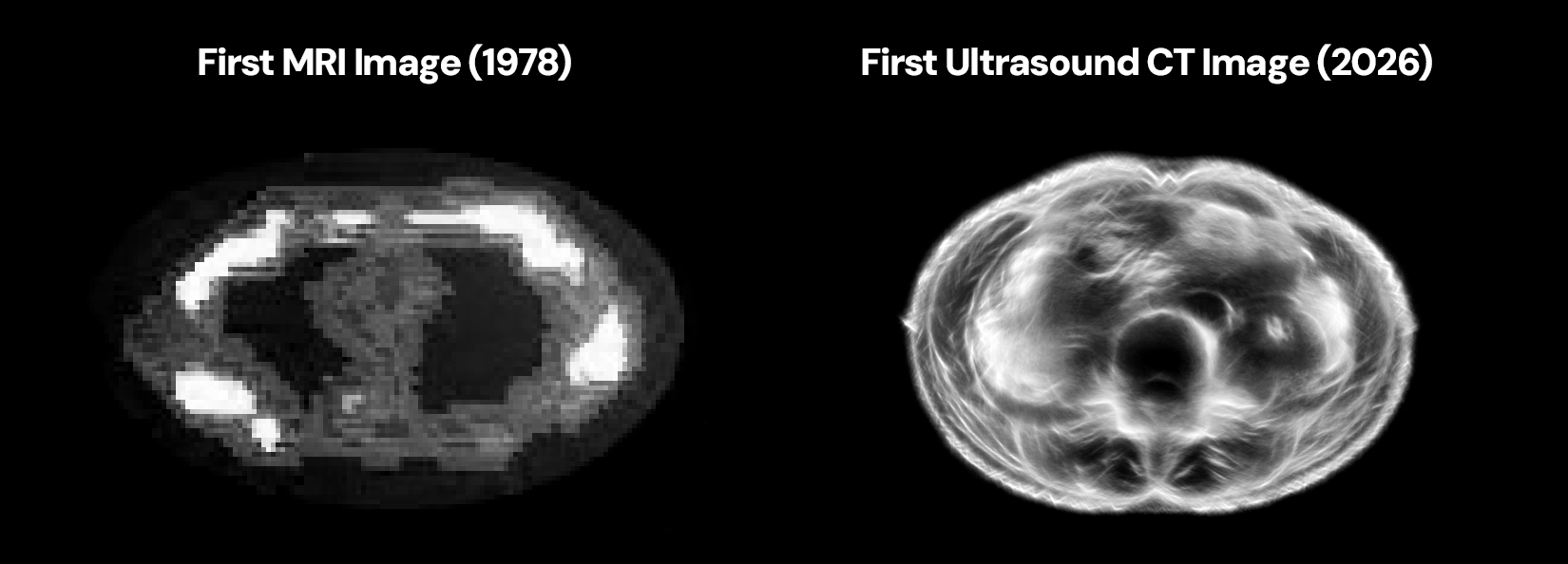
This goes in that direction, and I'm really excited to see where it goes. I could imagine that given enough training data, ML models will be able to pick up on minute details that make it possible to diagnose diseases that weren't historically considered ultrasound-diagnoseable from this kind of detailed ultrasound.
I think combining it with gas chromatography/mass spectrometry of e.g. breath or blood/sweat/urine samples would also have the potential to be a cost-effective diagnosis method - lots of data, probably not all too useful for human interpretation, but would open the potential to walk up to a machine, breathe into it, spit into it, pee into it, give it a swab, and have it come up with an accurate diagnosis without invasive testing. If mass produced, the cost of something like this could easily drop below the cost of a typical doctor's visit. (I googled it and it seems like GCMS is already used for some diagnoses, but screening only for a few specific diseases rather than "throw ML at it and try to diagnose everything").
convnet
an hour ago
It's a controversial and complicated idea. The downside, and the reason why most doctors do not recommend full body scans, is that every human body is a bit weird and there will almost always be something "wrong" that will be visible in a full body scan. This can lead to unnecessary testing, anxiety, and even unnecessary procedures. Many of these oddities flagged by the scan would never have caused any actual issues had the patient never been aware.
While there are many individual stories of full-body scans detecting early-stage cancer before it became symptomatic, there seems to be a general sense among doctors that implementing full-body scanning on a population level would lead to overall more harm than good. The thinking is that it is better to do regular targeted screenings for diseases that you're in a risk group for (e.g. colonoscopies, mammograms, cancer marker blood tests, etc.) rather than full-body scans.
I'm not a doctor, and I personally do find the idea of full-body scans very appealing, but I also know that if the scan detects a possible cancer, I wouldn't be able to just ignore it if the doctor tells me it's likely ok. Any time I felt any pain or any sort of symptom in that general area, I know I would worry about it. Maybe that's worth it for the potential life-saving results, but it definitely is a cost of this type of scan that needs to be acknowledged.
sroussey
43 minutes ago
If the whole population had a full body scan every quarter, the “weird” things would feel more like the noise they are.
But we would have great data over time, both individually (weird tends to only matter if they are changing) and as a population.
friendzis
22 minutes ago
> If the whole population had a full body scan every quarter, the “weird” things would feel more like the noise they are.
That's a tautology. We already have quite robust methods for detecting developed anomalies, treating every anomaly below standard human-to-human variation effectively raises the noise floor to already developed anomalies, defeating the purpose of population wide routine scans.
jibal
33 minutes ago
The fundamental problem is that you generally can't diagnose simply from shapes. Scans show shapes, shapes cause concern, concern leads to invasive procedures, results are negative.
Beijinger
31 minutes ago
"It's a controversial and complicated idea. "
It is neither controversial not complicated to detect some cancers by scent.
Taking the "headspace" of something is also not really complicated.
There are people who can reliably smell/detect Parkinson:
https://www.npr.org/sections/health-shots/2020/03/23/8202745...
philistine
11 minutes ago
You gloom on one aspect, the smell. OP focuses instead on full body scans themselves, and the irrelevant issues with everyone's bodies they would highlight.
jaggederest
41 minutes ago
I think the anodyne to this is - and I admit the degree to which this is indicative of my biases! - more data, especially early on. Getting a good baseline before you have really any significant chance of most cancers to be able to do within-individual diffs, effectively, might be a big deal.
It might also reveal that every MRI shows ghost artifacts a half a dozen times that make it longitudinally useless, of course. I'm not foolish enough to think that epidemiologists haven't thought of this.
david_shi
18 minutes ago
I've heard this argument before and it's always seemed downstream of capacity constraints and the current incentives of the healthcare industry.
There's a reason why billionaires like David Rockefeller, Larry Ellison, and Rupert Murdoch are able to live much longer lives than average, and having an oncall health team (that I'm sure does frequent testing and monitoring) is a big contributor to that.
More testing and data collection doesn't mean that every single anomaly would need to be investigated or communicated with the patient, but would provide a better longitudinal view that can help with disease prevention and health optimization.
vasco
9 minutes ago
It's obviously a lie to get us to accept no tests due to limited machines. The same as when COVID started masks "didn't help" because they didn't yet secure enough supply for everyone, then when they did, suddenly the masks helped.
Every system that exists as a black box is more understandable with more sensing, not less. Our bodies are not special.
It's also ridiculous that the proposition goes like:
1. Doctor knows some tests will flag tumors or variations that look weird and that we shouldn't then go investigate all of them
2. Doctor shuts off their brain and will then investigate all of them by doing invasive procedures
Just knowing how many such variations there are and if they grow or not is useful information. But the doctors pretend like they are super smart before the test and super dumb right after.
arcticbull
an hour ago
Don’t make me tap the sign.
Bayes Theorem: https://en.wikipedia.org/wiki/Bayes'_theorem
There’s a very good reason we don’t test asymptomatic people in low incidence populations. Basically all positives are false positives when you do that, no matter how accurate the test is.
When you’re testing healthy randos for everything the odds of a positive being false have so many 9s it would make an SRE weep.
Unless this is accurate to a degree previously unheard of in medical science it’s a boondoggle, and I can’t help but notice there’s no mention of accuracy.
Unfortunately that’s just basic statistics.
appplication
an hour ago
So you are certainly correct but you can also tighten up your definitions for true positives as you have more information on your false positives. There may exist additional signal as well.
To your point though I think there is a difference between collecting and evaluating additional data sources and using them as diagnostic tools.
I suppose I fundamentally disagree with the implication of your post that there is no value in gathering further data for these reasons, it would seem to suggest we’re already diagnostically optimal and could not do better with additional signal.
arcticbull
an hour ago
Sure collecting more data makes sense. We agree there. If that gets you to the required degree of statistical confidence my argument is moot.
jibal
20 minutes ago
Positive for what, exactly? Quoting convnet, above:
> The downside, and the reason why most doctors do not recommend full body scans, is that every human body is a bit weird and there will almost always be something "wrong" that will be visible in a full body scan. This can lead to unnecessary testing, anxiety, and even unnecessary procedures. Many of these oddities flagged by the scan would never have caused any actual issues had the patient never been aware.
The fundamental problem is that you generally can't diagnose simply from shapes. Scans show shapes, shapes cause concern, concern leads to invasive procedures, results are negative.
Also, overdependency on "spas" for health information could lead to an atrophy of other sorts of medical information gathering and diagnosis. e.g., there's no mention in the dreamy description of this spa experience of getting a blood draw or a patellar reflex test.
hereme888
an hour ago
That's precisely where medicine is headed: personalized medicine.
You [hopefully] won't have to become a rare missed diagnosis because you didn't fit the demographic for this or that screening test.
Cost of genomic analysis is exponentially decreasing, and so much progress is happening so quickly.
Consider for example how in cardiology we advanced from ASCVD's 10-yr prognosis, to the PREVENT 30-yr prognosis. And still most providers are using the ASCVD score for their patients.
arcticbull
an hour ago
You’re dealing with populations here. Literally the odds of a positive being false would be 99%. I’m not exaggerating. That means every almost every follow up you do is a waste of time, money and limited resources, denying care to those who need it. Including you when you actually do need it. It also exposes you to the risks of unnecessary follow-ups like infection. Your expected outcome is worse this way.
The chance a positive is real is so low you may as well just point to a body part and get it biopsied.
A positive from this kind of test is statistically meaningless.
munificent
an hour ago
It's scary in both directions.
If you let it give out tons of false positives, then patients are trained to ignore it when it cries wolf.
If you dial it back so that it gives out fewer positives, then now it starts giving out false negatives and not helping sick people.
krzat
an hour ago
If this argument was as solid as you say, then all routine checks would be pointless.
I don't know about traditional blood testing, but a permanent implant which checks HR, pressure, glucose, temperature & oxidation would be pretty useful, not necessarily to diagnose anything, but to provide data for doctor when patient has actual symptomps.
ricardobayes
32 minutes ago
They kind of are. Spain doesn't have yearly physicals, and during a GP visit, they don't even take your blood pressure. Blood tests are extremely uncommon, unlike in British medicine, where they take your blood pressure every time and blood tests are so prevalent people usually request one from time to time despite having no symptoms. Spain's example showed the above (or the lack of) doesn't increase all-cause mortality and even excelling in longevity statistics.
https://www.rieti.go.jp/en/columns/a01_0455.html This japanese article found "No clear-cut evidence exists to determine whether undergoing health checks leads to greater longevity and/or lower medical expenditures."
arcticbull
27 minutes ago
Several published papers agree. There is in fact little evidence to support regular checkups if you’re asymptomatic.
https://pubmed.ncbi.nlm.nih.gov/31642821/
And blood pressure is especially pernicious, basically every doctors office measures it wrong so the results aren’t particularly useful. Many use the wrong size cuff for example, or don’t give people time to relax before a reading. A ton of people have white coat hypertension, high BP only because they’re in a doctors office.
https://pmc.ncbi.nlm.nih.gov/articles/PMC1120072/
I saw a paper that showed only 36% of cardiologists did it right.
jibal
14 minutes ago
Math does indeed make for solid arguments. If you want to make a counterargument then you have to address their math, which you didn't.
ricardobayes
37 minutes ago
Medicine is not a statistical field. I've seen many times doctors dismissing someone "you're young, you can't have X". Although there is some truth in what you're saying: full body CT scans are on the rise now.
gfodor
an hour ago
You can just run more tests to get increased statistical power.
cbolton
a minute ago
No you can't. Statistical tests assume independent data points. Testing the same individual repeatedly would be pseudoreplication, leading to wrong conclusions.
If you mean run different tests, where you collect different data from the same individual, sure but that's not something you can "just do" in the general case.
moralestapia
an hour ago
Many smaht people have already pointed that out.
It's news to no one that tests are imperfect.
Do you have any concrete solution to that? Anything of value?
arcticbull
an hour ago
Yes, don’t do tests on asymptomatic low-risk people until you can demonstrate that a positive result has any meaning whatsoever.
friendzis
15 minutes ago
There's a ton of variation within medical testing and tons of different conditions affect test results in similar ways. VERY FEW tests (test classes maybe: biopsy, microbiology, skeletal Rö) can yield diagnoses in the first place. Most testing is used to support (not confirm!) and reject possible interpretations.
This non-invasive everything-scanner sounds more like science fiction.
CJefferson
an hour ago
Even at a smaller scale, I was shocked to go to the hospital in China and literally the first thing done was a blood sample, scanned under about 30 metrics, took about 15 minutes after the same was take. The results were sent straight to my phone. That sample had some horrendous results, so I then skipped the queue and got straight to see a doctor who already had all my numbers up on screen before he spoke to the for the first time, meaning he could immediately put me on an antibiotic drip.
aquafox
an hour ago
The problem is: Since we don't regularly full-body scan healthy people, we don't know how healthy, or say, still ok, looks like. This will create a lot of false positives and potential harm from unneccessary follow-up procedures and treatments.
mrtksn
an hour ago
In the rest of the world diagnostics aren’t expensive at all and medical data is centralized already (blood, MRI are almost routine for hospital visits, all data stored in govt systems).
During Covid it was useful for improving protocols.
kilbuz
2 hours ago
false positives are a real problem
adastra22
an hour ago
Only if you let them. The false positive thing is a nonissue that only arises from assuming you would respond to information a certain way.
jibal
8 minutes ago
That makes no sense at all, unless you're saying that people should respond to all such information by ignoring it.
Forgeties79
24 minutes ago
I don't really get what this means. A false positive causes issues inherently - you don't know if it's right or wrong. It's noise which is bad for care, and it's anxiety-inducing for patients which is also bad. It produces worse outcomes for everyone. There isn't a "choice" or assumption here, you respond to a positive as if it's accurate until you know it isn't. This is a known issue. Hell Scrubs did an episode about the negative impact of full, generalized body scans on a patient's wellbeing decades ago.
jrflowers
an hour ago
> pee into it, give it a swab, and have it come up with an accurate diagnosis without invasive testing.
Somebody should make a startup based around the idea of diagnosing diseases through eg. a drop of blood. Probably need a bunch of big name investors though