I hated writing until I learned there’s a science to it (2024)

227 pointsposted 21 hours ago
by o4c

96 Comments

ortusdux

20 hours ago

Nobody tells this to people who are beginners, I wish someone told me. All of us who do creative work, we get into it because we have good taste. But there is this gap. For the first couple years you make stuff, it’s just not that good. It’s trying to be good, it has potential, but it’s not. But your taste, the thing that got you into the game, is still killer. And your taste is why your work disappoints you. A lot of people never get past this phase, they quit. Most people I know who do interesting, creative work went through years of this. We know our work doesn’t have this special thing that we want it to have. We all go through this. And if you are just starting out or you are still in this phase, you gotta know its normal and the most important thing you can do is do a lot of work. Put yourself on a deadline so that every week you will finish one story. It is only by going through a volume of work that you will close that gap, and your work will be as good as your ambitions. And I took longer to figure out how to do this than anyone I’ve ever met. It’s gonna take awhile. It’s normal to take awhile. You’ve just gotta fight your way through.

- Ira Glass

justonceokay

19 hours ago

I am a handyman and have a lot of weird, specific physical skills. Like being able to paint around an electrical outlet, caulking, leveling concrete, juggling, cartwheels, tying cherry stems in my mouth, etc. The life of an embodied worker.

When I am teaching anyone any of these skills, the first thing I say is “are you ready to be bad at this for a long time?” Sometimes it catches people off guard. On the other hand, if someone says “yes” then I know that they are going to be a good learner.

mrexroad

18 hours ago

Heh. I’m not in the trades, but ~15 years ago I decided to rock/tape/mud ~800sqft of my house myself… to top it off, my lighting design included wall grazing lights and a satin sheen finish and another wall that gets hit lengthwise for 10’ at sunset. That was a long, long period that tested my sanity and marriage. It was probably good enough after first pass, but my standards were far beyond unreasonable and I had to live with results.

I eventually got rather good, albeit slow, and now can easily finish a wall where you can’t find butt or tapered seams with a flashlight, with minimal sanding. It took many hundreds of hours over the years, and a clear idea of what the bar was, for me to get there. The results still bring me joy, but more also the intuition built up around working with mud translated to a quick ramp up for more ambitious projects with stucco and concrete.

doodlebugging

13 hours ago

The trick with drywall is to avoid all the extra effort. Your drive for the perfect surface limited your options when, at the beginning you had a universe of potential outcomes. You chose for it to become monotonically flat.

When my mom was in her late 60's having never done any work with drywall or mud, taping, floating, etc and attempting to make lemonade out of a situation where every room in the house was being sheetrocked because Dad was actively using some of his many skills to convert their house into a home, she became creative and produced a collection of decorative walls that anyone could admire.

There are rag-rolled walls with layers of colors over imperfect textures. There are walls painted a neutral background color and then combed with spectacular streaks. Some rooms are wavy and others are vertical lines. She layered colors and textures because the drywall, after all the work was done had textural flaws and places where use of a single color would make all the imperfections pop like Shiprock from the New Mexico plain. It was hard making 1/4" (6.3mm) drywall hide all the changes to the structure and the shiplap that had happened in the 80 years (80 years) since the house was built.

My favorite walls are in a hallway with nearly 10' (~3m) ceilings. She used a variable depth texture, thicker than anywhere else in the house and knocked relatively flat though with plenty of knife swirls randomly distributed. In the heavy texture she used a leaf print to impress hundreds of oak leaves from floor to ceiling in random orientations as if they are all falling. The colors are autumn colors with a light base and darker accents that create additional shadowing. It really is beautiful and is quite original.

Every time I walk that hallway I hear:

The leaves are falling all around, time I was on my way.

Thanks to you I'm much obliged for such a pleasant stay.

But now it's time for me to go. The autumn moon lights my way.

With the original oak hardwood floor painted a nice checkerboard pattern and the trim all Dad's handiwork it is really great.

robocat

17 hours ago

Flat surfaces seem like such a modern obsession. I feel the attraction, but defiantly try to oppose the gravity.

At least you limited yourself to human scale hand-y work.

An engineer type can go down some dark yak holes trying to find solutions to achieve inhuman flatness

hydrogen7800

14 hours ago

I don't mind the old walls in my house with their lumps and bumps, but I do mind the half assed drywall job I hired out with poorly sanded joints, oversized electrical cutouts and other flaws.

detritus

17 hours ago

Yet the same skill that leads to perfect flatness then also leads to being able to make something look organic and natural, should they so wish.

It's about honing ability and competence.

turtlebits

18 hours ago

Id love to develop the skill for drywall, but then amount of mess and dust it creates is too much for me and my SO. Even if I did it off site, taking a shower and changing clothes every time is a hassle.

MobiusHorizons

13 hours ago

Is it really more of a hassle than going exercising or anything else with special gear? Hiking / skiing / swimming?

fragmede

7 hours ago

Yes. The fine dust gets everywhere. Imagine rolling around in the sand at the beach, but 10x worse. Skiing, what, you turn the corner of the mountain and there's a snow maker running full bore at you so you're a little bit cold but then the snow melts into water when you do get inside. You're all suited up but it's okay because it's cold outside. You could wear a tyvek suit to do drywall, but then you're sweating too much to do the job.

m463

17 hours ago

I had an electrician come out, it was a younger guy who owned the business and his crew.

And they had these minor-superhero things they could do.

Like he could hammer around a corner. You would think it wasn't a big deal, but he could put wire staples places where a beginner or a fancy staple gun couldn't reach.

CapitalistCartr

16 hours ago

I'm an industrial electrician. I'm also skinny; people often undrestimate me. Once I had two non-electrician coworkers helping me pull some large wire and make up splices in a trough. One beefy guy was struggling with the wire, so I grabbed it, twisted it around into place. The other guy says, surprised, "You're stronger than you look." I just said, "Sure".

Because of the way the strands are laid, wire has a direction and way it "wants" to go. I'd been an electrician twenty years by that point and knew how to work it. Not strength. Not that I said any of that.

doubled112

14 hours ago

I think some call that “old man strength”.

Might not be as strong or fast as he used to be, but knows how to do it smartly.

Sometimes the problem truly requires strength and brute force, but not usually.

Even something like taking up concrete. It seems straight forward but you can waste a lot of energy hitting the wrong places.

Ntrails

5 hours ago

> Might not be as strong or fast [..] knows how to do it smartly.

Friend of mine worked in Prisons for a while, and has a way of telling the difference between people with a lot of muscle and people who know how leverage their musculature to high effect.

imp0cat

11 hours ago

Also using all your motor units to their full capacity (the "invisible" strength) helps. Which usually requires at least some training.

iv4122

13 hours ago

Has this conversation with a friend the other day when an electrical crew came to our place. We couldn't wrap our heads around the way they were able to finish so quickly and efficiently, when for us it would have probably taken days. It's definitely not an easy skill

giwook

an hour ago

Out of curiosity, what brings you to Hacker News?

drtz

18 hours ago

I'm not a handyman, but I am a man who happens to be handy.

I have done quite a bit of painting and caulking for a guy who's not in the profession. I despise both with a passion, though, especially caulking, and I have never once been satisfied with a single paint or caulk job I've done. I feel like I'm the embodiment of "be bad at this for a long time," although I'm objectively probably halfway decent at it.

That is to say I think Ira Glass' quote of "You've just gotta fight your way through" to get where you want to be seems especially meaningful in the context of something like painting, where most everyone _can_ do it (or writing / storytelling in Ira's case), but very few are actually good at it.

sokka_h2otribe

18 hours ago

You need a silicone caulking tool, and a video. I have spent many years caulking like a fool listening to other fools who spray water and use their thumbs. Don't. Use the tool. Use the kind with a little oval tip usually (I mean, there are exceptions with harder caulks but for softer e.g bathroom caulks this is more superior.)

There's one UK guy on YouTube that convinced me of the evils of water/iso sprays and the beauty of the proper silicone caulking tool.

The little wedge shaped caulking tools btw are not enough, as you need some stick to it so you can get around certain angles/items.

ajb

12 hours ago

I don't know if it's specifically UK terminology, but here we don't call bathroom silicone "caulk" - we use that term for decorators caulk, which is much more sticky; so needs to be treated differently to silicone. Definitely true that the little tools are amazing for bathroom silicone, not sure what you do with the other stuff

virgil_disgr4ce

14 hours ago

> “are you ready to be bad at this for a long time?”

Oh, I love this so much. It communicates so many important things in one go.

My kids must be absolutely sick of me saying in a dozen different ways "you just have to do it a lot."

This also reminds me of how I've often responded when people ask me about learning to code. I ask them if they're ok with sitting in front of a computer for many hours.

It sounds obvious, but most people (in my experience) simply aren't ok with that, and hadn't considered it.

anonymous_sorry

7 hours ago

> ...when people ask me about learning to code. I ask them if they're ok with sitting in front of a computer for many hours.

I wonder if this puts people off who shouldn't be put off.

I certainly don't think I'd want that for myself if asked. But coding doesn't feel like that. Sure, I sit in front of a computer for hours, but productive sessions generally involve losing track of time and realising you've been sat there for hours

smitty1e

7 hours ago

"Everything's easy, when you know how to do it; it's that learning curve..."--me.

jonahx

17 hours ago

> But there is this gap... it’s just not that good.... But your taste, the thing that got you into the game, is still killer.

That is, verifying a solution is much easier than finding it!

P != NP

koolba

15 hours ago

The software version of this (pre-LLM!) was to write tons of software till the patterns just click. I don’t see that continuing though.

Does anyone truly think we’ll have another generation of nerds hacking away for hours by hand to hone their trade? Or will it turn into a craft like woodworking?

hombre_fatal

3 hours ago

I don’t see how “artisanal” software would make sense since what matters is the end result.

One of the worst parts of software is that you develop this deep expertise in something that has less to show for it to people than a guy dicking around on a guitar or someone who made a stool after 40 hours of experience.

People aren’t decompiling their iPhone apps to admire your handiwork and evaluate how thoughtfully you modeled the domain.

Will artisanal human-driven taxi drivers exist in the future? No, Waymo is even more expensive yet people prefer it. The human aspect turns out to be a liability and less of a human expression people would go out of their way to experience.

MobiusHorizons

13 hours ago

Why not? People have lots of hobbies.

knuckle

12 hours ago

If I'm being honest, software was a hobby before it was a profession. I just thought computers were fun from about age 10 or so. In college I wanted to study Civil engineering, but shifted to Computer engineering and then it turned out the world wanted software so bad they'd let me do whatever I wanted as long as I gave them a little software along the way.

I see my sons tinkering with software now in the same way I did. They want to play games and make games and build their own tools. I don't know whether they'll wind up building software as a profession, but I'm sure they'll have the base skills needed to.

utopiah

7 hours ago

> your taste is why your work disappoints you.

Damn, on point. So hard to go over that hump but so worth it, every time, in retrospect.

stackghost

19 hours ago

>And your taste is why your work disappoints you. [...] We know our work doesn’t have this special thing that we want it to have.

I think most of us have experienced this. I consider myself an above-average writer and I absolutely hate everything I write.

But the problem, for me anyway, is that it's exceedingly difficult to know what to work on next in order to improve. In that regard writing is entirely unlike a lot of sports.

My throws are bad? Better throw 100 passes a day, every day, until my muscle memory is there. I'm getting beat deep? Better work on my fitness. Maybe I'll never get to where I want to be, but at least I know why.

But improving one's writing is seemingly impenetrable, to me. I read what I write and it sucks but I have zero intuition about how to un-suck it. I fucking wish I could write like Heller, or Didion, or Tolkien. Not even in terms of writing novels but just the quality of their prose.

embedding-shape

18 hours ago

> But improving one's writing is seemingly impenetrable, to me. I read what I write and it sucks but I have zero intuition about how to un-suck it. I fucking wish I could write like Heller, or Didion, or Tolkien. Not even in terms of writing novels but just the quality of their prose.

In the beginning it's great to practice your art by yourself with lots of safety, but sooner or later you're gonna want to to ask the public/community at large what they think of what you do, so you can get external feedback from people other's who love the same thing. I think this is probably the only way to actually get better, you need to connect with other people around it, and get their point of view. I've found this true for any creative endeavor I've tried to get better at.

Receiving criticism is probably as hard to get good at as giving criticism, so don't let the harsher stuff get into your skin as some people aren't so good at giving criticism, but you'll find lots of other useful advice that you'll agree with, and find directly actionable :)

billypilgrim

17 hours ago

The thoughts you are having about this show me that you are at a local maximum, but you will find your way out if you keep trying everything. There is no single thing that will help. Read novels, copy them word by word, translate them, write short stories, dissect stories, stop movies halfway and ask yourself how you would continue them. Read a ton of writing advice, try them out but don’t take it as gospel.

Even if you don’t improve for 100 days straight, small successes accumulate. In a decade you will have transformed yourself.

There is just no way you won’t improve significantly if you keep trying new things and bring yourself to fail ever day.

What helped me was the saying “your first million words are gonna be shit”. I still distinctly remember, four or five years into writing every day, when things finally clicked, my voice came through, and my sentences became fun. It is delayed gratification to the max.

bpavuk

19 hours ago

one concrete thing I can name is "widening" your view on writing. force different styles upon yourself, different constraints. the results will keep being shit for a while, but at least it will be very fun to tonally cosplay Shakespear before the mirror! you won't notice how time will pass :)

listening to narrations of vast variety of poetry and narrating something yourself will help you develop your specific voice and read with more intent.

you may not even need the "science of writing" this article describes. let yourself just... be with text.

galaxyLogic

13 hours ago

People here are saying you must write a lot to get good. Makes sense. But what about also reading a lot to learn from masters?

How do LLMs do it? They don't learn by writing a lot they learn by reading a lot.

embedding-shape

3 hours ago

> How do LLMs do it? They don't learn by writing a lot they learn by reading a lot.

Literally they learn by both, training process is filled with "exercises" for the weights to be shaped by, not just "seeing" tokens :) At least the typical LLM that outputs tokens have to actually "practice" doing so.
offaxis

32 minutes ago

I have been writing for the past few months since starting my new job, and this writing is a huge encouragement to me. It makes me realize once again that I need to practice consistently rather than blaming my lack of ability. I think I was too fixated on the concept of 'talent.'

bawolff

19 hours ago

Well that was anticlimactic. I thought there would be at least a little more insight than just practise more.

tstrimple

18 hours ago

The most prolific author in the world, Ryoki Inoue, published over 1000 books. He has basically the same advice.

> "The secret of the creative process is in 98% of sweat, 1% of talent and 1% of luck."

MyHonestOpinon

17 hours ago

The least prolific very successfull author in the world was perhaps Juan Rulfo. He only wrote 300 pages in his whole life and lived to be 68. It is really hard to explain how was he able to produce such master works.

xtiansimon

3 hours ago

> “…hard to explain how was he able to produce such master works.”

I’ve heard that to be a good writer one should also be a good reader. Maybe they’re a good reader and had one great story in their mind. Having produced it, they were satisfied?

I just read a bio of the author Jack London. He suffered terrible poverty and dismal employment prospects as a youth. Writing was an escape. He produced a lot of mediocre work in order to get paid.

Paracompact

15 hours ago

Harper Lee (To Kill a Mockingbird) and Emily Brontë (Wuthering Heights) are two other important writers in this category.

StilesCrisis

14 hours ago

How many thousands of pages did he write and discard?

bawolff

18 hours ago

Yes, because literally everyone has the same advice about all fields of endeavor.

robocat

17 hours ago

"1% of luck" is so meaningless.

Did you have to be born to the right parents at the right time, or just avoid a car accident?

And the ability or desire to work hard has some very soft dependencies.

probably_wrong

5 hours ago

Based on my experience it's more about being able to recognize an opportunity when it shows up and being good enough at your craft to take it. But no one can tell you what that chance will look like. Maybe it's a smart question to the right person during a hackathon, or maybe it's being really into graph theory and applying to a small newcomer company called Google.

For a concrete example: in his book "On writing" Stephen King details his life up until the point he hit it big with "Carrie". You could say he was lucky for the book to sell as good as it did, but that would require ignoring that he had been writing (and getting rejected!) non-stop for roughly 20 years.

komali2

12 hours ago

Yeah 50/50 feels more accurate. The great success is equally dependant on both things. Actually probably more on luck since I know plenty of lazy but lucky successful people, but no hard working unlucky successful people.

bonoboTP

8 hours ago

Well, the part you can control is the effort, so there's not much use in worrying about the other two. But it's mostly a feel-good white lie.

nicbou

9 hours ago

And a hundred percent concentrated power of will?

gamblor956

16 hours ago

James Patterson would argue that the secret is 98% luck, 98% the sweat of ghostwriters and -96% talent.

jnellis

14 hours ago

As an ex-Navy Seal, and JAG officer who retired for the slow life of owning a hardware store in a sleepy small town, only to accidentally uncover a international multi-million dollar conspiracy with help from the voluptuous town sheriff twenty years my junior... this math all adds up nicely.

acheron

19 hours ago

“I used to hate writing assignments, but now I enjoy them. I realized that the purpose of writing is to inflate weak ideas, obscure poor reasoning and inhibit clarity. With a little practice, writing can be an intimidating and impenetrable fog!”

https://www.gocomics.com/calvinandhobbes/1993/02/11

wahern

15 hours ago

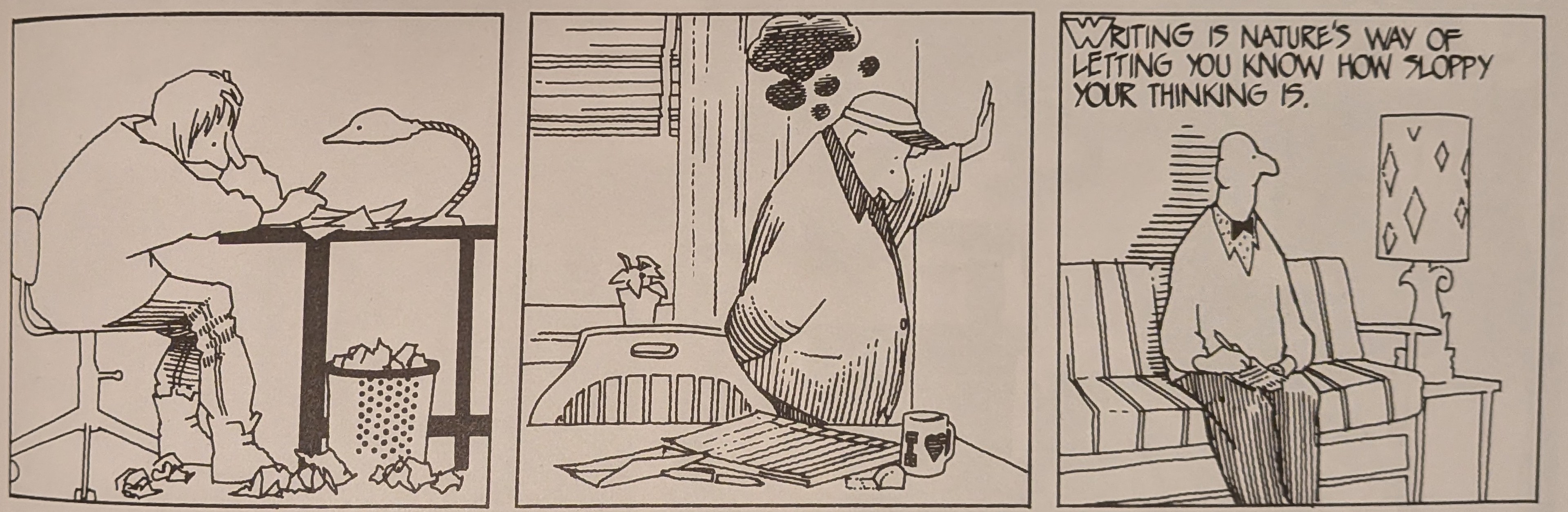
"Writing is nature's way of letting you know how sloppy your thinking is." -- Richard Guindon, Michigan So Far, 1991.

The comic has been quoted online many times, but I had to buy an old copy of Michigan So Far on eBay to actually see the comic: https://25thandClement.com/~william/links/img/Writing-Guindo...

susiecambria

14 hours ago

Or, as prep school teachers and college professors told students who asked the question "How long does the paper have to be?", "Short if you have a lot of time and long if you don't.

I (now) fondly remember getting my first English paper back as a hs freshman with an F. Shook me to my core. I had, after all, gotten into this good school as one of the select few. That was a good lesson and it's served me pretty well.

charlie90

12 hours ago

Heh, I've always thought this too. The most value I got out of writing assignments was making the research and outline. The step to turn the outline into the essay mostly involved adding BS fluff and transitions.

articsputnik

7 hours ago

For me, it was like this until I discovered the language English. I hated writing when I had to do it in school, "high German", I’m a Swiss. We talk Swiss German, and this is not a written language. So I had to kind of write in a foreign language. But later in life, when I did a mini-retirement in Denmark to learn proper English, all of a sudden I loved reading more, started listening to podcasts, and started writing.

It was through the language of English that I got to love writing and reading (mostly Audible). It was Writing in a Foreign Language again, but this time, it fitted more to my style, also because it’s straight to the point and you have so many of the same words to explain a specific sentence so well. I wrote more at https://www.ssp.sh/brain/writing-in-a-foreign-language just in case of interest.

iLemming

17 hours ago

If you have kids or if you ever get kids, consider what I have done years ago. When my kids were in middle school (and I think I should have asked them to do that in elementary) I forced them to write a single or a couple of paragraphs about their day, every day, and post into our family group channel in Telegram. "It doesn't have to be perfect or even beautiful", I said. "Just write something, anything. Every single day". It was tough in the beginning. They'd forget, but I was strict - the rule was set, and a rule is a rule. I'd wake them up to fill the gap if they'd go to bed without writing. My wife would get mad at me. Like many other parents I fell into that trap - I was reflecting my own fears (non-native English speaker, etc.), forcing my children to fight the anxiety they have now long forgotten.

That turned out to be the best life experiment we ever did together. They are teens now and dealing with far more writing every day than just a couple of paragraphs. The other day I found some cards they've written for Father's Day and other holidays over the years, and I can't even tell you how impressed and proud a parent I feel whenever I see their writing. That single skill manifested in improved overall literacy and discipline. My daughter received the Presidential Award of Academic Excellence. My son was accepted to an elite college with a scholarship. He's a competetive swimmer with dozens of medals. His team competed at the state level and even set state records. They are going to be fine. And the only thing I had to do is to teach them to face the thing they hated doing. One paragraph a day.

internet_points

6 hours ago

That is such a good idea! I hope I'm not too late to try something like that. Although mine are already interested in writing – we (parents) always ask for something drawn or made or written for our birthdays/christmas and it's amazing to see what they come up with, and we encourage travel journals whenever we travel, which they will very happily do. I think the fact that their parents read a lot of books also helps instill that there is value in reading and writing.

zeusdclxvi

17 hours ago

>our family group channel in Telegram

what country do you live in where this is a normal thing?

iLemming

17 hours ago

What does country have to do with that? We just don't use whatsapp, instagram or facebook but still need a way to communicate. Unlike something like WeeChat, Telegram is pretty popular in both hemispheres.

throawayonthe

17 hours ago

is the family groupchat a regional thing? where do you live?

iLemming

17 hours ago

The US for the past 18 years. I'm honestly not sure why would it even sound surprising. Maybe because I said "channel" not "group chat". Just to be clear - this is a private group chat between our kids, my partner and I. I wish my dog had a phone, we'd totally have him there too.

jalev

19 hours ago

A few years ago I was also like this. I wrote fiction but never tried pursuing it as a "real" hobby because I wasn't perfect at it first try. Why bother at all, right? ;)

"Good" Fiction writing is an inaccurate science but has a similar trajectory to what the author went through. To become good at it you _need_ to read other people's works (the good AND the bad stuff) to figure out for yourself what makes that writing stick out to you, and you need to learn to love to edit, and to show people what you did.

The most time consuming portion of the writing process is the editing process in my opinion. It's also my most favourite part. You take a half-formed idea and you cut. And you tweak. And then you cut some more, until paragraphs start to take the shape of the story you actually wanted to tell, and sentences become so load bearing you can't remove any of them without altering everything around it. It's a puzzle with no real "solution" other than what I feel works.

Really, it's only after I kept at this for a while (and put things out there and didn't get bad comments at all!) that I started to get a little more confident in myself and begin to go to writing groups and such. It's hard work but it's worth it, just like any skill.

kitchi

20 hours ago

Academic writing is surprisingly hard. Distilling months or years of work into its essential ideas is almost as challenging (for me anyway) as the research itself.

Often it forces a clarity that only comes from writing ideas down in a way that's necessary to explain your results to your peers.

The process itself sucks, but the outcomes are often quite satisfying and rewarding.

jvanderbot

18 hours ago

I admire the old papers. "In this manuscript we derive XYZ from ABC and show that EFG still holds" followed immediately by something akin to "We begin by showing ... "

Nowadays the intro/motivation/problem statement / related work (citation tax) / formulation/<actual results> / simulations / conclusions / futurework format is just soul crushing.

jltsiren

14 hours ago

Old papers were essentially essays. When there were fewer researchers publishing fewer papers, you were expected to read everything relevant you came across. It made sense to optimize the papers for reading.

Today there is much more research being done and published, and fully reading a paper is a special case. Papers are now more structured, and the primary use case is quickly skimming over the paper to determine if it merits more thorough reading. (Usually it doesn't.)

bonoboTP

8 hours ago

In math they often still skip those motivation, related work overview stuff and just do some math.

But I actually do think it's good to force people to think about the "why" question a lot.

jvanderbot

an hour ago

Maybe! But also maybe niche research can just be for the niche researchers. The work is funded, and therefore the "why" hoops have been jumped through, right?

And anyway, aren't reviewers themselves supposed to be able to connect dots?

When I was an active reviewer I tried not to ever say "Who cares" in so many words and just focus on the technical contributions. There's enough overinflation/fraud in papers that we dont need to be encouraging it by asking them to over-over inflate a possible reason for the work that is beyond the obvious ones that reviewers in the same field would appreciate.

All IMHO. There's no "right", just "preferred".

thelastgallon

9 hours ago

Writing is a forcing function for thinking. These days, most people are using AI to generate lots and lots of content, the 'writer' loses an opportunity to learn and understand, and creates garbage content for others consumption.

kirtivr

8 hours ago

How did this article (1) Get published in Science (2) Get 200+ upvotes on HN, with no explanation of the supposed science behind writing?

What's the null hypothesis? Is it possible to disprove your assertion?

jamesgill

16 hours ago

It's not a science. At best, there are best practices--and some of the best, most famous writing has ignored them. "Writing" is broad, means a lot of things, and defies algorithms.

GarnetFloride

11 hours ago

I help run a writer's symposium. We get about 200 presenters and 1200 attendees a year. No one's journey is the same. What worked for one; failed for another. You have to find what works for you. Writer's rules are more like tools, and try use the appropriate tool for the job.

Some things that I have learned from of them:

Write for yourself first and get to the end. Rewrite to add in all those things you didn't put in the right place the first time.

Speak at least the dialogue out loud. Spread the description around.

Read some of the worst to remind you that even they got published. Copy the greats for practice on dialogue, or description or whatever you want to work on as deliberate practice.

Try different things like write your story as a game, or a puppet play, or stage play, or screenplay, or radio play. Draw a storyboard or animatic. Go to the park and write what you see. Have your characters in a room together and eat a pie.

__patchbit__

7 hours ago

An option is to signup to a journalism school writing course done remotely and to follow at your own pace at set exercises with guidance from an assigned tutor. You'll sample more of the writing trade landscape than DIY and with luck discover your unique voice.

webnrrd2k

14 hours ago

As far as I can tell, according to the article, the "science" is get feedback and listen to it. Ok, that was perfectly fine advice, I guess.

user____name

5 hours ago

I found writing techniques employed by fiction writers to be surpisingly relevant for nonfiction.

phyzix5761

19 hours ago

The post doesn't actually describe any kind of science to writing. That was disappointing.

UncleSlacky

18 hours ago

It's essentially saying that you start with an outline, then progressively fill in the sections, iterating and providing more detail at each iteration. I do something similar, which is why I prefer to work in outline mode (e.g. in MS Word) as it is the most flexible and "minimalist" mode for structured writing.

jansan

18 hours ago

The science seems to be

1. Write stuff

2. Make it better

3. Continue with step 2

It even is an algorithm.

UncleSlacky

18 hours ago

Something like Feynman's algorithm:

1. Write down the problem.

2. Think very hard.

3. Write down the solution.

kesor

17 hours ago

The art of writing clickbait article headlines:

- Use a word like "science" to lure in the geeks

- (you don't even need to know what science is, its ok)

- Some of the geeks will push your headline to top of HN just because it had the right word in it

- Put some filler about life being hard in the article, so those who actually read it have to waste ten minutes of their lives (proving your point).

- Profit and glory!

readthenotes1

19 hours ago

Nice of her not to divulge the science of it and just say it's a lot of iterations.

That would not make me hate writing less.

indoordin0saur

18 hours ago

With a little practice you too can write a short essay on an interesting topic while not actually saying anything meaningful or useful!

eikenberry

19 hours ago

Didn't sound like any science was involved. There were no observing, hypothesizing and testing steps to be found. Can't have science without those.

HPsquared

19 hours ago

Science is like that too, it's mostly very tedious and repetitive work.

huijzer

19 hours ago

I finished my PhD and still hate (or at least severely dislike scientific writing). It just feels so pointless most of the time plus you constantly have to compromise on most of the text until it says almost nothing

QuantumNoodle

19 hours ago

So "be bad until git gud" through iterations and refining.

undershirt

17 hours ago

I don't even know what science is anymore.

pessimizer

12 hours ago

I have no idea how this was published or why it has generated discussion. The "surprising" discovery that the author made is that you don't just write something all the way through without stopping, you go back and edit it.

I always thought that even very small children knew that. If someone wasn't aware of this for years even after many attempts, I wouldn't trust them to do any sort of research.

Somebody should have put a red line through every word of this.

disclosure: I used the science of editing this comment after writing it.

chopete3

12 hours ago

That is a anticlimactic. There should be a new flag called AI slop to flag these faster.

vkou

15 hours ago

This article took ~8 million words to get to a point.

'Write shit. Edit it. Repeat.'

What a disappointment.

imp0cat

11 hours ago

    "Sucking at something is the first step towards being sorta good at something." - JAKE THE DOG

kirtivr

11 hours ago

TL;dr

Make a first draft that is bad, and improve it from there.

robmn

16 hours ago

Unfortunately AI > your skills sub 2 years

fullstackchris

16 hours ago

except AI writing is near 100% detectable. check out something like pangram. no matter what you generate, the cadence of their word choices, sentance structures, etc. are always the same and often blantently visible in the prose. in fact i doubt an LLM of any size now and into the future can properly write without a "fingerprint". real writing, in almost any language, given the possible combination of writing even just a few sentences, even given valid grammar, already exceeds the number of atoms in the universe. because LLMs are transformers, they will always leave behind clues.