hannesfur
a day ago
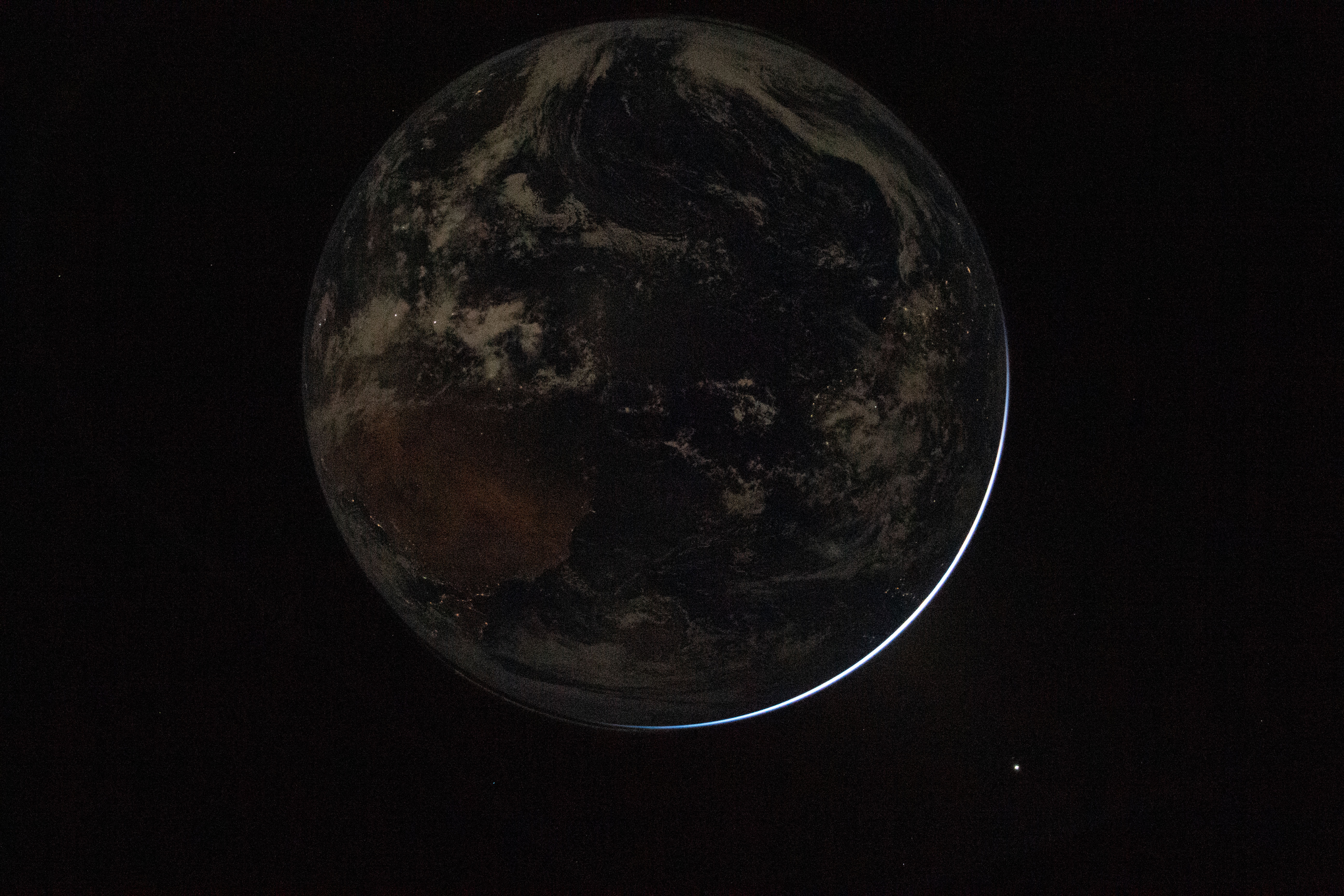
Looking at the EXIF (with exiftool) for the image uploaded by NASA (https://www.nasa.gov/wp-content/uploads/2026/04/art002e00019...), apparently this was taken by a Nikon D5 with an AF-S Zoom-Nikkor 14-24mm f/2.8G ED and developed with Lightroom. It also seems like very little was done in Lightroom. Amazing... I dumped the whole EXIF here: https://gist.github.com/umgefahren/a6f555e6588a98adb74eed79d...
throw0101d
a day ago
Yes, the D5s are the 'official' Handheld Universal Lunar Cameras (HULCs), but (a?) Z9 also got on-board at the 'last minute' (which means two years ago):
* https://petapixel.com/2026/04/02/a-nikon-z9-made-it-aboard-t...
They have a thermal blanket for exterior work:
* https://petapixel.com/2026/02/24/artemis-ii-astronauts-will-...
* https://petapixel.com/2025/01/10/the-custom-nikon-z9-and-the...
* Various stories with the "Artemis" tag: https://petapixel.com/tag/artemis/
The D5 has been used on the ISS, including EVAs, since 2017, so they're a known quantity:
* https://en.wikipedia.org/wiki/List_of_cameras_on_the_Interna...
The Mercury and Apollo missions used Hasselblad 500-series-based cameras (modified):
* https://www.hasselblad.com/about/history/hasselblad-in-space...
nate
11 hours ago
the morning after the launch i just randomly went onto their livestream and one of the astronauts was asking mission control for help on also using the gopros and iPhone cameras. i guess they have some. and he was struggling at getting a properly exposed photo with those. he said they were coming out super over exposed. but the D5 was working nominally. mission control said they'd get back to them about ideas on adjusting the gopros and iPhones. but it was funny to hear they're trying "new" tech and struggling with it up in space, and that 2005 D5 is still the champ :)
throw0101c
8 hours ago
The SLR-like cameras have a bunch of manual modes so you can 'force' them to get something captured, and you can then perhaps 'fix it in post'.
Modern tech allows more people to capture more things more easily, but when the automation fails there aren't really many manual modes to fall back on.
jjulius
4 hours ago
> ... 2005 D5...
About 11 years too far back:
> The Nikon D5 is a full frame professional DSLR camera announced by Nikon Corporation on 6 January 2016 to succeed the D4S as its flagship DSLR.
CWuestefeld
6 hours ago
he was struggling at getting a properly exposed photo with those. he said they were coming out super over exposed.
This is exactly what newbies experience when trying to photograph the moon from Earth. It's not intuitively obvious, but the light coming off the moon is essentially full-daylight bright. But the moon is small against a very black background, and depending on how the auto-exposure is operating, this often leads to guessing that the scene as a whole needs a lot more exposure.
I imagine that trying to photograph the Earth when a significant part of what's in view is experiencing daytime, is very much the same thing.
PeterStuer
6 hours ago
You have to wonder how unserious this can get. Given the unimaginable cost of this mission, they are faffing around as your typical aunt with Windows Home laptops and iPhones? Seriously?
jjulius
4 hours ago
I'll echo that "sheesh" in the other comment, too. They're so unserious compared to those super serious Apollo guys[1], right? After all, the Apollo folk never would've smuggled contraband for fun on the Moon[2]!
B1FF_PSUVM
5 hours ago
> faffing around
Sheesh, let the lab mice have a breather. Want them to solve physics during the trip?
keyle
11 hours ago
as a Hassie lover it made me a bit sad that they went with a D5 but hey, who cares about the camera, the picture was worth a billion bucks and it delivered.
It's so refreshing to be mesmorised by a picture in the age of shorts and reels.
layer8
a day ago
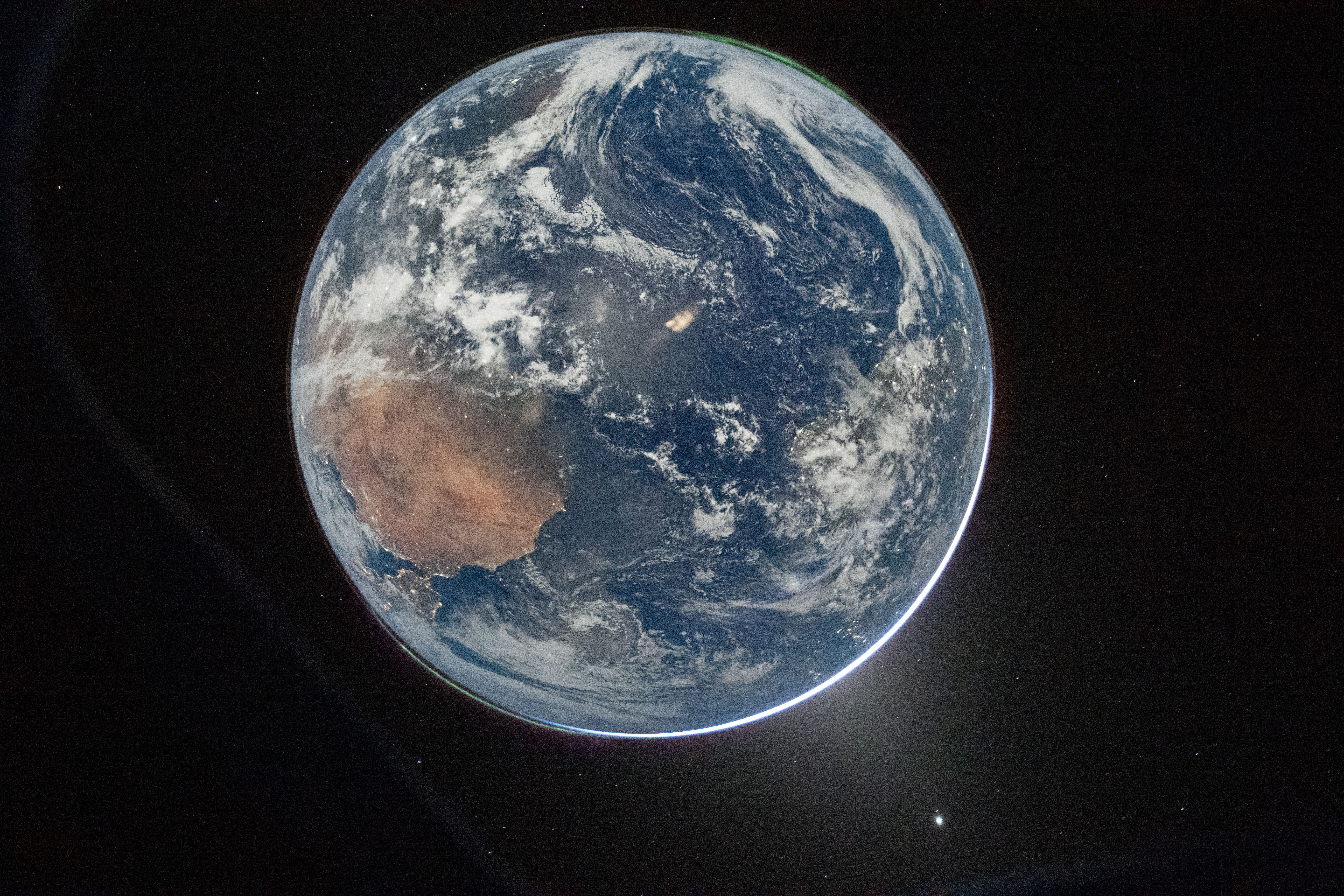
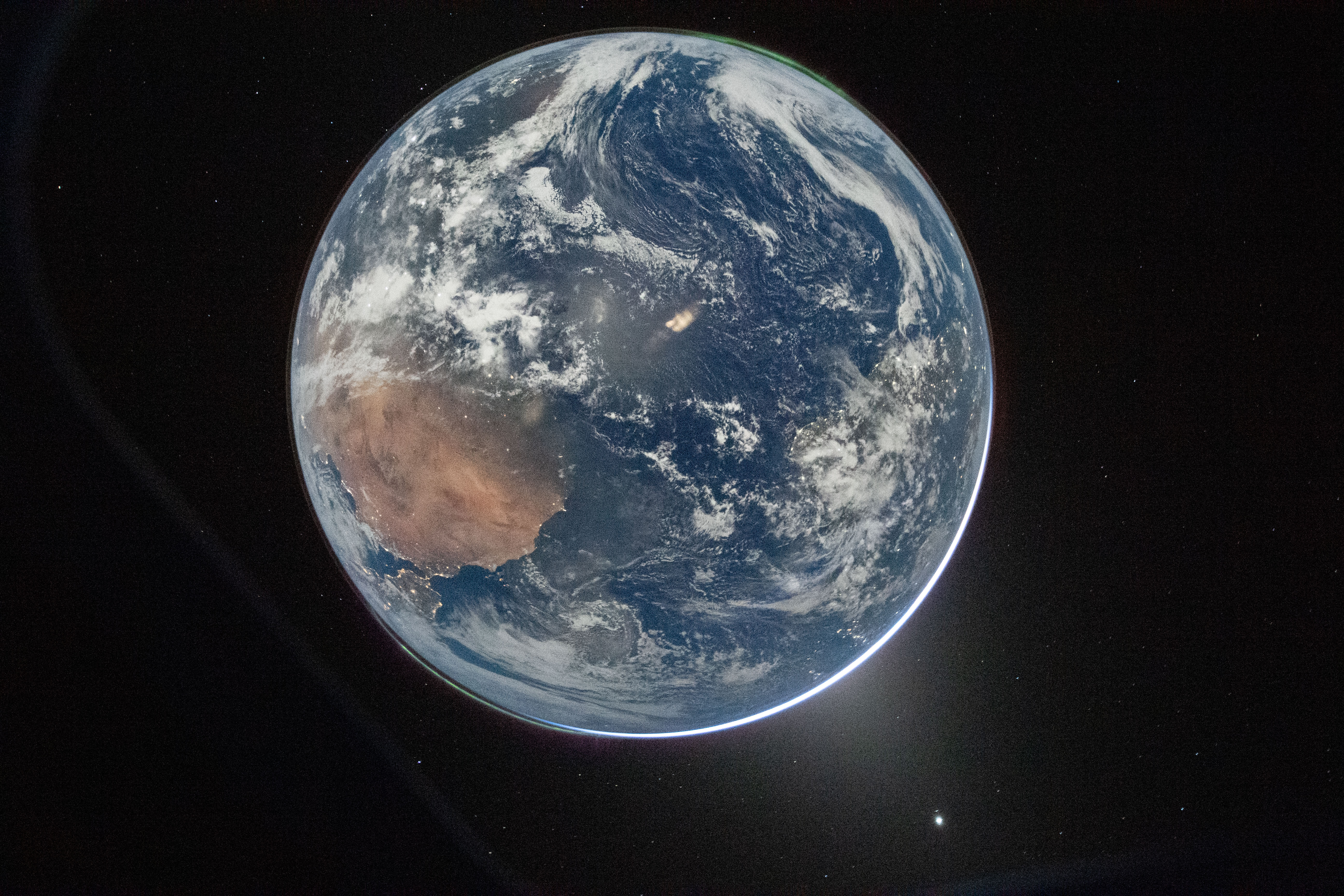
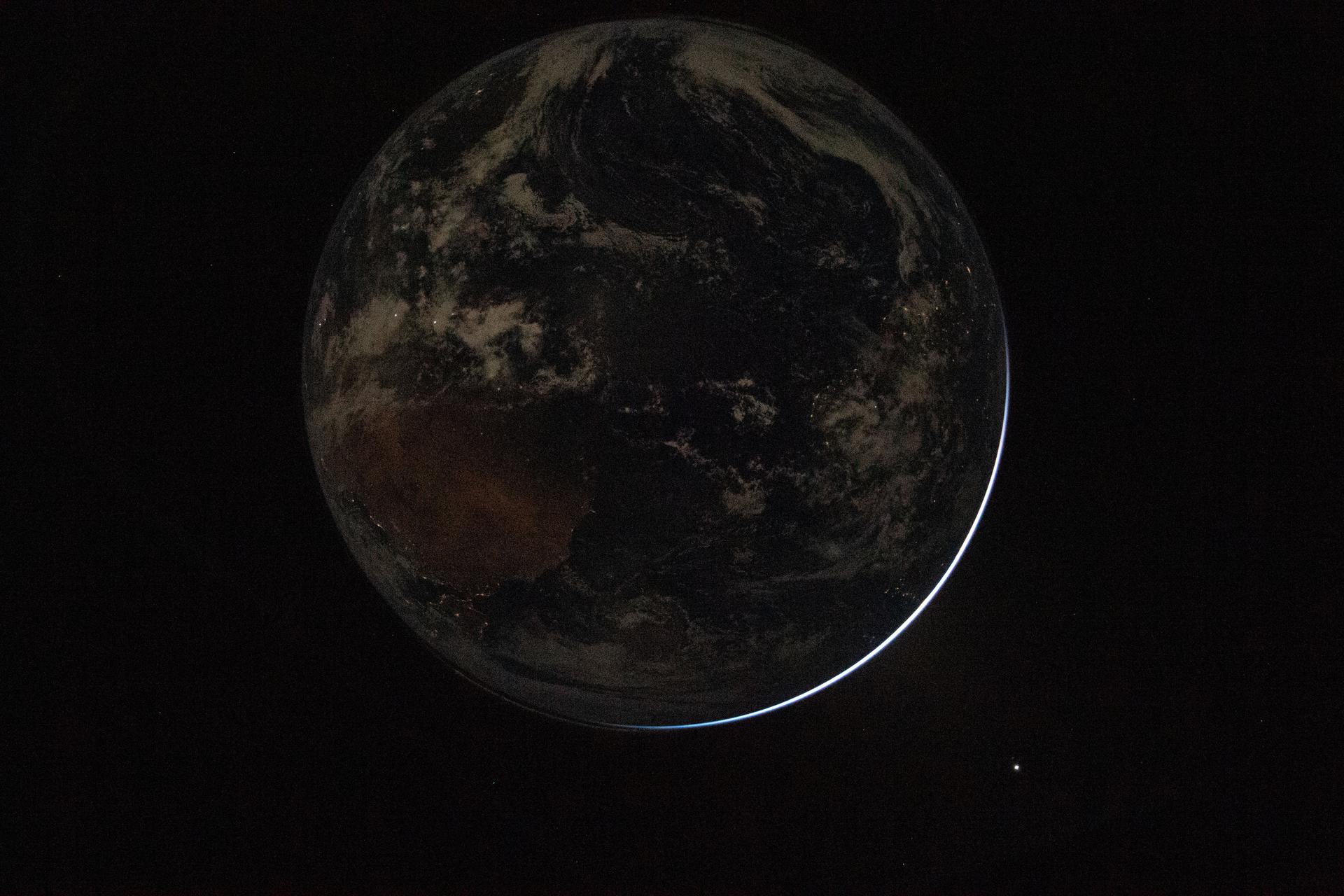
Before Lightroom it might have looked closer to this: https://images-assets.nasa.gov/image/art002e000193/art002e00...
hannesfur
a day ago
From the EXIF we can infer that every setting was left at the default. No exposure comp, no contrast, no HSL, no lens correction and a linear tone curve. Just the default Adobe Color profile at 5400K.
divbzero
a day ago
The photograph appears to show nightime on Earth with just a sliver of daytime. Beyond cities in Iberia and along the coast of Africa, most of what we can see would be reflected light from the Moon? We are just past full moon on April 1.
hparadiz
a day ago
1/4 exposure time so 250 ms of light. the light is coming from all the light sources in the universe, plus the moon, plus the sun's rays refracting through the atmosphere which happens even at night.
The natural blue light is coming from the oxygen in the atmosphere but it's so overwhelming in that spot that it turns the light pure white. The red/orangish is coming from particulates and the green/red from aurora. My favorite part I think is the very bottom where you can see the blue light taper off and not overwhelm the camera sensor and you can see the aurora with it. I love this photo so much.
Probably my favorite photo ever now.
pdonis
a day ago
> the light is coming from all the light sources in the universe, plus the moon
And all the others are negligible by many orders of magnitude compared to the moon. So it's really just the moon as far as this photo is concerned (except for the small sliver that's still illuminated by sunlight, including refracted sunlight).
tantalor
10 hours ago
> the light is coming from all the light sources in the universe, plus the moon
This is true for every photo ever taken
functional_dev
15 hours ago
so the atmosphere acts as giant lamp lit from behind by Moon? never thought of it that way
vasco
18 hours ago
> the light is coming from all the light sources in the universe,
That's highly incorrect. I have many lightsources that aren't contributing to any photons in that picture. For example my refrigerator light.
Y-bar
16 hours ago
I turn off my refrigerator light after I close the door by reaching in and pushing the button. Don’t you?
pdonis
a day ago
> Beyond cities in Iberia and along the coast of Africa, most of what we can see would be reflected light from the Moon?
Yes, exactly.
tayo42
a day ago
That's what the caption the article above says
ranie93
a day ago
Maybe it’s because I (like many) have experienced taking pictures at night and seeing the grainy result that _this_ image struck me as incredibly realistic.
Almost like I ran the grainy-to-real conversion in my mind and I felt like I was imagining seeing this in person. Beautiful image!
consumer451
a day ago
Might I ask, what was your path to finding this image?
rafram
a day ago
consumer451
a day ago
Thanks so much. Sending this link to my nerdy nephews immediately.
deepsun
a day ago
But that one (art002e000193~large.jpg) is only 287kB. The Lightroom-processed one is 6.2MB. I would expect original to be heavier.
porphyra
a day ago
The Lightroom one was processed from raw. Also, by brightening it a lot, the noisy high-ISO grain becomes more apparent. Noise is famously incompressible, so it leads to a much larger file size.
thfuran
a day ago
Brightening the image may make the iso noise easier to see, but it doesn't create it.
miduil
a day ago
But lossy-codecs job is to utilize psychovisual tricks to discard as much high-frequency information as possible, whilst remaining similar visual effects. If you increase the brightness in RAW and then re-encode the JPEG - more noise is being pulled up in the visual spectrum, therefor less of that information (filesize) is discarded.
For example, if you render Gaussian noise in photopea and export as JPEG 100% quality, it has 9.2MB. If you reduce the exposure by -2 it goes down to 7.8MB. That's partially because more parts of the noise are effectively black pixels, but also I believe because of the earlier mentioned effect.
porphyra
a day ago
Noise that's easier to see will not be compressed away by the JPEG compression. JPEG is basically just DCT + thresholding. Any higher amplitude noise is going to stay and increase the final file size.
Also, pulling more data from your 14 bit or 16 bit raws results in more noise in the end compared to the straight-out-of-camera 8 bit JPEGs.
godelski
a day ago
It's not lossless
saint_yossarian
a day ago
The resolutions are different, 1920x1280 vs. 5568x3712.
Also possibly different JPEG quality settings.
Melatonic
a day ago
Could be the thumbnail / preview image generated alongside the raw
fortyseven
12 hours ago
It's beautiful as these all are, that one is probably my favorite. And as somebody else said it kind of feels more real seeing the grain like that. It's just beautiful. A side we never see quite like this.
porphyra
a day ago
I'd have probably shot it wide open at f/2.8 rather than cranking the ISO up to 51200. Incredibly impressed at the steady hands for a sharp image at 1/4 s shutter speed though! Maybe they just let the camera float in space with the mirror up, triggering it remotely.
throw0101d
a day ago
> I'd have probably shot it wide open at f/2.8 rather than cranking the ISO up to 51200.
One of the reasons the D5 supposedly was chosen was because of its high dynamic and good low light performance. It can go up to ISO 3,280,000:
* https://en.wikipedia.org/wiki/Nikon_D5
The D5 has been used on the ISS, including EVAs, since 2017, so is a known quantity:
* https://en.wikipedia.org/wiki/List_of_cameras_on_the_Interna...
porphyra
a day ago
The good low light performance was amazing for its time (10 years ago), and it still holds up decently today. But let's not kid ourselves -- it has been clearly surpassed by modern backside illuminated CMOS sensors like the one on the Z9.
EDIT: sorry, it seems I'm wrong. I just checked https://www.photonstophotos.net/Charts/PDR.htm and while the Z9 has the clear edge with 2 more stops of dynamic range at low ISO, the D5 actually pulls ahead at high ISO. Perhaps the technological improvements haven't been that much for the shot-noise dominated regime.
throw0101c
8 hours ago
Sure, but D5s were also doing EVAs for many years and much more of a know quantity in space.
nelox
15 hours ago
Was hoping to hear from the person at NASA who made the choice and why.
ourmandave
a day ago
You can get a D5 on amazon.com. It would be amazing if one of the astronauts did a review explaining how it performs in space.
jen729w
a day ago
You might misunderstand how ISO works on digital cameras. (I did.)
deathanatos
a day ago
Good grief, that video suffers the YouTube-ism of "ramble on about how you don't understand X" for way too long.
Video alleges people think ISO makes the sensor "more sensitive or less sensitive". (I … don't think this is common? But IDK, maybe this is my feldspar.)
(The video also quibbles that it is "ISO setting" not "ISO" … while showing shots of cameras which call it "ISO", seemingly believing that some of us believe ISO is film speed, in a digital camera?)
Anyways, the video wants you to know that it is sensor gain. And, importantly, according to the video, analog gain, not digital gain.¹ I don't know that the video does a great job of saying it, but basically, I think their argument is that you want to maximize usage of the bits once the signal is digitized. Simplistically, if the image is dark & all values are [0, 127], you're just wasting a bit.
You would want to avoid clipping the signal, so not too bright, either. Turn your zebras on. (I don't think the video ever mentions zebras, and clipping only indirectly.)
The video does say "do ISO last" which I think is a good guideline. Easier said than done while shooting, though.
… also while fact checking this comment, I stumbled across Canon's KB stating to use as low an ISO as possible, which the video rails against. They should talk to Canon, I guess?
¹with the caveat that sometimes there is digital gain too; the video notes this a bit towards the end.
harrall
18 hours ago
ISO changes the analog gain and in a way yes, it does make it more sensitive to a certain range of brightness.
This is because the ADC (analog to digital converter) right after can only handle so many bits of data (like 12-16ish in consumer cameras). You want to “center” the data “spread” so when the “ends” get cut off, it’s not so bad. Adjusting the ISO moves this spread around. In addition, even if you had an infinite bitrate ADC, noise gets added between the gain circuit and the ADC so you want to raise the base signal above the “noise floor” before it gets to the ADC.
Gain is not great — it amplifies noise too. You want as low ISO as possible (lowest gain), but the goal is not actually to lower gain; your goal is to change the environment so you can use a lower gain. If you have the choice between keeping the lights off and using higher ISO versus turning on the lights and using a lower ISO, the latter will always have less noise.
Most photo cameras have one gain circuit that has to cover both dark and light scenes. Some cameras like a Sony FX line actually have two gain circuits connected to each photosite and you can choose, with one gain circuit optimized for darker scenes and the other optimized for brighter scenes. ARRI digital cinema line cameras have both and both are actually running at the same time (!).
seba_dos1
7 hours ago
> your goal is to change the environment
...or integration time.
OJFord
13 hours ago
> The video does say "do ISO last" which I think is a good guideline. Easier said than done while shooting, though.
> … also while fact checking this comment, I stumbled across Canon's KB stating to use as low an ISO as possible, which the video rails against. They should talk to Canon, I guess?
Isn't ISO last the same as setting it as low as possible? Obviously it's always set to something, so I thought 'doing it last' means start with it low, set exposure & shutter, increase as necessary?
(Shutter speed being dictated by subject and availability of tripod, essentially it's just exposure & ISO which becomes about how much light there is and how it's distributed, I suppose.)
I'm not really into photography though, so perhaps that's all nonsense/misunderstanding.
jen729w
a day ago
Sounds like you'll be spending your day making a better video! :-)
bingkaa
19 hours ago
i think we need to differentiate between raw or derivative format. canon KB might cater to wider audience thus the latter
js2
21 hours ago
Wide open generally sacrifices lens sharpness.
porphyra
20 hours ago
Sure, but less grain is often worth it. There's a reason why fast lenses exist. The high quality lens being used here can probably still resolve 20 MP adequately even wide open.
dgxyz
14 hours ago
I had that lens. It’s soft as fuck around the edges open.
Peak sharpness is about f/8. They should have had the D5 on aperture priority auto iso, pushed the exposure comp either way and then just fired at f/8 and let the camera make the decisions.
But they are astronauts not photographers :)
The modern Z lenses are far better and sharper open but much larger generally.
chrisbarr
9 hours ago
It was shot at f/4, so opening up 1 stop to f/2.8 would only reduce the ISO to 25600
narmiouh
a day ago
I would imagine since they are not circling the earth, that there will be pull of gravity and the camera would start to move relative to the spacecraft. But may not fast enough for a short exposure
gus_massa
a day ago
Once you are out of the atmosphere and turn off your thrusters, you are on "fee fall" and the gravity on the camera, you and the spaceship produce the same acceleration and they cancel and it looks exactly like "zero gravity". It doesn't matter if you are in orbit around the Earth, going to the Moon.
echoangle
an hour ago
Actually not quite correct. The camera and spaceship will generally have different starting positions of their center of gravity but the same starting velocity, leading them to drift apart.
The only real relevant thing for the photograph is rotation though as long as the camera doesn’t float in front of the window frame, and airflow is probably much more relevant for both points than gravity.
dotancohen
a day ago
The gravity of the Earth (and moon, and everything else) is uniform (i.e. no gradient) on the scale of things the size of that capsule at the distance that capsule is from them, on the order of time of the exposure of that photograph. So the gravity (from any source) will pull on the spacecraft and on the camera in the same fashion.
To fully answer the question, the moon's gravitational gradient does pull on the Earth, the ocean closest to the moon, and the ocean furthest from the moon differently. But those are objects separated by thousands of kilometers, having hours of gravitational influence acting upon them.
mr_toad
15 hours ago
They’re not circling the Earth, but they’re still orbiting it. Their orbit is highly eccentric, and will be near the Moon at apogee.
treis
a day ago
They're in space so they only sort of need to hold the camera.
sdenton4
a day ago
Or maybe press the timer and let it float...
embedding-shape
11 hours ago
Bad idea, shutter speed was 1/4 apparently (https://news.ycombinator.com/item?id=47632457), even the small rotational inertia everything in zero gravity gets from a human "dropping" it would probably be enough to be annoying, you'd get a better shot holding it.
plaguuuuuu
a day ago
or sticky-tape it to the window.
d5 has an actual shutter yeah? not mirrorless? I think the shutter moving will spin the camera.
hackerdood
17 hours ago
I haven’t looked at the manual but it likely has the ability to flip and keep the mirror up for direct capture on the sensor without the mirror flipping up and down between exposures.
throwaway290
13 hours ago
If you think they only took one shot, you're not a digital photographer)
In this special situation you get as many as you can a few dozen at least. Then only publish the one that looks the best. If it's f4 then f4 worked best.
didgetmaster
a day ago
The EXIF data says that the picture was taken with the flash off!
How did they get the Earth to light up when it is obviously dark outside? Is this fake?
jstanley
13 hours ago
Possibly you're just joking, but it's pretty obvious that the flash would not appreciably illuminate the entire earth.
didgetmaster
10 hours ago
Obviously. It was a joke.
atentaten
a day ago
Nice. It would've been cool to see what the location information in the EXIF looked like, if it were there.
Kye
a day ago
The D5 doesn't have built in GPS, and adding it requires an attachment. I don't know if the smartphone app works on that model, but it is from the same year as my D5600 which does support it. The app provides GPS but also drains the battery fast. I turned airplane mode on after the first dead battery.
GPS might work out there though: https://www.nasa.gov/directorates/somd/space-communications-...
echoangle
an hour ago
If you use a regular smartphone in space (or technically in orbit for this argument), it’s probably not going to get a fix because GPS receivers are required to stop locating when reaching some speed to not be export controlled. And that speed is picked so people don’t build missiles, orbital speed will be higher.
anjel
21 hours ago
Almost 6 decades later, Omega still has a firm hold on NASA by the wrist. https://www.gearpatrol.com/watches/omega-speedmaster-artemis...
dddw
20 hours ago
X33 Gen2 certainly looks better than gen1
kingforaday
7 hours ago
It's fun to think about tile dilation per the exif captured Create Date: "2026:04:03 00:27:39.26". I know it's negligible over the trip, but when they took it, was their time really "2026:04:03 00:27:39.25"?
pants2
a day ago
While the D5 is a great camera it's ~10 years old. Wonder why they didn't go for the Z9 which is its modern mirrorless equivalent.
jimbosis
a day ago
"The Nikon D5 remains the camera of choice for the Artemis II mission and will be assigned primary photographic duties. It is a proven, highly-tested camera that the Artemis II team knows will excel in the high-radiation environment of space. However, as Artemis II Commander Reid Wiseman explained ahead of yesterday’s launch, he successfully fought to have a single Nikon Z9 added to Artemis II’s manifest."
https://petapixel.com/2026/04/02/a-nikon-z9-made-it-aboard-t...
There are more interesting details in the PetaPixel article, such as: "'That’s the camera that they’ll be using, the crew will be using on Artemis III plus, so we were fighting really hard to get that on the vehicle to test out in a high-radiation environment in deep space,' Wiseman said."
H/t to "SiliconEagle73" who linked to that PetaPixel article in the thread linked below.
https://old.reddit.com/r/nasa/comments/1sbfevm/new_high_reso...
zimpenfish
a day ago
> Wonder why they didn't go for the Z9 which is its modern mirrorless equivalent.
From [0], "The D5 was chosen for its radiation resistance, extreme ISO range (up to 3,280,000), and proven reliability in space." (
porphyra
a day ago
They did bring the Z9: https://petapixel.com/2026/04/02/a-nikon-z9-made-it-aboard-t...
But yeah the grainy photo of the Earth with the D5 at ISO 51200 shows the shortcomings of the ancient DSLR. Still, great shot.
hypercube33
a day ago
I'd argue the D4s and D5 may be some of the best high ISO cameras I'm aware of maybe surpassed by that one canon video camera that can seemingly see in the dark (sorry I'm mobile) and the D3s. I think the lower numbers produce nicer looking max ISO noise but that's all preference. Sony has the A7s as well but as with some of these the overall resolution isn't extreme.
jeffreygoesto
15 hours ago
How does the age of the camera influence physics? The only thing that really helps would be increasing the aperture.
pants2
8 hours ago
Lower noise sensors and better image stabilization for longer exposures
ericcumbee
2 hours ago
The D5 has flight heritage to use the industry term.
miladyincontrol
9 hours ago
From what I recall reading its more or less, "we have established and validated processes for using the D5." Its less about getting the best possible photo, more about making sure what they do take looks fine and doesnt waste a ton of time.
apitman
21 hours ago
It might be the newest thing on the ship.
loloquwowndueo
a day ago
Zero point in measuring camera sizes (or other sizes haha) when JWST is floating there.
reactordev
a day ago
Government budgets man…
g-mork
a day ago
250 ms f/4 ISO 512000 in case anyone was wondering. I wonder if they applied any denoise, it looks great for such high ISO
hypercube33
a day ago
Wild. I saw a quick glance and assumed the Z9 but the D5 is near the peak of the DSLR world so I guess.
walrus01
3 hours ago
The ISO 51200 would certainly explain the grain when viewing the image at 1:1 scale.
HPsquared
a day ago
Any GPS data? I wonder if it would pick anything up. Altitude reading would be interesting!
SMAAART
a day ago
consumer451
a day ago
Thanks! This was my first question.
brudgers
a day ago
It also seems like very little was done in Lightroom.
This is consistent with good photographic technique that prioritizes "getting it right in the camera."
to11mtm
a day ago
...
My only curiosity, and yeah I know orders of significance etc...
Buuuuut I wonder why they didn't consider a Z5[0][1] and the Z mount 14-24, or the Z5 with an adapter for the F mount 14-24....
There's at least a pound of weight savings on the table.
Specifically, I wonder if it's a fun reason? i.e. it would be interesting if there was a technical reason like 'IBIS fails miserbly' or 'increased sensor resolution adds too much noise' (even at that ISO you gave from the EXIF...)
[0] I'm really more of a Sony person but am thus keenly aware about importance of UX feel, so I tried to keep the question apples to apples here.
Edited to add:
[1] Per [0] I may be stupid in thinking the Z5 is a 'at least minimal' substitute so happy to learn something here.
geerlingguy
a day ago
They have a Z9 on board for radiation testing, but the D5 is the primary body for imaging on this mission IIRC
throw0101d
a day ago
The D5 has been used on the ISS since 2017, including EVAs:
* https://en.wikipedia.org/wiki/List_of_cameras_on_the_Interna...
The ISS now (also?) has Z9s. So they're both generally known-quantities.
to11mtm
a day ago
Yeah other folks gave better insight while I was writing my comment, oops...
rafram
a day ago
When you're riding a rocket that weighs 3.5 million pounds...
chainingsolid
a day ago
Mass higher up the rocket costs several multiples more mass in propellant and propellant handling lower in the rocket. And the more deltaV you want the higher the multiplication. (If I remember right some weight issues of some kind on the Apollo capsule and or lander required a common bulk head in the first stage to make up the performance loss!)
However cameras probably fall into the variance in astoraunt weight somewhat.
to11mtm
a day ago
Is that the Rocket or the Craft+Mission payload?
My understanding is it's on the order of 5-10 pounds of rocket juice to get one pound of something to LEO, thus the question.
chainingsolid
a day ago
At 3.5 mil pounds that has to be the full rocket. But quick [1]googling is giving an even higher total mass number...
1. https://www.nasa.gov/wp-content/uploads/2026/01/sls-5640-sls...