probablypower
2 hours ago
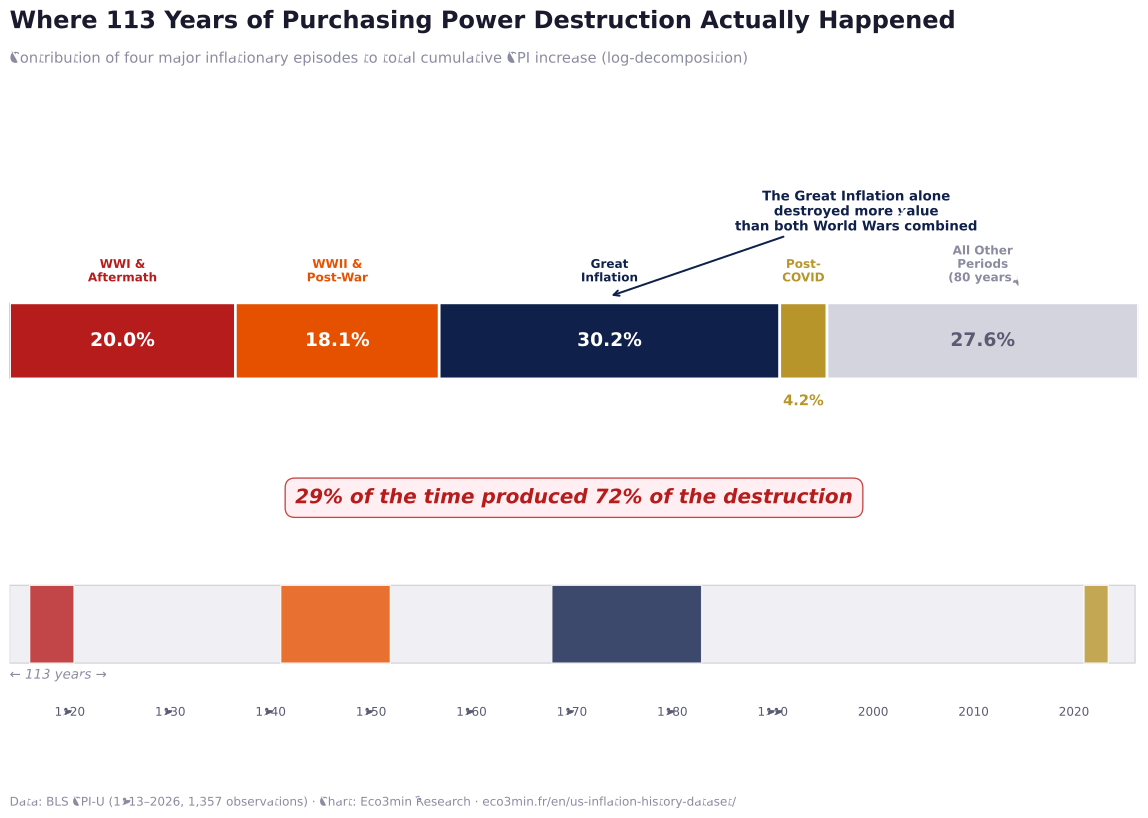
This study doesn't correct for baseline exponential decay due to inflation, to better highlight the meaningful variations. By comparing based on 1914 dollars it also causes old variations to be relatively more extreme and newer inflationary events to look less extreme. You must compare apples to apples.
Finally the events are quite cherry-picked. It is a conclusion looking for a result, when the statistical reason for choosing those 4 events simply isn't evident when you look at the data itself. There is no mathematical rule you could apply to your dataset that would distinctly highlight those 4 periods.
vessenes
an hour ago
Yes, a log chart would be better. That said, apples cannot be compared in this case; probably very few of us would choose to go back to 1914. A Tesla model Y would cost $1,680 in 1901 dollars, but would have been worth millions of those same 1901 dollars. Or nothing, depending on how much charging tech you could fit in the frunk. Many quality of life items are not covered by PPP (or money supply or other measures) adjustments.
onlyrealcuzzo
30 minutes ago
Why would anyone pay millions of dollars - that would be the equivalent to a billionaire's entire fortune - for a Tesla Model Y in 1901?
You'd have nowhere to charge it. Electricity would be more expensive than gas even if you did.
You'd benefit almost nothing from the technology. There's no internet. Not much of it would work. And it wouldn't really help move you forward technologically, as it's just too advanced.
twoodfin
23 minutes ago
Right. Many, many reasons why the dollar that bought the Tesla in 2026 is not quite so disadvantaged against the dollar of 1901 it’s being compared to by CPI.
rayiner
15 minutes ago
Also we’re looking at periods that involve dramatically different monetary policy (gold standard before WWII, Bretton Woods from 1944-1976, then the current regime).
elzbardico
an hour ago
Exactly, it doesn't matter to me how much COVID contributed to the erosion of 1901 100 Dollars.
abetusk
an hour ago
I think this graph shows the "apples to apples" comparison:
https://www.officialdata.org/us/inflation/1800?amount=1
Doing a spot check, this means $1 in in 1913 is equivalent to roughly $32.83 today.
twoodfin
26 minutes ago
That’s ~3.17% compounded annually.
Modest, stable inflation is good. It encourages investment & discourages deferring consumption for indirect monetary reasons.
“Stable” is the hard part.
jmyeet
44 minutes ago
You're basically critiquing a chart showing how purchasing power is decayed due to inflation because it isn't adjusted for "baseline" inflation. That doesn't make sense.
And yes, earlier variations are more impactful because compounding.
I will say that a better representation would be a logarithm of the inverse. The problem with doing it this way is that later changes look very small. $1.00 to $.99 is the same y-axis delta as $0.05 to $0.04 but the latter is very different.