Animats
a year ago
That's a good article. The whole history is there.
The commercial side has made huge progress, too. Look up "diamond making machine" on Alibaba. You can buy a high-pressure, high temperature six sided press for about US$200,000. A chemical vapor deposition machine is about the same price.
De Beers, the diamond cartel, has an R&D operation, Element Six. They sell synthetic diamonds for lasers and other exotic applications. The technology is good enough to achieve flaw levels in the parts per billion range, and to make diamond windows for lasers 10cm across.[1] This is way above jewelry grade.
Over on the natural diamond side, there's been a breakthrough. The industry used to break up some large diamonds during rock crushing. Now there's a industrial X-ray system which is used to examine rocks before crushing to find diamonds. It's working quite well. A 2500 carat diamond was found recently.[1][2] TOMRA, which makes high-volume sorters for everything from recyclables to rice, has a sorter for this job. This is working so well that there's now something of a glut of giant diamonds too big for jewelry.
The finishing processes of cutting and polishing have been automated. The machinery for that comes mostly from China and India.
Diamonds are now something you can buy by the kilo, in plastic bags.
[1] https://e6-prd-cdn-01.azureedge.net/mediacontainer/medialibr...
[2] https://www.forbes.com/sites/amandakooser/2024/08/23/monster...
[3] https://ikcabstracts.com/index.php/ikc/article/download/4101...
mitthrowaway2
a year ago
This is certainly good news for lasers. Many people don't realize how good diamonds are for this. Transparent with a 65% higher refractive index than glass, and 8x the thermal conductivity of copper. And completely scratch-proof!
biomcgary
a year ago
Diamond eyeglasses? The lenses would still be cheaper than the Luxottica frames.
_ph_
a year ago
I am pretty sure, diamonds would make awful eyeglasses. While their index of refraction is high, which makes glasses thin, their chromatic dispersion is high. That is the very thing which makes their glitter so colorful. For good optical systems you want to try to reduce the dispersion, to 0, if possible.
Another story is the scratch-resistance. For that it would be sufficient to coat the surface of the lens with a thin layer of diamond. Which is done in several applications.
amelius
a year ago
Maybe we can have diamond-based scratch protection on smartphones?
chasil
a year ago
Gorilla glass is already some percentage of "Prince Rupert's Drop" in strength.
This is not sufficient?
Stedag
a year ago
It’s definitely price performant at 6.5 on the mohs scale, sapphire panels are 2-4x more expensive to produce but 9 on the mohs scales so they’re typically only found in watches I bet. At a 10 on the mohs scale diamond is still best for hardness. Maybe the same effect of the prince Rupert’s drop could be induced on a round diamond with an alpha particle beam treatment where you add these ions primarily on the surface of the stone.
vladvasiliu
a year ago
I'm not exactly a watch nerd, so don't know how true this is, but I hear that sapphire shatters on impact. Or maybe that's just an excuse for people peddling "alternative" materials for their watches?
But if it is true, then I'd say that sapphire is a poor choice for mobile phones. IME I'm far more likely to drop the phone, preferably on some form of hard surface, that to scratch it. Phones are nowadays so ridiculously big, that there's zero chance I'll have anything else in my pocket.
regularfry
a year ago
Diamonds also shatter. It's got roughly the same toughness as sapphire but the cleavage planes are more annoying (in that it has them, while sapphire doesn't).
saagarjha
a year ago
I believe Apple tried to get sapphire for phones screens at some point, but their supplier folded.
dijit
a year ago
They did however manage to get Sapphire on the watch display (at least on the stainless steel LTE edition of the apple watch series 4 and 8, which I'm aware of).
The difference between my watch (which was 4 years old at the time) and a colleagues almost brand new apple watch (without the sapphire) was really telling, is his was lightly scratched on the edges despite him being quite careful, and I was exceedingly reckless with mine as I considered it old- yet there was not a single defect.
That was a major reason for me to upgrade to the LTE of the next version of apple watch that I bought.
craftkiller
a year ago
The sapphire on the Apple watch was a marketing gimmick, barely better than gorilla glass: https://www.youtube.com/watch?v=RF72hGIdrG8&t=10m20s
But there are other devices with better sapphire that actually live up to the hype.
dijit
a year ago
Well, maybe.
I have now had watches for 10 years without issue and my phone displays seem to scratch.
I’m not doubting you’re correct, I never boight it for this reason, it was just an interesting retrospective observation. Clearly its working for me, and I’m not sure I have anything with gorilla glass.
Unless the Pixel 7 has it.
EDIT: My Pixel 7 does have gorilla glass indeed and it has two scratches on the display despite being extremely rarely used. (its my work phone and sits on my desk mostly)
user_of_the_wek
a year ago
I have a Series 5 with the Saphire glass but my clumsy ass dropped it in the kitchen onto a stone floor. The edge of the glass shattered and while I still use it to this day, it's an ugly reminder of my clumsiness. The repair offer from Apple was to get a new one with a very slight discount.
Long story short, it is more scratch resistant but also more prone to break. So be careful.
DoctorOetker
a year ago
I wonder if they could put in tiny reaction wheel gyroscopes (to make it land in a safe orientation) or tiny linear reaction masses, or perhaps tiny replacable airbags or tiny sodium azide NaN3 charges/nozzles to blow air just before landing, to make for a gentler landing, replacable of course.
Tiny replacable airbags, on the corners. Preferably it should somehow detect the elasticity of the surface its falling to or going to hit.
kjellsbells
a year ago
There was a prototype design that a German student, Philip Frenzel, produced in 2018 that used the accelerometers to detect freefall and push out little spring claws to protect the device. It was supposed to be in production circa 2019 I think but I can't see evidence that it made it. YouTube has videos.
dijit
a year ago
Thanks for the warning!
I suspect the edges are more at risk than the face, as I've struck the face very hard against the edge of a scaffolding pole and there was no damage - which, actually shocked me a lot based on the force.
user_7832
a year ago
From what I remember, it was mainly because it was a fair bit more expensive to manufacture.
LorenPechtel
a year ago
The threat isn't so much scratching it in your pocket (but that is possible, I typically have my sunglass clip in the same pocket--it's supposed to be in it's own case but in theory something could happen) as scratching it against things.
xeonmc
a year ago
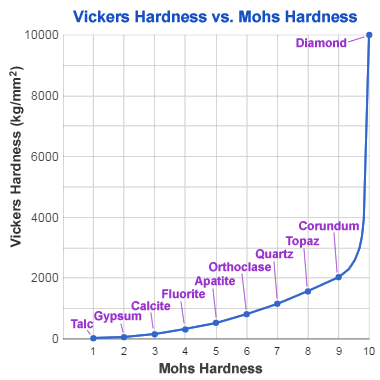
also note that Mohs is a qualitative ranking rather than a linear scale. Huuuuuge difference in hardness at the top end.[0]
[0] https://geology.com/minerals/photos/mohs-vickers-comparison-...
fsh
a year ago
Gorilla glass is easily scratched by sand, whereas sapphire or diamond stays flawless for decades.
roshankhan28
a year ago
gorilla glass with olephobic layer would be really helpful unless am missing some product that has already implemented this.
callalex
a year ago
I wonder if the process would be cheaper than the current high end (smart)watch and lens practice of sapphire coating?
opan
a year ago
Don't we already have good scratch protection? Cracks from drops seem like the main issue.
perth
a year ago
So scratching definitely still happens, both on sapphire camera lenses and new scratch-resistant screen technology. I’ve mainly had it happen with concrete. I think concrete sometimes just has some rocks in it that have a very high hardness because I’ve gotten pretty thick scratches in new iPhones when they’ve taken a slide over a rough concrete sidewalk due to a drop while walking.
kuschku
a year ago
I've similarly experienced bad scratches whenever my phone and my keys come into contact, hardened steel may still be able to cause scratches?
IgorPartola
a year ago
Your keys are by no means hardened steel. If they are steel at all (most are brass or silver/zinc), they would be mild steel. If they were hardened they would be really difficult to cut. The harder you make a steel the more brittle it gets. Think about what happens when you slam a file with a hammer vs a large nail.
kuschku
a year ago
Considering how easy it is to break keys in the lock, I'd say they're definitely more brittle than malleable?
serf
a year ago
I think that's mostly from mild work-hardening, I haven't experienced that with a brand new key.
kuschku
a year ago
What kind of material are your keys and locks made from? Over here nickelsilver or nickel plated hardened steel is common for keys and a combination of brass, steel and titanium for locks.
UniverseHacker
a year ago
This should not be possible with any type of modern phone screen. Do you perhaps have a plastic screen cover that is scratched? Or key metal could be deposited on the screen and just need to be scraped off
kijin
a year ago
Depending on your location and lifestyle, your keys and other possessions can easily collect a dusting of tiny sand particles. Quartz in the sand can scratch most types of glass.
gs17
a year ago
No, it's possible on modern phone screens. My Pixel 8 Pro has Victus 2 (AFAIK), which scratched very easily from fingernails alone.
kuschku
a year ago
No cover, just straight up gorilla glass victus.
And it's not just key metal deposited on the screen, there are deep grooves cut into it.
UniverseHacker
a year ago
I believe you, but there is some other explanation here- it warrants further investigation. You can scrape a regular glass window (about MOHS 6.5) clean with a razor blade (about MOHS 6.0) and it is impossible to scratch it, just from that tiny difference in hardness. I do this all the time, e.g. recently to get paint that my kid painted on the house windows off.
Your brass keys should only be about 3.0, and gorilla glass a 9.0- you should be able to rub keys into brass dust all day long and not mark the screen.
I store my keys right in my pocket with my glass iPhone SE, and it doesn't have a mark on it.
I suppose it is possible you have keys with some weird material or coating, or as another poster suggested- maybe something like an abrasive dust got stuck on your key.
kuschku
a year ago
Brass? Who said anything about brass?
Typical keys are made from nickel plated hardened steel and nickelsilver. Considering the shiny coating is long gone and the keys are ferromagnetic, I assume it's the first. The keys are certainly hard enough to scrape my glass ceramic stove.
And reports online say that gorilla glass victus is the mist scratch prone gorilla glass, scratching at or around 6 already :/
ralphhughes
a year ago
I think you may be onto something here. Taking apart old machinery I have often observed that the hardened part of a shaft is worn and has a noticable groove detectable with a fingernail. However the part that rubbed on it is often much, much softer eg a rubber oil seal. My theory is that the much softer material is so soft that microscopic inclusions of something much harder (grit?) are caught in the material and then abrade the harder shaft. Something similar may be occurring in the keys on glass case?
drjasonharrison
a year ago
Cutting with a lubricant and grit is super effective. Silicon dioxide, that is sand, is everywhere.
HWR_14
a year ago
Aren't both the lens and the screen are resilient to steel/metal scratches? I'm not willing to run keys or a knife over a phone on purpose.
gs17
a year ago
And it's a tradeoff. I found out the hard way that newer Pixels have incredibly soft screens to avoid cracks and shattering. Unfortunately, they're so soft that a fingernail (a 2.5 on the Mohs scale) will leave huge gouges quickly. Fortunately, there's third-party covers that use an adhesive that fills in the scratches well.
kazinator
a year ago
That's a little hard to believe. There are resin finishes that are hard to scratch by fingernail.
kazinator
a year ago
Think about it; you couldn't put a fingernail scratch into a cheap soda glass beer bottle. Why would Google make a phone with glass that could be scratched by a nail, let alone easily? Does that even exist? Perhaps there is some coating on the glass you didn't remove and that's what you're scratching?
gs17
a year ago
I'm sorry if you don't believe it, but it really happens. The "coating" would have to be pretty thick, this gouge was something you could easily feel with your fingertip. I was very careful to not let my keys or anything else get near it, and the gouge (which was essentially the only scratch on the otherwise flawless screen) was exactly where my thumb hits the screen.
My Pixel 4a, meanwhile, was in my pocket all the time and never got a scratch.
UniverseHacker
a year ago
I love going to the beach, and find that modern phones still scratch easily with sand.
nytesky
a year ago
I’m surprised no one has mentioned the ending of 2061
https://en.wikipedia.org/wiki/2061:_Odyssey_Three?wprov=sfti...
pie_flavor
a year ago
It's possible, and I remember seeing a very expensive prototype for it, but sapphire is already Good Enough for almost any cause of scratching you're likely to find.
david38
a year ago
We already have sapphire
shiroiushi
a year ago
Before I got to the end of your comment, I was just about to ask if it's possible to make a diamond coating. The scratch resistance would be very valuable, and I'm guessing if it's very thin, the chromatic dispersion wouldn't be an issue. This would probably be valuable for other applications too. However, I don't see how this would work on today's predominantly plastic (polycarbonate) eyeglass lenses, and switching back to glass lenses would make eyeglasses much heavier. It'd be great for smartphone screens though.
brohee
a year ago
Diamond coating is a thing for IR optics: https://sinoptix.eu/2023/10/27/what-is-dlc-coating-in-optics...
rlpb
a year ago
> While their index of refraction is high, which makes glasses thin, their chromatic dispersion is high
Isn’t the layer caused by the former? For a given required refraction, isn’t the chromatic dispersion the same?
In complex lenses corrections can be made, but for a simple single eyeglass lens, how is chromatic dispersion affected by anything apart from simple refraction?
namibj
a year ago
No, chromatic dispersion is due to wavelength/chroma dependant refraction. This is a separate thing from the overall/average index of refraction.
basementcat
a year ago
So… great for certain colorblind individuals?
Edit: Achromotopsia
almostnormal
a year ago
Unlikely. Same as under low-light conditions where everything is grayscale. The light is still colored and just not perceived in color, so it should be blurred grayscale.
passwordoops
a year ago
Like Luxottica wouldn't immediately roll up the diamond lens company...
Balgair
a year ago
I know this is a bit of a throwaway comment, but I'd never thought of diamonds for eyeglasses.
And, honestly, that would be really really cool.
Yeah, there are other materials with better refractive indices and that are tougher and cheaper and dont shatter. Sure.
But if we can get diamonds down to something that could be made into lenses for the (very high end) retail market, man, that would just be so cool!
LtdJorge
a year ago
I'd rather use the diamonds to manufacture the laser machines that do eye surgery and remove glasses lol
shiroiushi
a year ago
No, because eye surgery can't take the place of corrective lenses in all cases: it's not a full replacement for glasses or contacts. For people the farther ends of the spectrum (either needing very light correction, or extremely heavy), surgery doesn't work, or for very high prescriptions it only helps but it's not enough by itself. (Ophthalmologists please feel free to chime in.) And there's other reasons people aren't eligible for surgery, such as being too young.
kazinator
a year ago
Laser eye surgery cannot fix the problem of the lens having become inflexible and losing its focusing range. In such a case, surgery can only change where the focal distance lies.
shiroiushi
a year ago
Laser eye surgery won't do that, but intraocular lens implantation could. I think those lenses still don't work that great for reading, but I imagine they will eventually.
gosub100
a year ago
A lot of people regret LASIK. Dry eyes and diminished night vision are the top complaints.
parineum
a year ago
I know of these as side effects but I don't know if they are ubiquitous and people prefer them to glasses or of they don't happen to everyone. Do you happen to know amd know about what the rate of regret is?
gosub100
a year ago
I don't have the data. I think it depends on the severity of the correction. Also, age factors in, if you get it too young your eyes can go blurry again by middle age.
cainxinth
a year ago
Sounds like something from Neal Stephenson’s The Diamond Age.
divbzero
a year ago
How about diamond smartphone screens? Beats Gorilla Glass or sapphire.
mathgeek
a year ago
You probably don’t want more conductive lenses, though.
Lucasoato
a year ago
Luxottica is top tier.
ykonstant
a year ago
Top tier monopolist that needs to be broken up, preferably with a sledgehammer.
thfuran
a year ago
I just want a diamond heat sink. And a diamond kitchen knife.
Animats
a year ago
Diamond heat spreaders for ICs are available.[1] There are problems with coupling the heat to the diamond, and with the various materials having different rates of expansion. It hasn't really caught on.
Diamond layers within ICs to help get the heat out are being considered for future GPUs.[2] Again, it's not a magic bullet.
[1] https://www.diamond-materials.com/en/products/thermal-manage...
[2] https://www.sciencedirect.com/science/article/pii/S266638642...
adrian_b
a year ago
Zirconia kitchen knives are very hard and they are less fragile than diamond.
They have the advantage of keeping a sharp edge for a much longer time than steel blades, but they cannot be sharpened again with simple tools and for some purposes it may be inconvenient that the zirconia blades cannot be made as thin as the best steel blades, due to the risk of breakage, and there are also less choices of blade forms, e.g. there are no bird's beak zirconia blades, which is the best shape for peeling and paring vegetables.
High-quality zirconia kitchen knives, like those made by Kyocera, are very pleasant to work with. Diamond blades could not feel much different, even if they should remain sharp for a longer time, but with a higher risk of breakage when mishandled.
chii
a year ago
> And a diamond kitchen knife.
Which shatters on contact with a small bone.
adrian_b
a year ago
In my opinion, the right way of cooking is to always start by removing all bones with a specialized knife, i.e. a boning knife or a filleting knife.
The meat without bones and also most vegetables can be handled by the currently existing ceramic kitchen knives and they could be handled by a diamond knife (though diamond, even in polycrystalline form, is much less tough than zirconia ceramic or silicon nitride ceramic, which are better suited for kitchen knives).
gpm
a year ago
I believe that issue is solved with polycrystalline diamond.
nsteel
a year ago
Why are they not more popular as a material for heatsinks? Especially with those that like decorating the inside of the PC with fairy lights.
namibj
a year ago
Oh they are. But heat pipes/vapor chambers have them beat. So they are only used where electrical insulation (pure diamond sheet) or mechanical strength (cheap diamond grains sorted into a densely packed single layer of diamonds embedded into a copper matrix; this fits nicely for silver sinter bonding dies to due to the low thermal expansion of diamond) is needed from the heatsink.
nsteel
a year ago
Thanks. I since found https://www.cell.com/cell-reports-physical-science/fulltext/..., perhaps it makes sense where you don't have a lot of space.
namibj
a year ago
Oh, nice; I was thinking of what I believe is this, though: https://sumitomoelectric.com/products/cu-diamond : size-selected diamonds to match the thickness profile of the power module/brick base plate, then encased in copper. Benefit is arguably more the expansion matching to GaN/SiC than the thermal conductivity improvements over plain copper.
jaggederest
a year ago
Riffing on this, the amazing thing about diamond is not merely that it's a better conductor of heat, but that it's about 2.5 times higher than copper.
The only thing that beats it is single crystal boron arsenide which has some obvious downsides, being of course much more expensive and involving arsenic, which is considered a bad thing.
And with that, diamond is destined to be even cheaper than silicon, I think. Much more available and easier to purify, the hard part is rendering it into a crystal which is relatively solved.
chii
a year ago
I heard the expansion of diamond is quite different to many materials, which could lead to splitting or shearing when heated up next to another material attached: https://byjus.com/physics/coefficient-of-linear-expansion/
but perhaps it's not that big of an issue, not sure.
trissylegs
a year ago
No for PC heatsink, but in 3d printing heat is really important for the nozzel. And a company makes them with Polycrystaline Diamond, which is harder than normal diamond. The company needed it themselves as the carbon fibre filament they were using kept wearing out heads. They though "Why don't we make our own heads".
Animats
a year ago
That makes sense. Dies for drawing fine wire have been made of diamond for most of a century. Seems like that's filtered down to 3D printers, which is a less demanding application.
bitmasher9
a year ago
It’s still prohibitively expensive for such applications.
Raydovsky
a year ago
No deeper groves at 8?
hhh
a year ago
Diamond heat sinks inc?
userbinator
a year ago
The machinery for that comes mostly from China and India.
It's worth noting that the Chinese word for diamond is literally "drill stone", which highlights its application as an abrasive more than jewelry.
Xcelerate
a year ago
> diamond windows for lasers 10cm across
> Diamonds are now something you can buy by the kilo, in plastic bags.
I can’t wait to use diamond cookware. A pan with a thin layer of 430 stainless steel for induction, a wafer of diamond, and then another thin layer of stainless on top will be amazing. Almost perfect evenness over any cooktop.
chronogram
a year ago
> Thermal conductivity of natural diamond was measured to be about 2,200 W/(m·K), which is five times more than silver, the most thermally conductive metal. Monocrystalline synthetic diamond enriched to 99.9% the isotope 12C had the highest thermal conductivity of any known solid at room temperature: 3,320 W/(m·K), though reports exist of superior thermal conductivity in both carbon nanotubes and graphene.
https://en.wikipedia.org/wiki/Material_properties_of_diamond...
I had no idea it was that good. I wonder why they don't make them that way then, as expensive cookware already seems to be a high margin business.
amluto
a year ago
I’m not sure how hot one would need to get one’s pan to have potential problems, but diamond is carbon, and carbon is soluble in hot steel.
The mismatched coefficient of thermal expansion could also be a problem.
TheRealPomax
a year ago
This is what oil-core cookware already does. But there's only so much "heat spreading" you can do before faster conductivity does basically nothing. The thermal conductivity of steel itself becomes the limiting factor pretty quickly.
That said, if they can figure out vapor depositing diamond onto stainless steel, I'd take a diamond surface over an enamel surface. Provided they can figure out how to make it perfectly flat rather than so jagged at the molecular level that literally everything sticks to it.
("wouldn't that burn? It's just carbon after all": only if you give it the cast iron pan treatment and manage to have it sit on so much gas for so long that you get it up to 700C, which would make no sense)
amluto
a year ago
Having contemplated pan materials a bit, it seems to me that high thermal conductivity is nice, but one really wants is even heating, and that might be best accomplished by highly anisotropic thermal conductivity. Or maybe by having a good conductor sandwiched between poor conductors.
pavel_lishin
a year ago
Aren't diamonds fairly brittle? I'd be worried about such a cooking pan snapping in half as I flip an omelette.
dragontamer
a year ago
That's what the steel is for.
Steel for induction and strength. Diamond (like copper cores) for heat traversal.
agumonkey
a year ago
How will they maintain their jewelry business ? It feels like Sony CD-R drives in the Playstation era.
karunamurti
a year ago
Do it like here in Japan. They charged you 3x-4x the gold price and said "Oh it's not the gold price, but the craftsmanship".
wkat4242
a year ago
Maybe they'll just stop caring about it because they have a much better new business.
The same way rolls royce no longer sells luxury cars to stuffy British aristocracy but makes a mint building huge jet engines.
Nursie
a year ago
While that is a nice idea...
RR cars has been a BMW subsidiary for 21 years, having been separated out from the aircraft engine manufacturing business in the 1970s
https://en.wikipedia.org/wiki/Rolls-Royce_Motor_Cars
https://en.wikipedia.org/wiki/Rolls-Royce_Holdings
(unless that's exactly what you meant of course, Rolls Royce Holdings indeed no longer makes the cars... )
mr_toad
a year ago
On an unrelated note, Rolls Royce is probably more synonymous with Rap artists than British aristocracy these days.
taneq
a year ago
Better to move into a new related business than to Kodak yourself.
trissylegs
a year ago
I think people will keep buying diamond jewelry with natural because it the product is sold as real/natural diamonds. Prestige is important for the high-end market and most of the price will be markup anyway. (Well diamonds are nearly all markup anyway).
Tiffany's isn't suddenly going to be cheaper.
foobarian
a year ago
Or even the other way around: with the economies of scale created by industrial use cases removed, mining diamonds just for jewelry could get more expensive.
nprateem
a year ago
Nobody ever bought a CD-R to impress a cute piece of ass to marry them.
DeBeers are just positioning on price, natural more traditional and romantic, etc.
Who wants to know their engagement ring was half price?
foobarchu
a year ago
> Who wants to know their engagement ring was half price?
I mean...a ton of people. My fiancee and I just purchased her ring together and it was pretty much a silent agreement from both sides that lab grown was the way to go (confirmed out loud of course). The stone we ended up getting was about 1/10 the cost the closest natural we could find, and both of us agreed that there are way better ways to spend that money with everything else in the future.
Many people also love jewelry but would rather not have something worth a brand new car on their hand.
nimish
a year ago
The same way vinyl still sells.
trhway
a year ago
>diamond windows for lasers 10cm across
sounds like may be soon we'll see diamond wafers for the chips (especially as the price of processed wafer from a fab increases, the cost of the source wafer itself is becoming less important) Add to that X-ray lithography, and the Moore's Law will continue for quite a while.
namibj
a year ago
AFAIK you can still only buy diamond diodes outside of secret military stuff, and even those are not at all accessible.
Sadly GaN suffers from horrible p-channels (they use resistor/nmos logic as the non-differential logic family for GaN ICs), and SiC from kinda sorta delaminating gate oxide (JFETs are fine though, and vertical ones are very nicely behaved, including a lot of resilience like avalanche resistance (though actual (non-capacitive) current flow through the gate junction has to be limited to prevent damage)).
N-type diamond is just difficult, along with diamond itself at a purity approximating "intrinsic"/"none" levels of doping. The issue is that you have to continually etch graphitic carbon during the CVD process, requiring aggressive chemistry.
regularfry
a year ago
Impure diamonds for semiconductors were a plot device in Michael Crichton's Congo. I never knew if there was much basis to it.
samplatt
a year ago
And at 8x the thermal conductivity of copper, we might see some diamond HSF's as well.
hammock
a year ago
Incredible, great info. We are now living in the Diamond Age.
db48x
a year ago
Well, not quite. They were making diamond windows from atmospheric carbon dioxide at room temperature in household machines or machines you could rent at the post office. We’re a ways off from that yet.
Terr_
a year ago
Also the whole aerostat thing where you make a diamond "balloon" full of vacuum that floats in air, using the strength of the rigid diamond to avoid it being crushed and popped.
I'm no materials-scientist, but I did some napkin-math on that once and it came out to some ridiculously-thin-sounding layer of diamond.
Terr_
a year ago
Redoing the napkin math because I can't find the original and I've somehow nerd-sniped [0] myself. Assume a sphere that contains a cubic meter of air and is neutrally buoyant:
    Vacuum volume           1.00        m^3
    Vacuum radius           0.62        m
    Air density             1.23        kg/m^3
    Displaced mass          1.23        kg
    Diamond density         3250        kg/m^3
    Diamond volume          3.77E-04    m^3
    Sphere surface area     4.84E+00    m^2
    (Thin shells can be approximated by ignoring curvature)
    Shell thickness         7.79E-05    m
    Shell thickness         77.94       μm (microns)
    Human hair thickness    17 to 181   μm (microns)
Remember: The walls of party-balloons and soap-bubbles are a very different situation: They can have extremely thin skins because the gas inside is doing almost all the "don't get crushed" work, the skin is really just there to keep the two gases from mixing.
db48x
a year ago
Perhaps they use a diamond frame filled in with graphene instead. Still seems pretty unlikely though. And probably too easy to puncture, ruining the vacuum.
Or perhaps they just build surfaces out of more complicated things than carbon. Hydrocarbons could be as easily assembled as diamond with similar techniques, and are a lot lighter than pure carbon. Plus they would want to put electronic advertising on the surface of the ball anyway, so it’s got to have a bit more going on to form LEDs and whatnot.
Terr_
a year ago
I was thinking about smaller bubbles and aerogels, but when the volume changes by a factor of 0.10, the thickness-budget only changes by a factor of ~0.46.
So while many smaller spheres--or pockets sharing walls--might be easier to engineer, the square-cube law [0] eats away at your lifting-power as everything becomes mostly-diamond with very little air-displacing vacuum.
db48x
a year ago
Yup, the scaling works the wrong way for small objects. A vacuum–zeppelin makes a lot more sense than a beach ball.
IgorPartola
a year ago
Exactly. That’s why a cubic meter of air is probably not the right range to look at. Something several magnitudes larger might do better.
Terr_
a year ago
Likely, but even a cubic meter is already a large step up from the scales in the book, ex:
> Each aerostat in the dog pod grid was a mirror-surfaced, aerodynamic teardrop just wide enough, at its widest part, to have contained a pingpong ball.
It doesn't say they aren't relying on some kind of down-thrust, but at that point I'd wager it's much easier to skip the whole marginal buoyancy part entirely. Use those conductive diamonds for an ionic thruster or something.
HPsquared
a year ago
Buckling would be a problem.
jayd16
a year ago
so I guess it needs to be like 1/4th the thickness of the latex in a balloon (diamond is 4x the density). Vacuum gives you a bit more lift than helium but not that much. Yeah, seems pretty thin.
UniverseHacker
a year ago
The pressure across a latex balloon is only about 0.5% that of maintaining a vacuum in earths atmosphere. I’m guessing the diamond would need to be much more than 1/4 the thickness of a latex balloon.
db48x
a year ago
Yea, a bit of artistic license on the author’s part. You could make things quite light though.
user
a year ago
hammock
a year ago
I guess there is some sci-fi book everyone has read but me?
fennecbutt
a year ago
Where's my magic book then. And my atomic fabbers! Lemme 3d print a phone.
dredmorbius
a year ago
eBook readers exist, and with a bit of jiggery you could have programmatic content.
One of the hibernation screens for one of my ebook readers reads "Don't Panic", for all the obvious reasons. (Different franchise, similar concept.)
jiggawatts
a year ago
Magic book = iPad or Remarkable
Atomic fabber = chip fabs making things on ~10 atom scales
3D printing homes is possible now, just a bit niche
db48x
a year ago
And yet we’re not really there yet. The book wasn't just a tablet computer; it was programmed to continually analyze everything happening around it and relate those events back to the education of the owner. It shocked a bully who was playing keep–away with it. It noticed that the owner was eating junk food, and taught her a better diet. It taught her to read, as well as manners and exercises and elocution. Later a constable unobtrusively scanned it and then very carefully explained (so that it wouldn’t shock him) that nobody would try to take it away from her during her visit, so long as she didn’t show it to anybody or try to interface it with a printer. It told her stories that aided her in running away from an abusive father, in avoiding police patrols so she could sleep in a public park undisturbed, etc, etc. It invented new stories with fractal depth, allowing her to ask questions and get more and more detailed information. Its pages were both a sophisticated microscope and telescope. She used it to design and print a nanotech sword and later to infiltrate a hive–mind society.
And it also contained the text of every other book ever written, of course.
And arguably it was that character’s mother too.
I’m going to have to reread this one soon; it’s such a good story.
pixl97
a year ago
When I first read Diamond Age is was 90% science fiction, now it's seemingly far less than that.
Environmental sensing is a little weak in our own devices, but in theory your cell phone could listen to everything you do and (externally) analyze it for things like a bad diet. You'd have to point the camera intentionally at things you're doing for it to capture that information.
Now, no one is going to make a product that shocks people holding it, yet this isn't an impossibility. Failing to login, or having the camera capture the wrong person is using could very easily be designed in to the product. No one is going to do that for fear of lawsuits.
db48x
a year ago
Yea, I agree that it’s a little less science fiction than it used to be.
But remember the subtlety of it; the constable didn’t have his face recognized, or log in, he literally made a promise to the book while pretending to talk to the owner. It’s still mostly science fiction :)
jiggawatts
a year ago
About 70% of those are covered by the Internet especially if you include ChatGPT.
db48x
a year ago
I think you are overestimating ChatGPT, but perhaps one day. And the book was capable of doing all of this while off line. Again, perhaps one day :)
fragmede
a year ago
A Bambu P1S will let anyone just print a phone case with no fuss, so we're on the way there!
fennecbutt
a year ago
I already got an A1 mini to trial the brand, looking at replacing my Ender 5 Plus. Not bad Bambu, not bad at all.
taneq
a year ago
“You wouldn’t download some RAM”
failuser
a year ago
Not yet, not even diamond phone screens are here. And tax evasion has not killed the nation-states yet.
newZWhoDis
a year ago
I just want solid diamond cookware.
Wouldn’t a diamond skillet be incredibly non-stick, easy to clean, and totally non toxic?
UniverseHacker
a year ago
There are diamond pans that I think are a ceramic mixed with industrial diamond dust. I had one once and it was amazing- very non stick and didn’t scratch like teflon.
IG_Semmelweiss
a year ago
I am actually.surprised you arent getting any responses
With the current focus on PFOS and just amount of garbage materiel used to prepare our foods, I think some innovation is just around the corner.
semi-extrinsic
a year ago
> some innovation is just around the corner
It's already here! Stainless steel for pots, carbon steel for pans.
Once I got my first carbon steel pan (not cast iron) I knew it was game over for the teflon pans in my house. I'm now gradually replacing the teflon pans with carbon steel, and then I'll never have to replace another pan in my lifetime.
The upcoming PFAS ban in Europe will probably accelerate this transition greatly, unless DuPont et al have too much influence over politicians...
alex_duf
a year ago
I replaced my téflon pans with carbon steel. I find the transition and learning curve to be much more difficult than téflon.
Cooking an egg is a big no-no, I need to think about when to squeeze a lemon or when to put my tomato sauce otherwise I might damage the seasoning. Nothing blocking but definitely a lot of things I don't want to think about.
semi-extrinsic
a year ago
For stuff like eggs or pancakes, stainless is actually better in my experience. Just use a little oil and get the pan hot enough so that you have the initial Leidenfrost effect until the bottom of what you are frying has had time to solidify, then you're golden.
adrian_b
a year ago
The fastest and the easiest way to cook eggs is in a closed glass vessel in a microwave oven.
The power and time must be selected carefully, to avoid explosions, but once the right combination is determined it will always be perfectly reproducible.
I prefer to separate the egg whites and the yolks before cooking (and mix them with different ingredients, possibly whipping the egg whites first), but making fried eggs or scrambled eggs is as easy.
The eggs can be cooked alone and mixed later with other ingredients, or they can be mixed with other ingredients before putting them in the oven.
user
a year ago
the8472
a year ago
> a glut of giant diamonds too big for jewelry
Time to commoditize crowns.
user
a year ago
xeonmc
a year ago
Re: source #2, I believe this is a better reference: https://old.reddit.com/comments/1f06cpm
user
a year ago