Havoc
5 hours ago
More stoked for when the same is said for storage.
Solar is cool but solar that can make it through the night and a couple cloudy days is way cooler
AnthonyMouse
4 hours ago
> Solar is cool but solar that can make it through the night and a couple cloudy days is way cooler
The fun part is that we're still well before the point when this even matters.
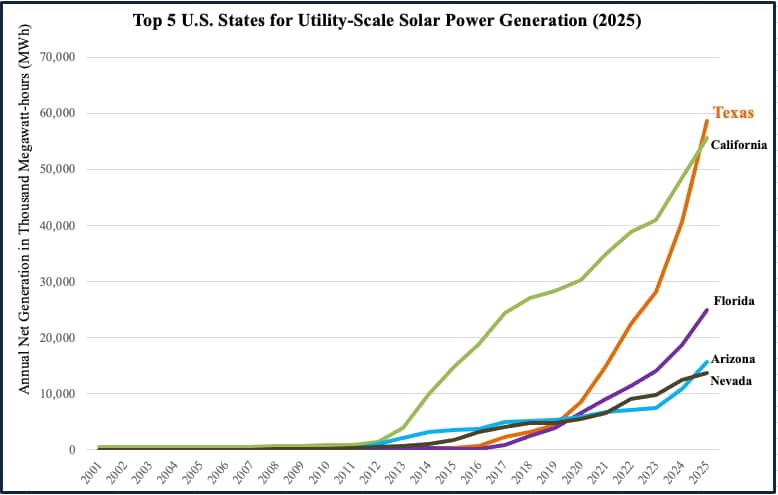
Almost 60% of the US grid is still fossil fuels, with around half of that still happening during the day. Which means you can get down to ~30% fossil fuels without any storage at all because all you do is go from burning fossil fuels during the day and at night to burning fossil fuels only at night.
Havoc
39 minutes ago
Yeah the US will lag behind on this.
Other countries are better positioned. e.g. UK has really spiky wind energy. Right this second more than half the grid is wind. Which is both cool and problematic for managing the grid.
Grid scale cheap storage would dramatic help manage that chaos
saltcured
3 hours ago
Hmm, how much of that is base load versus the dramatic rise of natural gas plants that respond to dynamic demands? Even in daytime, I think you need storage to get rid of those, right?
HDThoreaun
an hour ago
It doesnt make economic sense to serve the entirety of daytime electricity demand from solar without batteries. Youd have to tons of fossil fuel plants that turn off during the day and then back on every night. For solar to take the next step batteries are a requirement
jillesvangurp
4 hours ago
Usually solar and storage are a package deal these days for grid scale solutions. Mostly, storage is not really about providing long term storage but short term. It used to be that the sweet spot that makes the most economic sense was something like 2 or 4 hours of power (relative to the maximum output of the solar panels) but these days batteries are a lot cheaper and 8 hours or more is becoming fairly common. The point of storage is not really to cover for all the downtime when the sun doesn't shine but to give grid operators enough lead time to bring online extra generation or buy capacity on the open market and adjust their planning. Mostly a few hours is all they need to ensure the grid stays up and running through daily peak usage windows.
In aggregate, grid operators have a lot of other tools at their disposal via flexible pricing, flexible demand, and automated systems that can adapt to this to e.g. charge cars when there is a surplus of energy, turn on/off water boilers, etc. There's a lot of innovation around this topic in this space. This by the way is as much as making sure generated power doesn't go to waste than it is about ensuring there is enough power. They use batteries to time shift excess power to when they can utilize it.
Interconnected grids means that e.g. an operator in Denmark can import/export to and from the UK, Norway, Germany, etc. On a windy day they'll be exporting wind power. On a sunny day, they might add some solar to that mix. When there's no wind or sun in Denmark, they might pull in Scottish/German wind, Norwegian hydro, Swedish nuclear, etc. Batteries are being deployed all over the place at a pace that is only exceeded by the pace at which solar is being deployed. Whenever there's a surplus energy, batteries get charged up. It's very rare for all of the available generation to disappear all at the same time for long enough to drain all the batteries. And for those times of course fossil generation is still a thing as well, and will be for decades to come. There are a lot of gas based plants throughout Europe. As well as some nuclear plants of course. Singling out the EU market here but it's going to be similar elsewhere.
The point here is that there's no need to pair solar setups with days/weeks/months worth of storage. A few hours goes a long way.
pfdietz
4 hours ago
Diurnal storage is solved by batteries. Longer term storage will very likely be solved. For several days, cheaper batteries (perhaps with lower specific power). For longer periods, either thermal storage or e-fuels.
bryanlarsen
3 hours ago
Agreed, e-fuels seem to be far and ahead the front-runner.
We can get to 95% using just short term storage. I suspect that most jurisdictions will just say "95% is good enough" rather than paying for ridiculously expensive long term storage.
We've got the nat gas capability already; keeping it around for the 5% is quite inexpensive, making the massive investment in long term storage for marginal benefit hard to justify.
OTOH, while the premium for e-fuels seems excessive, if you're only running that nat gas plant 2 days a year that premium is not so scary.
pfdietz
2 hours ago
> Agreed, e-fuels seem to be far and ahead the front-runner.
For covering Dunkelflauten? Yes.
For seasonal storage with a prolonged discharge (so, low power/storage capacity ratio)? I think thermal storage wins there.
bryanlarsen
2 hours ago
Sure, thermal is great where it's possible. But there aren't that many places where district heating is viable.
pfdietz
2 hours ago
I'm not talking about district heating. I'm talking about high temperature storage for conversion back to electricity. Round trip efficiency could be around 40%, better than green hydrogen burned in combined cycle plants.
bryanlarsen
2 hours ago
Standard Thermal's website's front page only covers heat delivery; did you mean to link to somewhere else?
Those are 2 very different use cases.
Thermal is low rate extraction. It's 1 cycle per year, but the extraction is performed over months so is low rate.
Electricity long term storage is high rate extraction. It's only used a few times a year, but when it is used it needs to cover roughly 100% of the entire grid's needs. I doubt thermal storage is suitable for high rate extraction, but I'd love to be wrong.
Edit: rereading your parent comment you seem to think thermal is suitable for a different use case? Could you elaborate further? When is "prolonged discharge" useful?
ben_w
4 hours ago
My guess is seasonal will be handled with flow batteries. A big tank and cheap-ish electrolyte, with the expense being in the electrodes sized for whatever max power is required. Tanks good for multiple cubic meters worth of liquid storage aren't exactly difficult to find, nor to place in a garden.
Then again, I'm basing this opinion on a recent-ish video from NightHawkInLight: https://www.youtube.com/watch?v=eq7fR9ISuCw
pfdietz
4 hours ago
Flow batteries might be ok for a week or so, but their market window has been shrinking as Li-ion has gotten cheaper.
The technology I'm most excited about is ultra low capex thermal, as being done by Standard Thermal. Capital cost per unit of energy storage capacity as low as $0.10/kWh(th), so it can work with seasonal storage and just a few tens of charge/discharge cycles over its lifespan.
Standard Thermal has raised $11M and is building in Germany, where they say they can deliver 365/7/24 solar resistive heat (400 C or perhaps 600 C) for half the cost of heat from burning natural gas there.
d3rockk
29 minutes ago
It's encouraging- when one part improves usually the others follow.
dominicrose
4 hours ago
Electricity is cheaper at night but only 20% of my consumption is at night, so I wouldn't mind if the situation was reversed.
I guess using electricity to heat during the night could be an issue, but we could also accept to let the temperature drop.
masklinn
4 hours ago
Around here late morning to mid afternoon (11 am to 4 pm) is now off-peak, alongside the old 10pm to 6 am.
dieselgate
4 hours ago
Aren’t lead acid batteries great for this purpose? They have advantage over lithium in stationary setups because weight is not an issue and they can be “daisy chained” many many times. I’m unaware of more cutting edge alternatives and the way the electrical companies handle solar is confusing IME
sieve
3 hours ago
I dumped my 24V dual LA battery setup for a single 24V LFP battery for my inverter/UPS backup. LFP supposedly has a 10-15y life based on the 4-5000 charge cycles most cells claim. Sodium ion is on the way as well. My setup gives me about 10-12h of backup for critical loads (my PC, lights, fans).
I have a 5 kWp solar plant that produces ~25kWh per day, but it is grid-tied. I considered a hybrid setup with LFP battery back up, but decided to separate the two systems to avoid a single point of failure.
rcxdude
4 hours ago
Lead acid batteries don't much like being cycled heavily. Even the ones explicitly designed for it (the average car battery is not) have about a tenth of the lifespan of lithium ion.
LiFePO4 is probably the chemistry best suited to it ATM. Lasts a long time, more stable, pretty cheap, and just a bit less energy density than other lithium ion options. Sodium-ion is looking promising but only just entering the market AFAIK.
ElevenLathe
3 hours ago
Does this mean LA would be a feasible option for longer-cycle storage, IOW keeping a reserve topped up most of the year for those duldrums weeks with little solar or wind?
rcxdude
2 hours ago
I think it still loses out to lithium-ion on cost/kWh, and batteries in general are still a bit expensive for storage on the timescale of months.
literalAardvark
4 hours ago
They're not great.
LiFePo4 however is excellent and reasonably low cost these days
breakyerself
3 hours ago
The cheaper solar gets the more of a gold rush there has been to develop projects/technologies that take advantage.
adjejmxbdjdn
3 hours ago
We can simulate storage with overcapacity and broader geographical distribution networks, even if storage doesn’t become as cheap.
Fortunately that doesn’t seem like it will be an issue since battery storage costs are also seeing an exponential reduction.
jauntywundrkind
4 hours ago
Most of our chemistries are targeting things like cars and consumer electronics.
Ideally we see people like Form Energies, using iron-air (rust) batteries, for much easier to scale storage. https://www.technologyreview.com/2026/10/06/1145020/2026-cli...
toomuchtodo
5 hours ago
https://www.iea.org/commentaries/global-battery-markets-are-...
- Battery energy storage has grown at an exceptional pace, with global installations increasing more than 20-fold in storage capacity over the past five years. This growth has been driven by falling battery prices, abundant supply and relatively short project lead times. As variable renewable generation expands in many markets, battery storage is becoming an important source of flexibility and resilience for power systems, while also representing a growing commercial opportunity for battery manufacturers.
- However, more than 90% of battery storage applications rely on LFP batteries that are almost exclusively supplied from China, which accounts for almost all global manufacturing capacity and the associated technical expertise. Korean producers are investing to scale up LFP battery production that can offer an alternative, but they face intense competition from established, lower-cost Chinese producers in an oversupplied market.
https://www.iea.org/commentaries/battery-storage-is-scaling-...
- Battery storage now accounts for around 18% of installed dispatchable capacity in Australia, compared with 7% in China, 5% in the United States and 4% in Europe – underlining how rapidly batteries are becoming an important part of the electricity systems in some regions.
https://www.ess-news.com/2026/06/02/global-battery-additions...
Battery storage is right behind the solar adoption curve. Net zero in five years? Probably not. Ten to fifteen years? Almost assured considering rate of change and the overall economics (assuming ~1TW/year of solar PV deployment and enough battery storage to soak up that low carbon generation while also providing grid services to replace thermal generation grid support [voltage, frequency, etc]).
(China is curtailing renewables equal to the annual combined generation of Spain and the Philippines every six months, and India about ~100-120GW/month due to not enough battery storage, for example)
theoreticalmal
4 hours ago
I am desperate to find a battery inverter that can be used to supplement my existing grid-tied home solar setup. I only need about 5kW and 10kWh of batteries, but everything I can find is geared towards whole-home power at like 12kW. Way way more than I need. I understand I’m in the minority and there’s probably not a market, but I’d love to find something
user
4 hours ago
toomuchtodo
4 hours ago
Unfortunately, the market is somewhat bifurcated between what Anker, Jackery, Ecopower provide and stepping up to Base Power, Powerwalls, and other bigger system components.
My recommendation would be to see if Ecopower storage and inverters are a good fit for your use case. If you're feeling adventurous, you could build your own battery pack, but I only recommend if you are knowledgeable and confident. This comes with substantial property and life safety risk, only proceed if you know what you're doing and understand the risk (I'll work on my high voltage EV battery packs, but only with a helper nearby holding a 2x4, for example).