mbgerring
13 hours ago
I’m 38 years old, and I’ve worked in climate tech for the last 12 years. In my relatively short lifetime, and my relatively short career, I have seen the environment for political action, and funding for climate solutions, fluctuate maybe half a dozen times.
The physics, however, don’t change, and neither does the task in front of us.
I just spent ten months finding a job, the longest and most difficult job search of my career. It was hard because the macro environment is terrible, but also because I insisted on finding a role working on clean energy hardware.
At a time when basically all VC funding, and in many ways the entire productive capacity of the economy, is shifting to AI, it would have been smarter in some respects to just pivot to AI. I sat out the crypto bubble too, in which some of my peers made a lot of money by working on projects that were either useless, or straightforward scams.
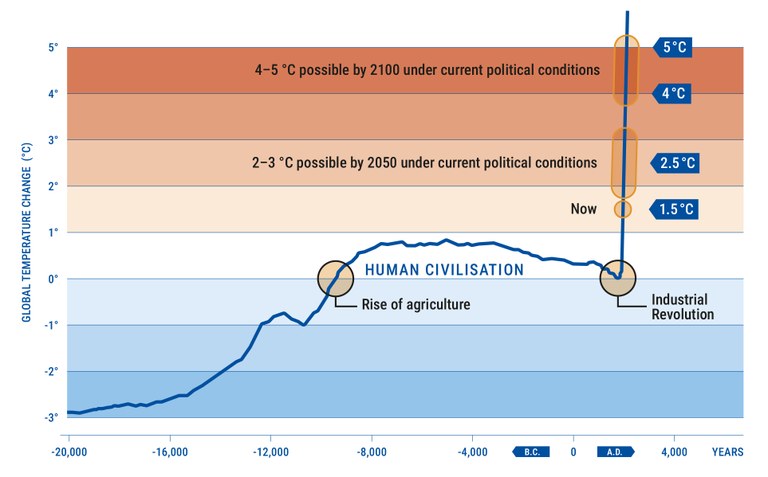
We crossed the 1.5 degree threshold because the money can’t help itself. The slow, steady work of transitioning away from fossil fuels is never going to be as profitable, as quickly, as the various forms of gambling and addiction that have driven the tech industry for most of my lifetime.
But you, individually, can make the choice to keep your eye on the ball. You can commit to working on this problem until it’s done, no matter what. You can choose to find the others to organize and prepare, so that the ideas closest at hand when the next crisis comes are yours.
It’s the best solution I’ve come up with so far, and in spite of the challenges, it’s still working.
palata
13 hours ago
> You can commit to working on this problem until it’s done, no matter what.
My opinion is that the very first things people should do are:
1. Get a little bit informed. It doesn't require a PhD, it could be done instead of a fraction of the time they spend scrolling bullshit on their smartphone.
2. Accept the situation. Too many are in denial, with variants of "it's not that bad" or "it's because those in power are stupid, I would certainly fix the world" or "it's because of foreigners".
3. Vote accordingly.
It's too easy to say "we don't have any viable candidates" and "I don't understand why they haven't fixed the problem yet, they must be stupid (somehow implying that "in all likelihood I would have solved it by now")".
In relatively-functional democracies, the reason the people doesn't have viable candidates is because the people does not vote for competent people. Either because they vote for competent politicians (with modern politics being about getting elected, not exactly solving big problems) or because they proudly vote for extremists (which is of course even worse).
In a democracy, the people is the government. When the people says "the government is stupid", it reflects on the people. Maybe they're right: the government is stupid, because the people is stupid and elects stupid people, and that's why we're screwed.
mbgerring
12 hours ago
I went from voting to electoral campaigns to the kind of activism that gets you arrested to working in climate as an engineer. I landed here because the first three were insufficient. I still support and encourage all of it, but the best you can get from voting is creating a better regulatory and funding environment for the necessary engineering and implementation work.
lukan
12 hours ago
"to the kind of activism that gets you arrested "
Glueing to the streets and alike?
I never found that to be helpful. Preventing chopping down forests to open new coal strip mining on the other hand .. I would be with you.
icantevenhold
11 hours ago
The latter gets you arrested even harder
lukan
11 hours ago
Depends how you do it.
https://en.wikipedia.org/wiki/Hambach_Forest
Glueing to streets can lead to terrorism charges, taking part of a demonstration even if it is not a legal one so far not.
(but among those activists there are certainly more radical elements, also actual eco terrorists, they recently showed solidarity to someone who was hiding close there, who made attacks on power plants and transmission lines)
icantevenhold
11 hours ago
What do you mean? A lot of people got arrested in the course of the Hambach protests
lukan
11 hours ago
Not the ones demonstrating, but those who threw stones at police and did sabotage.
icantevenhold
10 hours ago
Again not sure what you’re referring to.
The ones that made Hambach happen were the people that camped there in the woods literally for years in tree houses and they (some of them) also got arrested for it.
lukan
10 hours ago
The arrests and prosecution I know of, are not because of living in a tree house there.
There was a lot of intentional ideological violence towards police. Part of the reason why I did not engage with them further, but I know people there.
They still camp there btw
icantevenhold
7 hours ago
I know that they tried to evict the people in the forest in 2018 and a bunch of people got arrested because they resisted the eviction. Later on they walked it back and let them stay but still some people got arrested not because of violence but because they occupied the forest.
orwin
10 hours ago
The prosecutions are not because they camped there, but what about those who were arrested and not prosecuted? just taken into jail, strip searched, then let go outside the police station after a night in jail when nobody can find where they are? Without any prosecution because the police cannot stick them anything? The violence against the police is mostly not ideological, it's caused by a deep anger about how people are treated, getting teargased for nothing, or prevented from moving.
Also now with social media, you can find a lot of example of what are called in France "Appariteurs" who often start the mayhem then leave through police lines without getting arrested.
lukan
9 hours ago
"The violence against the police is mostly not ideological, it's caused by a deep anger about how people are treated,"
Yes yes, I heard that before. Let's just say I have been to many demonstrations and know the scene so sure, unprovoked police violence is a thing. But otherwise the pattern I witnessed quite often(and especially in the context of Hambach) is: some throwing stones or worse at police, police reacts with batons and teargas .. "wah wah, evil police!!"
When you have ACAB as a mantra and the core group consists of left wing extremists, what do you expect?
The openly showed solidarity with someone doing literal sabotage attacks on power plants and transmission lines. They are beyond reason and I claim the Hambach was temporarily saved not because, but despite those radicals. The mass demonstrations were what helped.
palata
12 hours ago
> I went from voting to electoral campaigns to the kind of activism that gets you arrested
You make it sound like you proved I was wrong... somehow? I never said "0% of the world is informed and votes accordingly". I said that the majority isn't and doesn't.
Sure, once you realise you personally aren't able to change that, you can move to the next thing that makes you feel good (in this case working on "green tech", if I understand correctly). Some people go live in a hut in the woods.
Doesn't change the fact that the people is the government, and can generally vote for change. But they don't, for many reasons, including "they actually spend very little time thinking about those things". I would argue that most people spend vastly more time saying that the government is stupid than actually getting informed on problems and what it would take to solve them.
galangalalgol
10 hours ago
35% of greenhouse gases are released by China and Russia. These are not democracies. They have killed their people to remain in power.
Another 8-9% is from India which while still classified as a flawed democracy is borderline.
And 11% is in the US which I guess we will find out if it is a flawed democracy or hybrid regime over the next few months. But at best it is paralyzed by polarization on the issue. And also due to lobbying/bribery from oil producing nations and states. The electoral system enforces two party rule which caused this problem in many nations, most of which are no longer classified as democracies.
These are also incidentally the nations best poised to solve the engineering issue of maintaining modern QOL while reducing emissions. The US has certainly contributed and China is working the issue very aggressively, largely out of a need for energy independence. But both of those contributions are fragile. The polarization is affecting it in the US and if China secured sources of energy that were cheaper but emitted, they would not hesitate.
palata
an hour ago
> 35% of greenhouse gases are released by China and Russia
And we all import tons of stuff from China. Stop importing from China if you want to reduce their carbon footprint. Instead of paying them to build cheap stuff and then complaining because they build stuff for you.
junofan
an hour ago
Aren’t they essentially Leninist? Like if they weren’t burning coal to make Nikes and iPhones they’d be burning it for something else? So what’s the point of my choices here? I’m not even complaining, but from a problem-solving standpoint, seems kind of irrelevant.
trollbridge
10 hours ago
Yet China has successfully pivoted to EVs, is building more nuclear than anywhere else, and is also helping the rest of the planet move to EVs.
galangalalgol
7 hours ago
As I said, they are aggressively contributing to the engineering side of emissions reductions. Probably the worlds most effective contributor in that regard. They are also the worlds largest emitter of greenhouse gases. Both are true. My final point is that those contributions are not altruistic, and their motivations could change if the entire oil production of Russia gets piped to them, they achieve naval dominance enough to secure malacca etc.
satvikpendem
9 hours ago
Both can be true statements.
lukan
9 hours ago
They are also building more coal plants than anyone else.
triceratops
8 hours ago
They are also building more renewables than anyone else. And unlike the new coal plants, they actually use the renewables.
card_zero
7 hours ago
What point are you making, that China is doing it right, pay no attention to China? They produce the most emissions, and are not amenable to international plans to reduce emissions, making everybody else's efforts futile. Want to see the ourworldindata graph (again, probably)? https://ourworldindata.org/grapher/annual-share-of-co2-emiss...
triceratops
7 hours ago
> They produce the most emissions
Oh yeah well your country produces more emissions than Vatican City. Since absolute emissions are bad, no matter the size of the country, your country sucks too. Every country that isn't in last place for emissions sucks! Get your emissions down to Vatican City levels otherwise you're just as bad as everyone else /s
> are not amenable to international plans to reduce emissions
Please tell me more about this. They're actually flattening or reducing emissions. They signed the Paris agreement.
> Want to see the ourworldindata graph (again, probably)?
That graph tells me North America and Europe combined produce the nearly the same as China. That means if they go 0 carbon tomorrow, it's like taking out one China's worth of emissions. Is that futile?
North America and Europe have also emitted way more cumulatively than China. Historic emissions are the cause of problems today.
Here's another ourworldindata graph: https://ourworldindata.org/grapher/cumulative-co-emissions
If you tell me "historic emissions" don't matter then I have to ask, where is the line? Do China's emissions yesterday also not matter? That's historic too, right?
card_zero
7 hours ago
What? The country that is in first place for emissions is causing most of the emissions.
> They're actually flattening or reducing emissions.
Reeeeally. Not reflected in the graph yet. Which of those is it anyway, flattening out, at a third of global emissions?
I've heard "historic emissions" before. You haven't reached for "per capita" yet. "Lump all the other countries together and blame it on them" is a new one. But what are you doing? Trying everything not to blame China, why?
> Do China's emissions yesterday also not matter? That's historic too, right?
That one doesn't even work, I could just agree that it's all about today's emissions.
triceratops
7 hours ago
> The country that is in first place for emissions is causing most of the emissions.
I'm not aware of a dictionary which defines "most" as 31%.
> Not reflected in the graph yet
Actually it is. The graph you yourself shared. And it only goes up to 2024. The following year had actual reductions.
https://climateactiontracker.org/countries/china/
> Trying everything not to blame China, why?
You're trying everything to blame only China. Why?
> I've heard "historic emissions" before
And you think they don't matter? What do you think is warming the planet right now?
> You haven't reached for "per capita" yet.
Hey if per capita isn't important then get your country into last place. Until then it sucks just as hard as every other country not in last place. That's what you're saying, not me.
card_zero
6 hours ago
The reason I blame China is because their 32% is within the control of their authoritarian government, while the rest of the world has to wrangle awkward agreements between many countries, and political will in any individual country is sapped by awareness that only a small fraction of total emissions would be affected anyway, which wouldn't actually stop e.g. wildfires, so participation in a grand global plan is the only persuasive policy, but those grand global plans, such as they are, include agreement that China will carry on as usual.
Yes, I think who did what in the past is irrelevant to solving a problem now. What's that for, punishing sinners? Not the goal. We can decide that it's not morally China's fault (ha), but they'd still be the ones doing it, and it would still be hot (in the future, the only controllable part).
I can't comprehend this "last place" stuff. I think your idea - or ideology - is that the West is responsible (as in having agency) and blames China as a distraction. This flies in the face of the plain facts of where emissions come from and which entities have control over that, specifically the CCP and the CCP.
triceratops
6 hours ago
> The reason I blame China is because their 32% is within the control of their authoritarian government
And you believe this government will be able to order the population to stop burning fossil fuels, go back to living pre-industrial lives? Heck no.
That government was however able to order far-seeing investments in solar panel and battery manufacturing (done for national security, not climate, but who cares).
Even if China went 0 carbon, it wouldn't solve climate change because the other 69% of emissions would continue. Existing emissions will go on causing heating. Everyone has to make a change.
China for its part has done a ton of heavy lifting with its 31% of emissions. It manufactures abundant panels and batteries which make the transition cheap for everyone.
> Yes, I think who did what in the past is irrelevant to solving a problem now
You may think so, probably because you live in a rich country. But the people in developing countries asked to sacrifice in solving the problem do not.
If you move into a shared house with existing housemates, would you accept that you have to clean the already-disgusting bathroom prior to moving in because you have IBS and would use the bathroom more after moving in? You'd say "fuck no the people already living here messed it up".
That's what convincing developing countries to abandon fossil fuels at great personal cost is like. Make it cheap for them and they will do it. But if they see Westerners driving SUVs and flying everywhere, it's the same as your average Westerner's resentment of Elon Musk's private jet.
> they'd still be the ones doing it, and it would still be hot
Only 31% of it. Not even most of it. It would still be hot if they stopped.
> I can't comprehend this "last place" stuff.
It's the same as your "first place" stuff. If "most emissions" is terrible and everyone else is blameless, then "least emissions" is unalloyed good and everyone else is to blame.
> that the West is responsible (as in having agency) and blames China as a distraction
I think everyone is responsible and the West blames China as an excuse to do nothing (probably China does the same internally, I have no idea). Most emissions happen outside of China and are very much within the West's power to affect.
card_zero
6 hours ago
> the people in developing countries
China, you mean, not changing the subject?
> asked to sacrifice in solving the problem do not.
So you mean that China wants the west to make some emission reductions, and then China will cut back on industry. I'm inclined to think they might be happy just with the first part and not bother with the second.
I think their 32% is instrumental to the rest of the world's political will, so I'm pretty much saying the reverse of what you're saying. This might indeed be a "you first" sort of situation, but there's no credible dialog about it anyway, Paris Shmaris.
triceratops
6 hours ago
> China, you mean, not changing the subject?
No I mean all developing countries including China. For example, India's emissions are rapidly rising and people in the West love using that as a secondary pretext for their own inaction.
> So you mean that China wants the west to make some emission reductions, and then China will cut back on industry.
China already has reduced fossil fuel use in electricity generation and industry. I gave you two sources earlier. Here's a third: https://ember-energy.org/latest-insights/china-energy-transi...
Now if you're intent on blaming solely China regardless of the facts, I really can't help you. You should examine your blindspots and biases before continuing the discussion.
> I'm inclined to think they might be happy just with the first part and not bother with the second.
I'm not. China is more exposed to climate change than most Western countries. And also PV and batteries are legitimately cheaper than burning coal. So they might just race ahead on sheer economics while we bicker.
> I think that 32% is instrumental to the rest of the world's political will,
I really don't think so. They'll just pick on India or some other poor country trying to haul themselves out of poverty. Because "political will" was never about what China or India do. It's about protecting the fossil fuel industry and its cheap energy.
A ton of carbon is a ton of carbon. It doesn't matter who reduces their emissions. Since we both agree on that logic, then the question is "who reduces emissions first?".
To me it's obvious: the richest countries first, because they have the most money to do it. This is where our views diverge.
card_zero
5 hours ago
In the west, people don't like various heatwaves and storms and fires, and they'd get behind a persuasive plan. What plan, though? They also like cheap energy. The reason why they vote for that is because they'll probably get it, while they won't get a cure for extreme weather. That's where international agreements, and the obstructiveness of the specific obstructive country in question, come into it. If your international agreement doesn't really do anything, the cheap energy has more persuasive power.
Why is "trying to haul themselves out of poverty" an excuse for causing climate change, by the way? That's a good trade-off, you imply? Being a poor underdog means you can have a dirty industrial revolution, because it's only fair that you should get a turn at burning a load of coal, is that the idea?
You say "China is more exposed": do they - anybody influential in China - actually express any concern about it? I don't know either.
triceratops
3 hours ago
> Why is "trying to haul themselves out of poverty" an excuse for causing climate change, by the way? That's a good trade-off, you imply?
It's a better reason than "I like hamburgers and steaks, big cars, and jet travel". Do you imply the West's choices are somehow nobler? Or is it ok because those "sins" as you call them are grandfathered in?
What are a poor country's choices? Stay poor, climate change happens anyway, and now they don't have any money to deal with it. Or get rich and have a chance of surviving.
> Being a poor underdog means you can have a dirty industrial revolution, because it's only fair that you should get a turn at burning a load of coal, is that the idea?
They would happily use free or heavily subsidized solar panels and batteries instead. Rich countries could easily fund this and tariff anyone who still burns fossil fuels. Why not do that instead of going "It's useless to do anything because China blah blah"?
> do they - anybody influential in China - actually express any concern about it?
They have targets to reduce carbon emissions, energy consumption per unit of GDP, particulate pollution, non-fossil fuel energy in total energy consumption, and increase forest cover in their current and previous 2 5-year plans. I didn't go back further than that.
https://en.wikipedia.org/wiki/13th_Five-Year_Plan
aeternum
7 hours ago
In many ways, EVs and renewables esp. turbine generators are byproducts of coal. Look into how the vast majority of rare-earths are mined.
actionfromafar
9 hours ago
China is not stable.
busssard
9 hours ago
its very interesting, because the US and India will suffer strongly from the effects of climate change.
Russia not so much, the melting of the perma frost might even enable agriculture in some regions previously impossible.
China will also suffer strongly, they know this so they are investing heavily also in resilience measures. anti desertification measures in the green wall, Water management, even geo engineering (which caused some tensions with india about raining off clouds before the water drifts away)
palata
an hour ago
> Russia not so much
Source? Climate change causes a lot more issues than just "it's a few degrees warmer", are you aware?
Like... extreme weather events and biodiversity loss, for a start.
guelo
9 hours ago
That's why it was so important for the US to lead when it was the superpower that had the authority, respect and most influence over institutions of international cooperation. We're in the process of throwing all those accomplishments of the 20th century away. We used to be the good guys.
galangalalgol
7 hours ago
The less-bad guys maybe? Good guys are pretty hard to find in any honest history books. The moment is gone in any case. Emissions reductowould no longer be sufficient even of we had any confidence they would occur. Engineering solutions need to start focusing on climate engineering in parallel to clean energy. Both will definitely be needed to mitigate the losses to human quality of life.
lukan
12 hours ago
"Doesn't change the fact that the people is the government"
That is not true in large parts of the world. Now even the most absolute monarchy has to listen to the people sometimes, but they absolutely can and do choose to do whatevery the small power circle on top wants, as long as the situation is somewhat under control for them.
wolvesechoes
9 hours ago
> Doesn't change the fact that the people is the government
That completely ignores realities of society, power and influence, even in democratic societies.
iamnothere
10 hours ago
I don’t know of any candidates (except a few outliers who have my support) who are pledging to reduce the footprint of the largest polluters. All anyone is willing to do is offer “feel-good” initiatives that make life harder for average people, building popular resistance to addressing climate issues, without actually taking the substantial, difficult steps that are needed. Meanwhile they work together on tightening the social control grid that is being rushed to completion before shit finally hits the fan.
> Maybe they're right: the government is stupid, because the people is stupid and elects stupid people, and that's why we're screwed.
Now you’re getting it. But they are stupid for a reason. The people are stupid because they are poorly educated and distracted by entertainment; they are poorly educated and distracted by entertainment because policy makers prefer passive consumers to active citizens; despite the long-term downsides, policy makers choose to create passive consumers because they are easier to control and unable to contest their power.
One of Reagan’s advisors warned that free higher ed was creating a dangerous “educated proletariat”, and he was right! The response to this danger was to end state funding of college tuition, to strip out funding for the humanities, and to gradually turn colleges into job prep centers rather than centers of higher learning. (This process started in earnest with Reagan, but you’ll notice that it was never rolled back.)
People did try to fight this, but we lost. And now here we are.
palata
8 hours ago
> I don’t know of any candidates (except a few outliers who have my support) who are pledging to reduce the footprint of the largest polluters
First, you apparently do know candidates like that, so...
Second, the reason we don't have candidates like that is because the candidates who get elected are the ones who do what they are doing now. Extremists get elected by being extreme, and they are because the people vote for them. If the people voted for consensual candidates trying to get the people together to find solutions, then we would have more of those. People in the US voted twice for Trump, no wonder all the other candidates are looking more and more like him. You get what you vote for.
> The people are stupid because they are poorly educated and distracted by entertainment; they are poorly educated and distracted by entertainment because policy makers prefer passive consumers to active citizens;
I don't know why people are stupid, but one thing I know for sure is that there are enough resources out there for them to inform themselves. And most people in Western democracies are educated, so they are capable of getting informed. They just... don't do it. Laziness maybe?
card_zero
8 hours ago
People being stupid doesn't lead to any specific outcome, it adds noise and randomness. To the extent that policies were the outcome of stupidity, those could equally well have been policies to reduce emissions.
palata
4 hours ago
If you throw LEGOs on the ground, they will form all sorts of random constructions, but it's very unlikely that they will end up building a model of the Empire State Building.
I would argue that in order to solve systemic problems, it's not enough to "randomly vote correctly once in a while". It needs to be carefully built.
I'm not surprised at all that "randomness" results in us not tackling the biggest problems our species has been confronted to.
iamnothere
7 hours ago
> I don't know why people are stupid, but one thing I know for sure is that there are enough resources out there for them to inform themselves. And most people in Western democracies are educated, so they are capable of getting informed. They just... don't do it. Laziness maybe?
This, folks, is the power of neoliberalism distilled. Is there a problem? Why, it must be the fault of the many individuals who failed to take the appropriate action. Of course there is no consideration that many individuals together encompass a group who may be part of a larger system in which causality flows both ways.
Your comment here is not so different from accusations against “the blacks” (“why don’t they just stop committing crimes?”) or “the jews” or other groups. It is a simple reformulation of the classic “pull yourself up by your bootstraps”. Obviously, if you fail to do so, it is a moral failure. Obviously.
The fact that this outlook infests so many minds is exactly why we have ended up here today.
If the trajectory continues, one day the people will pull themselves up by their collective bootstraps, and a real nightmare will begin, because such things are never clean.
palata
an hour ago
So when people massively vote for extremists, it's fine, but when they massively get informed and decide to try to do something constructive, it's... "never clean"?
> Why, it must be the fault of the many individuals who failed to take the appropriate action
I am actually addressing the opposite: people tend to say "it's because of the few in the governments", as if they themselves would do better.
> Of course there is no consideration that many individuals together encompass a group who may be part of a larger system in which causality flows both ways.
I don't understand the "causality flowing both ways" part, but for the rest, that's EXACTLY my point. People are collectively part of a system, and they are collectively NOT solving the problem at all. And in relatively good approximation, they are blaming the people THEY elected.
Now being part of a system and not having the power to change it individually is one thing. Being part of a system getting worse, complaining all the time about it getting worse (to the point of going in the streets and burning cars/schools), but not being able to actually realise that it is more complicated than "it's not my fault, it's the elites"... Well I don't know how to call it, but it's tragic.
Silhouette
11 hours ago
I think you hit the root causes dead centre there but there's an unfortunate consequence to your argument that you didn't call out.
The only way this changes is if there is real political/government leadership on the issue. That leadership can direct national resources. It can legislate. It can even tax - if necessarily to a very high degree - less useful ways of spending available resources in the private sector to deter waste.
We can't get that kind of leadership in many countries at the moment because too many people will just vote for whichever party they always have or whichever populist nutter has the most convincing sound bites. So before the political problem can be resolved there needs to be much more public education on the realities of the issue.
This is unfortunately a circular argument because the public information campaigns that are needed to fix the education problem are only going to be run by political/government leadership of the required calibre. If anything the populist lightweights will push the other way because dumbing down the voting population helps to sustain their own control and importance.
My hope is that before it's too late there will be enough politicians who are both capable of dealing with the real issues here and capable of taking on the populists convincingly enough to get elected to start moving the needle. Unfortunately I don't really see any other way this gets fixed instead of spiralling downwards.
palata
8 hours ago
> This is unfortunately a circular argument because the public information campaigns
I got educated in public schools. I was given all the tools needed to get informed and understand the problems well enough to... well at least not vote for extremists.
Saying "it's not the people's fault, it's the government that actively prevents them" is wrong in my experience. Even when the public education is good enough, extremism rises as soon as life becomes harder.
Silhouette
an hour ago
I don't think extremism and populism are the same thing FWIW - at least not as the terms are used here in the UK. (Obviously there is some overlap.)
A recurring problem with politics is that even a lot of decent and reasonably intelligent people still aren't interested enough to spend a lot of their time looking into political issues in detail. And that's understandable! Most adults have enough to worry about with jobs and families and their own hobbies and interests. The point of representative democracy as commonly used in Western nations is to have representatives who can devote their time to getting involved and understanding the issues on behalf of those they represent. But then how do voters know that the people they vote to represent them will take a good position on the issues that matter to them? A lot of it comes down to rhetoric and trust - and that's how folksy populist politicians manage to win votes and get elected even if better informed voters can see straight through the sales pitch.
The kind of public information campaigns I'm talking about here are the ones that try to raise awareness of the most important points about the most important political issues among the general population who can't or won't do enough research to find out for themselves. It's about getting the core message and basic facts to enough people who would then support doing sensible things as long as they have that essential information. But of course there can be a fine line between public information based on facts and logical reasoning from one party and mere political propaganda from another. The same tools of government and taxpayer funding can support either in exactly the same way - depending on who is already in power at the time.
AznHisoka
10 hours ago
“ When the people says "the government is stupid", it reflects on the people. Maybe they're right: the government is stupid, because the people is stupid and elects stupid people, and that's why we're screwed.”
Yep, George Carlin said this best when he was still alive. Bad Government is simply garbage in, garbage out, if the people are stupid, they will elect stupid people
nextaccountic
8 hours ago
> In a democracy, the people is the government.
This is just not true. There are many reasons so-called democratic elections fail to capture the will of the people. One of them is that many decisions are bundled into one, so lower priority decisions get sidelined by high priority ones.
The problem here isn't the people, it's a system that is built to have the appearance of being run by the people, while in reality the people will never be given reins to the system.
palata
38 minutes ago
> The problem here isn't the people, it's a system that is built to have the appearance of being run by the people, while in reality the people will never be given reins to the system.
In Switzerland, the people can actually collect signatures and then vote to add articles to their Constitution. So they are very much in control. Check what they have voted in the last few years. When you ask the people, they actually don't give a shit about the climate problem. Then they say the problem is the government (not sure if they say that in Switzerland though).
frankest
10 hours ago
This may be a contrarian view here, but a government that would force its citizens to reduce carbon footprint would be authoritarian by the views of most. China keeps backing the concept even though they are the greatest polluters and Putin got Schroeder in Germany to shut down nuclear. Authoritarian government without failure lead to wars. A war will come as a direct consequence of politicians selected because they can force people to do something “for their own good”.
You shouldn’t want political solutions to solve this - you want economic ones. I’ve been driving EVs almost exclusively for almost a decade and happy to see less smoke in the air, because and increasing number around are doing the same. Having solar during massive energy price spikes has been awesome. Tech that converts carbon from the air into bricks or some new type of fuel that generates revenue would quickly make factories want to capture it. Crops that grow in dry areas or tech to capture water and energy locally made affordable will increase local economies in countries that currently have so little that war is the only thing on the docket.
Forcing people to change what they eat or to pay reparations to countries that actually cause the pollution (much climate change action funnels money to China) or to lose jobs and factories will get you into war, because that’s precisely what authoritarians like Putin and China use to subjugate Europe.
dpkirchner
8 hours ago
Unfortunately a) economics and politics are inextricably tied and b) politicking will be required to allow economics to have a greater effect (ie by offsetting externalities through taxation).
lukan
9 hours ago
"Putin got Schroeder in Germany to shut down nuclear."
Merkel did after Fukoshima and with broad public support.
leonidasrup
8 hours ago
The nuclear phase-out came into effect in 2002, under first Red-Green Schroeder government. (the "Act on the structured phase-out of the utilization of nuclear energy for the commercial generation of electricity")
Merkel government wanted to postpone the nuclear phase-out, but after Fukoshima, reverted to the original Red-Green nuclear phase-out.
https://en.wikipedia.org/wiki/Anti-nuclear_movement_in_Germa...
ta20240528
9 hours ago
"Authoritarian government without failure lead to wars."
Huh? Who has China invaded this year? And the USA?
Run your statements though an evidence filter first.
chneu
6 hours ago
They also blamed China for being the largest polluter. Which, while true on a pure numbers basis, doesn't really account for population/per capita and total renewables.
It also dismisses the fact China's pollution is everyone's pollution when they make most of the crap we buy.
rendang
8 hours ago
Who is claiming that climate change is caused by foreigners?
neutronicus
9 hours ago
Yes, current polling basically indicates that the US electorate's overwhelming preference is "cheap gas".
mbgerring
9 hours ago
Correct, and the reason I work in climate tech is Amory Lovins’ famous observation that people don’t care where their energy comes from, they care about “hot showers and cold beer”
somewhereoutth
12 hours ago
Indeed and don't underestimate the influence you can have by participating in candidate selection (depending on your electoral system). For example in the UK the replacement candidate for a safe seat [i.e. almost guaranteed to be won by the party of the sitting representative] upon retirement of the incumbent may be decided by just a room full of people. Be in that room.
insane_dreamer
7 hours ago
> the government is stupid, because the people is stupid and elects stupid people, and that's why we're screwed.
the government isn't stupid -- it's smartly serving the interests of the wealthy, who are primarily concerned with increased profits in the companies they hold shares in, not the wellbeing of Americans (much less those in other countries)
the US gov for the most part, has always been pro-owners (a small minority), not pro-workers (the vast majority of Americans) -- it's a structural feature, not a bug. and that's why it's so difficult to change unless things get so bad and the threat of social revolution is so great, that the gov is forced to make concessions -- this mostly only happened once, during the Great Depression
> In a democracy, the people is the government
sure, in theory. but in the US you'd have to start by overturning Citizens United so that the people -- not corporations -- are the ones driving elections
vixen99
10 hours ago
What is your reaction to credentialed physical scientists who accept that climate changes and that human greenhouse-gas emissions have an effect, but reject or dispute important parts of the mainstream assessment? They do have a Ph.D. and one of them has a Nobel Prize in Physics so it's difficult to ignore them. This is not to take a position but to point out that they can hardly be idiots; if you think they are, this needs to be made plain.
palata
8 hours ago
> They do have a Ph.D. and one of them has a Nobel Prize in Physics so it's difficult to ignore them.
Hard disagree here. Having a PhD only says you got hired for a PhD and spent years doing stuff. Doesn't make your opinion better than a scientific consensus. Having a Nobel Prize means that you won the lottery when you chose your field of research (if you were lucky enough to have a choice there). There is a famous "regression to the mean" with Nobel Prizes who then have a tendency to be confidently wrong for the rest of their life.
Not saying that PhDs and Nobel Prizes are worth nothing of course. What I'm saying is that science is about consensus. It's okay to believe that the consensus is wrong and to try to prove it, but until you manage to do it, you have to admit that the consensus is the best theory we have.
> This is not to take a position but to point out that they can hardly be idiots; if you think they are, this needs to be made plain.
I don't think they are. I think people tend to misunderstand how science works.
If the vast majority of scientists in a field agree on something, and few disagree, that's perfectly normal. Now when you take one scientist from the minority, realise that they are not stupid, and conclude from there that it would be rational to believe that the large consensus is wrong... then you are doing it wrong.
In other words, a scientist could say "you should believe the consensus about global warming, but my research is about trying to prove them wrong. Until them I have failed, given that the consensus is what it is, and therefore you should not base your survival on my ideas". Of course they won't, and in all fairness it shouldn't be their job to say that. We really just need people to understand how science works, and stop thinking that they can select the one study they like and say "it's true, I choose to believe this one".
epolanski
10 hours ago
> 1. Get a little bit informed. It doesn't require a PhD, it could be done instead of a fraction of the time they spend scrolling bullshit on their smartphone.
The problem is that as soon as you start digging into it, you're essentially walking in a guilt trip.
The kind of "eating an hamburger pollutes more than driving an SUV for 50 miles" guilt trip.
And you realize most of the focus should be on materialism, consumerism and how/what you eat, not just cleaner transport.
But who really wants to do so? I myself am aware that me eating a beef steak per week has a gigantic impact on environment and resources. That switching to pork > chicken > eggs in that same meal would be better.
But I just don't want to enter the guilt trip. So I do a bit, but not as much as I could.
A carbon tax should help there. Make it so me eating a steak is not incentivized. But then good luck with farmers, the easiest like and empathy grabbing category of workers on the planet.
florkbork
10 hours ago
Oh good lord do I hate this "your carbon footprint" rhetoric.
Eating a hamburger or driving a car is not the problem at an individual level.
These companies are: https://www.theguardian.com/environment/2019/oct/09/revealed... Going to bet not much has changed since 2019.
You can't vegan hamburger your way to terminating those enterprises. You can tax, regulate and ban them though; and use the revenue to help society adjust.
trollbridge
10 hours ago
Yeah. I raise my own cattle and the amount of beef we get from a single cow is more than enough to meet our beef needs for a year (at normal Western averages). They are a "closed loop" - they forage on plant material that would grow and rot anyway and actually condition the soil and make our pasture and forest healthier, and remove any need to buy fertiliser for our gardens or pasture.
Telling people that eating a burger is somehow having a huge environmental impact is nonsense, and it becomes rather obvious it's just promoted by people who want to promote veganism for philosophical reasons who have hijacked the environmental reasons.
It is also a complete no-go in China where veganism is viewed with suspicion because it is associated with religious fanaticism.
triceratops
8 hours ago
> You can't vegan hamburger your way to terminating those enterprises. You can tax, regulate and ban them though; and use the revenue to help society adjust.
You can't tax, regulate, or ban them when people still eat hamburgers. Who would vote in favor of that?
But if enough people eat vegan hamburgers...
We have living proof that laws against meat get passed when voters eat less meat: https://en.wikipedia.org/wiki/Cattle_slaughter_in_India#Legi...
In this case the motivation is religion, not environment. The outcome is the same though.
myrmidon
8 hours ago
> Eating a hamburger or driving a car is not the problem at an individual level.
Strongly disagree. Oil is not getting produced because a handful of companies want to ruin the planet-- that happens because billions want those oil products, for personal mobility, cheap goods, cheap energy.
A lot of people simply don't care enough about the future consequences; they want to continue cheap consumption for as long as possible, and find justifications and excuses easily enough ("China emits so much more anyway", "I can't afford to pay more for gas", "why should I have to make any sacrifices that my parent generation did not have to make", etc.).
If you could disperse every last one of those companies into tiny 20-man operations, you would solve absolutely nothing. What would solve things is if a majority of people (in industrialized nations) would become willing to pay the cost for fast and extensive (green) electrification, to downregulate the size and frequency of personal transport, to pay a premium for green concrete and steel, to accept higher prices and worse availability in order to sanction any trading partner that is not similarly serious about emissions.
We can't get any of the above not because of evil corporations or politicians, but simply because most people just don't want to pay the price and make the sacrifice now for a better future.
marricks
11 hours ago
Extremists, as in lumping trump together left wing folks who want a green new deal and to actually do something about the problem?
No socialist/lefty has been elected in the US despite their ideas being super popular. Don't act like voting for a centrist dem like Biden would do anything but ever so slightly slow the climate change scenario we're in. We absolutely need and FDR new deal scope of attack on this problem.
Grombobulous
11 hours ago
The revisionist history on Joe Biden is insane. I honestly can’t even explain it, other than the idea that there must be an extremely effective opposition campaign to smear him.
The dude engaged in more climate action than any previous president. The Inflation Reduction Act was a huge clean energy manufacturing bill. This is established fact that isn’t even really disputed from what I can tell.
Remember those EV subsidies that disappeared under Trump’s second term? Yeah, those did more to curb fossil fuel consumption than just about anything else the government could have done with direct action. Transportation accounts for 28% of greenhouse gas emissions in the United States. The US is wildly car-dependent. The government should be practically forcing US auto buyers into EVs through EV incentives and gas taxes.
breezybottom
10 hours ago
Americans are woefully uninformed about how their own government works. Even watching Schoolhouse Rock would teach you that presidents don't write or vote on bills.
muchadoaboutnot
10 hours ago
>there must be an extremely effective opposition campaign to smear him.
In your world, Joe Biden was the modern day Abraham Lincoln, and the Russian propaganda firms are working overtime on HackerNews "smearing him".
In reality, Joe Biden was a career politician because he'd say whatever needed to be said to be elected at the time.
Grombobulous
8 hours ago
I’m definitely not saying he was a modern Abraham Lincoln, please don’t extend my words beyond their reach.
Being a career politician doesn’t mean anything positive or negative without further context. All that means is that you are winning elections.
You can be a career politician because you are popular and effective, or you can be a career politician because your political machine has done a good job of keeping you in power — or both.
Bernie Sanders has been in congress about as long as Susan Collins and they are definitely not the same people in terms of the integrity of their ideology and congressional voting record.
SideburnsOfDoom
8 hours ago
In actual reality "Joe Biden was a career politician because he'd say..." does not in any way contradict "Joe Biden did x and engaged in more y..." Outcomes matter, regardless of motives. Do you see the difference?
The rest is changing the subject - derailing and inflammatory.
muchadoaboutnot
10 hours ago
>1. Get a little bit informed
These viewpoints are exhausting.
A little informed about what? That we are destroying the planet slowly? Yeah, we know.
What is your actual solution? That we tell people they can't have plastic straws? That we need to install solar and wind farms (which is already happening at mass scale in the West, by the way. That includes the US)?
What are you actually proposing? That we "vote"? Do you want to de-industrialize your corner of the world, like Europe is doing, while the rest of the world plows ahead unabated?
Until you're ready to go to war for this, it's unrealistic. And good luck trying to force any country to do anything you want without a well equipped war-machine. You think Russia, India or China care what Europe thinks about their climate policies?
So, yeah, go ahead and vote in your green parties.
palata
7 hours ago
> What is your actual solution?
There is no easy solution. If you think that installing solar and wind farm is "a solution", then... you misunderstand the size of the problem.
> What are you actually proposing?
Get informed, work your way towards accepting how bad it actually is, and then work your way towards accepting that life will get more complicated and that we have to work together to try to keep is a bearable as possible.
As long as people will be adversarial (like you are here, criticising green parties for no reason, I don't even vote for them) we'll be screwed. As long as people will go in the streets because "life is getting harder", we'll be screwed.
The only solution we have is to work together. And even if we do (we probably won't, but let's be optimistic), our life will get more complicated. That's why I say that the first step is to accept that. We won't solve the problem while being in denial.
littlecranky67
12 hours ago
I think it is fundamentally a demographic problem. We have a growing aging population in the worst-offending western countries, soon to be the majority voters (in some countries we are approaching 50% voters above age of 50). Wealth and fortune tend to come with age, so the same group sits on the assets needed to make a change (and are the worst offenders regarding CO2 production). At the same time, this group cares the least about the future livability of the planet, as the worst symptoms will only start to show when they have already passed away.
That is a fundamental problem that you will not solve by asking youger folks, who are actually affected and have all reason to agree and comply, to make a change.
user43928
11 hours ago
I doubt that even younger folks in developed countries will be affected as drastically as "livability" perhaps implies.
I get the feeling that many are confused and fear the literal destruction of our planet by accelerating warming.
The reality is that the underlying physics fundamentally work in the opposite way, with warming slowing down rather than accelerating. I understand that for warming below 2C, the confidence is high that it is roughly a linear relation to additional CO2 emitted.
I'm optimistic about most things in life, perhaps it's a flaw of mine.
I do think we have decades, if not centuries, to develop solutions to climate change. Our planet will remain livable.
That said, I understand some ecological damage that may occur with global warming could be irreversible, and it makes sense to reduce emissions as soon as possible.
ACS_Solver
9 hours ago
I think the whole framing of climate issues as "saving the planet" is misguided. Yes, the planet will remain livable pretty much no matter what. The threat of climate change isn't the literal destruction of the planet, or even the literal extinction of humanity. Rather it's such severe changes to the planet's biosphere that human civilization would be threatened.
Potential climate catastrophe scenarios where rapidly rising sea levels submerge many inhabited areas and various knock-on effects disrupt the food chain, even in those scenarios the planet is fine on geological timescales. What's not fine is human civilization, on human timescales. And I think this is what gets inadvertently hidden behind planet-saving rhetoric. If the worst case scenarios are "only" about billions of people dying due to resource scarcity and conflicts over said resources, this is something to be avoided.
I see a parallel with global nuclear war. Such a war would probably not end the species, there would be groups of survivors here and there. But human civilization as we know it would be over, with the global population being back to what it was in the hunter-gatherer era.
user43928
9 hours ago
Isn't even that dramatically overstated?
If sea levels rise significantly faster than over the last century, this seems likely to cause economic disruption, rather than threatening human civilization.
Even when we look at knock-on effects and food security, it seems very unlikely to threaten wealthy, developed countries with diversified food supply.
It is still going to disproportionately affect developing countries that are already struggling.
graemep
10 hours ago
> I doubt that even younger folks in developed countries will be affected as drastically as "livability" perhaps implies.
From what I have seen its more linked to affluence of countries than anything else.
HDThoreaun
4 hours ago
The biggest issue in the near to medium term is that tons of people in southeast asia will soon be living below sea level. This will require either an enormous infrastructure program or a massive refugee crisis.
pseudony
11 hours ago
I just don't fully agree anymore.
I always cared. But I care more as I age. Why? Because I know (vaguely) the danger and I have ____KIDS____.
Older people usually have kids too. For anyone, ANYONE who accepts/knows the dangers we face to just shrug, knowing it's their own kids and grand kids that will suffer (wars, political upheaval, riots, deaths, migration) - no. I don't buy it.
Principally, it's the ignorance of the people to the things that matters most. Maybe they are partially sticking their heads in the sand a bit. But if it truly was properly reported on prime-time news and so on, they would know, and they would care.
OGWhales
10 hours ago
> But if it truly was properly reported on prime-time news and so on, they would know, and they would care.
I don't know a single person that isn't aware of the issue, it's just a significant portion of them think it is outright fake or they just otherwise don't care because they see it as a lame thing to care about. How does one fix that side of things? It seems a major impediment to any progress.
verandaguy
10 hours ago
In my experience, being a parent is unfortunately a poor predictor of caring and being ready to act on climate change or its effects.
The split seems mostly generational; my parents and other parents around their age seem to not really care (there are still dinner table debates about whether Al Gore's An Inconvenient Truth was a scam or not), but as my other-millennial friends are becoming parents, the vast majority of them do care, because this issue has been so front-of-mind for people my age. We're hyperaware of the fact that my country has more wildfires, milder winters, and hotter summers than it did when we all were growing up.
(There may be selection bias at play here; while I don't go out of my way to avoid them, I don't have many friends who deny the issue of climate change).
Many of us are also tracking the second- and third-order effects of these things; crop failures, droughts, and the migration and public services strain that come as a result of this; most frustrating is that the biggest voter blocs won't enact policy that's responsive to this, so when the inevitable (mass, climate-change-driven migration) grows over the coming decades, we'll be unprepared, and we'll either be overwhelmed by the movement of people, or complicit in one of the greatest humanitarian crises in history (and very possibly both).
littlecranky67
9 hours ago
> Older people usually have kids too
They are NOT, and the trend is pointing downwards. That is the demographic shift, which many call demographic catastrofe.
moomoo11
11 hours ago
90% of people are stupid and people who think this deep like you are basically <1%
so better to just live in SF or certain areas of the midwest
where climate change won’t affect me
DontchaKnowit
10 hours ago
It will affect you via second order effects
littlecranky67
9 hours ago
not as long you are rich (relative to the rest of the world)
imissmips
11 hours ago
I'm middle aged and have no kids so I probably fall into your category, in the sense that as long as it doesn't bite hard before I go it's in my top 5 political priorities but not at #1.
However my friends who have kids and grandkids care a great deal about climate change and generally do what they can politically (i.e. vote for Greens and so on) within the constraints of life (i.e. they're not out there throwing soup at paintings or whatever).
Maybe that's what it will take. I expect ecoterrorism to become a serious thing in the next decade or two. Who knew the Amish were right all along?
littlecranky67
9 hours ago
> However my friends who have kids and grandkids care a great deal about climate change and generally do what they can politically
As long as you got money, you can afford to "save on CO2" and buy a prius or whatnot. The thing is, we can't really avoid making things that are bad for the environment without making everything expensive. You can ban a product, like oil or fosil fuels, but you are banning the best solution - which is often also the cheapest. If it wasn't the best/cheapest, then why would you need to ban it, people would not be using it.
Climate politics eventually raises cost of living. If we could lower cost of living AND save the environment we would be already doing it.
So all the measures to save the climate will inevitable impact the lowest income households the most. Which is - and here we close the circle - the young, working population. The retired one have the wealth and assets, as established earlier.
dpkirchner
8 hours ago
Often the cheapest solution is only cheapest because its producers aren't paying for externalities.
littlecranky67
3 hours ago
You made my point. If those externalities are priced in, the producers will have to pay more, and ultimately all prices are passed on to the consumer -> rising cost of living.
win311fwg
10 hours ago
> Who knew the Amish were right all along?
When the Amish said that modern technology destroys the family they weren't envisioning a climate catastrophe being the thing that destroyed the family.
I recently travelled to the primary old-order region of my country, where I hadn't been in about a decade, and all the horses in the fields I remember have now been replaced by tractors. Let's be real: They don't fear climate change any more than the average Joe does, possibly less having less exposure to the science and messaging. All they have ever feared was families being broken apart by the kids leaving for the big city lights.
SiempreViernes
11 hours ago
> That is a fundamental problem that you will not solve by asking youger folks, who are actually affected and have all reason to agree and comply, to make a change.
Younger folks tend to be more enthusiastic about "making a change" by direct action means, so you shouldn't count them out!
Klonoar
11 hours ago
Individual action isn’t enough and they don’t have the resources.
Which is literally OPs point.
SiempreViernes
4 hours ago
It was a joke based on the historical fact that students frequently trigger violent uprisings...
win311fwg
10 hours ago
It is true that they don't have the resources in their natural state, but it is extraction and use of those resources that causes the problem. Letting the resources remain in their natural state is the solution!
Here's the thing: Resources aren't extracted just for fun. It is only done so to serve the consumer, and those consumers are disproportionately young-to-middle-age adults. Not using resources is the only way to combat this. That is fully within their control.
KellyCriterion
7 hours ago
> approaching 50% voters above age of 50).
IIRC,this is already true for some?
darreninthenet
11 hours ago
I'm not sure your age cut off is quite right, I'm 50 in a few months and my wife and our friends are all quite "pro climate" (just to easily sum it up), most people I know from the younger end of GenX are... the problem lies just a few years beyond that with the older GenX and up into the Boomers, which is where all the money is.
ryandrake
10 hours ago
Yea it’s not an age thing as much as it’s a “I got mine and I’m gonna pull up the ladder and defend it” mentality. Yes, a stereotypical Boomer take, but not necessarily limited to or locked to the entire generation.
morkalork
10 hours ago
It's hysterical seeing the younger generations being asked to forego plastic straws while leaders in their parents and grandparents generations wage selfish wars. I'm sure saving on those straws will catch up to all those oil tankers that were burned in the last few months.
intended
11 hours ago
Democracies in general are suffering the fallout of losing its information economy.
From the death of local newspapers, the end of classifieds and the pressures on ad revenues, journalism had no real options but to shrink and consolidate.
The more content we create, the more the market focuses on creating content that could garner attention.
People are going to vote based on the information they have. If they are part of a captive market, then they are going to pick between the choices they are presented or decline to participate.
It’s some sort of irony, that as a society we developed ways to neutralize free speech and expression by flooding the zone with more content, not by controlling content.
icantevenhold
11 hours ago
I think partly it’s also that democracies aren’t great at longer term planning.
Like in my country there is a big election every 4 years and you have state elections in between. So any government needs to constantly appease the people to stay in power and do anything. It’s basically impossible for them to make and more importantly realise any plans that go beyond that 4/5 year timeframe.
And to solve something like climate change we would need to think in decades or centuries.
skeptic_ai
10 hours ago
I guess that’s why I see a lot more future in China. No need these short term goals. They can have goals spanning decades.
icantevenhold
7 hours ago
They can have long term plans but they suffer from the consequences of authoritarian government.
Not the same problems as democracy but I would argue that authoritarianism is even worse.
actionfromafar
9 hours ago
They say they plan long term but look at what they do: build entire cities for nothing. A Supreme Leader who clings to power in advanced age, with no successor, setting the system up for a power struggle after his departure.
win311fwg
10 hours ago
> and are the worst offenders regarding CO2 production
Unless you're doing those strange mental gymnastics of entities like oil companies are the emitters and not the consumers, that's not true. Old people who have gained large amounts of wealth have also lost large amounts of mobility and tend to not produce much co2 because they don't do much in life anymore, comparatively speaking. The data is clear that peak carbon emitters are in their 30s-40s, and they're still the ones most often seen crying about not being able to afford a home.
graemep
10 hours ago
Do the voters matter?
A third of CO₂ emissions come from a country that is not a democracy.
jug
10 hours ago
So 2/3 from those that are? It just means that those that are need to do more heavy lifting because there is at least a choice. Fair? No, but Earth doesn't care about what is fair and who does the most. It only cares about total output and so will the environment you live in.
graemep
6 hours ago
> It just means that those that are need to do more heavy lifting because there is at least a choice.
That will not work because it means people just move high emitting activities to those countries.
For example the evisceration of the British steel industry means we import steel from China: dirtier energy mix, plus transport of a very heavy commodity.
breezybottom
10 hours ago
My math is a bit rusty, but I'm pretty sure 1/3 is less than 1/2.
graemep
6 hours ago
It is. How is that relevant?
If you want to compare democracies to non-democracies then you have to add all the other non-democracies too which would give you more than half.
win311fwg
10 hours ago
The people of China vote.
You are right that they don't have a democracy because the people are unable to truly organize without the powers that be at the top putting an end to any movements, but the people in the remaining 2/3s of the world never bother to take time to organize either, so the democracy they do have is really only a belief, something theoretical, and they if they ever decided to exercise it in the future may find out that they weren't actually under democracy after all.
Maxion
13 hours ago
Any tips for a senior SWE who would love to move away from coding and into the clean energy space?
mepiethree
10 hours ago
I applaud you for considering a change. However, you’re talking about making two career pivots at once, and I would suggest doing one at a time - i.e. either keep coding in clean energy, or do something other than coding, but not both. It’s hard to pivot.
If you want to be a senior SWE in clean energy, the Climatebase rec is good, or https://www.terra.do/, or subscribe to a newsletter like https://www.ctvc.co/tag/newsletter/ that announces when climate tech companies raise money (at the bottom of each newsletter), and apply to open roles at those companies when they start looking to spend their new money, usually ~1-3 months later.
mbgerring
13 hours ago
hgomersall
8 hours ago
There are loads of uses for improved software in clean energy. You don't necessarily need to move away.
pogopaule
10 hours ago
Why not keep coding in the clean energy space? https://github.com/pogopaule/awesome-sustainability-jobs
jmclnx
10 hours ago
If in the US, never vote for GOP canadites plus vote for progressive democrats.
But we all know the top 1% will make sure the US will never change so everyone needs to make sure they vote.
andsoitis
13 hours ago
> clean energy hardware
This sounds interesting. Tell us more?
mbgerring
12 hours ago
Clean energy hardware meaning clean electricity generation, energy storage, or energy management and arbitrage hardware that reduces the need for fossil fuel-derived electricity.
andsoitis
12 hours ago
So solar panels, wind turbines, and batteries?
hnmullany
12 hours ago
I would add flexible demand response sw/hw and long duration energy storage
doikor
11 hours ago
And nuclear if you all care about is the carbon footprint.
ViewTrick1002
10 hours ago
Not really given how ruinously expensive it is? Isn’t the most decarbonization per dollar the fastest what matters?
doikor
10 hours ago
It’s not always possible depending on where you are.
Actual real reasons like possibility of continuous dark cold windless weeks in the winter and then the more common/real one. Politics.
Also if someone wants to build nuclear why would you not let them? More production in general is better as long as the public money put into it is the same per kWh produced as wind/solar/whatever why would I care?
ViewTrick1002
10 hours ago
System studies find that renewable energy systems are cheaper than involving new nuclear from Australia to Denmark and Finland.
Denmark, 2026: system-level LCOE including storage, flexibility and system integration; renewables substantially cheaper than nuclear.
https://www.sciencedirect.com/science/article/pii/S036054422...
Finland, 2025: nuclear scenarios 71–84% higher system cost; unrestricted least-cost optimization builds zero new nuclear.
https://www.sciencedirect.com/science/article/pii/S036054422...
Australia, CSIRO + AEMO GenCost 2025–26: whole-system modelling including transmission, storage and firming; renewables + storage remain the lowest-cost net-zero pathway.
https://www.csiro.au/en/research/technology-space/energy/Ele...
What are these grid operators and researchers missing that you know?
doikor
9 hours ago
They suggest gas peaker plants to cover such climate scenarios (long cold windless winter weeks). Literally their solution for zero carbon is “build gas power plants”. And this isn’t just a coupe but several GW worth and also they only run during those week to two so price is in euros (not cents) per kWh.
Also their listed cost of nuclear power is a lot higher then actual real cost (TVO lists these publicly but every study still uses numbers that are much higher)
Edit: and again if someone wants to build (and pay for it) let them. Electricity production here (Finland) isn’t some single system where someone has control over all the investment but a free market where everyone is free to compete. If you think that you can compete with your solution (and can convince the investors/banks) why should we be saying no you can’t? In electricity production where there is actual cost for CO2 this actually works.
For the record I am against the government giving some guaranteed tariff price (or any other direct subsidy like that) to any production method. If new nuclear can’t be built without such subsidies then we should not build it.
sporkland
5 hours ago
> At a time when basically all VC funding, and in many ways the entire productive capacity of the economy, is shifting to AI,
Really enjoyed this snippet of your post. Not sure why, but being in the weeds with it, it had never really looked like this is an industrial revolution style retooling of how we work, with the pain and benefits that come along with it.
whinvik
12 hours ago
I have been working in Climate Tech for a while but not as long as you.
Unfortunately my conclusion is that Climate Tech companies in general have been delusional thinking the mission is enough and there is no requirement to be a business.
The reason I am saying this is not to discourage from working in Climate Tech. The reason I say this is to please not go in with eyes closed which is all too common.
Climate Tech needs to grow and be sustainable both for the mission as well as a business. And for far too long I feel business smarts have been missing completely in this sector.
mepiethree
10 hours ago
I agree with this advice.
On the other end of the spectrum, there are several “climate tech” companies that abandoned the mission as soon as they raise a Series B
newsclues
12 hours ago
Normal people don't care about climate, and 1.5C is meaningless to them.
Pollution in the air they breathe, the water they drink and the soil their food comes from? That's something normal people care about and understand.
Climate change is a branding and communications failure. Fight pollution (bad thing) not "climate" or "change".
Why doesn't anyone understand this and rebrand?
SiempreViernes
12 hours ago
This ignores the big wheezing elephant in the room: climate action is fighting extremely entrenched and monied interests that are betting on dying before the bill for their action comes due and are ready to lie on almost unimaginable scale.
Saying it is simply a "branding failure" is about as accurate as saying "planning failure" is why around 80% of Ukrainians lost power in 2024.
burkaman
11 hours ago
> Normal people don't care about climate
This is not true, it's fossil fuel propaganda that has been very successful. The overwhelming majority of people are concerned about the climate but assume that they are in the minority. See https://ourworldindata.org/climate-change-support for example.
"Fight pollution" is the old approach, it doesn't work as well because greenhouse gases are generally invisible and cause no noticeable short-term impacts, and because in the US the industry has been successful in distorting the law such that greenhouse gases do not legally count as pollutants.
ZeroGravitas
12 hours ago
Climate change and renewables are broadly popular causes.
It might not seem like it if you live under a broken political system that can ignore what people want and so that doesn't translate into action.
When you point this out people say, "well it's not as important as cost of living or health or migrants from hot countries or getting out of wars in the middle east" despite it helping with all of those too.
lotsofpulp
11 hours ago
The data says climate change is not broadly popular in the US. If it was, people (broadly speaking) would not have tripped over themselves buying bigger and higher vehicles and bigger houses in further flung suburbs. Not to mention the fierce political opposition to higher fossil fuel prices, which would be the easiest and most direct mechanism to combat carbon emissions.
derriz
9 hours ago
For me the root of the problem is politics rather than money. Or to be clear, the reasons for procrastinating are not economic. We have the technology to de-carbonize energy and in most cases it's cheaper and better than fossil-based energy production. On the consumption side, the move to electrification is also compelling and in most cases economical - EVs, induction cooking, heat pumps, etc.
But in terms of politics we have Trump paying companies to abandon half-built offshore wind farms and various European countries offering subsidies for fossil-fuel consumption 'to help with affordability' to shield consumers from their dependence on a volatile source of energy.
And that is ignoring the huge and persistent subsidies dished out by governments (estimated at about $800 billion globally - which ignores the externalities like pollution and global warming).
erg0s4m
8 hours ago
The sad truth is that shifting work to AI in a data center produces way less carbon than workers using even public transit to get to an office everyday.
pogopaule
10 hours ago
Shameless plug https://github.com/pogopaule/awesome-sustainability-jobs
faraaz98
10 hours ago
I've been increasingly more interested in agriphotovoltaics. What is your opinion on utilising this system for agriculture
api
11 hours ago
A major problem, I think, is that humans insist on making everything a big package deal bound up with tribalism and ideology.
If you think climate change is a problem, you're more likely to be on the left of the political spectrum and hold a wide range of other views that have absolutely nothing to do with reducing CO2 levels in the atmosphere.
(I'm not just picking on the left. Everyone does this with everything. It's human primate tribal behavior.)
The constant shifting winds are a result of political shifts and power struggles, often struggles over issues that are unrelated to climate change but are linked to it by this mechanism. It makes rational discourse and consistent action hard. The more bound up an issue is with politics the harder it is to even discuss reasonably.
Of course, people with a short term vested interest in not doing anything about this problem love it this way.
The problem is simple and the solution is to switch to power sources that emit far less CO2 or preferably none at all. This remains true regardless of our political, social, or cultural beliefs. Physics doesn't care.
graemep
11 hours ago
Yes, it happens, but its cultural not an immutable human characteristic.
People make things that are a matter of opinion (politics, religion, whatever) a matter of identity.
This is worse in the US than in most places, but its become a lot worse in the UK, which I attribute to create American cultural influence, especially as it has come at the same time as specific American ideologies.
pojzon
3 hours ago
I did find others to organize. We meet few times per year, train bushcraft and surviving in post apocalyptic world.
Looking at our politicians and bilionairs - this seem to be the only sensible choice we have.
presentation
12 hours ago
The problem is that most people do care about the environment but are hopelessly misinformed about what to do about it.
They think that personal acts of minor inconvenience like tolerating soggy paper straws saves the environment while fighting things that actually make a difference, like blocking transit to save a nest of bats; or blocking urban development to provide an extra 3 minutes a day of sunlight on a surface parking lot; or that somehow them flying across the USA to visit a national park and connect with nature or something is offset ecologically by token actions like reducing how many plastic grocery bags they use throughout the year. Most ordinarily people don’t understand the tradeoffs of their choices in the slightest.
And on top of that culture wars and geopolitics is getting in the way of progress - we could be blanketing the world in solar panels and batteries and EVs on the cheap right now, but it’s dominated by enemy #1, China, so we won’t; not to mention that the right in the USA seems to think that renewables are for girly sissies. And the alternatives we have, like nuclear power, are being shut down across EU countries because people have no idea of just how self sabotaging that action is, given that the alternative is going to be fossil fuels coming from Russia and the Middle East. They’d rather die of heat stroke than use energy efficient air conditioning, so the powers of most people’s imagination are shockingly weak.
Popular opinion wants to blame everything on capitalism when the reasons for these problems don’t actually stem from there. Capitalism will be the way out if it’s given the chance, but it’s not popular to say that, so it won’t.
aetherson
12 hours ago
There is obviously a deep desire for personal penance and absolution that manifests itself in the environmental space. (see: paper straws, plastic bags, formerly compact fluorescent lightbulbs, low-flow toilets, etc.) I'm not sure I agree that this fundamentally is about people being misinformed; it seems possible that people would want this even if they were fully clear that these penances were trivial -- even in aggregate -- in the big picture.
I think that people do care about "the environment," but what they mean by "the environment" is much more "my personal connection with spaces that feel unspoiled" than "atmospheric CO2 levels."
presentation
11 hours ago
Yeah, which is what makes me think that environmentalists are one of the biggest groups blocking the protection of the environment. Mostly concerned with whatever makes themselves feel absolved or at least have a pretty view from their window, while fighting tooth and nail against anything that can actually make a real difference for conservation. The actual saviors of the environment will be the capitalists who manufacture the green revolution at scale for profit, as it always has been for the last centuries of poverty reduction and social progress.
FiberBundle
11 hours ago
> But you, individually, can make the choice to keep your eye on the ball. You can commit to working on this problem until it’s done, no matter what. You can choose to find the others to organize and prepare, so that the ideas closest at hand when the next crisis comes are yours.
Why should the average person reduce his/her life quality in order to save the climate, when the average billionaire emits as much CO2 as one million people from the bottom 90% of the population combined? I do care about the climate, but it's clearly irrational to make sacrifices, when other people are unwilling to do that. Having a higher quality of life is more valuable to me than the tap on the shoulder I can give myself for playing my part in living responsibly.
kashunstva
10 hours ago
> I do care about the climate, but it's clearly irrational to make sacrifices, when other people are unwilling to do that
We do irrational things daily in order to live harmoniously in groups. Heck, the entire field of behavioural economics was stood on its ear when they figured out that humans don’t behave rationally in all circumstances. Moral choices are individual. I limit my QOL in many “irrational” ways because it helps me live with myself. Is it enough? Of course not. But we are too outnumbered by the greedy and the defeatists.
magicalist
11 hours ago
> Why should the average person reduce his/her life quality in order to save the climate
Read what you quoted again. That's not what it says.
paulryanrogers
11 hours ago
> Having a higher quality of life is more valuable to me than the tap on the shoulder I can give myself
It'll only be higher until things reach a tipping point. That point is only getting closer and very possibly within your lifetime.
pseudony
11 hours ago
That's an easy option.
But if more an more people changed their attitude, stopped envying jet-setters and instead shamed them for their environmentally reckless attitude, maybe you would see a lot less plane travel, a lot less gas guzzlers, a lot less conspicuous consumption.
Shame works on the vast majority of people. We may lack inherent ethics, but we seldom like to swim against the stream.
neutronicus
9 hours ago
How do you arrive at that figure?
teiferer
11 hours ago
> but it's clearly irrational to make sacrifices, when other people are unwilling to do that.
You realize that if everyone has that attitude then nothing will ever change, right? "You take the first step!" "No, you take the first step!"
> Why should the average person reduce his/her life quality in order to save the climate, when the average billionaire
I understand (and share) the sentiment, but there are not that many billionaires. Even if they all suddenly became vegans who never travel and live in a small house, that would not solve the problem. What the masses do is what has to change. How they travel, what they eat and buy and consume, their housing.
FiberBundle
11 hours ago
There are about 3500 billionaires in the world, meaning they emit as much CO2 in total as roughly 3.5 billlion people from the bottom 90%. They do play a huge part in this.
teiferer
10 hours ago
3.5 billion people are the bottom 90%?
A quick google search indicates that the top 1% accouted for 16% of greenhouse gas emissions. https://www.oxfam.org/en/press-releases/richest-1-emit-much-... Yes that is a lot. But 1% includes many more thn just the billionaires and it also means that if the remaining 99% don't get their emissions in check, it doesn't matter much what the top 1% do, let alone the billionaires.
Don't get me wrong, I'm not saying the billionaires should not do anything. If anybody is in a position to adjust their behavior, it's them. But acting as if as long as the billionaires don't change their behavior, nobody needs to, is the route straight to failure, though it is a very easy narrative for sure.
FiberBundle
7 hours ago
3.5 billion people does include the bottom 90%, yes. The 3.5bn number was referring to the fact that billionaires emit as much CO2 as a million people in the bottom 90%. That does include the footprint through their investments, however.
teiferer
6 hours ago
I'm sorry, I'm having a hard time following your math. Could you please enlighten me?
8.3bn people on earth. 90% if that is ... more than 3.5bn? Something like 7.4bn? How can "the bottom 90%" be included in those 3.5bn?
And I also don't follow where the "a million people in the bottom 90%" are suddenly coming from. Which million out if those 7.4bn people?
I'm really at a loss w.r.t. your arguments.
FiberBundle
6 hours ago
You take 3.5bn people of the bottom 90% in wealth and consider their CO2 emissions. The CO2 footprint of a single billionaire (incl the footprint caused by their investments) equals the footprint of one million people from that bottom 90%. There are 3500 billionaires, so their footprint is equivalent to that of 3.5bn people from the bottom 90%.
intended
11 hours ago
> But you, individually, can make the choice to keep your eye on the ball. You can commit to working on this problem until it’s done, no matter what. You can choose to find the others to organize and prepare, so that the ideas closest at hand when the next crisis comes are yours. > It’s the best solution I’ve come up with so far, and in spite of the challenges, it’s still working.
This helped. It’s pretty much the only thing you can do.
The system is looking for growth, not for sustainability, which is someone else’s problem.
Not to mention, this is all going to assume resources in America and issues from an American perspective. Not to ding America, just that the conversation will cluster around the topics that matter to funders.
redwood
7 hours ago
Out of curiosity did you ever explore opportunities to work on this problem in China? It's something that some of us are going to have to bite the bullet and start considering I imagine as that country has become the center of innovation for so many fields. While obviously we traditionally have seen the reverse with huge numbers of Chinese coming to Western countries for graduate school and or for careers we should explore the opposite direction.
tim333
12 hours ago
>We crossed the 1.5 degree threshold because the money can’t help itself.
Which is why I think we need carbon pricing / tax. If the politicians focused on that then the forces of capitalism and startups would be unleashed to bring down co2. Instead they ban plastic straws while the Chinese burn another million tons of coal.
It could maybe be brought in quite gradually in a decade or two ahead so people have time to install renewables, heat pumps and the like.
jmcgough
11 hours ago
> Instead they ban plastic straws while the Chinese burn another million tons of coal.
I know it's easier to blame China than look at what we've done, but:
- The US generates more co2 per capita than China does.
- A lot of what China makes is products that we buy from them.
- The US has about twice as many CUMULATIVE co2 emissions than China does (remember, the co2 stays trapped in the atmosphere)
- The feds have gleefully killed as many clean energy initiatives as possible. Meanwhile, China leads the world on clean energy, has driven down renewable and EV batteries by 90% since 2010, is the world's largest renewable energy producer and investor, and is on track to generate half of its energy from renewable sources by 2030.
cryptopian
10 hours ago
> has driven down >the cost of< renewable and EV batteries by 90% since 2010
I'm not one for pedantic corrections but I feel like this one's important
graemep
10 hours ago
> remember, the co2 stays trapped in the atmosphere)
You have heard of photosynthesis?
azornathogron
9 hours ago
The reason that total atmospheric CO2 is increasing is because the rate that it's being added is a lot higher than the rate that it is reabsorbed by the various natural carbon sinks (including plants).
Only about 10% is reabsorbed quickly [1], the rest stays for hundreds or thousands of years. That may not be "trapped" in a pedantic sense, but it's pretty close.
[1] https://climate.mit.edu/ask-mit/how-do-we-know-how-long-carb...
graemep
7 hours ago
It is an important distinction for many reasons. The general public have a pretty hazy idea of how it works. It also tends to lead to people to underestimate the impact of not destroying carbon sink ecosystems - it may not be the only reason so little is done about that, but it is definitely a reason.
riffraff
12 hours ago
plastic straws have been banned for a different reason than fighting climate change: they were the vast majority of trash showing up on shorelines.
I am with you with wanting carbon taxes, but it's not like there's a single issue that can ever be tackled at a time.
azornathogron
11 hours ago
Plastic straws are definitely a common form of beach trash, but they were never the "vast majority" of it. Not by item count, and certainly not by mass. They do rank in the top 10, but not at the top.
Ocean Conservancy has annual reports that include statistics from trash cleanup projects. The 2026 report[1] has a "global top items collected" list that covers 1986 to 2026; straws (& stirrers) are 5th at about 16 million items collected. Drinks bottles are number 3 at nearly 27 million. Cigarette butts are top (65 million)
Looking back at the report from the year 2000[2] as a comparison (this one lists numbers just for the year 2000 cleanup projects), straws are number 10 out of 12, cigarettes are still top, various other plastic items (not all of which are classified) are above straws.
[1] https://oceanconservancy.org/wp-content/uploads/2026/08/2026... [2] https://oceanconservancy.org/wp-content/uploads/2017/04/2000...
shoobiedoo
12 hours ago
Isn't the core issue that energy use and economic growth are deeply connected? If America uses a little less thanks to a carbon tax, it will just be cheaper for india and china, and their prosperity will grow more while americas begins to lag?
RetroTechie
7 hours ago
> Isn't the core issue that energy use and economic growth are deeply connected?
That's only true up to a point (see: efficiency, the length of logistics chains & so on). For the remainder, GHG footprint only holds for fossil-dependent economies.
Move to renewables & you're literally decoupling energy use from GHG emissions.
tim333
9 hours ago
They are connected but you'd try to make it global, and switch towards greener energy like solar so growth continues,
shoobiedoo
an hour ago
I mean that sounds nice, but when you have countries like China and India, they are going to be far more focused on lifting their population out of poverty over lowering emissions. From their perspective, we're living the planet destroying lives and the first world shouldn't have a say in the matter
AxelLuktarGott
12 hours ago
I think the pollution from the USA are way beyond what's necessary for their GDP
graemep
10 hours ago
> Which is why I think we need carbon pricing / tax.
That only works if its global. Otherwise people just shift activities to somewher with a lower tax.
well_ackshually
10 hours ago
>Instead they ban plastic straws while the Chinese burn another million tons of coal.
The chinese quite literally have greener energy than germany at the moment and are building the shit that you buy off of amazon. China is the only reason the current solar push is as successful as it is. Tame your sinophobia.
ZeroGravitas
4 hours ago
Germany has cleaner electricity than China (and the USA) you can directly compare by calculating CO2 per kWh:
https://ourworldindata.org/grapher/electricity-mix?tab=line&...
There's still complications e.g if the "dirty" electricity is being used to power an EV or a heat pump then it's reducing GHG compared with directly fossil fueled alternatives.
graemep
10 hours ago
According to this, Germany gets 84% of its energy from fossil fuels, and China 87%: https://ourworldindata.org/grapher/energy-mix?source=fossil_...
The trend is interesting too: https://ourworldindata.org/grapher/energy-mix?tab=line&count...
> nd are building the shit that you buy off of amazon.
So not buying Chinese made stuff on Amazon would help.
eastbound
10 hours ago
Paris accords were made on the assumption that each human emits the same. At least the stated goal is 16Gt-carbon-equivalent, and at an individual level 2t/yr.
The usual criticism is that it means every human emits the same, which is extremely tied to consumerism level, i.e. level of living, since in the climate universe, we have far enough access to consumerism and we're not limited by resources, but by emissions. And, like every policy claiming equalitarianism-for-all, it means it's no worth working if you'll have the same right to consumerism. Criminal, hard worker, bad country, good country, all equal humans.
The second criticism is how it's impossible to impose less consumerism to another country, let alone a megacountry, so this climate scheme has always been just about limiting the Western civilization, generally by people who go length to explain what Whites have done wrong in the world.
The Paris climate accord is a racist ideology that means that I should disappear. Typical from the 2012 era, but outdated in the 2020ies, and the more people claim that Whites should consume less, the more the world will burn in flames.
Hikikomori
6 hours ago
That's a lot of words to say white people deserve to emit more co2 because they're white.
christkv
12 hours ago
We are better off focusing on the top 10 countries and just forget about the rest. But we don't we do symbolic things that do not matter. Why?
Top CO₂ Emitters by Total Volume • China: ~13.12 billion tons (9.13 tons per capita) • United States: ~4.63 billion tons (13.59 tons per capita) • India: ~3.15 billion tons (2.19 tons per capita) • Russia: ~2.01 billion tons (14.06 tons per capita) • Japan: ~972 million tons (7.79 tons per capita) • Iran: ~829 million tons • Indonesia: ~812 million tons • Saudi Arabia: ~653 million tons • South Korea: ~588 million tons • Germany: ~580 million tons
SiempreViernes
11 hours ago
No, all CO2 emission must stop so everybody is gotta put on work anyway.
Also, if what you had in mind with "focusing on" is some sort of military solution, you are listing the wrong thing; what you need is a list of top fossil fuel exporters which looks different from the "top emitters" list.
mepiethree
10 hours ago
without hyperbole, literally tens of millions of people are working on decarbonizing these countries. the solar energy industry in just China alone is 4.2 million people
christkv
2 hours ago
If you read what they are actually and put 2 and 2 together no they are not reducing co2 generation.
China continues to expand coal and fossil-fuel capacity—adding roughly 20 GW of coal power in early 2026 and seeing fossil emissions tick up 2% in Q1 2026—even as it leads the world in building massive amounts of solar, wind, and electric-vehicle infrastructure.
The stated goal is.
2030 Goals: China aims to peak carbon dioxide emissions before 2030, bring non-fossil fuels to 25% of total energy consumption, and peak coal and oil usage.
But that 25% is of a growing energy pool which means the co2 production will keep increasing and increasing as the total power generation grows.
If they double the power production but still keep 25% of it in carbon based they have doubled the co2 production.
firesteelrain
11 hours ago
It’s hard to find any really good site for these numbers because it is highly politicized. Looking at this, assuming it’s correct, paints a different picture:
https://www.visualcapitalist.com/ranked-where-emissions-are-...
“Over the past decade, the fastest growth has come from rapidly industrializing economies.”
It seems that countries have to evolve through this stage before things get better.
“Meanwhile, several advanced economies have moved in the opposite direction. Countries like the UK, Germany, and Japan have significantly reduced their carbon output, largely by phasing out coal and expanding renewable energy.”
christkv
11 hours ago
Actually what has happened is that we exported our "cleanish" industry to areas that don't care so pollution shot up and co2 as well. The outsourcing fuelled a lot of the co2 production over the last couple of decades. We now have a dirtier and more polluting industrial base world wide than what we had 30 years ago.
pjmorris
11 hours ago
I just read 'The World-Ending Fire: The Essential Wendell Berry', a selection of his essays and speeches. I'm quoting a relevant chunk of his 2011 speech 'The Future of Agriculture':
What must we do? First, we must not work or think on a heroic scale. In our age of global industrialism, heroes too lightly risk the lives of people, places, and things they do not see. We must work on a scale proper to our limited abilities. We must not break things we cannot fix. There is no justification, ever, for permanent ecological damage. If this imposes the verdict of guilt upon us all, so be it. Second, we must abandon the homeopathic delusion that the damages done by industrialization can be corrected by more industrialization. Third, we must quit solving our problems by ‘moving on.’ We must try to stay put, and to learn where we are geographically, historically, and ecologically. Fourth, we must learn, if we can, the sources and costs of our own economic lives. Fifth, we must give up the notion that we are too good to do our own work and clean up our own messes. It is not acceptable for this work to be done for us by wage slavery or by enslaving nature. Sixth, by way of correction, we must make local, locally adapted economies, based on local nature, local sunlight, local intelligence, and local work. Seventh, we must understand that these measures are radical. They go to the root of our problem. They cannot be performed for us by any expert, political leader, or corporation. This is an agenda that may be undertaken by ordinary citizens at any time, on their own initiative. In fact, it describes an effort already undertaken all over the world by many people. It defines also the expectation that citizens who by their gifts are exceptional will not shirk the most humble services.
xyst
10 hours ago
I don’t know. I have honestly given up on humanity. We are so fucking greedy, status-driven, and prone to violence.
We are no longer merit, science driven.
oblio
7 hours ago
> We are so fucking greedy, status-driven, and prone to violence.
I have good news for you, so is all life. And even our closest relatives, the great apes.
We have succeeded overall despite (because?) of these traits.
mbgerring
9 hours ago
> I have honestly given up on humanity
No you haven’t
igleria
11 hours ago
line must go up forever, otherwise you are a communist or a luddite it seems.
surgical_fire
11 hours ago
> At a time when basically all VC funding, and in many ways the entire productive capacity of the economy, is shifting to AI, it would have been smarter in some respects to just pivot to AI. I sat out the crypto bubble too, in which some of my peers made a lot of money by working on projects that were either useless, or straightforward scams.
This is the problem with the "individual action" angle to fix structural problems. While it is commendable that you stood your ground and committed to your priors, structural problems are not fixed by good individual actions.
Capital demands that line goes up. Corporations are optimized to increase profits, all else be damned. Governments are beholden to GDP and Inflation goals, not to degrees Celsius.
A good example is meat consumption. Obviously it would be better for the environment if everyone went vegetarian, but doing so on an individual basis is foolish when governments give subsidies for raising cattle.
In other words, I would vote for banning meat consumption, but until it is tackled structurally, I am eating another ribeye.
> But you, individually,
Here lies the flaw of your argument. You, individually, can't do shit. You can work as much as you want in green tech while another GPU is fried while someone vibe-code their next slop copy of some open source software.
Because, as yourself said, money can't help itself. Self-destruction is inherent to the system. It's on the best interest of every individual to kill the world and keep raping its corpse while it makes another buck.
moomoo11
11 hours ago
speaking of meat it isn’t really the subsidies imo.
it’s a political thing. most people are dumb and politics is made for the lowest common denominators.
you’re called slurs if you reject factory farmed meat.
i personally eat a mostly plant based diet and only eat sustainably wild caught fish a few times a week.
meat is like 5x more expensive than tofu. beans and lentils are cheap. i get about 130g of protein a day and my health results are in the 99pct.
we live in a world surrounded by absolute dumb fucks.
the only solution is to make hella money (billions+) so we can control incentives.
surgical_fire
10 hours ago
> i personally eat a mostly plant based diet and only eat sustainably wild caught fish a few times a week.
That's commendable, but also does not fix the structural incentives for raising cattle to sell meat.
It improves your individual health, which is good. Just don't fool yourself into thinking you're fixing thr former.
> the only solution is to make hella money (billions+) so we can control incentives.
How naive.
When you get there you will be beholden to the same incentives of any billionaire. You, too, will be raping the world at that point.
The system is not bad because billionaires are inherently bad people. A well-intentioned billionaire will be incentivized to be as destructive as their peers by the structure in place.
moomoo11
10 hours ago
i’m just saying moneyed interests drive incentives.
the vast vast majority of people who can affect change come from money and influence.
the broke ones are the outliers.
voting and stuff is cool but end of the day it is an exclusive club.
hnfong
11 hours ago
Maybe your optimism is what we need, but I don't see the logic of it.
You've seen how the "money can't help itself". Individual choices matter only to a certain extent, and I haven't seen any evidence that "enough individuals making the right choices" is sufficient to effect any measurable positive change.
The logical conclusion of the evidence I've seen so far is to change the system. Capitalism sucks when your goal is not to make as much money as possible. But changing the system seems too hard (and too much like a commie/revolutionary/extremist), so instead people just try to try harder. It sounds almost like a religion (cult) -- if you are not favored by $deity, you don't have enough faith, so try to believe harder and your wishes will be granted.
It's not to say I don't respect your decisions and commitments. Just that there's 8+ billion people in the world and individuals are just one out of 8+ billion, and "try harder" doesn't seem to work so well given these numbers and facts.
burkaman
11 hours ago
What is your approach to changing the global economic system that doesn't involve trying harder? That sounds very hard.
hnfong
11 hours ago
At least if one is attempting to change the economic system, it would be tackling one actual thing that's preventing your desired change from happening.
Maybe it will fail. There's no guarantee.
jmcgough
11 hours ago
Most people I worked with in tech cared about things like climate change, but they were making good money and the problem felt so far removed and difficult. What could they do to make a difference? It's always easier to focus on the next sprint, the next title, etc.
I mostly blame greedy billionaires, citizens united, and cowardly politicians, but I have a hard time respecting people making six figures who aren't doing something to improve our broken country, even if it's volunteering at homeless services.
hnfong
11 hours ago
But.. how does volunteering at homeless services help with climate change?
I'm not saying volunteering isn't helping to create a better world, but there seems to be a disconnect in the logic.
vrganj
9 hours ago
This is precisely why I'm what I guess one could describe as "Eco-Socialist".
The problem is the incentive structures inherent to Capitalism. Until we fix that, we are only putting on small band aids and alleviating our conscience at best.
FBRshill
11 hours ago
Money/finance is the problem here, we've had the technology to make surplus exergy damn near free (in the ExROEI sense) since the 1960s but financial systems we had in place combined with political reticence and NIMBYISM/Nuclear fears have made the transition to the only energy source than can keep our modern civilization alive unattractive on the fiat ledger, and our civilizational malaise will continue to grow as our useful surplus exergy shrinks and shrinks with the available fossil fuels getting harder and harder (exergetically) to extract. Hydrocarbons were our consumable rope ladder to nuclear fission breeding cycles but we are almost out of remaining rungs to to make the climb IMO. Ban fiat currency, ban debt spending, ban the wallstreet casino and start the most ambitious project in human history to build out massive industrial parks around advanced cycle fission breeder reactors where we perform electrolysis, haber-bosch, direct carbon capture (atmospheric or from industrial exhaust) and manufacture synthetic hydrocarbons, while we directly electrify every single part of our civilization that is sensible to power that way (like homes, offices, stores and consumer transportation) with wind and solar.