> John was the most vocal person pointing out technical problems with the feature; the committee decided it did not agree and standardized the feature anyway over his and EDG’s sustained objections; and then instead of sitting back and saying “we told you so,” EDG ended up being the only company in the world who ever implemented the feature! To add a sense of proportion: It took the same team longer to implement just the C++98 export template feature than to implement a compiler front-end for the entire Java language. But John and EDG went and did it, to support the committee’s consensus decision… only to have the committee remove export template again a few years later, because John and EDG had been right about the feature’s problems. That’s a model of solid professional behavior.
Yes, but no reflection on the burn out this causes for the c++ community?
Sad. Those folks are some brilliant computer scientists.
Not really sad. They are getting older, worked for themselves doing presumably what they wanted their entire career, now they are done. They could have built the company up, instead it has been common knowledge for close to 10 years they were going to retire 'any day now.'
Wow. This is big news for C++.
For background -- and I am not an expert here -- their C++ frontend is widely known. I first heard of it because Visual C++'s Intellisense uses it, which was notable because VC does not use the msvc frontend for its own completion. I understand it's been either used or evaluated for other frontends in the past too. I worked as PM for one C++ product, and was fortunate to be able to learn a lot from our engineers; we didn't use it, but they thought highly of EDG.
It has a very strong reputation for being correct. And as such, I think open sourcing it will be a very beneficial thing for the C++ community.
There are essentially four C++ frontends: gcc, clang, MSVC, and EDG. Pretty much every C++ compiler is a reskinned version of one of those compilers. Most of the proprietary compilers have been slinking away from using EDG to using clang (e.g., Intel did this transition a few years ago).
The reason why the EDG frontend is being open-sourced is because EDG itself is closing up shop, and the open sourcing is an interim solution as EDG's customers work on migrating to using Clang instead. So... it's really not good news, because it means that one of the frontends is basically reaching end-of-life.
Well, if you're fine with not being up to date in terms of C++ standards there is also the OpenWatcom C/C++ compiler[0]. Jiří Malák (the main v2 dev) is doing a herculean job maintaining and improving it.
[0] https://github.com/open-watcom/open-watcom-v2
I'm not sure Watcom is C++98 compliant, let alone C++11 or newer
(and I'm implicitly using C++11 here when I say "C++", given that it effectively defines 'modern' C++).
According to some older comment by jmalak, it is compatible with C++98/C++03 with some C++11 features though, yes, it isn't C++11 compatible (there are some stubs for C++11 that i can see in the code but nothing implemented).
In my day (2006–2011) Green Hills used EDG's frontend. I have the vague impression they might have already switched away. (I know Intel ICC already switched to Clang a while ago.) I'd be very surprised to learn that GHS had ever developed their own frontend.
I always thought Intel C++ is its own thing, unrelated to the others?
The Intel compiler used to use the EDG frontend; they swiched to Clang a few years ago.
I’m hopeful open sourcing means a new life for EDG.
C++ is a sprawling language which will consume any available amount of effort or goodwill. So I don't expect you will see a "new life" for this codebase while continued effort on the "big three" compilers happens.
I wouldn’t hold my breath, but I hope I am wrong
> Wow. This is big news for C++.
But also quite sad. They've announced that they are closing down.
It is great news, it means that C++ can slowly wither as other organisms occupy the same niche.
i dont even use cpp and my immediate response was oh shit this is a big deal
It's got history! That's really unusual for moves to open-source; the dates on the earliest commits are in 1990 and they do go forward in time so that's really unusual to have that much history. I bet there's some fun stuff in there.
I never knew about the LLVM exception:
    > LLVM Exceptions to the Apache 2.0 License

    > As an exception, if, as a result of your compiling your source code, portions of this Software are embedded into an Object form of such source code, you may redistribute such embedded portions in such Object form without complying with the conditions of Sections 4(a), 4(b) and 4(d) of the License.

    > In addition, if you combine or link compiled forms of this Software with software that is licensed under the GPLv2 ("Combined Software") and if a court of competent jurisdiction determines that the patent provision (Section 3), the indemnity provision (Section 9) or other Section of the License conflicts with the conditions of the GPLv2, you may retroactively and prospectively choose to deem waived or otherwise exclude such Section(s) of the License, but only in their entirety and only with respect to the Combined Software.
I don't understand the second part. Can someone explain it to me?
The Apache's patent clauses conflict with the requirements of the GPL license. GPLv3 contains explicit wording to handle this conflict; GPLv2 does not. The exception here is adding wording to let this Apache-licensed code be used with GPLv2 code in the same way that it would normally be usable with GPLv3.
I wonder if the source-to-source compilation could be used to transpile C++ code/libraries to other languages - e.g. could this be used (with appropriate modifications of course) to compile FLTK into Free Pascal code and used directly by Lazarus as a backend for LCL? Trying to use C++ libraries from non-C++ is always a PITA, especially if you want to avoid dynamic linking.
Also, since i mentioned Lazarus, if it can compile itself to Free Pascal, i wonder if it'd be useful for adding C++ support to Lazarus itself so that Free Pascal and C/C++ can be mixed in a project to make self-contained executables for desktop applications. It'd most likely need much more work than that just the compilation to make it a first class citizen like Free Pascal itself is for Lazarus/LCL (e.g. things like the object inspector and code tools being able to understand C++ well enough so that refactoring and stuff like doubleclicking on a button in a form automatically declaring and defining the handler and moving the editor cursor to the newly defined handler's code body), but maybe it could be used as a starting point.
Borland compilers used to allow the mixing of C++ and Pascal code, so it is technically possible.
Well, Borland had the benefit of being in control of both compilers :-). C++ Builder even had Object Pascal compatible extensions to link against VCL (which was written in Pascal).
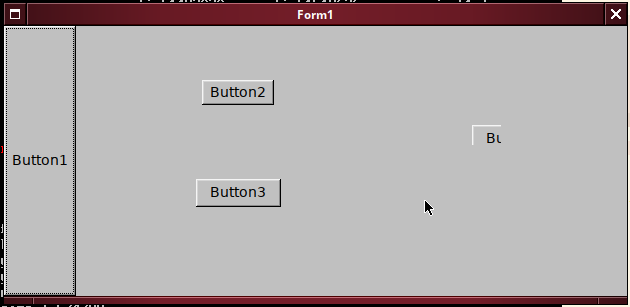
You can already mix Free Pascal with C/C++ code if you use the same linker and libraries - i did manage to get FLTK statically linked with an initial backend for Lazarus in fact - this shot[0] shows a form and a few buttons from a self-contained binary on Linux (it links against FLTK statically and X11/etc dynamically).
But it is a PITA to get working for C++ libraries specifically (and you need a C intermediate for FPC to use). Also i couldn't get it to work for Win32, only Linux.
[0] http://runtimeterror.com/pages/iv/images/8a6ff400ed9b0d424be...
Borland made the virtual tables used by C++ and ObjPascal compatible, that's why it was possible to mix the two languages. If the design is different than it becomes a much more difficult problem.
If I remember correctly, EDG was the only C++ implementation that actually attempted to implement the export keyword for templates in old C++. It was this implementation experience that informed the deprecation of export. EDG is a major influence in the development of C++.
Prof. John Potter told me they were the only frontend that correctly implement multiple inheritance for c++98. He thought very highly of EDG... For old time c++ folks, he was a mod on comp.lang.c++.moderated and a very cool teacher. So I hope I remember his lessons correctly...
Oh, you had him as a teacher? That's awesome.
I met him and his family 25+ years ago while they were vacationing in California... and they were all great! He was also at the Morristown WG21 meeting, where C++98 was voted out (in November 1997).
(I co-moderated comp.lang.c++.moderated with John. For several years he was the person that kept it alive.)
He was my advisor during undergrad; I had him for everything like C++, Assembly, data structures, operating systems, systems programming, an independent study, and he put me on the path to Unix guru.
His wife Anne was one of my professors as well (Cobol). I promised her I would never get a job writing Cobol. Unbroken.
Incredibly smart people...
Pretty easy promise to keep :)
Just curious, was she happy or unhappy about that promise?
It warms my heart to hear it!
He was my advisor in college
Slight correction, the other compiler/front end writers more or less read the white paper and said "that is what we thought it would be like and thus why we didn't implement it".
Imagine telling your competitors not to copy some feature you have and them listening!
Yes, it was also where C++26 static reflection was prototyped, as another example of its influence.
One of EDG developers prototyped his idea, and brought it to WG21 when it seemed reflection as originally thought for C++17 was never happening.
One interesting thing about the EDG front end is that it can emulate all the others (and in various versions of the others) and what they support, and the errors they might detect.
It isn't perfect, but it is awfully good.
Another interesting thing is that in 1999ish, when SGI open-sourced the Irix compiler (known as sgicc) into open-64, the it used a terribly hacked version of gcc as a front end to generate its internal intermediate representation.
This was because sgicc, even back then, used EDG as a front end, and EDG wasn't open and couldn't be opened up at the time.
The combination worked OK, but was pretty hacky, and I wonder if open64 would have gotten more traction than it did if it had been able to use EDG, or perhaps some other front end actually designed as a front end instead of the hacky thing.
what do you mean under "emulation"?
and why EDG is frontend? It's not a full compiler with optimizations and code generation?
No, we only parse the language, do full semantic analysis, and optionally lower the representation to something that roughly matches C-language semantics. (That lowering can do some minimal inlining if needed, but that's a historical thing.)
We have two "back ends": c_gen_be.c generates C code from the lower IL ("intermediate language"; EDG's term for the AST) and cp_gen_be.c generates C++ code from the unlowered IL.
"Three tracks, one codebase" this is such an LLM written sentence.
EDIT: But in this case it seems something significant is being released, it would be better with less writing and more human if possible.
I hate that now every catchy phrase are considered llm written.
llm overused them, but llm got its training data from catchy marketing materials and youtubers
I like this emulation feature. A frontend capable of mimicking MSVC or GCC behavior seems very useful for porting code or developing tools that need to exactly replicate the operation of another compiler.
I remember this was also used by SN Systems (Sony at the time) as the frontend in their C++ compiler for systems like the PS Vita and PS3.
I think it's probably irrelevant in this age of Clang a) existing and b) being everywhere but it still feels like the end of an era.
Ah, I used EDG for static analysis, but joined when we were switching over to using Clang for the frontend. I can't say for sure, but part of it was definitely just to save money using open source. The code that was hacked on top of EDG was also ridiculous, so there was a lot of accumulated tech debt there.
Looking back at that code definitely brings back memories. As a consumer of both frontends, I will say I much preferred working with Clang's. Both needed extra work on top to support everything we needed. Maybe I'm just not as acquainted with C as I would like to be. It's cool to look at this again, though.
For the uninitiated, what are/were the strong points of this frontend wrt the others? Why would anyone use it?
I'm one of the former EDG engineers...
I'd say:
- A single executable can emulate pretty much all versions of MSVC, GCC, and Clang. (E.g., pass the option --gnu_version=80300 and it emulates GCC 8.3.0, including a large number of bugs/idiosynchrasies.)
- An optimized binary is pretty small.
- It builds quite quickly. (A complete "from scratch" build on a modern solid workstation will take just a few seconds.)
- It has some interesting source-to-source transformation capabilities (via cp_gen_be.c).
...
Ooh, fond (and some not so fond) memories of when Silicon Graphics' (MIPS) C and C++ compilers were based on EDG's frontend, with a custom ucode-generating backend, and integrated into CASEVision. Early 1990s.
EDG was just 3 guys back then.
Wikipedia claims they have 6 employees, so they didn't exactly enjoy exponential growth over the years ;)
EDG started with two people. When John Spicer joined in 1992, they grew to three. I joined when Mike Anderson retired from software development in 1999, so we were still just three. Mike Miller joined in 2004 to make it four. Mike Herrick in 2007 to make it five. We were briefly seven in the early 2020s, and then fell back to six when Ellen Herrick stepped down. The three youngest of us moved to NVIDIA about a year ago.
Steve Adamczyk, the founder, told me that he created the company to be able to enjoy his work rather than to grow it into something that would rob him of that joy (I hope I paraphrase it right): He is an awesome human!
Despite using C++ for a few years now, the EDG source code is still mostly C code (and in fact, the C++ code is still using the old .c file names). In particular, there's no usage of the C++ standard library.
Where other languages might use inheritance, EDG still uses the C-style `union { ... } variant;`.
On a related note, compiling EDG is extremely fast: on my machine, the EDG frontend compiles in <10s; whereas clang takes >10min (caution unfair comparison: clang includes much more than just a frontend).
I think this is fairly common practice when writing compilers. You ideally want to be able to bootstrap from other languages, and C is a much simpler starting point.
Yes, of course. It makes complete sense to have the implementation of a C++ compiler to be written in a highly portable and much simpler language like C.
They also have a distinct style/naming convention, see for example `a_list_entry` as type name.
I have fond memories of working on an embedded systems compiler that used the EDG front-end — that would be almost 20 years ago now.
We certainly held it in high regard. It was rare that a compiler bug was in their code rather than ours :).
No comment about the substance of the article but I just have to give props: this site loaded incredibly quickly for me. Like it felt like a handful of milliseconds between tapping the link on my phone and it showing up, already scrolled to the right anchor within the article. Bravo on making it snappy.
I wonder what advanced technology they used to make it so fast?
Something like, oh, I don't know - HTML?
The only implementation to ever support the C++98 “export template” feature, as far as I know. I wonder if that’s still in the open-sourced version.
I'll never forget working on a personal C++ project in the very early 2000s. In parallel, I was reading Bjarne Stroustrup's famous C++ bible. He diligently explained how the “export template” feature worked. I tried to use it. I was compiling with GCC on Linux. I spent days trying to understand why it didn't work. Finally, I found a blog post explaining why it was so hard to implement, and no open source C++ compilers supported it. What a disappointment!
what this keyword did?
I never heard of it
It allowed you to put the _definitions_ of your function templates in your ".cpp" files instead of your header files.
Shit AI slop site, for one thing.
"Continuity is the point. This is a change of steward, not a change of course."
JFC it's like reading the haphazard ramblings of a lunatic. It's incredibly sad that a project of this importance felt that their site was safe in the hands of the AI slop machine. The site barely makes any sense.
It has an interesting code style, the comments go _after_ the function definition but before the opening bracket.
It looks weird, but it actually makes sense! The flow is more natural - first the function definition, and then the explanation of what it does. It also avoids repeating the function name.
One of the more unusual aspects is the naming convention for types. Most type names use the a_ prefix (e.g. a_statement_ptr), but names beginning with a vowel start with an_ instead (e.g. an_object_lifetime_ptr).
Code from that era predates the web, and a lot of open source style guides, and even most open source code itself.
So it came up in an era where folks were inventing their own style and the huge homogenizing influence of the gnu standards (and other open source projects) hadn't taken hold.
I like it. It feels like another language, and has its advantages. I really like to know of alternate ways of doing things, even if I don't adopt them myself.
I write comments about what a function does and it's interface before, but comments about the implementation after. Also my pre- and post-conditions go there of course. (I'm mostly writing in C.)
This is also where conditions go in languages with contracts, I like it
I've seen that in other code bases. Can't think of them offhand right now.
never occurred to me to write a comment there, but it actually looks kind of clean imho. Really old C code looked like
void func(var1, var2)
int var1,
char* var2.
{ ... }
perhaps some legacy from that? Probably not, but just first thing that popped into my head since it feels similar :shrug:
Oh wow, it even looks like they support far/near pointers from the old DOS days!