jacquesm
4 days ago
I've seen quite a few SMR proposals over the last couple of years and not a single one that dared to address the whole cycle from deployment to eventual decommission as a function of the total revenues - costs to operate. Most of these projects seem to be made to bilk investors or governments rather than to actually produce power. The day Italy produces the first KWh that is net profitable to the operators without counting subsidies I will be highly amazed, and that's assuming they get to operational in the first place.
asmodeuslucifer
4 days ago
I agree, I tell everyone who will listen that no country, not Russia, China, Japan, France, USA etc has ever made nuclear power profitable. And you can't blame it on the environmentalists in China and Russia.
That being said, many countries consider it a national security issue not to be held hostage to foreign oil.
stymaar
4 days ago
> country, not Russia, China, Japan, France, USA
Are you serious when putting France in this list? Nuclear is such a cash cow here that EDF manage to make profits even while being forced by the regulator to sell a big fraction of its nuclear capacity below the operating cost and buying it back to them at market price! (We're talking about a multi-billon subsidies scheme, look for ARENH).
And that is despite (rather legitimate IMHO) regulatory constraints that have no equivalent in any other industry.
selfhoster1312
4 days ago
France is in that list (hello i'm from france too) because construction is heavily subsidized and decommission is overall not happening, not planned, and more or less not even approaching the planning stage. The few decommissions that are taking place are decades late and billions over budget.
It's not industry secret that if you count the entire life cycle, nuclear is the most expensive (in terms of euros) energy we have. Does that mean it's a bad investment? Not necessarily. If you're an ecologist, it's a bad investment because it takes us in the wrong direction (more energy consumption) instead of going the way of degrowth. Also, the nuclear industry is very much in bed with the military industrial complex, which is something you may be concerned about.
And that economic analysis does not even account for how "stolen" the uranium we use is. If France paid an actual fair price to the Françafrique countries pillaged for their uranium, it would probably be more expensive. TBH, i haven't followed developments in the last years in regards to french neocolonialism collapsing in sub-saharan africa, but here's a small article from 6 years ago: https://infokiosques.net/IMG/pdf/uranium_de_la_francafrique-...
ponyfleisch
4 days ago
> If you're an ecologist, it's a bad investment because it takes us in the wrong direction (more energy consumption) instead of going the way of degrowth.
Why would an ecologist have to be against more energy consumption? For climate change, what matters is energy from the sun hitting the earth vs. energy being radiated back into space. More energy consumption also doesn't necessarily cause more pollution of any kind.
selfhoster1312
4 days ago
You're redefining environmentalism with a very narrow and technical view. Goodhart's law does not only apply to computer science, but to ecology as well, and says that CO2 emission alone is not a good metrics.
I'm not saying energy consumption overall is a perfect metrics, but the degrowth movement is a philosophy / science that's not aligned on a specific metrics: https://en.wikipedia.org/wiki/Degrowth
ponyfleisch
3 days ago
I think to most people, environmentalism is mostly about climate change and pollution. You're free to widen the definition of course, but note that even that Wikipedia article basically calls it a fringe ideology (in different words).
Can you name specific issues caused directly by energy consumption as opposed to specific energy sources or downstream effects like pollution, which is avoidable?
selfhoster1312
3 days ago
The degrowth movement is very fringe indeed. But its ideas are not, some have even been assimilated by the green-washing apparatus such as "reduce, reuse, recycle". I agree with your definition because it includes pollution, which is deciding factor for reducing production overall.
> Can you name specific issues caused directly by energy consumption
The question is good but not the framing. How is pollution avoidable? Energy consumption is not the problem but it's the means by which the auxiliary problems arise, and therefore a correct proxy to measure them. One of the problems is production of throwaway goods of dubious quality (leading to enormous pollution), a problem which technically could not exist before we had an abundance of quasi-free energy.
It's like in software development when people consider CPU/RAM is unlimited and don't provide any optimization. That may be fine in hypothetical settings, but in the real world resources are finite. (the analogy stops because using too much CPU/RAM does not "pollute" the rest of the machine and create memory corruption or whatever)
ponyfleisch
3 days ago
> One of the problems is production of throwaway goods of dubious quality (leading to enormous pollution), a problem which technically could not exist before we had an abundance of quasi-free energy.
Yes, but my entire point is not only is this solvable without throwing the energy baby out with the dubious quality goods bathwater, it's easier to solve with more and cheaper energy.
If the consumption of abundant energy has negative externalities, then those need to be appropriately priced. At that point, buying pollution causing junk will become more expensive than buying clean junk, but we'll still be able to afford the clean junk we want.
Voultapher
3 days ago
We are using that energy no matter how produced to terraform the planet into a less hospitable one for nearly everyone. Some get hung up on the resource extraction and associated pollution for renewable energy. But ultimately you can't fix "wanting the wrong thing" with technology. Our way of life and expected conveniences are not sustainable, they can't last 100k years, probably not even 100.
wolvoleo
4 days ago
The issue is not only climate change. More consumption means more consumer goods, more resource extraction, more transport, more waste
We have huge environmental problems ranging from ecosystem simplification, microplastics, etc. The answer is not to keep consuming as we are. We really have to stop the neoliberal system that's based on ever increasing growth and externalisation of environmental impact.
ponyfleisch
3 days ago
There is a possible future where none of these things are a problem and yet energy consumption is greater than it is currently. I think it's actually the most likely future. The ship may have sailed on climate change, but plastic pollution is not solved by consuming less, it's solved by consuming differently.
I get being critical of mindless consumerism, but degrowth doesn't seem to be about "order less junk on amazon/temu", but fundamentally reducing economic activity and energy consumption, which is civilisational suicide.
selfhoster1312
3 days ago
> I think it's actually the most likely future.
Well that deserves some actual argument. This abundant future has been promised to us for generations and has served as a justification for precisely fucking everything up in the name of the brighter future. Yet now we have, to my knowledge, no indicator of things getting better, but all indicators going way worse than we thought.
> I get being critical of mindless consumerism, but degrowth doesn't seem to be about "order less junk on amazon/temu"
Yes it is. It's about mindful production of useful products and services. Which is very much the same as reducing economic activity and energy consumption.
ponyfleisch
3 days ago
> Yet now we have, to my knowledge, no indicator of things getting better, but all indicators going way worse than we thought.
Several forms of pollution are now much better than they were decades ago. Chlorofluorocarbons, lead in gasoline, rivers and lakes around the world, catalytic converters, slash-and-burn agriculture etc. etc.
Electricity generation is also headed the right way.
The solution is usually better technology and political action, not abstinence. We still have fridges, just not with CFCs.
I'm not saying we'll fix climate change in time, by the way. That is uncertain. But if we do fix it, it won't be with degrowth.
> Yes it is. It's about mindful production of useful products and services. Which is very much the same as reducing economic activity and energy consumption.
Why do you think that wanting less cheap temu junk means overall economic activity will decrease? Why can't that economic activity be redirected to a sustainable future with abundance instead? I still want to eat food grown elsewhere in the world, just not sold in plastic packaging and transported with fossil fuels.
disgruntledphd2
4 days ago
> We really have to stop the neoliberal system that's based on ever increasing growth and externalisation of environmental impact.
Like, I too would like a pony, but we gotta live in the real world. Ultimately we need more energy of basically every carbon neutral form.
I agree that the ideology of growth at all costs is problematic, but it's how our society is structured right now, so we need to fix our current energy problems rather than bet on transforming society.
To be fair, the declining fertility rate will probably solve a bunch of environmental issues over the next few generations.
selfhoster1312
3 days ago
> I agree that the ideology of growth at all costs is problematic, but it's how our society is structured right now
With this mindset, nothing ever changes. No social problem was ever solved without looking at it from a social/political perspective. If you agree that growth ideology is problematic, then that's what you need to dismantle.
> To be fair, the declining fertility rate will probably solve a bunch of environmental issues
I think this is just wrong. The problem is the lifestyle: the throwaway culture and abundant consumption of throwaway goods. We could be just as many billions living OK in our environment, but you could have just 100 million average middle-class westerners continuing to fuck up nature (just slightly slower).
disgruntledphd2
3 days ago
> With this mindset, nothing ever changes. No social problem was ever solved without looking at it from a social/political perspective. If you agree that growth ideology is problematic, then that's what you need to dismantle.
OK great, what's the plan then?
Where do we start?
What small problem can we fix to make this better?
If you don't know the answers to the above, then this discussion is entirely pointless, and I would remind you that although I would love a pony, that doesn't mean that I'll get one.
Any "solution" that relies on changing the entirety of how society is structured isn't going to work, absent an incredibly good plan (against which one can make incremental progress).
To ask probably the most important question, in a world of zero growth, how do we pay back all the consumer debt we owe? Thinking specifically of mortgages here, as they're the largest amount of debt held by the populace.
wolvoleo
4 days ago
Well it's just American society that really has this so deeply ingrained that it's deemed irreversible.
Europe only turned neoliberal a few decades ago and only some countries are deeply into it like the Netherlands. Before the 90s we were much more socialist and can go back that way.
China also isn't neoliberal. They're good at playing the capitalist game but they're not afraid to pull the handbrake where needed and they are going good things for green energy.
disgruntledphd2
4 days ago
> Europe only turned neoliberal a few decades ago and only some countries are deeply into it like the Netherlands. Before the 90s we were much more socialist and can go back that way.
We all have the same financial system. Like, if you have interest bearing loans, then some amount of growth is required to pay back the principal + interest.
I think calling it neo-liberal isn't really correct, it's fundamental to the economic system we call capitalism.
wolvoleo
3 days ago
Neoliberalism is strongly tied to capitalism, but it is more than that, it's a strong belief that capitalism is the only possible way and that it works best with no restrictions on it.
What we need to do is restrict capitalism. Some capitalism is ok, I'm not advocating for a pure communist system, but there needs to be a balance between both. Since the fall of the soviet union, the balance has swayed wayy too much in favour of the unlimited capitalism option, whatever you call it.
And no the system isn't really the same, or at least it wasn't. Interest-free loans were pretty common and when I studied the government even provided them as student loans. Unfortunately they don't anymore.
disgruntledphd2
3 days ago
> What we need to do is restrict capitalism. Some capitalism is ok, I'm not advocating for a pure communist system, but there needs to be a balance between both. Since the fall of the soviet union, the balance has swayed wayy too much in favour of the unlimited capitalism option, whatever you call it.
I don't disagree with this at all, I'm all for red in tooth and claw capitalism, once every person has food, clothing, shelter, healthcare and education.
> And no the system isn't really the same, or at least it wasn't. Interest-free loans were pretty common and when I studied the government even provided them as student loans. Unfortunately they don't anymore.
I think that many people are missing my point here. Fundamentally, "capitalism" is structured (today, at least) around people with money giving it to others and getting the interest payments as the reward.
In a world with zero growth, where does the money for interest come from? (hopefully this is also a world with zero inflation, or we're all in trouble).
Again, philosophically I agree with a lot of this (our society is very rich, and yet millions of people starve and die from avoidable illness), but my core question is how we get there.
Preferably in small, incremental steps as that's the safest way for us in general.
hgomersall
4 days ago
The energy received is always the same as the energy radiated, its just the temperature increases to maintain that balance.
sfn42
4 days ago
No. Temperature increases until balance is restored. Temperature is currently increasing, which means the planet is not radiating away as much energy as it is receiving.
hgomersall
3 days ago
I think we're talking at cross purposes. There's a clear equilibrium state which is both higher temperature and notably bad whilst completely balanced from an energy perspective. Climate change is not bad because the temperature is increasing, its bad because it has increased and is going to increase more. The fact we still have baked in warming is additional bad.
sfn42
3 days ago
Yes, at equilibrium the temperature stays constant. I'm talking about the average temperature of the entire Earth over time. We are currently not at equilibrium because we're pumping unfathomable amounts of CO2 into the atmosphere, so the average temperature is skyrocketing. If we were to stop emitting CO2 today then in a few decades or so the planet would reach equilibrium and the temperature would stay constant at that new normal.
This is of course simplified, but roughly correct as I understand it.
user
3 days ago
dijit
4 days ago
Energy cannot be created nor destroyed, it can only be transformed. This is the first law of thermodynamics and as far as I'm aware nobody has managed to refute it.
Finding better ways of controlling where energy comes from and where it goes, and doing it in a controlled way that has minimal impact on the surroundings is good (from an ecological perspective)- it is the most pure good an ecologist can hope for.
"Reduce, Reuse" has its place, but that place has to be in-line with also finding a way to balance our human needs with the environment.
I don't think reducing our energy consumption is realistic, many things that have a long-tail reduction in energy consumption have a huge up front cost.
For example, electric vehicles are a bitch to manufacture but are less impactful for the environment over a long term; and this is amplified if the energy that is produced to be used in the electric car has a minimal impact on the environment (Solar, Wind, Nuclear) - but nuclear plants have a huge up-front energy cost too.
I'll be forthcoming and say that I have a concern that over-reliance on solar and wind may have negative consequences on the environment too- harvesting wind energy from the atmosphere that animals may rely on, will likely impact the environment in ways we haven't thought about. However it's significantly better than coal and gas, and that's the marker we're going for: not perfect.. better.
Everything is bad at a certain scale after all, we just haven't hit that scale with our renewables- and because of this, on a baseline, I agree with you.
leonidasrup
4 days ago
For France investment in nuclear is a big benefit, as you can see in the amounts of coal and gas burned to generate electricity in neighboring Germany in the last two decades, and still burning today.
Try to present the idea of "degrowth", to China, India, Indonesia, Brazil. They all on path of growth.
I agree that France, should be paying more to Françafrique countries, but raw uranium cost is only 50% of the finished nuclear reactor fuel. And nuclear reactor fuel is 5% to 10% of the operating costs of a nuclear power plant.
https://world-nuclear.org/information-library/economic-aspec...
Heinrich Böll Foundation and Rosa Luxemburg Foundation, both funded from Germany, published many documents criticizing uranium mining in Africa:
" Addressing uranium-producing countries in particular, whom it seems to want to stop or at least reduce their activities, the report also focuses on the health hazards associated with extraction and the neo-colonial aspect of exploiting the resource. Particularly virulent regarding France, which is the subject of three articles and cited in several others, the Atlas targets head-on Paris's relationship with one of its main suppliers: Niger.
The Atlas likens the uranium mining model to a vestige of Françafrique and accuses the French government of enriching itself on Niger's behalf while orchestrating an ecological, human and social catastrophe in the country. The French company Orano - formerly Areva - which mines and produces uranium in Niger for French power plants, is a particular target."
https://www.docdroid.net/y7NENZB/comment-lallemagne-finance-...
https://www.ege.fr/sites/ege.fr/files/media_files/German_Int...
throwaway2037
4 days ago
Thank you for this post. It is informative and nuanced about a complex topic.
> Also, the nuclear industry is very much in bed with the military industrial complex, which is something you may be concerned about.
> If France paid an actual fair price to the Françafrique countries pillaged for their uranium, it would probably be more expensive.
leonidasrup
4 days ago
History behind the French decision to build it's own independent nuclear deterrence was interesting:
" De Gaulle asked asked Kennedy: “Would you trade New York for Paris?” His point was that if he wasn't convinced, would the Russians be? So it's not just about numbers of warheads. It's about the defensive posture overall. "
https://www.rand.org/pubs/commentary/2025/03/nuclear-deterre...
https://www.theatlantic.com/magazine/archive/1962/08/de-gaul...
stymaar
3 days ago
De Gaulle, like most of the French political elite at that time, also got a wake up call during the Suez Crisis: if you don't have the bomb you can't intervene to protect your own interests anywhere in the world, because one of the great power could block you without shooting a single bullet and the other won't come to your rescue.
stymaar
4 days ago
> construction is heavily subsidized
It's not subsidized, quite the opposite EDF is subsidizing its competitors through ARENH.
> It's not industry secret that if you count the entire life cycle, nuclear is the most expensive (in terms of euros) energy we have.
It's not. It only appears expensive compared to other decarbonized means because the calculations never take the opportunity cost of intermittency. Wind and solar are only cheap because you never count the price of the back-up plan in the cost (and also because magnets and solar panels are bought for cheap from China). If you count the price of running an actual grid all year long then it suddenly becomes the most efficient option after hydro and that's why France has among the cheapest electricity in Europe. The German Energiewende is the canonical example of what the theoretical calculations leave out. It should have been cheaper and less carbon-heavy in the end, but instead hundreds of billions have been spent to get only expensive and high-emission electricity in the end.
>And that economic analysis does not even account for how "stolen" the uranium we use is. If France paid an actual fair price to the Françafrique countries pillaged for their uranium, it would probably be more expensive.
Come on, the Uranium coming from Niger is a just a fraction of the consumption: https://www.connaissancedesenergies.org/questions-et-reponse...
philwelch
4 days ago
> If you're an ecologist, it's a bad investment because it takes us in the wrong direction (more energy consumption) instead of going the way of degrowth.
What a horrible, nihilistic philosophy. Disgusting that anybody takes it seriously.
kriops
4 days ago
Taken to it's logical end it's quite literally just anti-human. Their ideal outcome is a suicide pact.
philwelch
4 days ago
No, it's not a suicide pact. If it was just a suicide pact, they'd get it over with and leave the rest of us alone. It's a homicide pact, a genocide pact for the entire human race.
testdelacc1
4 days ago
And we have tried it too! There have been energy shocks before, where the price of energy spikes and causes corresponding drop in energy consumption, leading to degrowth.
They only talk about the benefits in the abstract, but not what an energy shock actually means. It means people can’t afford to pay for heating and freeze to death. It means factories close down because the inputs are too expensive. Construction stops because the raw materials (steel, concrete) are too expensive to manufacture, and people don’t have money to pay for new homes.
We have done all these things just in the last 4 years! So why should we do more of it instead of just building more renewable energy?
_bent
4 days ago
degrowth is compatible with increasing standards of living for 99.5% of people all the while being able to then actually preserve these standards up in the future.
our current model produces growth without proportionally increasing standards of living, and accepts that livelihoods will collapse all over Europe and Africa as it becomes increasingly hostile to agriculture due to climate change.
think of the viability of degrowth as a policy within the prisoners dilemma of global capitalism as you want, but please come up with a more serious critique that doesn't equally indigte the staus quo
philwelch
4 days ago
None of that is true.
account42
4 days ago
> degrowth
Thanks for showing your true face. But no thanks for your anti-humanism.
mrngld
4 days ago
It's interesting that they're feeling emboldened enough these days to not hide who they are and what their agenda is. That general movement had a slow motion replay of the Bolshevik vs. Menshevik action, where the moderates (like Patrick Moore, Michael Shellenberger) got purged, and after quite a long time of having an established, comfortable monoculture now they're starting to no longer feel the need to create fake narratives around why nuclear or mines are bad, now they're just straight up saying they want civilization to collapse. (Which is what would happen, there's never going to be any such thing as an orderly impoverishment)
Maybe it's for the best. If they're being honest maybe it'll clarify debates and positions.
bopou
4 days ago
Finally, someone with common sense. Nuclear is bad BECAUSE it produces lots of cheap energy. We DON'T WANT this. More energy = more capitalism = evil.
DEGROWTH NOW!
capr
3 days ago
"degrowth" ... aand this is how you spot the real agenda of most environmentalists. ofc they'll call that a "philosophy".
dzonga
4 days ago
glad you pointed out something very few people point out in these conversations - the cheap uranium fuel France gets has a very large hidden cost.
the coups that happened recently in west africa are largely due to that largely hidden cost.
zxexz
4 days ago
Yeah I’m really confused why France is in that list (also, less so, but China - they have come a great way, further than almost any western country save France, I’m just unsure I’d the metric here applies evenly).
I’ll stand by the only reason nuclear power is unprofitable (in most cases) is because we decide it is unprofitable.
asmodeuslucifer
4 days ago
close04
4 days ago
I'd consider power generation (solar, wind, nuclear) as strategically important and accept that it may need subsidies long term. If this allows the country a degree of independence from external shocks, it would be worth it.
qlte
3 days ago
Agreed, I've always been pro-nuclear (although the arguments have been getting weaker as solar+batteries keeps getting cheaper). I just want the vocal advocates to be honest about the cost and timelines instead of blaming everything on environmentalists as a way to side step the argument.
asmodeuslucifer
4 days ago
Anything is cheaper when you don't count all the costs.
In January 2017 a parliamentary committee reported: "The cost of decommissioning is likely to be greater than the provisions," the technical feasibility is "not fully assured" and the dismantling work will take "presumably more time than expected."
https://world-nuclear.org/information-library/country-profil...
stymaar
4 days ago
Decomissionning is a made-up issue: no other industrial activity is expected to return clean nature after they stopped operating, even mundane things like business offices real estate or highways wouldn't be economically viable if they had to provision for decommissioning.
You could clean up the high activity thing and let the buildings and their asbestos in place and nuclear decommissioning would still be more environmentally friendly than every other heavy industry.
throwaway7356
4 days ago
> Decomissionning is a made-up issue: no other industrial activity is expected to return clean nature after they stopped operating,
That is factually wrong. Coal mining has to re-naturalize the areas used for mining after the coal was removed.
And most industries are supposed to not just leave toxic waste and instead have a plan what to do with toxic waste products these days. And no, an empty building cannot be compared to radioactive waste.
padjo
4 days ago
Wind farms are expected to a account for it and it is routinely included in cost calculations.
gspr
4 days ago
> no other industrial activity is expected to return clean nature after they stopped operating,
Oil and gas extraction platforms here in Norway, I believe.
abdullahkhalids
4 days ago
I have a family member working for a Canadian company that steps in after a mine has stopped operating. It cleans up and remediates the surrounding land and water to minimize environmental impact. This is usually a thorough process that takes a long time. Many months or years.
selfhoster1312
4 days ago
> no other industrial activity is expected to return clean
Does not mean it's a made up issue. That's classic whataboutism. Ecologists are not concerned just about nuclear activity, but precisely about the overall industry destroying our entire environment, and for whose profit?!
themaninthedark
4 days ago
Funny how all that concern they have never manifests for wind and solar power.
Nor do I see a great deal of concern for manufacturing, as long as it is done somewhere else. If it done here: it is super dirty and dangerous, jobs no one wants. Elsewhere: what great opportunity for them to rise out from poverty. The fact that the environmental regulations are nonexistent, either never brought up or dismissed because we can't regulate another government.
selfhoster1312
3 days ago
You seem out of touch with actual ecologists. Just because some ecologist discourse you don't hear on CNN doesn't mean it doesn't exist. Of course ecologists are very concerned for solar and wind power, or rather for their industrial counterparts! I know quite a few activists who are very concerned with non-recyclable solar panels and wind plants, but build solar "boilers" and tiny wind generators from spare parts and renewable materials (such as wood).
Ecologists are also concerned with outsourced manufacturing. Not every ecologist is a caricature of a Silicon Valley engineer who says we'll save the planet by buying Tesla cars and building solar plants. In fact, 100% of the ecologists i know (who are actually involved in activism) will say that those people are not ecologists but merely green-washing.
victorbjorklund
4 days ago
Do you think it is cheap to decommission a large water power dam?
Moldoteck
4 days ago
That's just a bullshit Statement considering all german plants except experimental or soviet units are decommissioned on operator money.
Costs are accounted and in some cases you have even price breakdown https://www.kkg.ch/de/uns/geschaefts-nachhaltigkeitsberichte...
philwelch
4 days ago
The only reason nuclear power facilities get decommissioned is because anti-nuclear politicians panic and force them to shut down. Sure, there's an ongoing cost of maintenance and replacement, but once you have a nuclear power facility, there's no reason for it not to continue generating power indefinitely. We're not going to stop needing or wanting more energy.
joinHNtheysaid
4 days ago
[dead]
tcfhgj
4 days ago
If nuclear is such a big cash cow, why is edf in huge debts, state owned and suffering from aged power plants having issues?
stymaar
4 days ago
Re debt: check how much debt the SV giants have. Debt isn't a bad thing per se, it's just how you finance investments.
Its has always been state owned, and it's much better for critical infrastructures to be so anyway.
> suffering from aged power plants having issues?
There was one (1) instance if of a serious common issue between multiple plants found in 2022, unrelated to the age of the NPPs (the most recent were affected as well) which affected the exploitation for about a year. It was bad for a moment, but not that bad, it's like saying the automobile industry can't be profitable because the Tataka airbag problem happened. (And the corrosion issue was much less severe than the Tataka one!).
Moldoteck
4 days ago
Because it isn't. EDF devt to EBITDA ratio is as healthy or healthier vs german eon/rwe. Debt is ok to have for big corpos, unless you think Apple is a failed company.
Over half of french fleet was already upgraded to have safety similar to gen3 reactors through great carenage.
France also set record production this summer vs prev ones
victorbjorklund
4 days ago
Because being a cash cow does not mean the cash will be reinvested by the owner. The owner might just milk the cow and use the money for other things.
rightnutwingjob
4 days ago
Couldn’t be because nuclear-hating bureaucrats have over regulated the industry?
goodpoint
4 days ago
No. Either it's profitable or it is not. It is not.
rightnutwingjob
3 days ago
You don’t believe markets exist in a political environment?
ZeroGravitas
4 days ago
When EDF signed a fixed cost contract to deliver nuclear in England the CFO resigned.
It's currently double its original budget and likely to grow further.
The "profits" are from running decades old reactors that were never transparently costed.
stymaar
4 days ago
> When EDF signed a fixed cost contract to deliver nuclear in England the CFO resigned.
Yes, because they had to borrow at a 7 or 9% long term rate on the market (in the era of ZIRP!), which makes financing costs 70-80% of the overall final electricity price.
Of course that kind of deal was insane, but it says more about financing long term projects on the market than it says anything about nuclear as a technology.
> The "profits" are from running decades old reactors that were never transparently costed.
EDF gave more in subsidies to its competitors through ARENH over the past 15 years than what the entire fleet costed.
French nuclear has been an indisputable financial success over the past 40 years (while giving France one of the cheapest electricity in Europe). Saying otherwise is just ignoring reality entirely.
atwrk
4 days ago
> Of course that kind of deal was insane, but it says more about financing long term projects on the market than it says anything about nuclear as a technology.
Well sure, but the alternatives aren't really affected by this, because they don't have to be planned and financed these such long time frames. So this is a problem for nuclear. The core technology seldomly is the deciding factor for these things.
stymaar
4 days ago
Sure, but sometimes it's better to invest for the long term, and that's among the most fundamental purpose of the State.
vjvjvjvjghv
4 days ago
France doesn't have an answer for decommissioning costs.
oatmeal1
4 days ago
I saw a DW Planet A documentary about decommissioning a nuclear plant in Germany. They walked around the plant in some safety gear, but with their faces fully exposed and no breathing apparatus. They said the project was decades behind schedule and it was costing ten times as much as expected. The decommissioning process involved spraying water and gels on slightly radioactive materials from the factory to reduce their radioactivity to effectively zero. The process created much more radioactive material than there was in the first place, which then itself had to be dealt with. The cost of decommissioning is determined by the lobbyists for the companies that do the decommissioning. Voters have no idea what decommissioning should cost, and no one will ever question going over budget. It's a great business.
Moldoteck
4 days ago
Now check how decommissioning is going with Isar reactors instead of soviet ones
Black616Angel
4 days ago
Would you like to provide some context?
Moldoteck
4 days ago
The context is that all german reactors that aren't experimental or soviet are decommissioned on operators money without state financing.
The example of isar is particularly interesting - isar 2 is one of the latest that started decommissioning but is in much more advanced state vs others. Each operator does it as they wish. If you wait a bit more, rad levels drop so it's easier to decommission with less specialized equipment
leonidasrup
4 days ago
" EDF Group assumes sole financial responsibility for decommissioning power plants. The cost is factored into operation from the start and included in the price of the kilowatt-hour. It is re-assessed every three years to take account of changing technical and financial assumptions, as required by law. "
https://www.edf.fr/en/the-edf-group/producing-a-climate-frie...
ZeroGravitas
4 days ago
The 100% state owned EDF group take sole responsibility for the finances? What a relief for the taxpayers of France...
But at least the cost is factored in from the start. Those costs often double during construction but at least we know the decommissioning costs are factored into the fake numbers they use to get approval to start builds.
leonidasrup
4 days ago
Taxpayers of UK are supporting wind energy producers using CfDs (Contracts for Difference).
UK Eighth Allocation Round are from 20 July to 7 August 2026, Offshore wind £113 /MWh, Onshore wind (>5 MW) £92/MWh
UK Government also awarded a CfD to Hinkley Point C nuclear power station, set at £92.50/MWh for a 35 year period.
https://en.wikipedia.org/wiki/Contracts_for_Difference_(UK_e...
ZeroGravitas
4 days ago
You've quoted strike prices at the time, adjusted for inflation Hinckley is the most expensive of the three you quote. And it lasts nearly twice as long.
In fact this nuclear plant was the first use of CfD.
It's a great scheme because it (in theory) prevents cost blowouts being added to energy prices. Good incentives to get things built quickly and cheaply.
The actual price for Hinclkey is roughly a third higher than the CfD and that extra cost should be borne by the French taxpayers via EDF.
In reality they shifted some costs onto the next nuclear plant instead, working around the CfD and foisting the excess costs back onto the British tax/billpayer.
Obviously they refused to use CfD for the next UK nuclear plant because unlike wind power, they have no faith in it being completed anywhere near on budget. And if they bid the real cost it wouldn't get built in the first place.
So now UK taxpayers are paying in advance for a decade to get new nuclear built with no cap on cost.
tialaramex
3 days ago
> You've quoted strike prices at the time
Technically I think the Hinkley prices are what we'd call £2012 [if we could easily write a subscript here I would use that for 2012] that is, they are prices in the Pound Sterling as it was at some fixed point in the year 2012 and so when paid in the CfD contract they'd be adjusted for inflation.
All the early CfD prices were in £2012, whereas those newer CfDs have strike prices in £2024 which is about 40% more money in real terms. You can see this notation in the linked Wiki page.
So, if we adjust all the prices to £2024 that price for Hinkley is about £130 per MWh whereas Solar farms are £75, onshore Wind is £92, off-shore Wind is £113
Except, that's not really what's going on either because those AR8 prices are what's called "Administrative Strike Prices". AR8 like all the other allocation rounds is a reverse auction whose results we won't know for months, and those are the start prices in the auction, if you want to win and you're not the only bidder you will need to come lower. Maybe your competitor says they can do solar for £72, but you stared at your loan sheet and projected sunlight over the next decade and dared to say £71.50, you win that contract. But the strike price is now £71.50 not £75 per MWh. Your competitor might still build their solar farm, but at market prices not the guaranteed £71.50 per MWh you've contracted for. Maybe they get lucky - this summer the CfD "subsidy" for Solar farms paid us back many millions of pounds, because electricity prices were high and the subsidy is effectively a fixed price. Of course this doesn't cancel the hundreds of millions we spend subsidising Drax, but that's a completely different discussion.
Edited to add: Just like a conventional auction there may be no bidders at the start price. Unlike some low stakes auctions you might have seen in person or on TV they don't offer again with a better price, the auction just fails. This happened for offshore wind in AR5 a few years back, the government wanted to pay no more than £44 per MWh in £2012 for offshore wind energy -- cheaper than solar, so the firms who build wind farms looked at their costs and said "No thanks" and there were zero bids that round, and a subsequent government increased the ASP for AR6 wind and got bids at much more realistic prices.
himata4113
4 days ago
technically speaking they don't have to be decomissioned and when they absolutely have to be I believe at that point we will have fusion which is only 10 years away.
adrianN
4 days ago
There is no reason to assume that fusion will be a particularly cheap power source.
stingraycharles
4 days ago
Fusion has been 10 years away for the past 3 decades.
(I think fusion is great, by the way, but I just don’t believe any timelines at this point anymore)
himata4113
4 days ago
That was infact the joke, but surely by the time this would need to be decomissioned we would have fusion power right? Some reactors we operate today are older than the oldest people on the planet!
mikestew
4 days ago
Some reactors we operate today are older than the oldest people on the planet!
You might want to look that up, because I’m older than the oldest operating reactor.
sarchertech
4 days ago
>Some reactors we operate today are older than the oldest people on the planet!
That is not correct.
vjvjvjvjghv
4 days ago
My mom is older than any reactor that’s used for power generation.
fuzztester
4 days ago
fuzztester
3 days ago
some dumbkopf hners can't even handle historical stories and simple straightforward comments on them, so they downvote.
and yet they aspire to run or work in startups. ... hee hee.
Propelloni
4 days ago
I see what you did there :D Good one, thank you!
schainks
4 days ago
And the world leaders don't have an answer for the cost to keep our atmosphere habitable due to using fossil fuels as hard as possible?
MentalM
4 days ago
> using fossil fuels as hard as possible?
All the data showing that it is still free. There is no cost, generally anthropogenic climate change is increasing the habitability of our atmosphere.
rightnutwingjob
4 days ago
What are these decommissioning costs?
The reactor vessel and the primary coolant loop.
All that steel can be vitrified and stored in stainless casks somewhere fairly indefinitely.
Or just buried. It doesn’t stay reactive very long.
The rest of the site is no different to any other electricity generator, and no different really to the average industrial manufacturing plant.
Everyone likes to just say ”decommissioning costs”, without actually thinking about what any of that means.
It’s not like every nuclear power site is a Chernobyl.
rich_sasha
4 days ago
I remember reading about coal-fired power plants specifically in Poland, which exceed the radioactivity levels for nuclear plants. This because the burnt-off coal contains small amounts of radioactive elements, which form particles and drop off near the flue.
But of course there are no norms for max radioactivity levels at a coal power plant site.
teamonkey
4 days ago
Coal plants spread radioactivity because it concentrates all the radioactive elements naturally found in the coal into ash, much of which then gets released into the air, deposited on surfaces and breathed in, which is extremely harmful.
But if decommissioned properly, most of the ash inside the building can be collected and mixed into soil and bricks at a safe concentration not far above background radiation level.
In a nuclear power plant, there is no release of radioactive materials, but it’s possible for parts of the structure to absorb radiation and become radioactive itself, and that’s much harder to deal with.
leonidasrup
4 days ago
Steel is not vitrified, only high level nuclear waste - spend nuclear fuel with highly radioactive fission products.
Steel is taken apart and measured, non-activated steel can be melted down and recycled. Activated steel has to go into storage, either low level nuclear or medium level nuclear waste.
The biggest concern for steel is cobalt. During manufacturing steel with very low cobalt content is usually used for nuclear applications, but there is still small amount of cobalt.
In reactor, under neutron radiation, stable cobalt-59 changes to cobalt-60, strong gamma ray emitter with a half-life of 5 years. So neutron activated steel has to storage for at least few decades.
When done not properly, this is a health hazard.
" Circa 1983, construction was finished of 1700 apartments in Taiwan which were built with steel contaminated with cobalt-60. About 10,000 people occupied these buildings during a 9–20 year period. On average, these people unknowingly received a radiation dose of 0.4 Sv. Some studies have found that this large group did not suffer a higher incidence of cancer mortality, as the linear no-threshold model would predict, but suffered a lower cancer mortality than the general Taiwan public. These observations support the radiation hormesis model, however other studies have found health impacts that confound the results. "
account42
4 days ago
They have to be stored but storage isn't particularly difficult. Just don't built them into a structure where to close to people.
leonidasrup
4 days ago
They are similar to many other landfills.
" The four low-level waste facilities in the U.S. are Barnwell, South Carolina; Richland, Washington; Clive, Utah; and as of June 2013, Andrews County, Texas. "
atwrk
4 days ago
Have a look at this nuclear plant in Northern Germany that is in the process of being decomissioned since 1995. It's still not finished, suspected end date is now in the 2040s and is now projected to cost about 10B €. For a single plant.
https://de.wikipedia.org/wiki/Kernkraftwerk_Greifswald (you have to translate that page yourself, the English version doesn't contain the relevant information)
account42
4 days ago
Surely that's not because the people in power - the same people who have pushed trhough the decommissioning of these still functioning power plants - are want them to be expensive to decomission because it suits their agenda. Decomissioning costs can always be however high you want them to be but that doesn't mean that they have to be. Worst case you can just encase the whole thing in concrete until radiation levels naturally drop.
atwrk
4 days ago
Did you honestly just invent a conspiracy about some unnamed people with a hidden agenda of making nuclear look expensive by paying 10B euros for decommissioning a working plant?
Just a suggestion, but alternatively you could also accept that in reality, decomissioning actually is expensive.
rightnutwingjob
3 days ago
It’s not really that much of a stretch to think this is exactly what is going on.
One state in Australia, Victoria, recently disappeared $15 billion of public funds to criminal organisations under the guise of funding a big infrastructure project.
Okay, that’s not entirely accurate. No one knows how much money disappeared, it could be up to $30 billion.
Labor-Green governments do this everywhere.
It’s entirely reasonable to suspect something similar is going on in Germany around their nuclear decommissioning.
tialaramex
3 days ago
> Labor-Green governments do this everywhere
I suppose your name ("rightnutwingjob") gives it away but "Did you know crooks exist" isn't actually a proof that grand conspiracies are true.
wolvoleo
4 days ago
Yes, a lot of that is just waiting for the active parts to get less 'hot' though. But yes it's incredibly expensive and it's only going to get more so as we start caring more about pollution and proliferation.
Moldoteck
4 days ago
Why people spread such bullshit statements? Take Germany which enacted EARLY phaseout, yet all it's reactors are decommissioned on operator money except experimental and soviet units
tancop
4 days ago
Just declare that LNT is wrong and treat materials as non radioactive if they are less than half the radiation level associated with cancer. For the rest you can try and reuse them in new reactors if possible or store it in the same place as other nuclear waste.
mrngld
4 days ago
We've got the technology to drill deep bore holes, kilometers below where water will move on any time relevant to human existence, where we could stick what small amounts of dangerous material is left.
Encapsulating the waste and burying it somewhere on an abyssal plain in the deep ocean should also be a pretty low-risk approach, the IAEA has looked into variations of that.
Like someone else said, I think it's all expensive because some people want it to be.
KellyCriterion
3 days ago
Only true since 2023/2024, before EDF was nationalized by the Gov. because of the massiv debt and hefty losses, they kicked all shareholders and delisted the company then.
joe_the_user
4 days ago
Yes, France is pretty much alone in making nuclear work. It's impressive. That said, it is alone.
IE, I don't see other nations reproducing the French institutions and culture that allowed this. Will France itself even continue them?
sien
4 days ago
What about Sweden?
South Sweden, with most of Sweden's population is at 20 gC02eq/kWh and at 36% nuclear
https://app.electricitymaps.com/map/zone/SE-SE3/yearly
Also Ontario?
Finland?
thomashabets2
4 days ago
Sweden has been phasing out nuclear for 40 years, after a referendum where the people had the choice of "No nuclear!", "No nuclear", and "No nuclear". There was no "yes".
It's been phasing out nuclear since then.
Nowadays the Green party and the (formerly named) Communist party are the only ones against nuclear power, but thanks to the left block winning the recent election, they may push that one issue enough that they get to continue the destruction of our planet.
leonidasrup
4 days ago
Green party and the (formerly named) Communist party are against nuclear because: ‘Peaceful’ Sweden once sought nuclear weapons. They conflate civilian and military use of nuclear energy
https://theconversation.com/peaceful-sweden-once-sought-nucl...
Sweden is currently using almost none natural gas for electricity production. How could the replace the current 25% of nuclear electricity? wind+natural gas? New hydro dams?
thomashabets2
4 days ago
> [the two parties] conflate civilian and military use of nuclear energy
I would never associate these two parties with competence or intelligence, and there certainly are people who think that a power plant is basically a bomb.
But no, their rhetoric against nuclear power today is at least ostensibly environmental. Well, as it's becoming clearer and clearer to everyone that environmentally it's at the very least the least bad option, they are shifting into trying to make it about economics. Of course completely ignoring that they want to price in (like in this thread) insurance with nuclear, but don't want to price in environmental damage of the alternatives.
Between 1987 and 2006 "the thought crime law" made it illegal in Sweden to even think about constructing a nuclear power plant. https://sv.wikipedia.org/wiki/Tankef%C3%B6rbudet
How much does nuclear power cost? Well, it was literally illegal in Sweden to run those calculations until 2006. Could criminalizing thought for decades maybe drive up the costs, once the law is repealed?
> New hydro dams?
Unlikely. It's already built out where feasible and economical. And besides, the Greens would block new hydro at scale because of their environmental impact.
> How could the replace the current 25% of nuclear electricity?
Most common argument I see is "we'll just import it", which is just greenwashing since that comes from fossil fuels.
> ‘Peaceful’ Sweden once sought nuclear weapons.
I don't see the contradiction. USSR took 10% of Finland in living memory, hell that was just single digit years before Sweden started looking into becoming a nuclear state. The Baltics were under USSR control too, and during the cold war they (USSR) seized Swedish ships in international waters and killed and otherwise "disappeared" the crew.
I find the article you linked complete garbage. It's viewing 1940s defence choices through a 2020s post-nonproliferation treaties and post MAD game theory lens.
But even if we do that, would it be un-peaceful to have deterrence? Sweden preemptively surrendered to Germany in WW2 (a bit of hyperbole, and doesn't account for secret allies collaboration), rather than have the country destroyed. Having a nuclear deterrence would mean not having to surrender again, when the Russian comes.
Hopefully NATO membership has the deterrence without the drawback. But of course NATO wouldn't be NATO without its nuclear members. And with the US becoming unreliable, Sweden's defence is still backed by the nuclear agreement with France. So own nukes or not, at least by treaty Sweden still has nuclear weapons as deterrence. Is it really vital to discuss the operational control? If that's the sticking point, then fair enough. I'm not saying it's NOT a difference.
A better critique of Sweden is its relatively huge arms exports. But that too is not black and white. Si vis pacem, para bellum (if you want peace, prepare for war).
user
4 days ago
Y-bar
4 days ago
It's a strange affair when swedish leftists are the economically responsible parties and the right wing wants to use government subsidies to prop up an industry which is not economically viable compared to all the other electricity generating methods are cheaper and easier to implement.
thomashabets2
4 days ago
Every single word you said is wrong.
I know HN comments should be more constructive than that, but your comment is setting all these trumpesque fires in the form of lies, that no constructive debate or rebuttal would be useful. You would not be convinced, and anybody reading the back and forth would be under the misapprehension that "the truth is probably somewhere in between".
Y-bar
4 days ago
I know there was a bit of liberty with the phrasing that the leftish parties in Sweden aren’t always considered the strongest on the economic arena. But that was not my main point, and sorry if I stepped on your toes. My main point is that all science and facts point to the truth that NPP are not economically viable without significant government subsidies. No matter how much I (and perhaps you?) want NP to succeed, it should do it on a level playing field compared to the other energy industries it should never do that with unfair advantages not offered to others.
thomashabets2
4 days ago
While we may not disagree on the base facts, I don't think that's a fair characterization. First of all, you say that there have never been solar panel subsidies, which of course there have been. So the advantage has most certainly been offered to non-nuclear.
By law, opting in to "green energy" on your personal electricity means to have a definition that excludes nuclear, so that's government steering of the market towards non-nuclear green energy. Certainly qualifies as incentive, if not downright subsidy by manipulating market forces. (I even contacted my energy provider saying I would gladly check a box if it included nuclear. They said it was out of their control)
Of course on oil lots more has been spent fighting over the resources. For a given country the cost of acquiring the resources may be more political than directly monetary. But I don't think you're defending fossil fuels, so I probably don't need to argue that being controlled by Russia has a cost.
Now, if nuclear is not economical as base load, I'd like to see a comparison with solar & wind for base load compared to nuclear. And it should be a calculation for the (very nearly) 100% use case. So comparing like for like. The cost of wind&solar is extremely different if aiming for 90 or 99.999%.
Some Greens say "shrug, what's so bad about power outages?" (yeah, good luck with that). Some say "we'll just import in the greater European grid!" (greenwashing).
> not economically viable without significant government subsidies.
Nor is gasoline or road maintenance. I'd like to price in those externalities first.
Oh, and as for the left-ish opinion in this issue. IIRC only Greens and Communists were actually against nuclear. The big one (Social Democrats) manifesto could be summarized as "Well, we're pro-nuclear, but we know we have to give that up because we need Greens & Communists to be able to form a government". It was very transparent.
pfdietz
4 days ago
For some definition of "work". They don't seem to be able to build new nuclear plants now without massive cost overruns.
tcfhgj
4 days ago
I am pretty sure anyone could make nuclear work by throwing lots of money around
stymaar
4 days ago
The only money thrown around in French nuclear is handed out to EDF's competitors by EDF themselves as a compromise with the European Commission who didn't want EDF to reap to massive profits of the nuclear plants for itself (EDF has handed out around €100B over the past 15 years and still made a profit pretty much every year, despite massive forced investments in reaction to Fukushima).
Moldoteck
4 days ago
Considering how much money is extracted from edf through dividends and in the past through arenh, it's the opposite - edf is subsidizing french state.
I'm sure edf would be happy to get 18bn/y in govt handouts like ren get in Germany through EEG
molszanski
4 days ago
One can argue that Switzerland is doing a good job too. Also, it is profitable for existing plants for the next 60 years or so.
throw0101c
4 days ago
> Yes, France is pretty much alone in making nuclear work. It's impressive. That said, it is alone.
Ontario, Canada may have something to say about that:
usrnm
4 days ago
> I don't see other nations reproducing the French institutions
Gaullism and strong governments are not in fashion these days. The main thing that made Messmer plan work was Messmer himself, a strong leader with the power to tell everyone to stfu and do it.
planckscnst
4 days ago
Is that because every country fails to adequately charge oil/coal/etc for its externalities? Are we essentially subsidizing oil, bringing the costs artificially low such that nuclear can't compete?
Arnt
4 days ago
Nuclear has several major cost problems if it's own. Insuring against a major accident is prohibitively expensive, the kind of inspection+maintenance regime that's necessary for safety isn't amenable to cost reductions. The list goes on. Basically:
Nuclear isn't similar to the things that grow cheaper as the operators gain experience.
Llamamoe
4 days ago
Much if fhe inspections and standards aren't "necessary for safety" but the direct product of paranoia and lobbying. Nuclear is brutally overregulated, far, far beyond what's necessary to ensure safety, and that's where most costs come from.
pinkmuffinere
4 days ago
> Nuclear is brutally overregulated, far, far beyond what's necessary to ensure safety, and that's where most costs come from.
Is this really true? We seem to have a pretty large disaster perhaps every 15-20 years (3 mile island, Chernobyl, Fukushima), which makes me think that it is either correctly- or under- regulated. Of course coal and oil are worse, but that’s not exactly a high bar…
azan_
4 days ago
> Of course coal and oil are worse, but that’s not exactly a high bar…
It is what we want to replace with nuclear power, so that's exactly the bar we should jump over. So let's say it: all of these disasters did not cause even 1/1000 as many deaths as coal power plants.
pinkmuffinere
4 days ago
I agree coal power plants are much worse. As an aside, I’m not convinced that’s the bar we need to clear. I would think we need to be safer than solar power, since that’s the source that’s actually growing rapidly. If we’re going to add new power generation, I think it’s probably a trade off between nuclear and solar.
And anyways this isn’t the claim I was disagreeing with — the parent claim is that nuclear is regulated “beyond what's necessary to ensure safety”. I just don’t think that’s the case. As dramatic as it sounds, we regularly have nuclear disasters.
Moldoteck
4 days ago
Ironically, nuclear is similar to solar already with old gen2 plants https://ourworldindata.org/safest-sources-of-energy
pinkmuffinere
3 days ago
Wow, that's really fascinating to me! I am a bit cautious that the distribution of outcomes from nuclear may be skewed, so we've maybe avoided some of the "black swan" events so far simply because we don't have much nuclear deployed. I think the common example is "Picking up pennies in front of a steamroller"; you'll be totally fine until you totally aren't. However, I expect we'd also learn more and improve the safety as we deploy more, so I (somewhat naively) feel this is a good argument in favor of more nuclear.
Moldoteck
4 days ago
In Fukushima zero people died from radiation. If we regulated everything to a similar point (cars, planes, fossils), you'll start living like a monk. Fossils aren't just worse but orders of magnitude worse
pm3003
4 days ago
In France after Fukushima nuclear plants that are 500 km inland had to be safeguarded against the risk of a tsunami.
brohee
4 days ago
They are in valleys and I think the risk assessment was heavily influenced by https://en.wikipedia.org/wiki/Cumbre_Vieja_tsunami_hazard which has been toned down quite a bit since... But IRSN (now ASNR) studies all kind of risks seriously...
hdgvhicv
4 days ago
Fukushima killled a couple of people? More died that day from car crashes.
ppsreejith
4 days ago
You're right but this seems difficult to estimate. From the wikipedia* article:
> ... Despite this, there were no deaths caused by acute radiation syndrome. Given the uncertain health effects of low-dose radiation, cancer deaths cannot be ruled out. ...Predicted future cancer deaths due to accumulated radiation exposures in the population living near Fukushima have ranged in the academic literature from none to hundreds.
> ...For evacuation, the estimated number of deaths during and immediately after transit ranges from 34 to "greater than 50". The victims include hospital inpatients and elderly people at nursing facilities who died from causes such as hypothermia, deterioration of underlying medical problems, and dehydration. The old people and already sick, were more likely to be injured because of being relocated than damaged by radiation.
* https://en.wikipedia.org/wiki/Fukushima_nuclear_accident_cas...
leonidasrup
4 days ago
The 2011 Tōhoku earthquake and tsunami (which also caused meltdown in the Fukushima Daiichi nuclear accident) caused 19,759 deaths, 6,242 injured, 2,553 missing.
So nuclear radiation impact from Fukushima is minimal in the total loss of life.
https://en.wikipedia.org/wiki/2011_T%C5%8Dhoku_earthquake_an...
hdgvhicv
4 days ago
So a couple of orders of magnitude below the number of deaths caused by things like car crashes in Japan in a single year.
Moldoteck
4 days ago
Per UN no deaths are recorded nor will be recorded due to the low dose.
Evacuation wasn't necessary, govt enforced it deliberately. If ppl weren't evacuated in such a rush(or not at all), they would have been fine
The low dosage claim is shady considering we have parts of the world with higher natural background radiation and in some cases cancer rates are lower there
Still, even by wildest estimations nr is fairly low
myrmidon
4 days ago
This is incorrect and naive.
Fukushima prefecture itself counts a total of ~2100 disaster related deaths of which ~1350 are "nuclear plant related". This is somewhat of an upper bound with lots of indirect deaths mainly as a result of having to evacuate an entire city, but the nuclear meltdown was a major component of making the tsunami disaster significantly worse (locally).
See https://en.wikipedia.org/wiki/Fukushima_nuclear_accident_cas...
pinkmuffinere
3 days ago
To be fair, people will say many of those deaths are due to the evacuation rather than the meltdown, and they’ll say the evacuation was overblown — too _much_ regulation. However, I think you’re right that these can still be attributed to the meltdown, since the evacuations were undertaken to avoid the difficult-to-predict impact of the meltdown. In hindsight, we can see the evacuation wasn’t needed. But the reactor meltdown made an already-bad situation even more brittle, and in a disaster scenario i think we naturally prefer the evacuation, as opposed to the (low) chance of total destruction.
The deaths are due to the evacuation, and the evacuation is due to some combination of [poor judgement] and [reactor meltdown]. If we attribute all the deaths to poor judgement, then we’re asserting we could confidently predict a reactor meltdown would pose no danger. Some people might claim that, but it seems implausible to me.
hdgvhicv
3 days ago
> For evacuation, the estimated number of deaths during and immediately after transit ranges from 34 to "greater than 50”
In 2011 4,612 died in Japan from motor vehicles. And a similar number every year since.
kortilla
4 days ago
Your 3 examples were all different regulatory regimes.
cycomanic
4 days ago
That myth keeps persisting. In reality per $ of the project wind farms face significantly higher regulatory costs in many countries. Nuclear power operators also managed to get regulations on the turbines dropped compared to coal plants (in Germany IIRC).
In reality we see it time and time again, the larger a project (and that applies to pretty much all infrastructure) the easier it is for the operator to get regulations loosened, because of the large amount of money involved, they tend to have much more leverage over politicians.
markvdb
4 days ago
Then why is the insurance for every single reactor public sector based?
DennisP
4 days ago
Possibly because if there's a big accident, everybody in the region who gets cancer will sue, even if there's no detectable change to cancer rates.
tcfhgj
4 days ago
Cancer is the smallest problem when bigger areas become inhabitable, and food inedible.
account42
4 days ago
Yes and we should also shut down the large hadron collider because it might cause a black hole.
tcfhgj
3 days ago
you do you
account42
3 days ago
Unfortunately if other people act on irrational fears to the extend that it affects my energy prices I cannot just do me.
tcfhgj
3 days ago
Nothing irrational here, already happened
DennisP
3 days ago
Once, with a horrible reactor design that nobody builds anymore. It had two major problems:
1) It was inherently unstable because when the fuel temperature increased, it made the reaction speed up. Modern reactors do the opposite.
2) It didn't have a containment dome.
tcfhgj
3 days ago
how many black holes have been created by particle accelerators in the past?
user
4 days ago
joe_the_user
4 days ago
No,
The reason that constant inspections are need is because radiation weakens everything. Since nothing is immune, everything can break prematurely and so everything must be inspected.
pvaldes
4 days ago
Fukushima and Chornobyl happened directly for a lack of paranoia, regulation and lobbing. I hope that we don't commit the same mistake again.
rcxdude
4 days ago
Fukushima happened in a highly regulated (and correspondingly expensive) environment. Improving the regulation doesn't necessarily just mean adding more of it or tightening targets far beyond any useful range. Also, arguably the evacuations as a response to Fukushima caused more harm than the radiation would have, an example of paranoia as opposed to effective regulation.
(Chernobyl also happened because of paranoia but that was largely the Soviet's obsession with saving face to the point of hiding a design flaw from the operators).
Though, I will push back on the idea that this is exclusively why it's so expensive: Nuclear has plenty of other issues with cost beyond excessive safety targets.
leonidasrup
4 days ago
Lot of health impact of Chernobyl disaster was also because of Soviet's obsession with saving face.
The biggest radiation dose to the population was not from breathing air filled with radio-nuclides, but from drinking locally produced milk and eating milk products and leafy vegetables. In the first days after explosion Iodine-131, with half-life 8 days, is the biggest source of radiation dose.
Had the Soviets informed the population not to eat local milk, leafy vegetables for 3 months, the health impact would be much smaller (also distribution of Potassium Iodide would help). In case of Fukushima accident, health protection was implemented.
https://en.wikipedia.org/wiki/Iodine-131
https://en.wikipedia.org/wiki/Nuclear_fission_product#Iodine
pvaldes
4 days ago
> the evacuations as a response to Fukushima caused more harm than the radiation would have
This is a convenient opinion, not a true fact. Not different than saying, "I broke my leg after running from a tiger, so not running from a tiger would had been safer".
People try to convert that opinion on truth by the procedure of repeating it again and again, but we are still waiting to see the facts and the logical thinking that sustain this claim.
The radiation could have done a lot of harm, and nobody in march 2011 knew if the plant could be stabilized. They toke the 120% correct choice with the available data. And would be still the option taken in 2026 under similar circumstances. Everything else is reckless negligence.
To those that repeat in 2026, "but the plants never exploded". remember that they didn't had the luxury of knowing this at the time. Also that the inconvenient facts (like cancer ratio increasing, or newborns with troubles) were hidden under the rug and ignored for as much time as they could, so any comparison is biased from the start.
AnthonyMouse
4 days ago
But now you're using older designs to argue against not building newer ones.
The explosion at Chernobyl wasn't actually a nuclear reaction. It was that the reactor got hot enough to separate the cooling water into hydrogen and oxygen, and then you can get a hydrogen explosion.
If the primary coolant is water. And the reactor is designed in such a way that that can happen.
Meanwhile you can use other primary coolants or other designs where that isn't a thing. There are designs that don't explode even if you lose power entirely. At which point the cost of an evacuation that the design doesn't require you to do, isn't a cost that you have to pay.
rcxdude
4 days ago
There is a fair argument for the uncertainty at the time affecting that call. And I think we can agree that avoiding what happened at Fukushima is a core part of nuclear safety. My main point, though, is that people often think that nuclear safety people spend most of their time and effort on 'make the reactor not blow up', but actually the regulations and practical reality is that they spend most of that instead on avoiding trivial amounts of radiation exposure to their workers and the public, perhaps to the expense of effort that could be spent on 'not having a massive disaster' or (assuming you somehow fix the other bits of nuclear that are really expensive) 'not having a climate that's too hot'. I'm not arguing that there should be no regulation, I'm arguing that even from the point of view of safety outcomes more regulation is not intrinsically better.
pvaldes
3 days ago
The problem is that if we don't find an exit, climate change will come with its old friend, war. War for the resources. And we didn't even globally agree in a minimum ruleset.
We are being promised about how much safe will be this new plants in a normal context while we do that, this context is vanishing. New possibilities opened and now we must deal with the possibility of a nuclear plant versus 1000 drones that want to destroy it, or that will keep coming for months until destroying it. Each energy plant is now a target, guided by AI.
Too much people in power are plutonium grade unstable, and is just a question of time that at some moment new "smart robot soldiers" will be asked to do unstable things also
So... how can you convince us, and guarantee that this is not just planting bombs under our own bedrooms?
Moldoteck
4 days ago
No they didn't. Data was available to jot do rushed forced evacuation and for older people evacuation literally led to death. Even if Fukushima was as bad as Chernobyl (which would be a wild statement considering it has containment), those ppl would have died from age earlier vs cancer. It was absolutely idiotic decision in this regard.
fragmede
4 days ago
> Nuclear has plenty of other issues with cost beyond excessive safety targets.
What are they?
rcxdude
4 days ago
The physics of nuclear reactors push you towards making them big, and that means that there are correspondingly few of them, and they are all big civil engineering projects that are a little bit different from each other. This is a recipe for expensive and slow construction. The whole reason people are trying to make SMRs a thing is to try and get around this but it's not obvious there's an intersection between what the physics is happy to make efficient enough and a scale where you can actually get some learning rates and economies of 'scale' (which is more economies of unit volume than just in total how big something is).
therealdrag0
4 days ago
The human impact of those is a fraction of fossil-fuels. So it’s not fair to judge nuclear for being expensive if we don’t hold other fuels to similarly rigorous standards
Arnt
4 days ago
[flagged]
aeonik
4 days ago
Not GP, but plutonium is overhyped in how scary it is.
Don't get me wrong, it's super deadly, but there are loads of toxins that are more deadly than plutonium. And while its radioactivity is seen as ultra scary, it's actually pretty nice, because you can at least detect it. Harder than beta or gamma, but still, it announces its presence.
How I wish I had a magic wand (spectrometer) that I could wave over my food to see if cyanide, ricin, mercury, or lead were there.
stymaar
4 days ago
This. I wish people made a Geiger counter equivalent for pm2.5 and other atmospheric pollutants, people would never get to the subway again. And breathing air in any big Asian city is much more dangerous than doing the same in Prypiat.
tintor
4 days ago
It exists already.
joe_the_user
4 days ago
Yeah, the problem is the overhyping of radiation's danger kind of covers-up the other problem, radiation weakens everything. Hairline cracks are a threat because the radiation is going to weaken the cement that's holding the very high pressure steam that's generating electricity.
Nuclear meltdowns have been common but dangerous radiation leaks rare and over-hyped, sure. But meltdowns involve an extraordinarily expensive piece of equipment irrevocably breaking and that is what has made nuclear power uneconomical, not environmentalists' hand wringing. Indeed, I'd suspect nuclear company executives love to say the environmentos killed things, much better than saying their operations weren't economical.
pvaldes
4 days ago
> plutonium is overhyped in how scary it is... it's super deadly
"Super deadly" sounds enough scary to me, thanks
There are things that are "super deadly premium" of course. Stupidity terrifies me more than Plutonium. Specially when both things come together, but in the end the result is not much different.
chermi
4 days ago
See nuclear topic, scroll just like 2 turns to see once again someone claiming nuclear is the one technology in all of history that doesn't improve with technology.
Moldoteck
4 days ago
Insuring is dirt cheap. You don't insure against any nonsense but against most probable one.
Nuclear gets cheaper if you have several units built in same place and if you increase CF with various methods, incl higher enriched fuel
AnthonyMouse
4 days ago
> Insuring against a major accident is prohibitively expensive
Isn't this the thing where you require something in one case but not the others?
If every oil drilling operation had to carry enough insurance to cover Deepwater Horizon and every hydroelectric dam had to carry a policy large enough for Banqiao and every solar panel factory had to insure against leaving Superfund sites that leak into the groundwater in some of the most expensive real estate in Silicon Valley then they'd be in trouble too.
> the kind of inspection+maintenance regime that's necessary for safety isn't amenable to cost reductions.
People often say things like this and then if you actually have someone go through the existing process you find out that more than half of the labor is going to inspect things that aren't actually safety-related, or some corruption is involved which is quadrupling the cost because the contractor bribed a politician to make use of their services required by law or create artificial scarcity for something which is actually important but shouldn't cost as much as it does.
elevaet
4 days ago
Yeah, let's not forget defence budgets that are spent to prop up oil availability too.
genxy
4 days ago
War would be so much harder w/o oil, yet we fight wars for oil. Hmmm.
AtlasBarfed
4 days ago
Yes, think about the US military budget.
I'd argue at least half of it basically functions as a petroleum subsidy.
And the other thing that people just simply do not understand is it's solar and wind are now cheaper than anything else, even if the subsidies are applied to them, and would be even more so if the trump tarrifs were eliminated.
The only justification in nuclear right now it's deglobalization and energy independence. But I would argue all the money you throw into nuclear for that, it's much better served simply building out solar and wind
MentalM
4 days ago
> And the other thing that people just simply do not understand is it's solar and wind are now cheaper than anything else, even if the subsidies are applied to them
> so if the trump tarrifs were eliminated
That sounds very very questionable. We have like tens of countries in Europe that are trying to implement solar and wind energy throughout the decades, and are undoubtful lieders and visioners in that areas. And what is the practical results? Energy costs like 10 times more than if that energy was generated through burning fissile fuel alone.
ZeroGravitas
4 days ago
Yes this is true. Once you include all subsidies nuclear is cheaper than fossil fuels. Much cheaper than coal and oil and slightly cheaper or on par with gas.
But, the same is true for solar and wind which starts off much cheaper than fossil fuels in the first place.
Most new build energy is renewables, that's what nuclear needs to compete with.
leonidasrup
4 days ago
You can count only the pure costs of generation of single type of power plant. But the customers are also paying the costs of distribution, costs of backup and firming.
Is the customer 10, 50 or 500 km from the power plant?
Do I need to build a second backup power plant for each installed primary power plant, 100% backup capacity? Or 40%, or 20% backup capacity?
Costs of pumped hydro/battery energy storage.
What are the costs of CO2 emission? Europe 80 Euro per tCO₂, China/India 8, US zero.
lokar
4 days ago
That is clearly true, here and in other situations.
But, the public has made it clear they are unwilling to give up the implied subsidy the unaccounted externally provides.
Hammershaft
4 days ago
That... doesn't seem true?
https://m.youtube.com/watch?v=cbeJIwF1pVY
Here's an Illinois professor going through the economics compared to a gas plant.
Nuclear power can become dramatically cheaper than other energy sources in the long run.
rstuart4133
4 days ago
He mixed some units there, mostly by translating Chinese costs into OECD/USA costs. China does indeed take 5 years to build a reactor. That's what happens when you build a couple a year for decades. After 20 years, that might be true in the OECD/USA too, but for now you are looking at over 10 years, $10B/GW, and over 8% interest.
None of that is the real issue though. The real issue is for at least 8 hours a day, but probably more like 16 hours a day, renewables can generate power at well under 1/2 the price of what he calculated. So they won't sell the 9 units of power he forecast - it will be at best 4.5 units, and the nuclear plant even at his optimistic assumptions never makes money.
If you look at South Australia [0] - they are at 80% renewables now. At 80%, the average wholesale is cheaper than what nuclear can supply. The percentage will go higher, probably to around 90%..95%. They are and will achieve that with very limited (ie, cheap) storage.
But obviously that isn't 100% - so it becomes a question of what can fill the gap of 60 days or so a year the cheapest. Nuclear has no hope. Generating and storing ammonia using excess renewables and burning it when needed is one of the most expensive forms of energy available - but if you only need to do it for 60 days a year, it is still far cheaper than nuclear, because nuclear's primary cost is it's interest bill, not fuel.
The good professor paints gas fuel cost as a disadvantage. But when you are only burning it 60 days a year, then compared to paying nuclear's interest bill 365 days a year it's cheap.
[0] https://www.energymining.sa.gov.au/consumers/energy-grid-and...
jasonwatkinspdx
4 days ago
Which should we expect will find more cost reductions in the next couple decades? Nuclear or battery storage?
Looked at it that way, I'm skeptical of all these new nuclear projects. No one has made SMRs work economically, yet we're seeing incredible improvements in batteries, and there's enough unexplored chemistry possibilities we don't have a reason to think we're near the end of the road on that.
pfdietz
4 days ago
There's also very interesting work on non-battery storage technology. The one that has gotten my attention is Standard Thermal's "hot dirt" thermal storage technology. I don't know where they are in crossing the chasm on this, but the theory looks very promising, with capex as low as $0.10 per kWh of thermal storage capacity. This promises to make 600 C heat available 365/7/24 for a cost as low as $3/GJ, similar to heat from combustion of Henry Hub natural gas.
sorenbs
4 days ago
Indeed. Cost of nuclear is static or climbing. Renewables are cheaper and falling. Batteries are about the same, and falling.
If a western country starts building nuclear today, they will have something to show for it in ten years at the earliest. Renewables and batteries are already cheap, and getting cheaper, so it seems like a very silly bet. Especially in a place like Italy with excellent sun and lots of space.
filleokus
4 days ago
This must at least partly be region-dependent right?
In the darker northern parts of Europe, the German transition to renewable haven't really been a cost-saving success story (right?).
From my (very) casual Swedish vantage point, the wind build out here was a very government subsided race to zero marginal prices that barely helped anything?
jltsiren
4 days ago
Most of Finnish wind capacity was built without subsidies. The demand was saturated at ~25% of total generation, after which the market started building solar. Wind power is more cost-effective at these latitudes, but solar generation is currently more valuable, as it correlates less with existing renewables.
coryrc
4 days ago
That only makes sense if you're burning hydrocarbons to heat your homes; about 1/3 of total energy use is space heating. Shifting to heat pumps and more wind before wasting money on solar panels at high latitudes is better ROI on energy independence and carbon reduction.
jltsiren
4 days ago
Heat pumps already became popular a long time ago. Electricity is so widely used for heating, that the difference in electricity consumption between the coldest winter days and July nights is almost 2.5x. While there are some old legends of Finnish (or maybe Sami) wind wizards, we still haven't figured out how to generate wind power on demand.
In any case, it's up to the market. If you believe it's possible to make money with wind / solar / nuclear power in Finland, you should be able to get permits in a reasonable time. Right now, those building solar are investing more than the others.
pfdietz
4 days ago
> China does indeed take 5 years to build a reactor.
I've seen it claimed that this figure is not equivalent to the time-to-build in West, as the clock starts later in the process. I don't know if that's true, but I've seen the claim.
sien
4 days ago
SA is at 168 gC02eq/kWh for 2025.
https://app.electricitymaps.com/map/zone/AU-SA/yearly
France is at 32 gC02eq/kWh for 2025.
So France's emission intensity is 1/5 that of SA.
SA has a population of 1.9 M. France is at 69.1 M. SA is physically larger than metropolitan France ( 983 km^2 vs 549 for France). It is very sunny. It is rich and solar has been subsidised for ages.
It is really ideal for solar.
But the emissions are still much higher than France.
Australia is ideal for solar in general and the government has been giving money to millionaires all over the country to put it on their roofs.
But most of Australia, with the exception of Tasmania that uses hydro, has fairly high emissions.
Australia's emissions have also been effectively flat for the past half decade :
https://www.abs.gov.au/statistics/measuring-what-matters/mea...
This is despite increasing solar.
rstuart4133
4 days ago
> So France's emission intensity is 1/5 that of SA.
True. But France is 70% nuclear plus 15% renewables, with the remainder 5% fossil. In 2026 South Australia was 75% renewables, and 25% CCGT (gas turbine - fossil).
So France is 5% fossil vs SA's 25%, and accordingly has 1/5 the CO2 intensity. No mystery there - and obviously has nothing to do with nuclear vs renewables.
SA says they will hit 100% renewable in next year. [0] I struggle to believe that, but 95% at some point seems likely given the price of CCGT.
[0] https://www.energymining.sa.gov.au/industry/hydrogen-and-ren...
dalyons
4 days ago
This really should be a top level comment. It accurately explains the broken economics of nuclear, and is the real reason effectively no nukes will be built going forward. Not the usual tired points about regulations and safety fears and Chernobyl or whatever
dukeyukey
4 days ago
To be fair South Australia is:
* Incredibly sunny
* Incredibly sparely populated
* Functionally winterless
Like it's the perfect setup for solar.
Somewhere like Denmark, Japan, even the US Northeast does not have those.
MomsAVoxell
3 days ago
Imagine a city-sized solar panel array, sitting somewhere very shiny in the North African region.
A long, not insurmountable, cable strings its way across the gap and into Europes tender bits, i.e Spain and Turkey/etc.
Electrons, once redirected/collected, can be redirected far.
Heck, at scale, probably a lot of it could be done with microwave, anyway ..
If only these nations weren't in such constant conflict with one another. Those with all the energy could turn their deserts into paradise. Those with paradise already, could use their free time to find new ways to collect energy, better.
Instead, we drive to work.
hylaride
4 days ago
Precisely. France built out its current nuclear fleet over decades. The first reactors were expensive, but then costs came down. Of course, then they stopped and are now trying to restart again with new reactor models. It's been expensive and it's not clear they'll start building en-mass again.
esarbe
4 days ago
France's reactors became successively more expensive as the need for more layered safety features was exposed. The first generation (CP0, CP1, CP2) was quite inexpensive, the P4 and P'4 designs were already more expensive and the N4 was yet more expensive.
At this point I think if you want inexpensive nuclear, you just have to accept some risk. Going from 99.9% safety to 99.99% adds just too much complexity to remain economically viable.
epistasis
4 days ago
Some people have irrational exuberance around nuclear technologies, and the numbers in that overly long explanation are an example of that. $5B for 1GW of nuclear?! HAH!
There's a systematic bias among all energy professionals to both vastly underestimate the cost of building nuclear, and overestimate the cost of solar, wind, and storage.
Go back 5 or 10 years, look at the numbers projected, and it's just wild. I've never seen any other industry where there's such a mass hallucination among people that otherwise consider themselves "serious people."
red75prime
4 days ago
Look at LFSCOE instead of LCOE. The electric grid can absorb a bit of intermittency relatively cheaply, but then you need to account for the system costs.
epistasis
4 days ago
Or LACE, or Lazard's "Cost of Firming Intermittency" or whatever metric you want...
The systematic bias against renewables and irrational exuberance around nuclear is true across all of those metrics.
Even people that make their living on renewables underestimate how quickly it gets cheap. Jenny Chase, famous for pointing out that people underestimate the pace of solar technology, also underestimates solar technology.
And the skepticism of batteries is similar. I can't tell you how many nuclear advocates have said in past years that grid-scale batteries are impossible because of "physics." Yes literally "physics" that they can't quite seem to cite.
It's just a continual shifting of goal posts as people's systematic bias against batteries are again and again disproven by actual deployments and costs.
pfdietz
4 days ago
> Yes literally "physics" that they can't quite seem to cite.
Those arguments typically assume Li-ion batteries will be used for seasonal storage, which is a completely clown argument.
esarbe
4 days ago
I've yet to see any serious engineer make the argument that Li-ion batteries will be used for seasonal storage. I've more often seen it used as a straw man argument against renewables.
pfdietz
4 days ago
I've seen the argument made plenty of times. Even nuclear engineers from MIT basically made this argument!
You can say anyone who makes this argument isn't serious, but that sounds like a No True Scotsman argument.
red75prime
4 days ago
I've seen "just slap a battery onto a steel mill to make it work with solar." So what? People on every side are saying dumb things. The required restructuring of the grid makes wind + storage + peaker plants + solar not so dominant as you picture it. Some countries can have it cheaper without nuclear, some can't.
pfdietz
3 days ago
> Some countries can have it cheaper without nuclear, some can't.
From what I've seen, some countries have renewables comparable to nuclear for baseload power, at least for now, but in no country is new construction nuclear cheaper.
Those countries where nuclear does best will be energy ghettos in the post fossil age, as they will be competing with countries (typically sunny places closer to the equator) with cheap renewables.
pfdietz
4 days ago
One can account for those with more detailed optimization/simulation, and if you do so you find nuclear still doesn't compete.
red75prime
4 days ago
I've seen calculations for Denmark that has a great offshore wind power potential[1]. They indeed don't need nuclear. The lowest cost mix is offshore wind power (66%), combined cycle gas turbines (26%), and solar PV (8%). The costlier carbon-neutral option is offshore wind power (84%), solar PV (13%), and biomethane CCGT (3%).
Solar photovoltaic is so low thanks to its intermittency. The more solar you have as a percentage of the total production the more costly it gets. At the limit of 100% solar its SLCOE is about 4 times higher than nuclear (Fig. 3).
So, the availability and the quality (offshore wind is less variable, causes less backlash and so on) of wind power resources play a big role.
[1] https://www.sciencedirect.com/science/article/pii/S036054422...
looofooo0
4 days ago
Yes, thank you. Eroi ist the only thing which matters from a hard physics stand point.
rgmerk
4 days ago
That’s just not true.
An energy source with an EROI of 20 but which requires thousands of highly skilled people to tend it is going to lose to an energy source with an EROI of 15 that sits in a field and just works for 30 years.
micromacrofoot
4 days ago
30 years is generally the guarantee for some minimum output so it's the floor too... could still be outputting 60-70% of original spec for 50 years
looofooo0
4 days ago
Sure but all the residual stuff needs als be considered.
micromacrofoot
4 days ago
as with every system, yes
looofooo0
4 days ago
Yes but with RE it is the major cost, because they are not firm energy.
looofooo0
4 days ago
That is not how RE works at scale.
epistasis
4 days ago
It turns out that economic cost of labor and inputs also factors into energy considerations. It's rather soft thinking to ignore them, and leads to very bad conclusions.
looofooo0
4 days ago
Sure labor amount is strongly correlated with EROI
pfdietz
4 days ago
Why use a bad metric when one can use the actually relevant metrics?
I see this from nuclear advocates when they talk about "energy density". Energy density (or EROI) are only relevant insofar as they affect cost. Why not just use cost? (The answer is that cost isn't giving the nuclear advocates the answer they want, so they have to lie and use some substitute metric.)
looofooo0
4 days ago
Huh? Cost vs EROI differences show potential for improvements. You can never cheat bad eroi of RE grid.
pfdietz
4 days ago
RE grid doesn't have a "bad EROI". The EROI of renewables is quite acceptable.
looofooo0
3 days ago
Not if you factor in all the residual. Adding to fossil or water based grid is okay, running on its own with all the necessary residual it gets way worse.
pfdietz
3 days ago
Yes, even if you factor in "all the residual".
EROI cannot be bad, since energy is only a small part of the cost of manufacturing. If EROI was unacceptable, then overall cost would be too.
barrkel
4 days ago
Profitable compared to what, that provides base load?
If energy prices are too high, industry suffers. If you let the price rise, maybe China just eats your lunch.
What's the option value vs risk of gas price rises? Gas sets the marginal price of electricity in Italy today for 60% of the year [1]
[1] https://www.terna.it/DesktopModules/AdactoBackend/API/direct... "However, the electricity system remains significantly exposed to gas price volatility, which in 2024 determined electricity prices for more than 60% of the hours."
TomK32
4 days ago
Neither nuclear nor gas or coal will matter any more in a few years. It took California only six years to install 41% of the battery capacity goal it has for 2045[1]. As batteries are becoming part for new solar and wind installations, they will push nuclear and gas out simply by being cheaper and more predictable as an investment.
[1] https://www.emi-bg.com/en/battery-storage-in-california-has-...
disgruntledphd2
4 days ago
> they will push nuclear and gas out simply by being cheaper and more predictable as an investment.
Unfortunately, this probably won't work everywhere. Particularly in Northern Europe winter is tough as there's very little sunlight (manageable) and often very little wind (not manageable,as it lasts longer).
Nuclear is an expensive way of solving this problem, but it's carbon neutral which is super important.
Timon3
3 days ago
Even that would be manageable with enough solar panels and batteries, no? Or is it certain that too much surface area would have to be covered with panels?
disgruntledphd2
3 days ago
Batteries work for 1-2 days right now. These wind breaks can be 1-2 weeks.
Like, to be fair, batteries have improved so much in the last decade that this may be solved, but I'm generally sceptical of one thing that will save us, as I reckon we'll need multiple things to ensure resilience (which is really, really, really important when it comes to core needs like electricity and heating).
Timon3
3 days ago
Okay, so scaling batteries up would work, got it.
disgruntledphd2
16 hours ago
> Okay, so scaling batteries up would work, got it.
Maybe? Only if there are pretty large breakthroughs in storage, so we need a backup plan.
Timon3
7 hours ago
Is the need for "pretty large breakthroughs" based on realistic calculations, or are you just guessing? I know that most people subscribe to your position, but I can't say I've really seen convincing analyses that show the numbers:
- What thresholds of $/kWh, charge speed, power density etc. do we need to reach before scaling becomes viable? What are those thresholds based on?
- Where are we now on those metrics, and how did they evolve over the last 2-3 decades?
People seem to forget that we've already been making pretty huge breakthroughs in storage for decades: https://ourworldindata.org/battery-price-decline
Still, everyone seems very confident that scaling is non-viable now. But IMO it should be possible to demonstrate the non-viability using the approach above - even if the exact numbers are wrong, the orders of magnitude should be good enough, right?
Retric
4 days ago
Nuclear power plants need to be taken offline for multiple weeks to months at a time for refueling and maintenance over their lifespans making them a poor fit for base load without extremely costly redundancy in a small country.
mrngld
4 days ago
A couple points. No, entire plants aren't taken offline at once typically, individual reactor cores are, and modern designs work to minimize that. They still maintain extremely good uptime, especially if you're comparing them to intermittent renewables. Secondly, Italy isn't super tiny, and you need redundancy for outages and such in any grid regardless of its components.
Retric
4 days ago
A large fraction of all nuclear power stations only have one reactor.
> maintain extremely good uptime
Not from a capacity planning standpoint.
throw0101c
4 days ago
> Nuclear power plants need to be taken offline for multiple weeks to months at a time for refueling
CANDU reactors, for one, can be (and are) refuelled live:
* https://en.wikipedia.org/wiki/Online_refuelling
Every few decades they do need to be refurbished though.
Retric
4 days ago
Cutting out the “and maintenance” bit is misleading.
It’s commonplace for maintenance issues at non CANDU reactors to extend the “refelling” downtime. So no, CANDU can’t stay online for decades without maintenance and instead have similar downtime issues. The major benefit is when manufacturing plutonium due to shorter fuel cycles, but overall CANDU reactors are less cost effective which is why adoption fizzled out.
throw0101c
4 days ago
> So no, CANDU can’t stay online for decades without maintenance and instead have similar downtime issues.
There are several situations:
* refuelling occurs
* maintenance and/or inspection needs to happen
* refurbishment may be desired
Some of these things take downtime, some do not, depending on the design of the reactor and other factors. A blanket statement of "refuelling forces a downtime" is incorrect in many situations. Depending on the maintenance (or inspections) needed, this may or may not need downtime. Refurbishment generally means tearing things apart, so usually means downtime, but if a site has multiple reactors they can be done one at a time, e.g.:
* https://news.ontario.ca/en/release/1006993/ontario-delivers-...
throwaway2037
4 days ago
Eh, again, I disagree. As an example: Many CANDU reactors have insanely high availability. Example: Qinshan CANDU Unit 1 only had a planned outage of less than 27 days in 2023. There are many other examples. That is crazy uptime in the world of electricity production. And to be clear, if you come at me with "Oh, what about the major maintenance required every 10+ years?". Thermal (coal/gas) has the same issue.
vegardx
4 days ago
Your average hydroelectric power station measure yearly downtime due to maintenance in hours.
throwaway2037
3 days ago
Moving the goal posts?
vegardx
3 days ago
Not at all.
You said 27 days of planned outage is crazy uptime in the world of electricity production. Hydro routinely beats that by an order of magnitude.
user
3 days ago
throwaway2037
4 days ago
I had a discussion with ChatGPT about this concern. When comparing a modern EPR (European Pressurized Reactor) to a modern coal or natural gas thermal power plant, the required maintenance cycles look fairly similar. For the nitpickers/tomato throwers (I see you!): I am using EPR because it is state-of-the art for nuclear power, and I am specifically using the term "modern" for thermal power plant because the newest ones (China, Japan) are nearly at the frontier of efficiency possible for that type of electricty production.
Roughly: EPR runs for 18 months, then requires 1-2 months of maintenance (which includes refuelling about one third of its fuel assemblies). A modern coal or natural gas thermal power plant runs 12-18 months, then requires 1 month of maintenance.
Next, I could not resist as other commenters already mentioned it. You wrote: "small country". As the Aussies say: Yeah, no. Italy is 300,000 sq km. That is not small. If compared to the United States, it would be the fifth largest state.
Finally, why does it seem that all discussions about electricity production on HN always devolve into the "Base Load Wars"? For me, it is starting to feel like a meme. (Are there LLM troll bots trained to enter HN discussions and make a bunch of "base load" arguments?) Seriously, can someone please create a text-based role playing game that revolves around a future society locked into eternal "Base Load Wars"? (See: PhD Simulator[1])
DarkNova6
4 days ago
But is this the intended maintenance duration, or the actual one? Because the construction of every EPR project has been a disaster. Construction took 20 years in Europe and 9 years in China.
throwaway2037
4 days ago
Well, there are only four EPRs in the world. It is too early to say. Frankly, as a non-expert "armchair observer", Finland was dumb for starting the EPR project before the design was finalised.
DarkNova6
4 days ago
From what I read no further EPRs are planned and they fully want to go ahead with a streamlined EPR2 design.
I think the problem of the Finns was that they really wanted energy independence and tge inly ones that were on the market were the french. No doubt the frenched used much diplomatic muscle to attract them as a first experiment.
Retric
3 days ago
> That is not small.
There are 70 countries larger than Italy, Russia is more than 50x the size.
America the 4th largest country is still 20x the size of Italy.
palata
4 days ago
Profit is not everything.
> That being said, many countries consider it a national security issue not to be held hostage to foreign oil.
Spot on. That, plus... peak oil.
jandrewrogers
4 days ago
Peak oil was supposed to have happened decades ago but current projections put it well past 2050. Demand for oil is going to fall due to electrification long before we run out of sufficient oil production capacity.
It is clear at this point that peak oil was another failed Malthusian projection. I don't think peak oil is guiding much national policy aside from the national security aspects.
asmodeuslucifer
4 days ago
Yes. There's all kind of hydrocarbons that aren't economic or barely so, like oil shale or shale oil, with is rock with a stain on it.
Interestingly, Venezuelan extra heavy sour crude oil is not profitable to use at $55 a barrel, the price before the Iran war, but is profitable when it's over $90 a barrel.
It's easy to make money when someone else pays the costs but you get to keep the revenue.
palata
4 days ago
This is wrong. The peak of conventional oil is documented around 2007. Since then, Europe's economy has been slowing down (if you look at physical indicators like how much is transported by trucks or what surface is being built each year, not artificial ones like the GDP).
Global peak is estimated to be around now (a few years ago maybe?).
no-name-here
4 days ago
Peak oil was initially believed to occur due to depletion - I believe that’s what the GP was referring to: https://en.wikipedia.org/wiki/Peak_oil
palata
4 days ago
Still we had a peak of conventional oil in 2007, I don't get why I'm getting downvoted for that fact.
no-name-here
3 days ago
> we had a peak of conventional oil in 2007, I don't get why I'm getting downvoted for that fact.
I don't think you were downvoted for that; instead, I think you were downvoted for saying "This is wrong" when GP commenter claimed the peak oil has been predicted decade after decade. GP also just said "peak oil" not "peak conventional oil" so I'm unsure why you brought up that distinction?
A better reply might have been "Peak oil has been wrong decade after decade, but current projections are somewhere between 2025 and after 2050. Additionally, if we restrict it to only specific geographic regions, or to only a subset of oil extraction, it occurred in the mid-2000s instead of the original global projections of between 1922 and 1960."
I'm not the one that downvoted you.
bdauvergne
4 days ago
Maybe you could give numbers because french nuclear industry is completely profitable. If you like numbers like me: there were more subsidies to wind and solar energy the last twenty years in germany than the price of the whole french nuclear program (300 billions) since its inception (250 billions since the 1974).
The reliability of french electricity benefits both France and Europe as a whole. I cannot say the same about what germany is trying to do.
derriz
4 days ago
Why then was EDF nationalized in 2023? A year after making an €18B loss? Why was EDF forced to buy the massively loss-making Areva/Framatome in 2017? How will Flamanville 3 - the latest reactor - at a cost of €24B to deliver 1.6GW ever be profitable, given it will need to earn €138 per MWh over 60 years just to break even? This is over 2.5 times the average wholesale price of the market it will be selling into and twice the €70/MWh state mandated nuclear electricity price cap.
- https://www.powermag.com/flamanville-3-europes-hard-won-nucl...
- https://www.techniques-ingenieur.fr/actualite/articles/epr-d...
Moldoteck
4 days ago
It was nationalized to force it build new reactors despite demand not growing enough
The 138€ is under pessimistic assumptions. Min profitability limit on the other hand is 9ct/kwh. But nobody denies fla3 was a failure.
You didn't understand the electric cap in France. It's a cap on profits. If edf sells at certain thresholds above 70€ due to market, the state will take extra profit. It's sort of like double CFDs for renewables except edf has no minimum compensation
derriz
4 days ago
> It was nationalized to force it build new reactors despite demand not growing enough
It was nationalized because it had suffered record losses in the previous year and was struggling with a ballooning debt mountain of 65B euro. The French government didn’t need to nationalize it to control its strategic direction - it already owned 84% of it. That was the press release claim in order to present the bailout as “strategic”.
And the point was to address the gp’s claim that nuclear was profitable. Profitable enterprises don’t lose 18B a year or suffer financial instability due to a debt mountain on their balance sheets.
> You didn't understand the electric cap in France.
I don’t see how you drew that conclusion - the reactor needs to earn €138 per MWh (that’s the middle estimate not the worst case which is €180 per MWh). But the most it can earn is €70/MWh due to The cap? You’re just restating what I said. This reactor will be deeply unprofitable for its entire life.
asmodeuslucifer
4 days ago
Anything is cheaper when you don't count all the costs.
In January 2017 a parliamentary committee reported: "The cost of decommissioning is likely to be greater than the provisions," the technical feasibility is "not fully assured" and the dismantling work will take "presumably more time than expected."
https://world-nuclear.org/information-library/country-profil...
pyrale
4 days ago
Just after your quote:
> EdF responded that it "assumes full responsibility for the technical and financial aspects of dismantling its nuclear plants," and noted that it was currently decommissioning nine reactors, so had a good basis of experience. It also pointed out that its funds set aside for decommissioning were audited by the Ministry of the Environment, Energy and the Sea the previous month.
And, a little bit earlier, the article author's assesment:
> There are well-developed plans for dismantling these (which have been shut down since 1990 or before) and work is progressing.
Please don't cherry-pick articles.
krferriter
4 days ago
There’s tons of costs associated with coal, oil, and natural gas extraction, processing, and use, which are neither priced into up front costs nor the price that customers pay for the product. If those were priced in, then fossil fuels would have to become more expensive. Those costs currently get diffused into various other areas and paid for by a wide net of payers, including both the customers and non-customers, and a big one is the government (taxpayer).
legulere
4 days ago
> The reliability of french electricity
Except for the winter of 2022 when more than half of French reactors were not running, which was especially critical because of the Russian War against the Ukraine. Coal reactors had to be reactivated in Germany so lights didn't turn off in France.
Or summer when reactors have to be shut down because the rivers are too hot or running low.
Moldoteck
4 days ago
France net exported power this summer every single day and hour.
France net imported in 2022 less vs Germany net imported in 2024 in business as usual situation
Edf also announced yo add cooling towers to bypass old environmental laws, especially for Golfech
throw0101c
4 days ago
> Or summer when reactors have to be shut down because the rivers are too hot or running low.
Palo Verde is right next to the Sonoran Desert and has been running for forty years in Arizona heat:
* https://en.wikipedia.org/wiki/Palo_Verde_Nuclear_Generating_...
There's no technical reason why nuclear plants can't run in low/hot water situations.
K3UL
4 days ago
So many reactors off was a special event of delayed maintenance, things are done so that does not usually happens. And it's not true to say that Germany reactivated coal reactors for French lights.
Germany activated coal to reduce dependance on gas, and Germany exported energy to France because of the maintainances ; you know, the old correlation =/= causation.
That one occurence over 4 decades, I would say we can dare to call it pretty reliable
geysersam
4 days ago
There were also issues recently where low river water levels forced reactors to reduce output and even shut down.
pyrale
4 days ago
This has been happening for decades. It's pretty common in summer, which used not to be an issue since peak use is during winter.
This may come as an issue if air con develops fast, though.
Moldoteck
4 days ago
Check out data this summer and tell me how many hours or minuts did France NET import power in all 3 months?
user
4 days ago
ceejayoz
4 days ago
Until the rivers run low.
https://www.reuters.com/business/energy/hungarys-paks-nuclea...
> Nuclear plants along the Danube river in Hungary and Romania were forced to cut output this week and could be shut down completely in the coming days due to record low water levels.
Moldoteck
4 days ago
Hungary and Romania made a mistake by not diverting earlier more river flow. France net exported every single day of summer
Zopieux
4 days ago
You know when rivers run not-low? In winter when we need to heat all those freezing homes. Crazy how that works. Yup, it's not ideal in a summer heat wave... but that's precisely when solar can shine.
We need both until we've solved storage. There's no need for more false dichotomies and FUD.
ceejayoz
4 days ago
> We need both until we've solved storage. There's no need for more false dichotomies and FUD.
"Solar and nuclear are the only two options" is a false dichotomy, lol.
graeme
4 days ago
>I agree, I tell everyone who will listen that no country, not Russia, China, Japan, France, USA etc has ever made nuclear power profitable.
This is comparing to the base case of fossil fuels. But those have tremendous negative consequences.
Loudergood
4 days ago
Yeah but they get to dispose of their waste for free.
tremon
4 days ago
Why the myopic focus on profitability? Only one nation has succeeded in making healthcare profitable, please tell us how that has led to the best outcome for society?
Klaus23
4 days ago
Because for power creation there are alternatives, but for healthcare there aren't. Renewables are cheap now and they also solve the sovereignty issue. Ideally we could use land currently dedicated to energy crops to install solar panels that operate at a significantly higher efficiency.
ImJamal
4 days ago
Many countries do not have the raw materials to build solar, wind turbines, and batteries so it doesn't solve the sovereignty issue.
AndrewDucker
4 days ago
Once you have a solar panel you can't be cut off from using it. It's not like oil where you need regular deliveries forever.
Moldoteck
4 days ago
You als can't be cut if you stockpile uranium for a decade or 2
ImJamal
4 days ago
Sure, but when your existing ones break or you need more you can have issues.
triceratops
4 days ago
> when your existing ones break
They last 25 years. Enough time to spin up domestic manufacturing if you're really paranoid.
> or you need more
Lots of countries manufacture them today.
ImJamal
4 days ago
I'm not talking about manufacturing. I am talking about raw materials for chips, battery cells, etc. You can't be sovereign if you have the capability to build something but don't have the resources to build it
triceratops
4 days ago
If your electricity usage isn't growing like crazy, existing batteries can simply be recycled to make new ones.
What chips are you talking about?
Again, by your definition, almost no country is "sovereign" for anything. Not fossil fuels, not PV and renewables, and certainly not nuclear. It's an impossible standard but only renewables get held to it.
ImJamal
4 days ago
> What chips are you talking about?
Electronic chips in wind turbines, hydro stations, etc.. Believe it or not but all of these use chips...
> Again, by your definition, almost no country is "sovereign" for anything. Not fossil fuels, not PV and renewables, and certainly not nuclear. It's an impossible standard but only renewables get held to it.
I am not holding renewables to it. The person I was responding to made the erroneous claim that you would be sovereign with renewables. "Renewables are cheap now and they also solve the sovereignty issue." I am just pointing out that most countries wouldn't actually have sovereignty and would still be reliant on other countries.
I am the one holding the consistent standard since I believe most countries wouldn't be sovereign regardless of them using fossil fuels, nuclear, solar, wind, etc.
triceratops
4 days ago
No one meets the ImJamal Standard of Sovereignty. It's completely useless.
Might as well go with the source of energy that pollutes the least and allows you to be import-free for the longest amount of time - solar, wind, and batteries.
ImJamal
4 days ago
The US, Canada, Russia and many other countries could be sovereign with oil and coal.
China, Brazil, Russia and other countries have a lot of rare earth minerals to build electronics for turbines and other sources of power.
Australia, Canada, Russia and other countries have a decent amount of uranium.
So, yes, some countries meet the definition of energy sovereignty.
sfn42
4 days ago
So you think oil and coal doesn't use electronics?
They use exactly the same stuff. Nearly all power generation is just spinning magnets, obvious exception is PV. There are no particular electronic components you need for wind turbines that you don't also need for a coal or gas fired power plant. Everything uses electronic control systems.
Why do you people argue so incessantly when you clearly don't know what you're talking about?
ImJamal
4 days ago
We had electricity from coal and oil prior to electronics... Or do you think we had electronics in 1900?
Why do you people argue so incessantly when you clearly don't know what you're talking about?
tremon
3 days ago
We did have electronics in 1900: Kirchoff's circuit laws date from 1845, the first semiconductor device (crystal detector) is from 1874 and the first vacuum tube is from 1904. What we didn't have is transistors and the miniaturization technology that gave us integrated circuits and microprocessors.
ImJamal
3 days ago
The conversation was clearly about more modern electronics since I was talking about rare earth minerals which were not used in the devices you are talking about.
You are able to drill and burn oil along with transmit the electricity without technology that requires rare earth minerals which are the electronics I was referring to.
sfn42
3 days ago
You were able to drill and burn oil without modern technology. These days, pretty much all those easily accessible wells are drained and the only oil left is in harder to access wells that you'd never even find without modern technology. That's why we're fracking and messing around with oil sands and building offshore oil rigs etc.
We also had windmills long before we had electricity. And the west has plenty of rare earth deposits, despite the name they're not actually that rare. They're just expensive to refine and the refinement process causes a lot of pollution. China does it cheaper, polluting itself in the process and that's why we don't do it. If they were to stop giving us access to these minerals we could restart our own production. It's not just used for electronics by the way, it's also used for magnets which are a key component in electric motors/generators, so without rare earth minerals you're not generating electricity regardless of having oil.
This whole argument of yours is asinine.
triceratops
4 days ago
If you think all those countries are ImJamal Sovereign you don't know what you're talking about.
ImJamal
4 days ago
I'm not saying they are currently sovereign, only that they could be if necessary.
triceratops
4 days ago
That's like saying oil-producing countries aren't sovereign unless they also manufacture oil drills and pumps and pipes and tanks.
The sun is an oil well. Panels are drills or pumps. Batteries are oil tanks.
Not having oil drill and oil tank factories in your country isn't a critical energy sovereignty issue.
ImJamal
4 days ago
They don't need to make things themselves, they just need to have the capability to make it themselves to be sovereign.
If you get cut off from global oil trade while having oil in the ground but no ability to make drills, what use is the oil? If you want sovereignty then it is critical to have the ability to make drills, tankers, etc in your country if you rely on oil.
This is no different than solar panels, wind turbines, batteries, etc when it comes to renewables. If you don't care about sovereignty then great, you are good to go. If you do, then you need to be able to handle everything yourself otherwise you are always going to be reliant on other countries.
triceratops
4 days ago
> If you get cut off from global oil trade while having oil in the ground but no ability to make drills, what use is the oil?
Your existing drills and pumps might work long enough for you to stand up a domestic drill manufacturing industry.
Same for solar, except that panels and batteries operate for way longer than drills and pumps.
> If you don't care about sovereignty then great, you are good to go
If no one is sovereign then sovereignty is meaningless. Who cares.
ImJamal
4 days ago
> Your existing drills and pumps might work long enough for you to stand up a domestic drill manufacturing industry.
> Same for solar, except that panels and batteries operate for way longer than drills and pumps.
This is not about factories, but raw material as I said in a previous comment that you responded to. Most countries don't have uranium. A lot of countries do not have rare earth minerals for electronic chips.
> If no one is sovereign then sovereignty is meaningless. Who cares
The person I was originally responding to did and was claiming that you could achieve sovereignty with renewables.
user
4 days ago
dalyons
4 days ago
An awful lot more countries in the world have the potential to sovereign manufacture relatively simple renewables than the massive engineering in reactors
ImJamal
4 days ago
I am not talking about manufacturing but the resources necessary to build them.
dalyons
4 days ago
But they have the resources to build nuke plants?
I don’t understand the point
Moldoteck
4 days ago
Nuclear requires the least amount of mining and materials vs alternatives https://ourworldindata.org/low-carbon-technologies-need-far-... So in both cases the argument makes little sense
ImJamal
4 days ago
The person I was responding to made the claim that renewables makes a country sovereign. I am saying it doesn't and it seems like you agree so I don't understand your point.
I never made the claim that nuclear would make a country sovereign. Only a small number of countries could have sovereignty with nuclear.
frumplestlatz
4 days ago
And in a society that hasn’t made health care profitable (Italy), I waited 12 hours, literally on the floor, with a broken arm and covered in my own blood, before I was seen after a motorcycle accident.
I literally would’ve been better off flying to New York. I still have scars and nerve damage from the incredibly poor care in Italy’s medical system.
In the US, I was rushed into the ER in an ambulance and seen immediately after a car hit me while I was bicycling — and that was just because they were worried about the speed at which the accident occurred. They had me patched up within the hour. I was fine, road rash and sore for a couple weeks.
There’s no silver bullet here, but I’m very sure that healthcare is not a good analogy for nuclear power.
I’m also very sure that anyone that advocates for government healthcare should try actually using it in one of these countries. I hope you enjoy waiting and long-term adverse health effects from poor, delayed, and inaccessible care.
ktzar
4 days ago
I had an non urgent injury in Spain last week. Went to A&E and was seen by a doctor, x-rayed, and given advice and the results within 90 minutes. I paid zero euros for that on top of my taxes. Maybe it's an Italian problem... And for sure Spain has its own issues as well, but private is not always necessarily better.
hunterpayne
4 days ago
I've lived in Spain a couple years ago. I've seen the quality of its health care. Its easily 20 years behind the US and that's being charitable. The family that lived next to me had a man who had the exact same break I had had 20 years before. He had worse, more primitive care than I did in the US decades before. I had to explain to them why it was a bad idea for him to sit in his wheelchair all day because nobody in the Spanish system seemed to know how to care for a simple broken leg. You got what you paid for...
PS Spanish taxes are absurdly high...insurance in the US is still cheaper than the difference in taxes between the two countries. All that and an actual working economy and energy system.
MentalM
4 days ago
> insurance in the US is still cheaper than the difference in taxes between the two countries.
If you are a white male. But what about suppressed minorities and women (and especially minorities women and nonbinary persons) that can't get job because of chauvinistic billionaires?
frumplestlatz
4 days ago
Sometimes it works — but the overall quality, speed, and care outcomes remain, on average, very poor when compared to the US.
The price is only good if you ignore the outcomes and what you’re paying on the backend through taxes.
amarcheschi
4 days ago
>I’m also very sure that anyone that advocates for government healthcare should try actually using it in one of these countries
I actually do since I'm Italian lol
Don't get me wrong, what has happened to you feels at best a bad practice, at worst something that goes on the news or that has a legal proceeding afterwards. I've known people with good and bad experiences, I can't complain too much about it. Can I ask in which region? Italian Healthcare is somewhat region-dependant
frumplestlatz
4 days ago
This was at the Ospedale San Carlo di Nancy in Rome.
amarcheschi
4 days ago
Understood, never had to deal with healthcare in Lazio region
belowavgiq
4 days ago
Uhhh, some nerve damage, news worthy? Ho qualche dubbio al riguardo.
Fellow italian here, let's not act like our third rate ERs never leave people suffering for hours without caring that it may have lasting consequences. I understand it's partially due to understaffing, but this is the reality. My dad had this happen to him as well. Thanks
Mawr
4 days ago
> I waited 12 hours, literally on the floor, with a broken arm and covered in my own blood, before I was seen after a motorcycle accident.
So literally just a broken limb. Non-life threatening, can wait. Sorry, triage is a bitch. Some patients will literally die within minutes/hours if not actively treated. Go figure.
> In the US, I was rushed into the ER in an ambulance
The second they dispatch an ambulance, you owe them how much exactly these days? $5000?
frumplestlatz
4 days ago
A broken limb, fractured elbow, deep cuts/lacerations/abrasions on my legs, elbow, and arms. I was in pain, my wounds were filled with gravel and dirt, and I just closed my eyes and laid on the floor and disassociated for twelve fucking hours. My girlfriend was losing her shit trying to advocate for me.
Subjectively applied, uncaring triage that leaves people poorly cared for is exactly what happens when you lack sufficient capacity, aren’t paying your staff enough to care, and staff's incentives aren’t sufficiently tied to their outcomes.
My father, an ER doctor in the US, was losing his shit over their quality of care when I FaceTimed him afterwards.
Your lack of compassion is also exactly what produces these kinds of systems. Who cares about the actual outcomes or the affected individuals, as long as your ideological ideals aren’t challenged.
> The second they dispatch an ambulance, you owe them how much exactly these days? $5000?
My insurance covered all of it. The driver’s insurance reimbursed my own.
And even if they hadn’t, I’d rather be in the hole financially than spend 12 hours in pain and have persistent issues caused by free health care doing a hack job putting me back together.
The US healthcare system isn’t perfect, but I’ve got at least another four decades left on this planet, and the cost of US healthcare is nothing compared to the cost of living out those decades in a body that’s not as healthy as possible.
the_gipsy
4 days ago
> I’d rather be in the hole financially
You don't have the slightest clue what it means to be poor and in a financial hole. Like, it's impossible to explain to you.
belowavgiq
4 days ago
Count me in. I'd rather be poor in the worst neighborhood (or village) in Nigeria but healthy than in a European mansion and unhealthy. Feel free to tell me all about how I can't understand, champion of the proletariat.
frumplestlatz
4 days ago
[dead]
belowavgiq
4 days ago
[flagged]
JumpCrisscross
4 days ago
Power is an input. If it isn’t profitable it needs to be subsidized from elsewhere.
Healthcare is the same. It just turns out subsidizing it from wages works because healthy people are more productive.
Profitability isn’t a hard limit. But if something isn’t internally profitable, it requires an external partner to get going.
jacquesm
4 days ago
Because for healthcare profit isn't a motive to begin with (or at least, it shouldn't be) and there aren't many different alternative sources for it either.
Muromec
4 days ago
Neither it is for nuclear. It fixes the externality
palata
4 days ago
Healthcare is profitable like schools are, or roads, or public transportation, or sanitary systems: the goal is for us a society to live better.
When something is profitable in the sense that a few oligarchs make more an more money, I see it as a bug, not a feature.
leonidasrup
4 days ago
If the nuclear power would not be profitable, then Germany would not have push nuclear phaseout through parliament in 2002. (Law: "Act on the structured phase-out of the utilization of nuclear energy for the commercial generation of electricity")
The German nuclear phaseout, had as side effect a national security issue, increased dependence on Russian natural gas.
Moldoteck
4 days ago
That's a bullshit Statement. Nuclear in Germany was phased out because of ideology, not economics.
It was cheapest firm power in german merit order. Instead the guy that was later hired at gasprom had other plans, together with greens. As result coal is still used. New gas plants approved this summer
leonidasrup
4 days ago
Exactly, there were no economical reasons for nuclear phase out in Germany.
It was a political decision and in the end a very costly one: much bigger burning of coal then necessary, new gas power plants, increased dependence on foreign energy imports.
ndr42
4 days ago
But many nuclear power plants in europe are running on russian uranium - so I don't get the argument that you are "hostage" to foreign oil just to become "hostage" of foreign uranium.
Something like wind and solar combined with batteries would be a more sovereign form of energy generation that is (as a bonus) more decentral and less prone to attacks.
ink_13
4 days ago
Plenty of uranium available from Canada, Australia, and Namibia
FWIW Russia produces less than either Kazakhstan and Uzbekistan
LtdJorge
4 days ago
Even in Spain we have Uranium, but the politicians made it illegal to mine it, lol (I wanna cry)
kccqzy
4 days ago
Why? Isn’t it in the national interest of a government to preferentially use foreign sources of uranium to preserve domestic sources?
31aHgd
4 days ago
It should be in the national interest. But every nation is determined to let Russia have the last resources in 30 years by boycotting Russian oil and gas.
As we hear downthread though, we'll have warp drives by then.
succo
4 days ago
there is a strong environmental reason for this without even considering that there are plenty of alternatives to nuclear energy that do not require destroying the environment, because everything has consequences. destroying entire ecosystems puts many species at risk, mining requires huge amounts of water, money, and often involves legal slavery. plus, the extraction and processing process releases significant amounts of CO2 due to heavy machinery and refining. So thankfully, your country took a good decision
pigpop
4 days ago
Mining isn't a great argument against nuclear. Uranium fuel has an incredibly high energy density so a relatively small amount of high grade ore can be converted into a large amount of electricity so even when compared to the one time input from mining required to produce all of the components that go into making a PV installation it can still perform favourably. Uranium mining is also transitioning away from open pit mines to using in-situ recovery where a liquid solution is injected into a uranium ore formation to dissolve the uranium before recovering the solution, about 55% of current uranium production uses this method already.
rebolek
4 days ago
Mining uranium in Spain would destroy environment and involve legal slavery?
the_gipsy
4 days ago
Slavery is obviously not an issue in a country like Spain, but any kind of mining operation here seems to be heavily opposed by the people that live around the potential sites, for environmental reasons.
afiori
4 days ago
The only alternatives to nuclear are coal and LNG
Or starting with solar more 20 years ago.
Moldoteck
4 days ago
Again bullshit. Nuclear requires least mining vs any alternative https://ourworldindata.org/low-carbon-technologies-need-far-...
And in situ mining is one of the best environmentally
8note
4 days ago
canada has raw uranium. russia runs the centrifuges, im pretty sure on canadian uranium, too
has fossil fuels been profitable? or just had most of the costs externalized? same with solar and wind - the negatives have been written off as free, whereas the environmentalists from russia have pushed to make sure that nuclear has every possible cost counted against it
jjk166
4 days ago
Canadian reactors don't use enriched uranium. Also many countries have centrifuges - Germany, Netherlands, Japan, Brazil, and of course all the nuclear armed states. Further, enrichment plants can be built anywhere.
dukeyukey
4 days ago
Nuclear fuel is available from lots of countries, including Canada and Australia, plus deposits in Europe that aren't being minted because uranium is very cheap.
Plus you can stockpile it super easy.
XorNot
4 days ago
Nuclear power plants refuel on yearly cycles.
That's plenty of time to source alternative uranium supplies presuming you haven't stockpiled.
Plus: Australia has an absolute ton of the stuff.
harrouet
4 days ago
Uranium is not rare. You can even extract it from sea water.
Russia's is just cheaper.
But it accounts for 5% of the cost of a produced MWh, so if it had to be generated otherwise, we'd know how to do it.
looofooo0
4 days ago
Wrong uranium you can easily stock for 10years inadvance
ceejayoz
4 days ago
Maybe don't keep it all in one spot, though.
rich_sasha
4 days ago
Refueling nuclear power plants only happens fairly rarely. You hold your customer hostage a lot less if you say “ha! Next time in 8 years time when you need to refuel, we won’t sell the goods to you!” as compared to literally turning off the gas tap.
pm3003
4 days ago
You can easily store 10 years worth of uranium, unlike gas and oil.
Moldoteck
4 days ago
Many is how? Why are people spreading such bullshit? Only a subset of plants, mainly VVER are dependent on Russia, albeit that'll change too.
Russia is ore importer itself and Orano+Urenco have enough capacity to satisfy most of Europe, both expanding.
Decentralized is not guaranteed. You mostly deploy ren in productive areas, see northern offshore, or that most of Ukraine's ren were in the South. Guess what happened to that. France has a decentralized grid too- many plants scattered around the country, each with multiple units
fooker
4 days ago
Why does it have to be profitable? Not everything is a publicly traded company with quarterly earnings reports.
You do things with it's output that are profitable instead.
milchek
4 days ago
I’m curious why profitability is the concern here? I was under the impression that abundant clean energy would be of higher concern than profitability of energy companies - unless you mean that profitability concerns will reduce the willingness to invest and develop more nuclear?
I guess we could argue that these sorts of operations should be state owned?
Emma_Goldman
4 days ago
It's not. This whole discussion is confused because it's based on a misunderstanding of how electricity markets work. When states charge a captive customer base whatever nuclear project costs turn out to be, profitability is not a meaningful measure of economic attractiveness. Levelised cost of energy, or system cost of energy, under different regulatory and market regimes, is the relevant benchmark.
NewJazz
4 days ago
Even if they are state owned, they should break even at least somewhere on paper. Explicit and bounded subsidies are very different from implicit, open-ended ones.
doikor
4 days ago
TVO in Finland seems to have managed that.
https://www.tvo.fi/material/sites/tvo/sijoittajasivut/pwmzkr...
So profitable yes. Would the owners/investors have made more money if they just bought random stocks based on some index? Probably. But not a loss.
Technically as a Mankala principle company TVO will never make any profit or loss. Profit here is some imaginary “how much money would they have made if the energy was sold directly to the nord pool”
DarkNova6
4 days ago
Not to detract from your point, but France had a good run with nuclear energy throughout the 70s, no? They built them on mass, built them reliably and quickly, learned from project to project and had economies of scale.
And if I am not mistaken then for a long time energy prices in France were smaller than that of neighbouring countries.
But to be fair, it is difficult to tell what "profitable" means because a primary motivation has always been the development of nuclear weapons, so the true amortization is across industry and national security.
jmyeet
4 days ago
China is the only country on Earth that I would trust to build, manage and maintain nuclear power plants.
The point you're touching on is that nuclear power is expensive, so much so that not a single nuclear power plant has been built in the world without significant government subsidies. And even then the LCOE cost is basically the highest amongst all electricity sources. And it only gets that "low" by them pushing out the lifetime of the power plant, at least on paper, to 60 years.
As an example, Hinkley Point-C ("HPC") has that 60 year lifespan, a cost that has doubled since it was approved and a contracted electricity cost that is among the highest in Europe but I believe that contracted price only lasts 35 years. So what happens then? Likely because of increased costs of plant maintenance the costs are going to go way up.
But back to China. China is building over 30 nuclear reactors currently. It has largely standardized on two designs (rather than a unique design for each site). It owns the supply chain and the IP. And each project is getting cheap credit from the state (under 2%). All of this is going to make the end result far more cost competitive.
I cannot stress enough how much standardization matters here and China has proved this time and time again, for example with trains (both long-distance and for metros). A time-consuming and expensive part of any large capital project is procurement. Every city in the West that wants to build light rail has to put out RFPs for the rolling stock. That process is time-consuming and you get no economy of scale. China basically says "this is what you're using" and it saves years and billions off any project. As an example, there are cities in China that had no metro system 20 years ago that now rank in the 10 largest metro systems in the world by track length, number of stations and ridership.
Any private nuclear power plant in the West is going to try to raise profits by cutting maintenance. We see this with every private utility in the US. Even with oversight by the NRC, the NRC itself is subject to budget cuts.
There are large, unsolved problems with all of this too. Processing the fuel, processing the spent fuel and the transportation and storage of spent fuel are all unsolved problems, despite what the pro-nuclear crowd like to say.
AtlasBarfed
4 days ago
I am generally of the opinion that nuclear power is not justified on the basis of base economics.
But I thought South Korea made a good swing at it, but I haven't kept up on things much
user
4 days ago
tw04
4 days ago
And I’d argue if you’re saying we need to take complete end to end costs into account, oil isn’t profitable either.
If oil companies are ever on the hook for climate change, the bill will be measured in trillions.
reenorap
4 days ago
This is false. Nuclear power plants are very profitable, if streamline the regulations that are choking them to death with bureaucracy and no safety.
Moldoteck
4 days ago
And you're basically telling bullshit. French nuclear is profitable and made profits pretty much every single yearexcept 2022. Swiss data is open too https://www.kkg.ch/de/uns/geschaefts-nachhaltigkeitsberichte...
Such statements can come either from ignorance or malice
harrouet
4 days ago
It is usually people parrot-repeating (like GenAI?) whatever intox Grennpeace and the likes (e,g, the German government under Merkel) spread.
idiotsecant
4 days ago
What exactly does it mean for a powerplan in china or russia to be profitable?
ceejayoz
4 days ago
The same thing it means anywhere else?
Any argument that environmentalists run amok is the sole cause of nuclear's failure to launch has to address the fact that these two places, where environmentalists are a lot more likely to get a club to the head than a say at the table, are largely not expanding their nuclear power that much versus, say, solar in China.
idiotsecant
4 days ago
The power trading market in the US and the markets in Russia and particularly China are not the same, at all.They are rife with tarrif pricing, state-set prices, and state-owned players. The whole idea of profit is only tangentially applicable.
In any case, your premise doesn't hold. China is hugely invested in nuke and continues to build as fast as they can. Theyve got 58 reactors operating (about 56 GW) and 33 more (over 35 GW) under construction. Theyve consistently been approving at least 10 new units a year. It's literally in the current 5 year plan.
ceejayoz
3 days ago
> They are rife with tarrif pricing, state-set prices, and state-owned players.
This is the case in the US, too, as public utilities.
> Theyve got 58 reactors operating (about 56 GW) and 33 more (over 35 GW) under construction.
They added 315 GW of solar in 2025 alone, so we agree.
idiotsecant
3 days ago
I'm not sure if you think the two are equivalent ...
nailer
4 days ago
Yes, while we’re looking at expenses, add the military to oil.
dev_l1x_be
4 days ago
I am not sure what you mean by profitable here?
numpad0
4 days ago
no country had made road or water profitable either
looofooo0
4 days ago
This is wrong, Germanies Konvoi where immensely profitable. The greens complained about these as money printing machines.
EA-3167
4 days ago
China, Russia and the USA all have massive and vested interests in fossil fuels. In the US for example we’ve been subsidizing the everloving hell out of fossil, eroding regulations that would hold them accountable for externalities…
…and then people wonder why nuclear isn’t competitive. When you hold one thing under a microscope because “radiation” scares people, we end up with millions dead per year from air and water pollution due to fossil fuels.
nradov
4 days ago
China has some coal reserves but overall they're a major net fossil fuel importer. They're quite short of crude oil and natural gas reserves relative to demand. This is a serious national security risk which is why they've been rapidly electrifying their economy and building solar, nuclear, and hydro power plants (along with coal fired power plants).
EA-3167
4 days ago
They’ve been building out every form of power generation they can. Nuclear, solar, wind and fossil. It’s all skyrocketing.
The talking point that they’re going green doesn’t stand up to scrutiny.
https://www.globalelectricity.org/china-electricity-producti...
XorNot
4 days ago
China can be going green while also refusing to constrain it's economic growth on the short term.
When you actually build things, throwing up a coal plant for 10 years because you need it while you grow your solar and battery industries or wait for reactors to cover your base load is just sensible.
All narratives about China always have this static world baked into them: "they're currently like this, and that's all they'll ever be". But China develops fast. Shenzhen was a farming village by a ditch. 10 years ago buying a Chinese car was inconceivable - I took delivery on one yesterday, etc.
At some point in the very near future China is going to hit a cross over point on their emissions and they'll start falling fast because reactors + renewables will be building out fast enough they'll want the coal plants gone - no one likes ruling over a polluted wasteland.
Edit: it can also be the case that they don't care at all about going green...but renewable energy technology is the most sovereign possible energy security. No one can take away your access to the sun.
bryanlarsen
4 days ago
That link is out of date. China's coal share fell under 50% this year (your link says 58%), and their CO2 emissions dropped 1% the first half of 2026.
So yes, it can be reasonably claimed that China is greening. "greening", not "green" -- 49.7% coal is still a lot of CO2.
https://finance.yahoo.com/energy/articles/china-pushes-coal-...
rgmerk
4 days ago
To add to this, China’s overall greenhouse gas emissions have been flat or declining for a couple of years now: https://www.carbonbrief.org/analysis-chinas-co2-emissions-ha...
EA-3167
4 days ago
Your own link says the following:
> After the first three quarters of the year, China’s CO2 emissions in 2025 are now finely balanced between a small fall or rise, depending on what happens in the last quarter.
And then goes on to describe how the largest drop (3%) is happening at a time when it just happens that fuel is increasingly expensive and scarce, shipping is increasingly expensive and slow, and the global economy has spent months grinding increasingly towards a terrible outcome.
People might as well brag about their incredible weight loss journey through amputation.
coryrc
4 days ago
That's 50% of electricity, but not 50% of energy. Coal still provides ~80% of energy IIRC (roughly 10% is carbon-free and growing faster than the US). China burns so, so much coal, while much of the world has shifted to natural gas, which has much less carbon per energy.
bryanlarsen
4 days ago
You don't recall correctly. Coal is also 50% of energy. It's used a lot for heating, but that is dropping rapidly. It's used in manufacturing, but that is also doing rapidly, except for steel. It's not used for transportation.
coryrc
2 days ago
You're closer to right. I was remembering oil+coal=80%. Coal is 60% today and oil is 20%.
EA-3167
3 days ago
Bit of a shell game as usual unfortunately.
https://clintel.org/chinas-massive-coal-to-liquids-expansion...
ericmay
4 days ago
Maybe emissions fell because industrial activity fell instead? Maybe oil and gas have been used less because the cost has risen. Maybe that explains coal as well depending on how it is used. I’m speculating coal might be used in the production of steel - what if that product is highly tariffed in the US and EU so China had to cut back?
China is “greening” but we should be skeptical that it’s out of some lofty moral goal. If it was they wouldn’t be hoarding the production of rare earth minerals and would be freely giving away technology for the sake of the planet.
EA-3167
4 days ago
Oh you're correct, the same thing is happening in India without any of the nonsense fanfare.
https://www.carbonbrief.org/analysis-coal-power-drops-in-chi...
https://www.carbonbrief.org/wp-content/uploads/2026/01/span-...
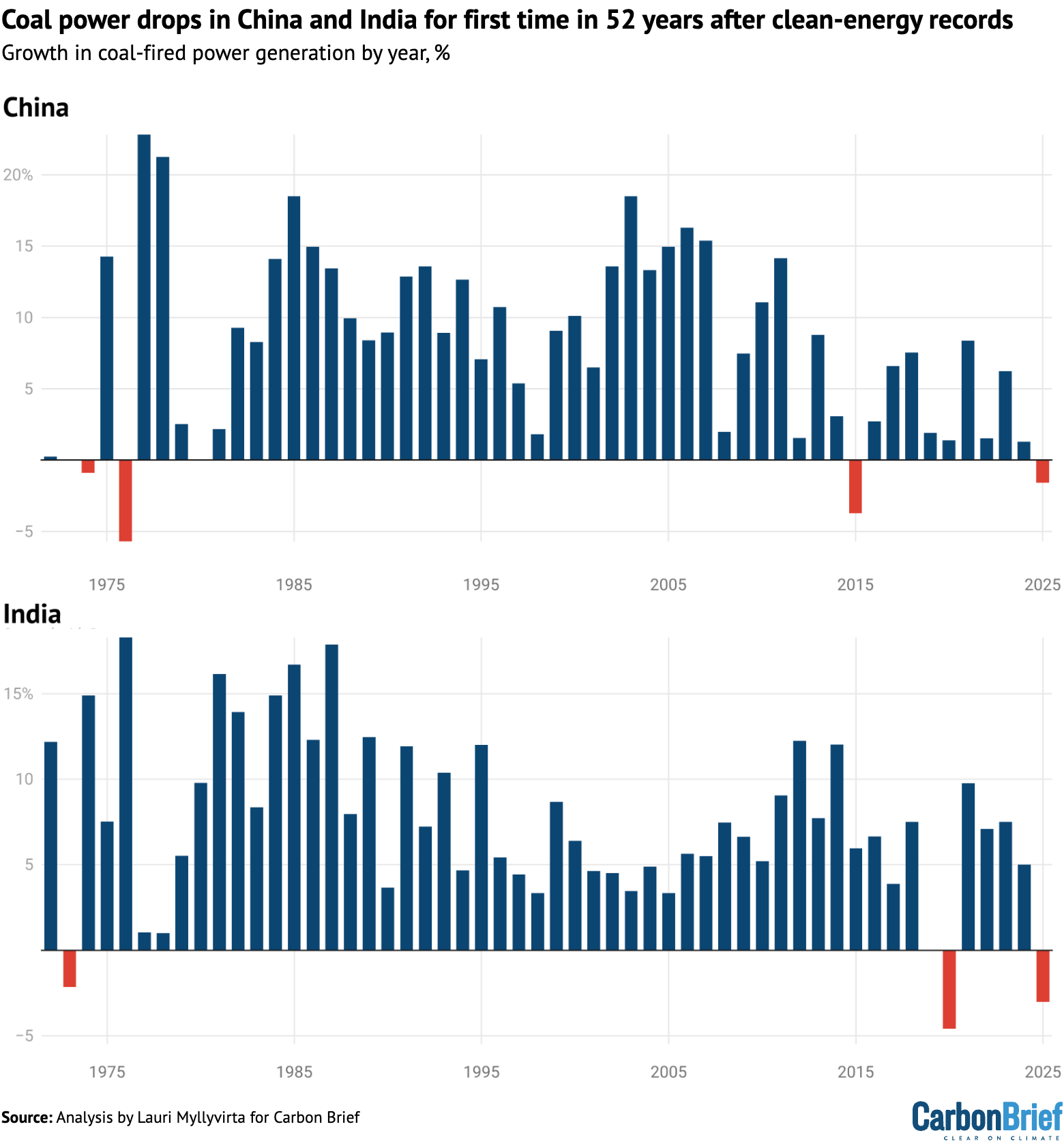
You can see the same dips hit at the same time for the same reason.
In terms of Chinese coal though there's a reason boosters always talk about percentages and not absolute number... one goes down, but the other keeps rising. Even if China continues on the current course in terms of tonnage burned they won't reach "peak coal" until at least 2030.
triceratops
4 days ago
> China is “greening” but we should be skeptical that it’s out of some lofty moral goal
Why does the "why" matter? Tons of carbon are tons of carbon, right? That's what people say when you tell them about per-capita emissions.
> they wouldn’t be hoarding the production of rare earth minerals and would be freely giving away technology for the sake of the planet.
You can freely buy as many cheap panels and batteries and EVs and heat pumps from China as you like (unless your country is stupid enough to tariff or ban them). Those come with minerals. When they reach end-of-life they can be recycled.
What exactly are they "hoarding" that the planet needs to go green? It hasn't prevented Pakistan or Vietnam from going ham on PV deployment.
ericmay
4 days ago
> Why does the "why" matter?
Well it doesn’t entirely matter but we should just acknowledge that it’s a geopolitical strategy and not really something they are doing for the planet.
> You can freely buy as many cheap panels and batteries and EVs and heat pumps from China as you like (unless your country is stupid enough to tariff or ban them). Those come with minerals. When they reach end-of-life they can be recycled. What exactly are they "hoarding" that the planet needs to go green? It hasn't prevented Pakistan or Vietnam from going ham on PV deployment.
Are you unfamiliar with China’s restrictions on rare earth exports for example due to alleged “dual use” as they continue to apply military pressure on democratic Taiwan? I’d encourage you to read up on these restrictions with respect to Japan for example who is alarmed by Chinese and North Korean provocations.
You can buy so many cheap panels practically only from China because they subsidized the industry so other countries couldn’t compete and build their own solar panels. For some these tariffs and bans are responses to these anti-competitive strategies. It’s not just the US, by the way. The EU is tariffing China too.
They are entitled to pursue these strategies but we are also entitled in the west to recognize them and combat them how we see fit.
triceratops
4 days ago
> not really something they are doing for the planet
If it doesn't matter why do you feel the need to acknowledge it?
> Are you unfamiliar with China’s restrictions on rare earth exports [to Japan] for example due to alleged “dual use”
How do these restrictions prevent Japan from using Chinese PV and batteries in their grid?
> You can buy so many cheap panels practically only from China because they subsidized the industry
Translation: they gave the world a ton of deeply discounted goods. And you said they didn't do anything nice for anyone!
> so other countries couldn’t compete and build their own solar panels
Other countries are free to subsidize their own solar and battery industries. Godspeed to the ones doing it right now. But also is it really that amazing an industry to have? Low-margins, constant price wars, undifferentiated commodity product without much of a moat. Rich economies tend not to have those industries anyway.
> For some these tariffs and bans are responses to these anti-competitive strategies
Surely then the US must be approving solar projects at record pace then? And wind too?
> The EU is tariffing China too.
There are no EU tariffs on Chinese solar panels or grid-scale batteries or heat pumps. They are considering tariffing heat pumps right now.
ericmay
4 days ago
> If it doesn't matter why do you feel the need to acknowledge it?
Just to make sure nobody is ever confused. Why do you feel the need to defend China?
> How do these restrictions prevent Japan from using Chinese PV and batteries in their grid?
It limits Japan from developing their own home grown market or utilizing technology for what China considers dual use?
> Translation: they gave the world a ton of deeply discounted goods. And you said they didn't do anything nice for anyone!
Other translation: Those cheap goods weren’t worth the cost to the environment or to empower an autocratic regime.
> Other countries are free to subsidize their own solar and battery industries.
When that happens there can be retaliatory measures against countries who are in for example the WTO or have other trade agreements. You don’t just subsidize products in a vacuum.
> Godspeed to the ones doing it right now. But also is it really that amazing an industry to have? Low-margins, constant price wars, undifferentiated commodity product without much of a moat. Rich economies tend not to have those industries anyway.
You’re focusing on solar panels but that’s not all we’ve been discussing.
> Surely then the US must be approving solar projects at record pace then? And wind too?
That doesn’t follow from what you quoted.
> There are no EU tariffs on Chinese solar panels or grid-scale batteries or heat pumps. They are considering tariffing heat pumps right now.
They are tariffing other products/industries and working on additional ones.
triceratops
4 days ago
> Just to make sure nobody is ever confused.
That a country is acting in its own interests? I don't think that's news.
> Why do you feel the need to defend China?
I think climate change is the biggest problem of our lifetime. China's output of green tech is our best chance. I think useful idiots for the fossil fuel industry demonize China to transitively discredit renewables (i.e. not for "lofty moral reasons" like democracy). There's a genuine double standard.
> It limits Japan from developing their own home grown market
Drill deeper. How does this prevent Japan from "greening" today? That's the topic we're discussing.
> or utilizing technology for what China considers dual use?
Why can't Japan source "dual use" rare earths from somewhere else? They aren't actually that rare. Japan could invest in mines and processing facilities in Africa or the US or Canada.
> Those cheap goods weren’t worth the cost to the environment
Cheap, abundant PV and batteries that can decarbonize the world? I'm ok with localized damage to one country's environment, done voluntarily, for that. Climate change will wreck the global environment.
> empower an autocratic regime
Describes most oil-producing countries. This is virtue signalling.
> there can be retaliatory measures against countries who are in for example the WTO
How did China do it then?
> You’re focusing on solar panels but that’s not all we’ve been discussing.
Ok what else then? You want battery manufacturing? Motors? Has China somehow restricted countries from building their own industries?
> > Surely then the US must be approving solar projects at record pace then? And wind too?
> That doesn’t follow from what you quoted.
Ok what is the US doing for renewable energy under this administration?
> They are tariffing other products/industries and working on additional ones.
We're focusing on renewable tech here. That's the focus of this thread.
ericmay
4 days ago
> That a country is acting in its own interests? I don't think that's news.
You changed the topic though, that wasn't what we were talking about.
> I think climate change is the biggest problem of our lifetime. China's output of green tech is our best chance. I think useful idiots for the fossil fuel industry demonize China to transitively discredit renewables (i.e. not for "lofty moral reasons" like democracy). There's a genuine double standard.
That basically proves my initial point lol. That's why it's important to make sure while the effects may be good for the climate, it's not done with any intention for the planet's benefit and specific tactics that are being used are harmful to other countries.
> Drill deeper. How does this prevent Japan from "greening" today? That's the topic we're discussing.
I'd challenge you to do the same thing. How can Japan "green" when China has restricted exports of rare earth materials to Japan because China and its junior partner North Korea are engaging in provocative military activities near Japan?
If your version of "Japan can green by buying China's products" you're being immature in your understanding of international relations, the importance for countries like Japan to maintain their industrial base, and how the environment is an important consideration, but just one of many.
> Why can't Japan source "dual use" rare earths from somewhere else? They aren't actually that rare. Japan could invest in mines and processing facilities in Africa or the US or Canada.
Well Japan and western allies and democracies are working on it, but the problem isn't the location of rare earths it is the ability (as far as I understand) to process them. It'll take time for those capabilities to be stood up, and they have to be subsidized or benefit from tariffs because China has built up so much excess industrial capacity that other countries can't build their own without such policies.
> Describes most oil-producing countries. This is virtue signalling.
Norway is an oil-producing country and not an autocracy. Your point was disproven.
> Cheap, abundant PV and batteries that can decarbonize the world? I'm ok with localized damage to one country's environment, done voluntarily, for that. Climate change will wreck the global environment.
That's your opinion but it's not the opinion of others. I disagree, for example.
> How did China do it then?
You want me to explain the history of the World Trade Organization, the US advocating for China to do it under the guise that China was going to liberalize and democratize, and then how China used most-favored nation status, a regime of state subsidies, and artificially depressing its currency to boost exports? If you're not aware of this stuff, are you sure you should be speaking on this topic without even the basics?
> Ok what else then? You want battery manufacturing? Motors? Has China somehow restricted countries from building their own industries?
Already explained above.
> Ok what is the US doing for renewable energy under this administration?
Idk? We'll have a new administration in a couple of years though.
> We're focusing on renewable tech here. That's the focus of this thread.
Ok then you can stop replying to me since that's not the only thing I'm talking about. I'm focused on more than renewable tech and that's of little concern to me in the grand scheme of things including climate change.
triceratops
4 days ago
> > Describes most oil-producing countries. This is virtue signalling.
> Norway is an oil-producing country and not an autocracy. Your point was disproven.
Are you somehow unfamiliar with the definition of the word "most"?
> That basically proves my initial point lol
I don't know what your "point" was honestly because you yourself conceded it didn't "matter much".
> Ok then you can stop replying to me since [green energy is] not the only thing I'm talking about
https://news.ycombinator.com/item?id=49821986 that's what you were talking about there.
> If your version of "Japan can green by buying China's products" you're being immature in your understanding of international relations
Japan (and most other countries) are already "not green" by buying oil from other autocratic nations. Like I said this is all virtue signalling to avoid going renewable. The fossil fuel industry loves it.
"Rare earths" are a strategic necessity for defence, and China won't sell them for that reason - fine. Countries who still need them can nationalize processing capacity and run it at a loss for the sole use of defence industries. No need to participate or compete in the market at all. China's subsidies and the WTO don't matter.
ericmay
4 days ago
> Are you somehow unfamiliar with the definition of the word "most"?
Your point was still not great, but I apologize as I misread what you wrote.
> I don't know what your "point" was honestly because you yourself conceded it didn't "matter much".
If you don't know what we were discussing why are you arguing about it?
> https://news.ycombinator.com/item?id=49821986 that's what you were talking about there.
Industrial output falling because of tariffs for example would be aligned with my initial post. You're being argumentative here for no good reason. If you just want to talk about the engineering technology I don't have much else to say about it. But if you want to talk about the important stuff, why it's not being adopted, why some countries are adopting it and others aren't, I think that's an interesting conversation to have.
> Japan (and most other countries) are already "not green" by buying oil from other autocratic nations. Like I said this is all virtue signalling to avoid going renewable. The fossil fuel industry loves it.
Well they're stuck between buying oil from autocratic nations (China also buys oil from autocratic nations) or buying green technology from autocratic nations which are also threatening them or stopping exports of the technology or industry. Saudi Arabia (or insert whatever country here) doesn't for example stop oil exports to Japan for example if Japan also does their own oil drilling or exploration. China does stop exports of certain technologies or even processed rare earth minerals.
> "Rare earths" are a strategic necessity for defence, and China won't sell them for that reason - fine. Countries who still need them can nationalize processing capacity and run it at a loss for the sole use of defence industries. No need to participate or compete in the market at all.
No lol they'll subsidize them and refuse to buy China's products to protect domestic industries and capabilities to build the products themselves. It won't be limited to defense. Plus as I have pointed out a few times China itself restricts exports because of the threat of dual-use (which is in response to Chinese provocations) so China will in effect stop the export of defense-related products even when they can be used by consumers.
> China's subsidies and the WTO don't matter.
That doesn't make any sense.
user
4 days ago
nradov
4 days ago
I never claimed that China is "going green" (whatever that means), merely that they're gradually reducing their dependence on imported fossil fuels.
triceratops
4 days ago
Fossil is flat or declining. Everything else is skyrocketing.
otherme123
4 days ago
China also? How is that? China is a big importer of oil, and is heavily burning coal (more than 50% their energy mix), that is also partly imported. They are fighting for a cleaner energy not because they are green but because they don't want to be dependent on imports, and some people even accuse them of undercutting solar panel pricing to get all the world market.
They are installing nuclear power like no other country (1 GW yearly since 2014), and Wikipedia says that 50% of all nuclear capacity being built is in China (https://en.wikipedia.org/wiki/Nuclear_power_by_country): 37 new reactors, followed by India with 6 and Russia, Egypt and Korea with 4. USA and France, which are both pro-nuclear or nuclear neutral, are building 0 reactors. But yeah, China has interests against nuclear power.
You are not helping your case by spreading misinformation and calling other people misinformed by making a strawman ("radiation scares people"). I am against nuclear (or rather not pro-nuclear) because it is not economically sound, because it is massively subsidized by Governments for the private sector to profit.
bryanlarsen
4 days ago
Coal's share of electricity production in China fell below 50% in 2026 for the first time ever. This is despite idling nat gas plants due to the war in Iran messing up shipments.
Nuclear's share of electricity in China is below 4% and dropping. They do not use a significant amount of nuclear. That this insignificant amount of nuclear is more than any other country is quite telling.
EA-3167
4 days ago
Quite telling, but then so is climate change and it's not exactly hard to understand the motives of those who want(ed) to deny it for power and profit. We should be listening to their wise advice on this topic... why?
hnedeotes
4 days ago
If china that is the number one producer of solar panels and batteries is investing in nuclear perhaps that shows that indeed it's not such a bad bet? Specially taking into account the military applications of such capabilities.
It would also seem that investing into it may perhaps render significant gains into the future as R&D becomes more involved with actual running systems and funded (skin in the game?)
It seems the only ones who lost by abandoning their nuclear programs were European countries (specially Germany) in detriment of Russia and other Oil trading countries... It's even probable that much of the "bad press" nuclear has had for the past decades was in fact instigated by oil-producing countries doesn't it?
otherme123
3 days ago
Even if China is the number one in installing nuclear power, the installed capacity dwarfs compared to solar. China is "betting" on anything that produces electricity that doesn't depend on imports, and if that is nuclear they go for it. But it is clearly not their main bet:
https://en.wikipedia.org/wiki/Electricity_sector_in_China#Pr...
Wind overtook nuclear production in 2016, Solar FV in 2022. Today both more than double it.
Tables in https://en.wikipedia.org/wiki/Electricity_sector_in_China#Ch... are also very telling. Total power production: 15% wind, 17% solar, 5% nuclear. Nuclear is almost stagnant, but they will probably finish what they are already building, or have planned. That is the way they work. But they are slowing the rate of nuclear installations, it took 5 years to go from producing 400 TWh to 500 TWh, while wind in the same time went from 500 TWh to 1.1k TWh and sun from 260 TWh to 1.2k TWh. These growing rates will drive nuclear from being ~5% of production to be irrelevant in 10 years. But you will read from pro-nuclears that they "plan" to double nuclear output in those 10 years, even when they barely put a +20% in last 5 years. I wouldn't be surprised it they pivot to solar, wind and batteries suddenly (a very China thing to do), abandoning all nuclear that is not already almost finished.
IMO China is not betting on nuclear. Just before solar was economically sound (c. 2015), they believed nuclear could be a solution for their dependency problems, and bet on it. As of today, they are no longer betting on nuclear, or at least the bet is crawling to a halt.
No nuclear debate without Germany. This is my opinion: Germany actually is winning. Not a lot, but their current situation is far from the catastrophe some predicted (massive blackouts! outrageous electricity price!). Nuclear was quickly replaced with solar and wind after an initial coal and gas spike. But now coal usage is going down, and gas is stable. Dependency from Russia is less than 10 years ago. OTOH, France is having serious problems to 1) increase their nuclear production and even maintaining what they have (average reactor age: 35 years, younger reactor: 18 years) and 2) to deal with the install of cheaper energy sources because their base load is so high and can't be easily phased out.
And please, stop with the "bad press" tune, as if everyone that doesn't blindly believe nuclear is the future is dumb and can be manipulated with ease, meanwhile pro-nuclear are very smart and impossible to manipulate. Do you think there is no nuclear or fossil lobby also releasing "bad press" about everything else and selling nuclear as the only solution? It only causes high friction unproductive debates: it is like Democrats firmly believing that Republicans are dumb, and vice versa. Either you accept that you are also being manipulated by the nuclear lobby to support them, or stop accusing others of being manipulated. Italy is running without nuclear power for more than 30 years, but only recently, when it makes absolutely no economical sense to start new nuclear plants if you have your production-demand figured out (not booming like China), some politics, not at all "manipulated" or "bought" by the nuclear lobby, plan up to 10 new reactors against people will (94% of voters against installing new nuclear in 2011). Yes, people are dumb, politics are honest and smart. That is the only possible cause.
hnedeotes
3 days ago
I would imagine that China not having a world wide market for selling/dumping their reactors would have some relation too.
I have no horse in this race but anyway, I hope Europe goes back to nuclear, and then get nukes enough to wipe out anyone in the world some 35 times if needed.
otherme123
20 hours ago
Europe is already heavily nuclearized. Even the nuclear lobby recommends a "10% nuclear power in the mix", which many countries en Europe already meet... or way more than that. On average 24% (varies between sources) of European mix is nuclear. Yes, there are a couple of countries (Germany and Italy) that banned nuclear, but there are also the most nuclearized country in the world (France, 60% nuclear), and countries like Slovakia (60% nuclear), Hungary (40% nuclear).
Europe produces almost no uranium, and France has a historical problem with uranium mining in Africa, is not like Europe is giving up a free-of-trouble energy source. Honestly, sometimes it feels that some pro-nuclear won't be happy until 100% of the base load is nuclear. They are asking for more nuclear than the nuclear lobby does.
lukan
4 days ago
People who know how much effort it takes to constantly measure and contain radioactivity and what a mess it is to mine for Uranium in the first place also don't wonder.
If not, reading a list of this helps:
https://en.wikipedia.org/wiki/Lists_of_nuclear_disasters_and...
But sure, oil leaks can be bad as well. Solar leaks on the other hand seem bearable.
batisteo
4 days ago
I believe burning coal realease far more Uranium and radioactive material than nuclear ever did. Listing the plane crashes over the last century wont buldge the statistics of the safety of this mean of transportation.
lukan
4 days ago
Did I imply anywhere anyhow that I am a fan of coal?
I just don't think it is a good idea to replace something dirty with something else dirty that is indeed quite safe if all goes well, but is horrible if something goes wrong.
Italy has lot's of sun and wind (and geothermal potential).
EA-3167
4 days ago
Everything is a comparison to what exists, not your dreams. The alternative to coal today isn't just renewables, and thinking in those absolute terms is in large part what's handed the fossil fuel lobby decades of default victories.
We don't have time for perfect solution, do all of what you said AND THEN ALSO MORE.
lukan
4 days ago
"We don't have time for perfect solution"
Exactly. You can buy and deploy solar, wind and batteries as much as you want now. If you care about strategic independence, build factories for them.
But a nuclear reactor takes a long time to get build. And is likely way more expensive. If italy manages to do it fast and cheap - other countries will follow, but I believe it when I see it.
otherme123
3 days ago
And China is importing some of their reactors from France, Russia and USA. It is not like they become fully independent (maintenance and parts). More independent than oil and gas imports, but can't depend forever on these three either.
EA-3167
4 days ago
I am someone who knows, hence my disgust. Time to learn about the radioactivity of coal fly ash and how carefully that’s managed.
lukan
4 days ago
Oh, I know and am in favor of shutting coal down asap and before nuclear. But you seem to imply handling radioactivity is not a big problem compared to fossils, but I believe it is, considering how faulty and corrupt individual humans are, or corporations or government bodies doing the oversight.
8note
4 days ago
why is profit the right descriptor?
wouldnt you instead count the net benefits to the whole economy from having that cheap and plentiful electricity?
boringg
4 days ago
This statement is kind of wild.
If your trying to argue that 417 operating reactors and 377 GW of operating nuclear capacity at end-2024, producing roughly 2,600–2,700 TWh/year, about 9% of global electricity isn't profitable at all and that somehow all that money is just lit on fire not generating profit/value? Bold claim -- the ecosystem is about $300-500 B/year globally per isn't profitable?
How can the scientific progress of developing nuclear power + medical isotopes and the entire value chain associated with that development, incredibly long lived assets, nuclear fuel development not have been profitable? The fact that you have baseload generation that supports the entire grid?
What part of the equation are you talking about - at what part of the project life cycle? Are you trying to say they were built and weren't profitable the minute the switch turned on?
asmodeuslucifer
4 days ago
Off topic, but this guy on youtube is a knowledgeable (pro-nuke) resource.
Al-Khwarizmi
4 days ago
Why does electricity need to be profitable? Are roads, justice systems, or armies profitable?
rjzzleep
4 days ago
Most electricity and infrastructure is profitable. But not after carving it out in a way that looks at it in complete isolation. Just like train infrastructure creates a lot of business around the area of the train infrastructure, even if the train itself may seem not self sustained.
reenorap
4 days ago
They are not profitable. They add taxes to gas so that it pays for it.
palata
4 days ago
Sure, but then that's not "profitable" in the direct sense of "makes rich oligarchs richer".
I'm all for improving the quality of life for society. In the end the goal is to live well, not to destroy our living conditions for a few oligarchs to make more money. But "profitability" is not generally optimised like this, unfortunately.
sodacanner
4 days ago
I'm fairly sure that the total economic value that we get out of roads far exceeds the cost it takes to create and maintain them, yes. A similar argument can probably be made for justice systems and armies.
If a power generation system costs more to operate than the value of power we get out of it, it's probably not very useful. I think that's what we're talking about here.
Ldorigo
4 days ago
I think that for your analogy to work, you also need to consider the total economic value that we get out of electricity as opposed to just revenue from electricity bills...?
pigpop
4 days ago
If every government had subsidized and pushed forward a transition to ~100% nuclear power back in the 70s it would have effectively solved climate change. Electricity, industry and heat production account for >50% of CO2 production.
Then there's all the other effects of not having a high demand for hydrocarbons including less Middle East entanglement, less mining and drilling, more abundant and cheaper oil for uses other than burning it, etc.
palata
4 days ago
> If a power generation system costs more to operate than the value of power we get out of it, it's probably not very useful.
There is more than money. There is stability (not depending on foreign oil, peak oil, etc), there is climate change, etc.
kccqzy
4 days ago
Notice how for roads you compare the total economic value of all roads against the cost of them. But for electricity you compare a single power generation system. You are not comparing the same thing. A fair comparison would be the total economic value of having electricity against the cost of all electricity infrastructure. Sadly this fair comparison is irrelevant in this thread.
Nifty3929
4 days ago
Profit is the best way to measure that economic outputs exceed economic inputs, which is the whole point. But profit doesn't work so well as a measure when the outputs are hard to measure per individual beneficiary. Inputs are generally always pretty clearly measurable, but outputs aren't always, as in the case of roads and bridges - although even there often you can.
Electricity is super-duper easy to measure the individual benefits of, so profit is a really simple and easy way to measure the overall effective economic benefit. It's not perfect though - there are external costs to consider which aren't paid for directly, but we have lots of experience with that across all sorts of industries and usually solve for that via taxes and regulation, which become part of the profit equation.
mynti
4 days ago
It does not. But there are so many sources that can be. And easily at that. So why go this route?
asmodeuslucifer
4 days ago
A lot of countries consider energy security national security, and national security always bats last.
A lot of countries also use it to help subsidize (or help cover up the costs of) their military nuclear programs.
bdauvergne
4 days ago
That's just not true. Event is PWR reactors take their root in the nuclear program for plutonium generation, that's not the case anymore.
epistasis
4 days ago
Why would we choose a more expensive form of energy rather than cheaper forms?
There are good reasons to choose more expensive things, but "nuclear sounds cool" is not a good reason. There must be some sort of rationale and benefit beyond that.
NiloCK
4 days ago
Emissions.
epistasis
4 days ago
Batteries and solar and wind are a lot cheaper, faster to deploy, and scale a ton better.
Nuclear is far too slow to solve our emissions problems, there's no chance of us being able to scale the nuclear industry to be able to confront climate change on the time scale necessary.
In contrast, batteries, solar, and wind are scaling on their own, without the massive government subsidies that would be needed to deliver nuclear too late to help.
Panzer04
4 days ago
Nuclear is actively negative-value too, because it discourages investment when people know that government-subsidised competition is coming.
dalyons
4 days ago
Those things you pay for indirectly via taxes. Electricity you pay for directly. you can build unprofitable economically uncompetitive power, like nukes, and your rates will go up. People tend not to like that, but you can do it.
SoftTalker
4 days ago
So the alternative is relying on solar panels made by a quasi-hostile country, because for some reason we can't produce them economically ourselves, or continuing to burn fossil fuels?
dalyons
4 days ago
Countries just can pretty easily make solar economically themselves, it’s no great secret. But they don’t because china makes them a bit cheaper , you keep them forever and we’re not in a war. You think all the billions of parts and steel in a nuke will all be locally built too? For eg Go look up who owns almost all the foundries in the world that are required to build large pressure vessels for reactors.
So, option a sounds great to me, but you clearly have some kind of agenda here, that maybe you could make clearer
BurningFrog
4 days ago
The costs for generating electricity needs to be paid for somehow.
Having the consumers of the electricity pay for has a lot of advantages!
jasondigitized
4 days ago
Not sure about profitable but the lower the cost is the generate electricity, the better off the world will be. Cracking energy is, to state the obvious, a huge unlock.
jacquesm
4 days ago
Because in their wisdom the politicians have created energy markets.
jmyeet
4 days ago
SMR makes no sense. It never did. It's a program to fuel academic empire-building and to siphon government money in the form of research grants and investment.
You see this pattern a lot in academia. Education is a great example. We know what works when, for example, it comes to teaching literacy. It's phonics. But over the past few decades we had a fad with "sight words". The evidence has come in that this has been a disaster. So why did it happen? Because nobody is going to get prestige in their education PhD by pushing an existing idea. They're incentivized to reinvent that wheel to shape themselves as an expert in the new wave.
That's exactly how SMR came about. It takes the idea of scaling by going small and repeating what you're doing rather than doing what you actually need to do and that is to standardize large designs. Larger reactors are just more efficient and that's physics.
I bet I could come back to HN in 10 years and SMR will still be exactly nowhere yet people will still be promising a bright future for it.
kvgr
4 days ago
Yeah but we are su subsidizing so much stupid stuff in the world, that dont need to be. Safe and clean energy is on top of my list of things i am very much ok with.
rightnutwingjob
4 days ago
So you won't mind if I prefer (some of) my tax dollars go to subsiding reliable energy production.
If safe is your metric, nuclear power kills fewer people than roof top solar.
pfdietz
4 days ago
Solar/wind made reliable is still cheaper than new nuclear (which also requires some add-ons for reliability/leveling.)
kvgr
4 days ago
yeah, works great for germany compared to france :) new nuclear price is skill/regulatory issue...
also great fosil things happening with backup plants
pfdietz
4 days ago
At the current cost in France for building a new nuclear power plant, renewables would be much cheaper. The existence of legacy plants there doesn't change this. Realize also that much of the cost of those plants was off the books, involving subsidized financing. That a government can fund something at lower interest rates doesn't mean that isn't a subsidy; it's just that the subsidy is concealed.
kvgr
4 days ago
I am very pro nuclear :)
analog31
4 days ago
Are fossil fuels net profitable after subsidies, wars, and externalities are considered?
rebolek
4 days ago
Oh boy, they are sooooo profitable that there are wars around them.
altern8
4 days ago
Does it need to be profitable without subsidies? Governments run a lot of stuff at a loss as a service to citizens. For instance highways, trains, post offices etc.
Wololooo
4 days ago
Where is most of that future power going? Where are those power plants going to be installed? What need does those particular nuclear reactors would fill?
Do not get me wrong: I am not anti-nuclear per-se, but my main concern is that it would have made sense to have a long term strategy including phasing out of nuclear not directly shutting down in the 90's as the Italian did, but progressive phase out with upgrades to existing plants... Now it seems to be going a bit backwards.
Also, to contrast and put in context, in Belgium, Nuclear power plants were build by the state and therefore paid by the tax payers, raising taxes in order to afford them. The underpinning idea was that you pay a bit more and then once paid off you can get cheap energy.
This is not what happened, the power plants got privatised and the gains went to the new operators, leaving tax payers with the bill...
altern8
4 days ago
I agree with that, in Italy the telephone lines, highways and trains were privatized the same way, but that's just because politicians are corrupt and they were able to convince people that public companies had to make money like they were private and operating at a loss was bad.
prettygood
4 days ago
[flagged]
Moldoteck
4 days ago
Why not subsidizing? What's the problem with that considering both renewables and fossils are subsidized?
Most sound smr is Canadian BWRX which is already under construction
pyrale
4 days ago
> without counting subsidies
Every energy industry has subsidies. Believing that one of them should work "without subsidies" simply misses the mark.
dataflow
4 days ago
Does it really matter if it's profitable? We're destroying the planet. Heaven forbid we lose money on something that gives us a chance.
xyzzyz
4 days ago
Yes, because profitable enterprises are able to grow faster than unprofitable ones. If you think something is good, and want more of it, making it profitable is conducive to your goals.
AlienRobot
4 days ago
Do you mean nuclear isn't profitable compared to coal, whose costs are externalized, or compared to other renewables?
Propelloni
4 days ago
> other renewables
Nuclear power is not a renewable power source in the technical correct meaning of the word. Fission material is "only" abundant, in that we can win nuclear fission material from many sources, including recycling spent nuclear material, but it is not available and spent without human intervention (otherwise we could argue fossil fuels are renewables, too).
As an aside, nuclear fission power differs from renewable power in many other ways, too. It is not clean, it is not easy to harvest, it is not safe, it is not cheap, it is not a mass job engine, it is not low-maintenance, it has less utility, and it has less flexibility.
pfdietz
4 days ago
IF the world got its primary energy from today's kind of light water reactors, uranium available at up to 3x the current price would only last for about five years.
A fully nuclear-powered world (including all energy use, not just grid electricity) would need breeding of some kind; otherwise the uranium just gets too expensive. So when you hear people claiming nuclear is cheap, ask them if that cheapness includes the technologies that would actually be needed for nuclear to do the full job.
sfn42
4 days ago
If we needed more nuclear fuel we would be producing more of it. Comparing current production to a world where we use a thousand times more of it is ridiculous. Uranium is not that rare, and spent fuel rods still have well over 90% of their potency so they can be recycled.
Nuclear energy could easily power the entire planet for thousands of years.
pfdietz
4 days ago
Sure, we could produce more. It would have to be from much lower grade ores, and so would be much more expensive and disruptive. This is why breeding would be needed, so the cost of the uranium would not make nuclear even more unaffordable than it already is.
sfn42
3 days ago
The argument about affordability is quite ridiculous in a world that is becoming uninhabitable as a direct cause of the "affordable" alternatives.
We could easily afford to use nuclear, and we wouldn't have to rely on it entirely - we have many alternatives such as solar, wind, hydro, geothermal etc. I'm also quite confident that economy of scale would improve the fuel cost, and the higher investment would make breeding and other nuclear technology advancements much quicker than they are and have been. Not to mention fuel cost is quite insignificant in nuclear energy.
We can however not afford the consequences of fossil fuels. We are already severely impacted by global warming and it will get much worse very quickly. I think this chart conveys the severity of our situation very well: https://www.dpg-physik.de/veroeffentlichungen/publikationen/...
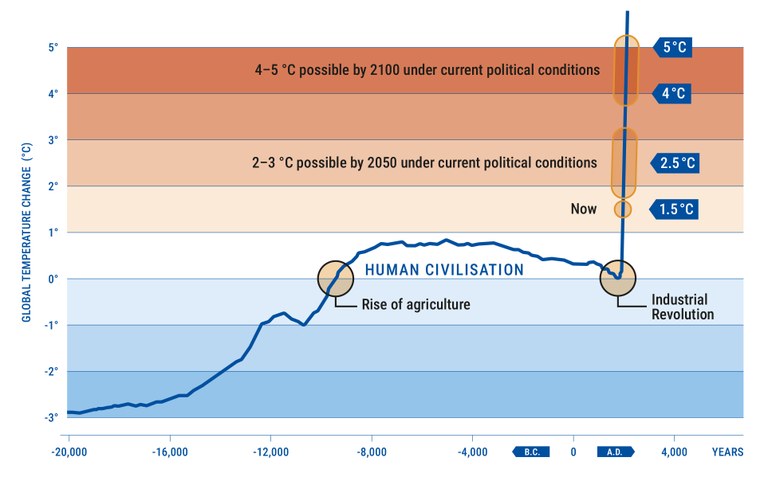
pfdietz
3 days ago
Affordability most definitely figures into which avenue forward should be taken. It cannot be used to justify fossil fuels over nuclear, but it can be used to justify renewables instead of nuclear.
Nuclear doesn't have a "get out of economics free" card just because fossil fuels are to be eliminated. I understand the desire of nuclear fans to pretend otherwise.
sfn42
3 days ago
I'm not a "nuclear fan", I'm a "don't destroy the planet fan". I'm not saying we should build nuclear instead of renewables, I'm saying we should build it instead of fossil fueled generation. It seems you agree with this, so I'm not sure why you seem to be arguing against it.
Until the day that we stop burning fossil fuels entirely, we should be building nuclear to replace it. If it's more expensive that's fine, I don't think it would be, at least not significantly, but I can't prove it and I don't care either way, it doesn't matter. What matters is replacing fossil fuels as fast as possible. It's probably already too late, and the powers that be don't give a shit anyway so none of this will actually happen but this is what we should do.
AtlasBarfed
4 days ago
That's why I think lifters are really the only true path to cost reasonable nuclear power... They "burn" almost all fuel and have separation procedures for the other fission products, and I believe they can consume nuclear waste since it's a breeder reactor.
7952
3 days ago
Any commercial venture will just become dominated by compounding interest payments on debt. Keeping so much capital tied up for so long without revenue is just too expensive.
throwaway2037
4 days ago
I agree with the sentiment of your post. In short: "I'll believe it when then finally build and operate one."
About decommission: (segway first) When the United States Navy decommissions nuclear submarines (and there are a lot!), they basically chop out the nuclear reactor whole, then seal in a giant steel box, and bury it in an open trench. It called "Trench 94" at Hanford Site, Washington (state). You can read about it here[1]. The photos are weirdly dystopian. You can also see it on Google Maps here[2].
How do small modular reactors (SMRs) plan to decommission? Can they follow a similar route as the US Navy? Honestly, I don't know if the size is comparable, or if "sealed in a big steel box" will also work for SMRs.
[1] https://www.popularmechanics.com/military/a46065875/trench-9...
Joel_Mckay
4 days ago
In most sunny places a decentralized per-home solar policy is cheap, sustainable, and more robust to severe local weather events.
While fission reactors are still the cheaper initial energy choice (like a future cancer patients love of cheap cigarettes.) Small Modular reactors are a fools errand for most places, as they have all the same security, labor, and maintenance issues of full sized installations. Thus, instead of repairing one of four turbines every few years, the contaminated components must now be reprocessed or safely hidden away on mass.
Maybe fine for submarines or aircraft carriers, but for massive infrastructure it is trivial to prove it causes major long-term problems.
Anyone that has ever purchased a property with an old leaky heating-oil tank nasty surprise site-reclamation cost... will understand the initial unit price never covers the actual clean up cost. =3
hk1337
4 days ago
Also, dealing with the nuclear waste can be problematic. Even if you recycle it like France, it still costs to re-enrich it and still produces waste itself.
harrouet
4 days ago
oh the irony...
In France, which has the most nuclearized electricity, 13% of the electricity bill is actually a tax to finance the subsidies to solar and wind power plants.
Nuclear is highly profitable, if you compare prices for 24x7 electricity (i.e., if comparing with solar, factor in the cost of energy storage at grid scale, or separate power generators able to provide for peak demand).
Krasnol
4 days ago
They didn't because the taxpayers will finance that and no politician would be able to sell this.
looofooo0
4 days ago
Treat power plants as public infrastructure. No need for high returns or insurance of every risk.
Retric
4 days ago
That’s not a blank check to suddenly behave irresponsibly.
In Italy battery backed solar is going to win from a lifetime cost perspective and it’s only getting worse over the next 50 years here. The solution isn’t government subsidies it’s making nuclear cheap and safe without subsidies at the same time.
iamflimflam1
4 days ago
We’re at the point now where this has to be a problem for the future.
3astg
4 days ago
Yes, it is part of Trump's tariff deals forced on e.g. Japan:
https://www.neimagazine.com/news/us-japan-in-smr-deal/
Italy should be buying proven French technology instead.
ViewTrick1002
4 days ago
Which proven French technology?
Given the outcome of Flamanville 3 and that the proposed subsidies for the EPR2 fleet are ruinously expensive France is unable to build competitive new nuclear.
motionlessveloc
4 days ago
Not sure why this is downvoted. Look up Olkiluoto 3 in Finland, it was 14 years late and (depending on whose figures you believe) cost nearly 10x more than the original estimate of €3 billion, bankrupting Areva in the process.
lemmetellya
4 days ago
[dead]
simianparrot
4 days ago
Solar and wind aren’t profitable either if you count the entire lifecycle including bill of materials, production, transportation, maintenance, and teardown for replacement.
madduci
4 days ago
At least it is greener and cheaper. Especially Solar cells have become incredibly cheap now. Combined with battery storage, it's far safer and cheaper than nuclear.
And in a territory affected from seismic activities, I would avoid nuclear at all
simianparrot
2 days ago
You can't power a modern country like Japan with green energy. Please educate yourself.