silverFork
6 hours ago
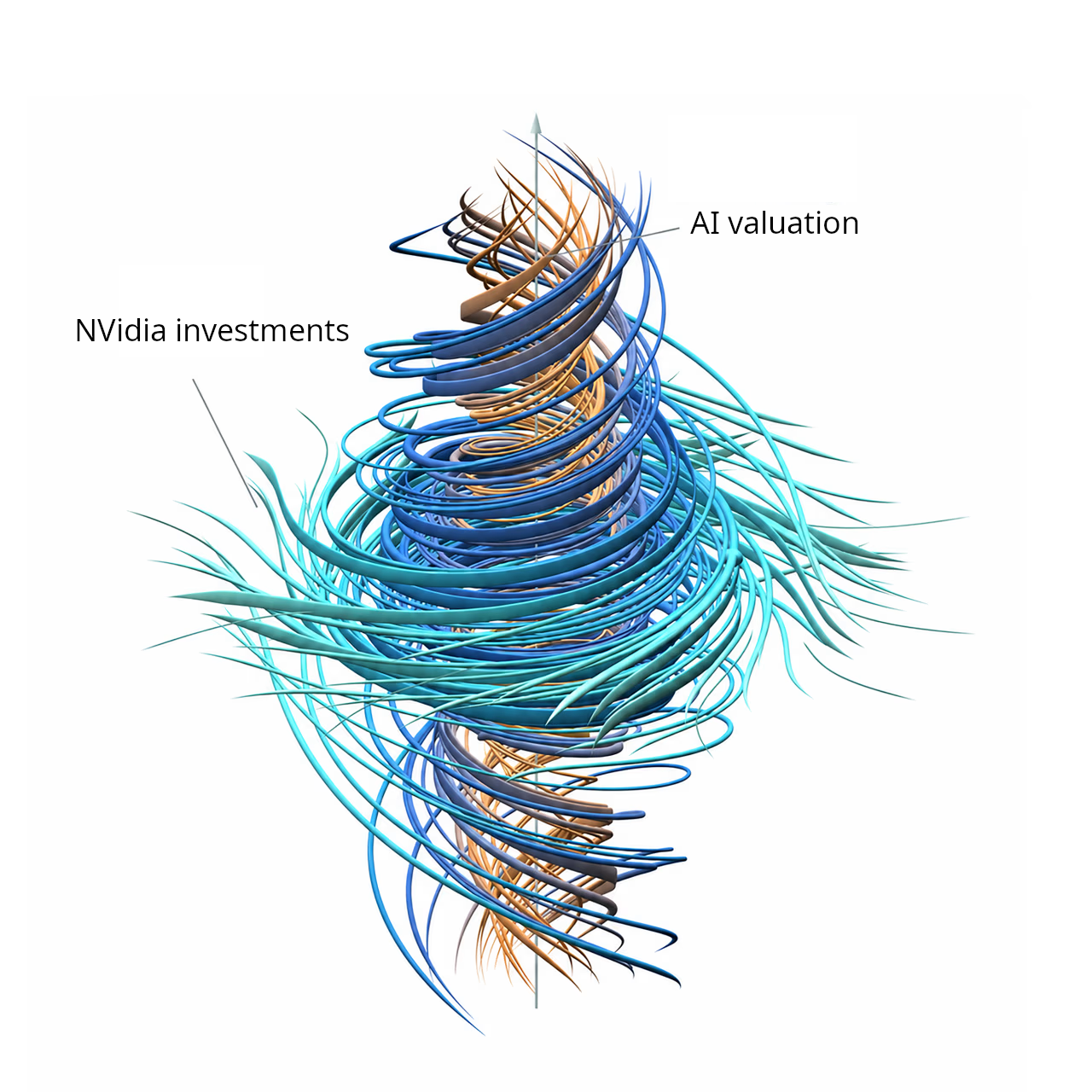
A la Enron but completely legal. It is not just a circle, it is more like a swirl. Wallstreet invested in Ai Farms to purchase NVDA chips and then NVDA invested in Ai Farms and not only that it is investing in its customer, Anthropic and its IPO.. They are recycling the cash that they harvest from stock markets till it becomes the famous singularity in funding like a financial hurricane.
dzonga
5 hours ago
80-90% of AI costs are related to inference. Once zAI served their new model entirely on Chinese chips for free then the nVidia jig is up.
who is going to pay back the money nVidia invests in AI labs, AI datacenter companies if the models are being served dirt cheap.
the Chinese are not the only competitor - Amazon with their Trainium, Google with their TPUs etc.
Nvidia might have a moat on training but on serving it's gonna be a blood bath.
But for now they're capturing 80% of all the AI spend so they gonna keep making money.
LogicFailsMe
5 hours ago
Pretty much fanfic. The gap between premise and execution remains limiting. Nvidia has adapted to changing markets better than anyone else up to this date which is what got them to the top in the first place. What makes you think "this time it's different?"
The fallacy I see repeatedly is someone spots a legitimate issue that could hurt Nvidia and by the time they have stood up the challenge to pull that off, Nvidia has pivoted and addressed it. Or more recently, they just acquired it like Groq.
For your premise to hold, you're asserting Nvidia is blind to inference. And yet his public positioning suggests otherwise.
https://qz.com/nvidia-gtc-2026-jensen-huang-keynote-takeaway...
What makes you think they've hit some sort of metaphorical iceberg and all they'll do before they sink is rearrange deck chairs?
dzonga
2 hours ago
I'm not saying the bet is against Nvidia the company as in how it executes, or enters new markets.
the bet is against the high margins in inference - when other capable players have entered the market as models become commoditized and the inference serving chips as well. Cerebrus ai etc are already showing custom silicon can make a dent while being served cheaper & faster.
mlyle
3 hours ago
I don't think anyone expects nvidia to "sink". We're concerned that competitive pressures and possible reductions from sky-high demand could make it really hard for nv to justify or maintain their current valuation.
That is, revenues may be unusually cyclically high.
It's going to be hard for frontier labs to keep spending at this rate without starting to make money. And even if they do, lower cost alternatives will likely impact at least to -some- extent how much of that revenue nv gets.
LogicFailsMe
3 hours ago
Have you ever checked out the beta on Nvidia stock? Not to mention its surprisingly sane P/E ratio?
Compare and contrast with Tesla.
mlyle
3 hours ago
I know the P/E isn't completely nuts.
It still prices in revenue growth.
It is possible that nv maintains an absolutely dominant market position and total amount spent on GPUs continues to rise.
It's also possible that either of these things doesn't happen.
LogicFailsMe
2 hours ago
Yes, but the first mover advantage really is a thing. As an example, Yahoo really had to mess up to lose its spot to Google, but they were up to the challenge.
mlyle
2 hours ago
That doesn't really have anything to do with what I said.
echelon
5 hours ago
> But for now they're capturing 80% of all the AI spend so they gonna keep making money.
And this is why the stock remains high. This hasn't even started to make a dent in Nvidia's bottom line yet.
These comparisons to Enron are absurd when Nvidia is generating this much cash flow.
Let's see the other alternatives come online and start taking away sales.
iterateoften
5 hours ago
There is the Law of Demand. As ai costs plummet, demand increases, just nobody knows the curve shape yet. But could be that cheap inference is how all the AI supply meets the demand
JumpCrisscross
4 hours ago
> There is the Law of Demand
What is this?
Demand functions (price as a function of quantity demanded) take all kinds of shapes. Veblen goods are the silly example of wrong-sloped demand [1]. The in-vogue example of sigmoid demand, however, is hot water–make hot water (or lighting, for that matter, as another comment today pointed out for LEDs) cheaper and there is a limit to the things we want hot water for. Halving the cost of hot water doesn't induce much new hot-water demand, it increases demand for other goods and services.
moffkalast
4 hours ago
I don't think that follows when free plans to get people interested are still a thing. Most people aren't paying anything at all.
iterateoften
5 hours ago
Wut? Enron was literally shutting down energy grids in one location to spike prices in another. Way way way more to Enron story than financing to begin with.
Not everything is an Enron
SpicyLemonZest
2 hours ago
Enron was doing some bad things in energy markets, but they were profitable bad things and unrelated to the collapse. What brought Enron down was accounting problems, with many of the specific details having clear parallels here.
In particular, the "circular financing" agreements look very structurally similar to things like the Merrill Lynch barges. They're not exactly the same, but Nvidia's statements in the source article make me more rather than less concerned; does it just so happen to be the case that their investment targets all want to spend lots of money on Nvidia products, or does an Nvidia investment come with implicit and unaccounted guarantees that the target will spend lots of money on Nvidia products?
SecretDreams
5 hours ago
> Enron was literally shutting down energy grids in one location to spike prices in another.
Kind of reminds me of the current lack of supply of GPUs and ram to consumers.
infecto
5 hours ago
How? Two very different things but because we don’t like AI we make bad comparisons?
cmiles8
5 hours ago
Enron comparisons folks are making is about why they failed, not why they made a lot of money. They ultimately failed for reasons scarily similar to what’s going on now across the industry with special purpose vehicles and off balance sheet liabilities.
infecto
5 hours ago
Just wrong. It’s a superficial comparison at best. Enron was cooking books using entities they controlled but making it look like they did not.
You could make an argument that maybe this is similar to oracle (I think?) in the com bubble financing networking gear to customers.
I still think that misses the mark since the customers using hardware are have demand for computer by their customers.
cmiles8
5 hours ago
And people were really buying electricity too.
The WSJ recently reported that there’s around 3 trillion in off balance sheet liabilities floating around in AI. It’s very unclear where the $3 trillion to pay those bills will come from.
Nobody is saying it’s “illegal” but it was news in the WSJ as the companies using creative accounting aren’t exactly going out of their way to make sure everyone knows that this $3 trillion in liabilities exists.
infecto
2 hours ago
What is your point about electricity? Enron was cooking their books by controlling other companies they said they had no control of to improve their own financial health.
I think there questions for the commitments your talking about but they are not due today and I suspect when spread out over the life of the commitment are dwarfed by cash flow.
mrlonglong
5 hours ago
Boots. You could cook boots but they still won't be edible.
s1artibartfast
2 hours ago
who is "[harvesting cash] from stock markets"? Show me where consumers are being bilked.
NVDA hasn't sold any stock to the public since 1999. If they want to trade shovels for ownership stake in the mines - good for them.
They have issued billions corporate bonds, but buyers like Goldman Sachs and J.P. Morgan have armies of analysis and lawyers.
JumpCrisscross
6 hours ago
> Enron but completely legal
Nvidia's financing is disclosed. Enron lied about its schemes.
I've also seen zero evidence that Nvidia is extending this credit to related parties to put in sham orders–that was part of Enron's shtick, too.
silverFork
6 hours ago
The mechanics are legal but the objective is the same which is buy your own output by manufacturing a demand. I am sure they can buy good lawyers to keep it completely legal.
nl
6 hours ago
Vendor financing[1] has a long and successful history. Here's a good WSJ article from 2001 about the practice and risks[2], written after the DotCom crash in March 2000.
There is nothing illicit or illegal in anyway about what NVidia is doing. It's reasonable business practice, and people on HN are simply ignorant to think otherwise.
NVidia is very aware of the risks it entails, but has the money to cover those risks.
ElProlactin
5 hours ago
A big problem in discussions about Nvidia is that people can't distinguish between:
1. The equity investments Nvidia has made in its customers.
2. The guarantees/backstops it has extended to some of its customers.
3. Vendor financing.
The vendor financing is the least interesting of the bunch. Nvidia has already disclosed that when it provides vendor financing, the average customer pays in less than 60 days. These are not long-term financing arrangements and virtually every big company sells on these type of terms (net-30, net-60, etc.).
The equity investments and guarantees are where there is room for legitimate debate.
JumpCrisscross
5 hours ago
> equity investments and guarantees are where there is room for legitimate debate
The guarantees dwarf the equity investments. If there is a shenanigan, it's going to be there.
A problem: the line between the guarantees and traditional vendor financing is blurry–one could argue use commitments are no different from repurchase commitments.
stymaar
6 hours ago
> There is nothing illicit or illegal
Which is exactly the point of the person you're responding to. What part of “but completely legal” isn't clear enough?
JumpCrisscross
5 hours ago
Enron was illegal but also a sham. The point is we have no evidence Nvidia's financing is a sham. It could be. And if it is, it's a huge problem. But the shammiest parts of what Enron did do not apply to Nvidia, which makes the comparison a bit like saying OP is Hannibal Lecter but legal while glossing over the fact that OP never murdered anyone but once drank red wine.
(Also note that illegal != illicit.)
nl
5 hours ago
Their implication ("A la Enron", "they can buy good lawyers to keep it completely legal") that there is something illicit or wrong in what NVidia is doing.
The OP clearly is implying that it should be illegal for some reason. This is wrong - not only is it nothing like Enron (!?) but it's a great way for both NVidia and the companies building on them to build what they want.
nonethewiser
6 hours ago
Are you claiming NVIDIA manufactured the demand for AI?
Avicebron
6 hours ago
Not a lot of people were clamoring for copilot in their outlook. But NVIDIA are giving money to labs so that they will buy their hardware. Manufacturing demand for their hardware, which is used for more AI, which eager PMs stuff into every crevice they can find and call demand.
CuriouslyC
6 hours ago
ChatGPT was the fastest growing software of all time not that long ago. Citing a bad AI product as evidence for lack of demand is saying the failure of the Homer car was due to the fact that people don't like automobiles.
oblio
6 hours ago
ChatGPT was the fastest growing gratis software of all time.
I wish we still lived in an age where things were sold to cover their costs.
My money's on their product having 10% of its current user base if they charged 50 cents per month.
user
6 hours ago
RussianCow
6 hours ago
Which doesn't matter if they're still not profitable.
saberience
5 hours ago
You could have said this about Google's Search product...
How much would the average normie pay if Google suddenly charged? Sure the user-base would drop.
And what? Did Google suddenly become a bad business?
I find it funny how people have these strange and hypocritical viewpoints when it comes to OpenAI and Anthropic when the hyperscalars like Google, Amazon etc, followed these exact same kinds of playbooks for years and years.
detourdog
4 hours ago
Probably not a normie but I pay for Kagi search because it’s a lot like pre-seo google. So far haven’t tried any AI since OpenCYC.
disgruntledphd2
4 hours ago
The labs have raised far, far more money than any of the hyperscalers ever did, with no sign of a route to monopoly profits.
oblio
3 hours ago
Oh, besides my other comment.
Yes, I'm against all predatory economic behavior. Selling user data, price dumping, platforms/walled gardens/monopolies/oligopolies/cartels/etc.
oblio
3 hours ago
I think you, and many LLM fans, have a grossly distorted view of per unit SaaS costs vs per unit current LLM costs.
Google Searches, once the infra setup was finished, were ridiculously cheap. Not the case for OpenAI & co.
Inflation adjusted, launching most of Google's core services (Search, Gmail, Maps, etc) cost less than launching ChatGPT 5. Running them at similar scales is also much cheaper per user.
There is a point at which it's just too much.
Oh, Google and Amazon never had these kinds of humongous losses and they reached profitability much sooner.
simoncion
6 hours ago
> ChatGPT was the fastest growing software of all time not that long ago.
Google+ was the fastest-growing social network of all time not that long ago.
When you're one of a pair of VC darlings that have effectively-infinite money because of -in part- handwavy promises to cure cancer and eliminate 90% of payroll everywhere, or if you're an established company that has total control over very widely used consumer products, you can do all sorts of things to manufacture amazing growth numbers.
In the case of those VC darlings, we're seeing their shift towards providing their products that are most expensive to create exclusively to B2B customers and also the shift towards justifying the elimination of most of their R&D expenditure. Every company performs belt-tightening in advance of their IPO, [0] and those two are no exception.
[0] ...which is when their finances will be scrutinized by the public and regulators...
echelon
5 hours ago
ChatGPT is in my tool belt now, and I barely touch Google anymore.
The world is fundamentally and momentously being rewired.
brazukadev
6 hours ago
Don't need to go far. Sora by the same company was the fastest incineration of dollars in software of all time.
silverFork
6 hours ago
Yup. Investing in your customer, what is that if it is not buying demand. They get the cash to buy your output.
JumpCrisscross
6 hours ago
> Investing in your customer, what is that if it is not buying demand
It can be manufacturing demand that wouldn't otherwise exist. It can be facilitating demand to come online sooner and smoother. You can't tell which it is by only looking at the transaction; you need to know how many dollars are going into the ecosystem as a whole for purchases of goods and services. Until Anthropic's S-1 lands tomorrow-ish, we won't have that publicly.
CuriouslyC
6 hours ago
I'd argue that in this case, Nvidia is accelerating a flywheel to try and reach critical velocity rather than manufacturing demand.
JumpCrisscross
6 hours ago
> to try and reach critical velocity
Do you mean economies of scale?
oblio
6 hours ago
> I'd argue that in this case, Nvidia is accelerating a flywheel to try and reach critical velocity rather than manufacturing demand.
I'd argue that in this case, if the flywheel never reaches critical velocity, they are manufacturing demand.
fuzzfactor
an hour ago
Well, Nvidia started out as a manufacturer first & foremost.
Maybe I'm in the middle of the road :)
Seems like economy, scale, velocity, and even "critical mass" are related in some way, but not the same at all.
I would say it's quite possible that economies of scale can go from positive to negative without much warning.
I think it's most sustainable financially when the underlying "economy" is what drives the resulting scale-up, which usually does occur in phases or stages where each successful milestone informs the next campaign more realistically than you can get any other way.
As market demand grows beyond baseline sustainability it becomes less costly to serve each additional customer this way.
The opposite effect could occur if meeting lofty scaling goals requires an ever increasing cost of customer acquisition beyond the point of unmet initial pending demand.
When the scaling process itself is what drives the activity without being limited by the actual buying power of the ultimate consumers at any one point, things can really get ahead of themselves. Accounting practices can be so diverse that the only way to be sure whether scaling ahead of the curve was actually "economical" is after liquidation ends up occurring.
Unfortunately, liquidation of one kind or another is more likely when the scale is based on hyperbolic dreams rather than more reasonably optimistic estimates. But who's to say which is which, and the continuum between them is blurry enough without any highly interested parties trying to muddy the waters even further. Who even knows if they've given it as much thought as it deserves, or if more clear-headed thinking could be the primary factor given what there is to work with :\
Hence the designation "Hyper-Scalers".
JumpCrisscross
6 hours ago
> mechanics are legal but the objective is the same which is buy your own output by manufacturing a demand
Eh, I think it's an open question whether OpenAI and Anthropic would be buying GPUs like they are with or without Nvidia's financing. Financing customers' purchases isn't proof per se of demand creation versus demand inducement. Anyone who claims they've seen a certain fact in these financings is deluded or lying.
silverFork
6 hours ago
The Ai companies are not really profitable now so they need cash incoming from the skies to grow even more and they are still losing money. Ai farms and much of Ai software world are money sucking machines with assumed profit in future. Their P/E is assumed to be positive in future but it isn't now. The hardware suppliers are making the real money now from the AI hardware pipeline and NVDA is pretty much the center of hardware pipeline sucking most of the cash. In my opinion NVDA knows that the profits from AI have to flow from Ai software to keep the music playing and that it has a lot of competition incoming and so it is funding its customers and buying its own output to circulate the cash towards itself to make as much money as possible now. It has no other choice in reality.
JumpCrisscross
6 hours ago
> Ai companies are not really profitable now
You need to be more specific, because there are absolutely sections of the AI economy that are clearly and presently profitable.
> Ai farms and much of Ai software world are money sucking machines
If AI farms refers to datacenters, plenty of existing ones are currently profitable.
silverFork
5 hours ago
Their assets are depreciating faster than they can pay it off and that means that the profits are pretty much a temporary illusion in my opinion that is because the so called ai chips have short lifespans and don't age gracefully. What happens when you buy a car and say use it for delivery for income for example and then the engine dies. You have to buy a new car and pay for the old one as well.
JumpCrisscross
5 hours ago
> Their assets are depreciating faster than they can pay it off
Whose assets? Where are you getting this from to be able to state it with this level of certainty?
silverFork
5 hours ago
I said in my opinion..
But here a reference; https://www.tomshardware.com/pc-components/gpus/datacenter-g...
phil21
4 hours ago
> The utilization rates of GPUs for AI workloads in a datacenter run by cloud service providers (CSP) is between 60% and 70%. With such utilization rates, a GPU will typically survive between one and two years, three years at the most, according to a quote allegedly made by a principal generative AI architect from Alphabet and reported by @techfund, a long-term tech investor with good sources.
This is just extremely unbelievable to me. I am certainly not operating at a level the hyperscalers are and have much more limited direct experience. But I do actually put various GPUs inside datacenters (and much harsher locations) and have operated them at balls-to-the-wall 100% utilization for over a decade now.
You get the typical bathtub curve of failures. Unless the hyperscalers are operating these things even more overclocked and beyond thermal specification limits than early GPU crypto miners used to do, I simply cannot believe that the average hardware life is less than the useful life of the whole chip generation itself.
I have plenty of decade old GPUs that operate today just fine. Both consumer and datacenter form factors. The failures tend to be board-level like capacitors and such, so if you are operating at a massive scale partnering with someone who can fix those relatively cheaply is not all that difficult either.
It could be that these H200 and above class sort of stuff is engineered extremely fragile, but I seriously doubt it. The prevailing "common knowledge" pre-AI for GPUs were that they'd burn out in a year or two of heavy use, and that was simply untrue. I saved a ton of money buying batches of used units because everyone was terrified of this - and had no more early failures than I did buying brand new after basic refurb of re-pasting and putting a new fan on them.
JumpCrisscross
4 hours ago
> I said in my opinion
I've been pitched data-center deals. They depreciate on an 18- to 24-month schedule, well under the Tom's Hardware terms. The ones who went online a year or two ago aren't losing their chips like ducklings through a storm gate; if anything, their resale value has remained remarkably stable because compute production is the bottleneck.
You've given a source (a great one, btw) for depreciation but not revenue. If you can name a company, I can look if I have a public source that confirms what I know. But broadly speaking, no, unit economics in the AI economy is weirdly sound, though I suspect it's because every non-AI CEO is blowing out their budgets on frivolous spending.
cmiles8
5 hours ago
Within the whole industry (beyond Nvidia) this is starting to look a lot more and more like Enron. It does appear “legal” but the special purposes vehicles and off balance sheet commitments are having the same net effect. Convincing everyone things are fine while hoping they don’t notice the massive liabilities building up that are kept out of reporting.
If you haven’t read “Smartest guys in the room” it’s important reading now as it’s scary similar to what’s going on now across AI. Nobody has alleged anything illegal but the net effect on building a house of cards in the AI bubble can be the same.
And that gap in where people are watching (AI company press releases or the creative accounting going on) explains why those watching this are saying “oh no, we’ve seen this movie before” when others are blinding all rah rah about the AI bubble going on forever.
fyredge
5 hours ago
Enron's mistake was doing it too early. Nvidia investing in AI labs to use their own chips falls under anti trust, but I don't think the latest administration is interested in investigating it.
weird-eye-issue
6 hours ago
Right, that's why it's legal. We all get that
JumpCrisscross
6 hours ago
> that's why it's legal
Which is a fundamental difference. When Apple extends me credit to buy an iPhone, that isn't circular financing in a problematic way. I was buying the phone anyway, the financing just made it easier.
mschuster91
6 hours ago
It's still questionable. Similar to car manufacturers or IKEA, who all have their own banks, Apple has an incentive to hand out credit to people who should not get it, increasing the likelihood of people getting underwater with their debt.
Generally, the fact that most non-Boomer people simply don't have the means to even save up for basic consumer goods like cars, furniture or a phone but have to go into debt instead is scary. Our entire economy has become a house of cards.
JumpCrisscross
6 hours ago
> still questionable
Oh hell yeah. But a lot of folks are treating the existence of customer financing as damning per se. The scale is daunting. But the scale of the entire AI enterprise is massive.
mschuster91
2 hours ago
> But a lot of folks are treating the existence of customer financing as damning per se.
Yeah because it's gotten completely predatory. That is what people are getting ever more pissed off about - advertising, social media and gamification (have you seen the ads for Tiktok, Whatnot, Wish and whatever else goes with "live shopping" recently?) leads people to go way deeper into credit than they can afford.
jqpabc123
6 hours ago
But the scale of the entire AI enterprise is massive.
Yes --- and the scale of the money being set on fire is epic. And if/when the burning comes to a screeching halt, the resulting crash wil be likewise.
jqpabc123
6 hours ago
I've also seen zero evidence that Nvidia is extending this credit to related parties to put in sham orders
Have you bothered to look at the finances of Nvidia's AI clients?
None of them are making any money. They're borrowing money they don't have in oder to buy from Nvidia. And now some of this money is coming from Nvidia itself.
In a round about way, Nvidia is buying it's own product.
It's pretty clear that this sort of thing can't continue indefinitely --- just like any Ponzi scheme.
JumpCrisscross
6 hours ago
> None of them are making any money
Who are you thinking of? Because yes, I have, and they're not in line with the YouTube influencer consensus.
jqpabc123
5 hours ago
Who are you thinking of?
All the "frontier" AI vendors are borrowing money to invest in AI (and buy from Nvidia). None of these Nvidia customers are actually making money from it.
Anthropic and OpenAI are two cash burning machines that Nvidia has invested billions into --- so they can continue buying from Nvidia.
Bottom line: A lot (if not most) of Nvidia's cash flow is borrowed money --- and some of it is borrowed from Nvidia itself.
Some of it isn't even "cash flow". It's contract futures being counted as cash flow --- a la Enron accounting.
saberience
5 hours ago
All of what you said is totally wrong and deluded.
The amount of money Nvidia has put into the ecosystem is much, much less than money coming into the ecosystem from actual customers who are willing to pay for the products!
The idea that somehow Nvidia is financing the entire AI industry is laughable. The numbers do not add up at all if you look at the numbers of people paying for Google cloud GPU compute, AWS GPUs, Azure GPUs, Nebius, Coreweave, etc, not even including companies like Fireworks, BaseTen, Together AI, etc .
The reality is this, enterprise companies are spending HUGE amounts of their money on AI products because they are gaining value from them. This money (which doesn't originate from Nvidia) is flowing into the ecosystem. The money being spent by enterprises combined is far, far more than Nvidia puts in.
jqpabc123
4 hours ago
The idea that somehow Nvidia is financing the entire AI industry is laughable.
Yes, it is --- and this is not something I said. This is an absurd extrapolation done by you.
But there is no denying that Nvidia is investing billions in it's own customers (aka "lending") and others up and down the AI infrastructure stack.
And all of it has one objective --- to create and enhance what is being marked as "sales" for Nvidia. In a round about way, Nvidia is buying at least some of it's own product.
https://www.cnbc.com/2026/05/09/nvidia-embraces-ai-investor-...