sigmoid10
5 hours ago
Should be pointed out that this is a critique of common popsci journalism tropes and not a fancy new research result. Anyone who has taken a graduate level class in General Relativity would have been able to tell you the same.
rf15
2 hours ago
As someone with basically only popsci knowledge of black holes: people claiming it would be a literal point never made much sense - fundamentally, common sense (as much as it can apply here) dictates that you cannot compress particles to an absolute point.
cvoss
2 hours ago
Common sense cannot be trusted on matters like these. Common sense is calibrated for reasoning over matters encountered in daily life. The further away we get from that, into more and more exotic phenomena, the less common sense can apply. Black holes are very far from the domain of common sense.
ghosty141
25 minutes ago
I always suggest looking at the quantum eraser experiment to see how bad common sense works with quantum mechanics. It's fairly simple but intuition fails most people when it comes to explaining how it works.
shagie
2 hours ago
The question of "what holds it up?" is where that leads to. There's an interesting history of answering that question again and again - and the discovery of new types of stars each time.
History of the Universe : What Is Hidden In The Core Of A Neutron Star? - https://youtu.be/YoYjkNQ27T8
That video goes into it... without getting mathy at any point.
One of the bits that you're having trouble with is the compression of matter to a point. There's a theoretical type of black hole known as a kugelblitz - https://en.wikipedia.org/wiki/Kugelblitz_(astrophysics)
A kugelblitz is a theoretical astrophysical object predicted by general relativity. It is a concentration of heat, light, or radiation so intense that its energy forms an event horizon and becomes self-trapped. In other words, if enough radiation is aimed into a region of space, the concentration of energy can warp spacetime so much that it creates a black hole. This would be a black hole the original mass–energy of which was in the form of radiant energy rather than matter
__MatrixMan__
an hour ago
A particle is a region of space where it's probable that a certain kind of interaction will happen. I don't see any reason why they can't overlap infinitely and then squeeze to the Dirac delta function: certain to be here, no error bars. That is, apart from the Pauli exclusion principle. But you have to leave that one behind if you're dealing with masses beyond the TOV limit.
Of course I'm missing something here. I've taken QM and not GR so I would have this interpretation.
somat
an hour ago
My rather pop-sci understanding is that when you start playing around with relativity math, trying various masses and densities you hit something rather worrisome. As you approach some great, but still possible, value the plot goes infinite, the singularity. This is bad for the theory because going asymptotic like that usually indicates a fundamental problem in the math. But relativity does so well everywhere else... What if it could? And thus the black hole was born.
The easy thing to miss, and blew my mind when I read it. is that general relativity is the concept of space-time, emphasis on the time, and this is also compressed by the mass, so if this singularity can actually occur it would also take an infinite amount of time to fall into it. So nothing can actually enter it. From the point of view of an astronaut(deliberately ignoring all the other relativistic implications) flying directly toward the event horizon. As you approach you will quickly see the rest of the universe age and die. and if hawking radiation is real the black hole will evaporate in front of you before you can reach it.
saimiam
44 minutes ago
Does time accelerate just for the astronaut approaching the black hole (meaning they would be witnessing the future) or does it accelerate for everyone (meaning approaching a black hole is going to make everything end quicker)?
somat
11 minutes ago
My rather limited understanding is that. first there is a lot going on and due to the forces and gravitational gradients involved, matter itself probably would not survive the journey that close to the horizon. But ignoring that, When in compressed time, from the point of view of someone freefalling, timewise everything is normal, the rest of the universe has accelerated and in the case of a black hole has just aged out and died but you are fine. from the external point of view they are taking forever to get there.
Where my imagination fails(above my pay grade) is in the face of infinity, what are the implications of infinite time compression?(everything happens at once?)
antonvs
44 minutes ago
> … you cannot compress particles to an absolute point.
What do you mean by “particle” here? This kind of handwaving is fundamentally classical, and breaks down in the presence of quantum physics.
XorNot
2 hours ago
Common sense - the experience gained from your common everyday experience of reality - does not apply in black holes.
Common sense would tell you they can't exist at all because you can't compress atoms - you have lived your entire life with atoms being entirely incompressible for the practical purpose of anything you do.
Leaning on common sense to discuss fundamental physics has been wrong since round about the start of the practice of physics.
goatlover
2 hours ago
Aren't fundamental particles like electrons and quarks treated as points?
PaulHoule
an hour ago
If you really treated them as points the theory would blow up because the electrostatic potential energy of a point charge is infinite. This is dealt with by “renormalization” which is roughly: assume the theory isn’t really valid all the way to a zero length scale and that we can average out everything that happens below some cutoff size and that it doesn’t really matter where we place the cutoff because the theory works the same if you change the cutoff and change the other parameters accordingly.
somat
an hour ago
They are, but there are some interesting theories about their internal structure. Be aware that this is probably junk science but I have currently been enjoying this effort to describe them via the em field.
https://quicycle.com/understanding-electrons/
And the video essay on the subject https://www.youtube.com/watch?v=hYyrgDEJLOA (Huygens Optics: Williamson & Van der Mark electron model | Are electrons made of light?)
TheOtherHobbes
41 minutes ago
Points are a realist view - there's a real object there.
Although some physicists disagree, QM slants very anti-realist. There are no objects anywhere, no particles, no waves, only probabilistic interactions, some of which can be snapshotted into localised partially definite results.
So there are only interactions between probability distributions in space and time, and "particle-like events."
No pointy objects, and no need for them.
kevindamm
2 hours ago
Kind of, but not really.. though there are simple models with electrons as a point charge, a more accurate model involves the electron field describing the probability of an electron existing at any region in space (not to be confused with the electromagnetic field, the medium in which photons propagate).
drdeca
35 minutes ago
Sure the position of an electron is not definite, but neither is that of a buckyball, but a buckyball has a shape we can describe, an internal structure we regard as extended over space, in a way that is separate from the indeterminacy of its center of mass position. This is unlike an electron, for which, if we set aside the uncertainty as to its center of mass, my understanding is that the only internal degrees of freedom it has left (in the Standard Model) are its spin and whether it is left or right handed, with no other structure to it.
It is in this sense that, AIUI, electrons are modeled as point particles.
Of course, that doesn’t mean that if we zoom in enough, probing at higher and higher energy scales, that it can’t turn out to have some non-zero fundamental size outside of just uncertainty in its center of mass position. I think string theory would say that at the string scale it would be a string.
But, AIUI, no experiment has shown it to have the kind of extent that would make it be called not a point particle (an extent in a sense beyond just uncertainty in COM position)
dhosek
an hour ago
I figure at least some of it comes from the idea that mathematically, a singularity is a point (e.g., in the graph of z=1/w, there is a singularity at the point w=0, and in the graph of z=(1-w)²/(1-w) there is a removable singularity at w=1 (that is, the function is undefined at w=1, but if you put a point at (1,0), the graph will be continuous and no longer have any holes in it). The fact that both have the same name and the similar behavior of a black hole singularity to a mathematical singularity¹ can lead people to make an incorrect assumption.
⸻
1. I must admit to a lack of sufficient GR education to feel confident in this, but I think that one of the issues that made physicists unwilling to accept the idea of black holes when they were first postulated was that there ended up being a division by zero in the mathematics.
sigmoid10
an hour ago
>The fact that both have the same name
They don't just have the same name, they are the same thing.
A Schwarzschild black hole has both: a removable singularity at the event horizon that is just an artefact of a particular choice of coordinates and a true non-removable mathematical singularity at r=0 where curvature really does go to infinity. It also wouldn't be much of an issue in classical physics, because this singularity is always hidden from outside observers, so the mathematical weirdness there can't screw with your normal predictions in space outside the black hole. The problems start once you consider quantum mechanics, because any such singularity will break unitarity (a fancy way of saying that probabilities must add up to 1), which means your theory as a whole can no longer make predictions. This has opened a whole can of worms with a bunch of solution attempts, which are all sadly untestable for the foreseeable future.
NooneAtAll3
16 minutes ago
OSM - slight generalization of Schwarzshild BH, where you take evolving spherically-symmetric mass distribution instead of point mass - shows that point singularity in the middle can be naked (aka observable), so it's not just QM that causes worms...
kwoff
5 hours ago
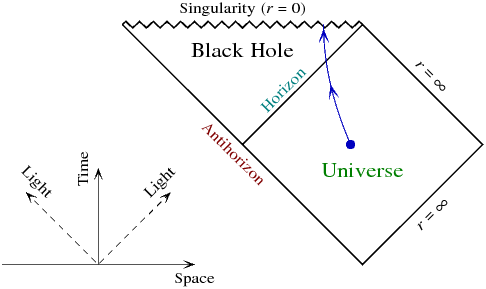
Or read Susskind's "The Theoretical Minimum: General Relativity". For a non-spinning blackhole at least, not only is the singularity not a point, it is a surface in time, not space (as the book explains, the space and time coordinates switch places as you cross the event horizon).
pdonis
3 hours ago
> the space and time coordinates switch places as you cross the event horizon
If Susskind's book does in fact say that, it's extremely disappointing to me, because, as a number of other GR textbooks will tell you (e.g., Misner, Thorne & Wheeler and Wald, the two great classic GR textbooks), the "switch places" is an artifact of a particular choice of coordinates (Schwarzschild coordinates), and does not represent anything physical. So it's not something that should be relied on. (Not to mention the confusion it causes when pop science sources repeat the statement and then draw all manner of wrong conclusions from it.)
The part about being "a surface in time" might be all right, assuming that by that he means "a surface representing a moment in time, not a place in space"--in more technical language, a spacelike surface. That is correct, and it's an invariant that does not depend on any choice of coordinates. But that invariant fact can be described without having to talk about the "switch places" thing at all.
sigmoid10
2 hours ago
Kruskal-Szeres coordinates indeed get rid of the wonky coordinate stuff at the event horizon, but if you look at the corresponding diagrams, you'll just end up with the same confusion, because the singularity is still a point (or rather surface) in the future instead of a point in space. The issue is that these diagrams are for eternal, static black holes, which cause diagrams to have these weirdly stretched infinite regions that are quite useful for understanding details of the math, but are highly confusing to laypeople. In fact these diagrams make it look like you'll always fall into the black hole at t=infinity, no matter how far you are away, when in reality you could orbit a static black hole pretty close for eternity.
If you really want to get a picture of what is happening, you can look at Eddington-Finkelstein coordinates. In particular at a light cone field diagram around a collapsing shell of matter that turns into a black hole. Then this whole stuff suddenly makes sense without even going into the math. You don't just see how an event horizon can form out of nothing, you also see how gravity starts to bend your causal forward light cone (i.e. all points in spacetime with events that you could interact with in the future) inward in such a way that you will necessarily always fall closer to the center of the mass once you pass a certain line (aka the event horizon). No need to deal with those weird infinities or points in time suddenly lying on a different axis.
The great Roger Penrose (the same guy who also came up with some of the most confusing diagrams) published a beautiful, simple overview of exactly this stuff in Scientific American: https://www.wkbpic.com/wkbx/SA/1972/1972-05-01.pdf (starting on page 38)
Still one of the best things you can read if you don't just want the math.
pdonis
an hour ago
> the singularity is still a point (or rather surface) in the future instead of a point in space.
It's a spacelike line on the Kruskal diagram, yes.
> The issue is that these diagrams are for eternal, static black holes
The full Kruskal diagram is, yes. But the essential features of the black hole portion of that diagram are still there in a black hole that forms by gravitational collapse of a massive body. That includes the singularity being a spacelike line, and there being spacelike curves inside the horizon that are infinitely long.
I agree that Eddington-Finkelstein coordinates can help with intuitions about this spacetime geometry as well.
sigmoid10
an hour ago
>It's a spacelike line on the Kruskal diagram
It also is in Schwarzschild coords, so you've gained nothing with respect to the original issue from switching coordinates. Kruskal-Szeres really is only useful for demonstrating that the event horizon is not such a weird place, but it does nothing for the singularity at the center.
>the essential features of the black hole portion of that diagram are still there in a black hole that forms by gravitational collapse
The issue is even the limited diagram doesn't really show you that and the full one goes crazy with white holes. So not a good place if you don't want to confuse laypeople.
XorNot
an hour ago
This doesn't seem meaningfully different to me? Like the notion that the singularity is always in your future (because you can't escape it anymore past the event horizon) makes sense, the point of confusion is what are the implications?
Roughly the general public (including me) knows that gravity is meant to have some effect on the apparent passage of time, so it seems significant but under explained what it means to be in a region of space where all possible directions lead to the singularity.
sigmoid10
43 minutes ago
>the notion that the singularity is always in your future makes sense
But it is just a mathematical artefact of weirdly chosen coordinates. In reality, the singularity is still just a point in space (or a line in spacetime), except that inside the event horizon all paths you are allowed to travel lead to it. There's no need for this whole "space turns into time" notion apart from the fact that you are guaranteed to hit it in *your* future as a local observer. And in Eddington-Finkelstein coordinates you can easily see that globally, things simply hit the spatial coordinates of the singularity at certain slices of coordinate time. Other coordinate systems make this whole process seem much more weird than it is.
pdonis
an hour ago
> the singularity is always in your future
It's not just that it's always in your future in the sense that you can't avoid it. It's that the reason you can't avoid it is that it's a moment of time, not a place in space. You can't avoid it for the same reason you can't avoid tomorrow. And which direction in space you move has no effect on whether or not you reach the singularity for the same reason it has no effect on whether or not you reach tomorrow.
kwoff
2 hours ago
Susskind's book does also mention that the event-horizon shenanigans are due to coordinates and not a physical thing. Certainly I'd trust what he says rather than me, so sorry if I was misleading.
(If anyone has the book, it is chapter 6 section "Interchange of Space and Time Dimensions at the Horizon" and the following section points out the singularity is a time (and you can't escape it (in a Schwartzschild model at least) just like you can't escape time). I'm sorry if my wording is still incorrect.).
pdonis
an hour ago
> Susskind's book does also mention that the event-horizon shenanigans are due to coordinates and not a physical thing.
That's good. However:
> Interchange of Space and Time Dimensions at the Horizon
This still seems misleading to me, because "Dimensions" makes it seem like it's not just an artifact of coordinates--but it is.
SoftTalker
2 hours ago
The way Brian Cox puts it, a singularity is a point in time: the end of time.
I have trouble really conceptualizing black hole physics, I just think of it as a mass so great that nothing, including light, can escape its gravity. Works for me.
PaulHoule
an hour ago
The singularity in a non-rotating, non-charged black hole is as you say. It’s like in a finite amount of time you “run out of time”, like there isn’t any more time on that trajectory.
The singularity in a rotating black hole is entirely different but the interior of classical Kerr (rotating) black holes is one of the most controversial if inconsequential topics in theoretical physics because there are reasons to believe (without real proof mind you) the Kerr solution is unstable inside the inner event horizon so that whatever happens in there is not what that theory says.
And of course black holes are quantum objects which might actually have an “interior” entirely different from the classical picture.
XorNot
an hour ago
The more interesting component is that black hole physics is almost an anti-free will zone.
Everywhere else in the universe with mass and energy you can do what you want (sort of). An event horizon throws a hard shroud over that and drastically reduces opportunities: your free will to use mass and energy is significantly curtailed (you must head towards the singularity).
dash2
4 hours ago
> the space and time coordinates switch places as you cross the event horizon
I'm sorry but this is blowing my mind. What???
Kranar
3 hours ago
Because it's very misleading. Time and space do not switch places past the event horizon. What happens is that the direction/path between an object and the singularity becomes a timelike dimension, and the direction that plays the role of time outside of the event horizon becomes a spacelike dimension. That is not the same as them swapping or that time becomes space and space becomes time not to mention that space has 3 dimensions and time has only 1 dimension so how could they even swap places.
Really what it means is that past the event horizon you can use the direction in space between you and the singularity as a way to measure time, specifically the amount of time left before you reach the singularity. It's not so mind blowing when you interpret it that way now is it? You can imagine many things in ordinary life that you use to measure time without claiming that time has literally swapped places with it. On a road trip, the number of kilometres to your exit tells you how long you have left, that's using space as a proxy for time... big deal. The notable difference between a road trip and a black hole is that on a road trip you could stop for a break, you could maybe take a detour, you could decide to go back home... and these would all break your use of space as a proxy for measuring time. Well with a blackhole you can't do any of those things, there is no going back, there is no detour, the relationship between the spatial direction towards the singularity and time is fixed and causal and there's nothing you can do about it.
The phrasing used is used almost certainly to evoke some kind of voodoo mind-blowing mystery that completely disappears when you get down to the more strict formalism.
pdonis
3 hours ago
> Really what it means is that past the event horizon you can use the direction in space between you and the singularity as a way to measure time
That's not correct. There is a relationship between the radial coordinate r you are at and the time it will take you, by your clock, to reach the singularity (at least assuming you are freely falling), but that relationship can't be described the way you are describing it.
To put the issue with what you say as starkly as possible: at any event inside the black hole's horizon, there are spacelike curves in every direction from you that will hit the singularity! So "the direction in space between you and the singularity" is not even well-defined.
To be clear, you are right that Susskind's statement is very misleading (I posted my own criticism of it upthread).
jimberlage
2 hours ago
Am I understanding this right by thinking - if I was walking toward the black hole past the event horizon, and then I turned around, I would still be walking toward the black hole?
pdonis
an hour ago
> if I was walking toward the black hole past the event horizon, and then I turned around
Note that, once you're inside the horizon, you can't "turn around" and go back outside again. You're inside the hole for good.
And once you're inside the hole, yes, no matter which direction in space you move, you're moving "towards" the singularity. But a better way to look at it is that the singularity is a moment of time, not a place in space. You're moving "towards" the singularity in the same sense as you're moving "towards" next Tuesday. You can't stop moving towards next Tuesday by changing which direction in space you move. The same is true for the singularity once you're inside the hole's horizon.
HappMacDonald
2 hours ago
Once you pass the event horizon, every direction leads to the singularity in your future. Directions "away" from the singularity may still visibly show what things looked like outside of the event horizon before you fell in, but that is from your past. Heading in that direction will not get you back there anymore, you will only find the singularity along that path in your future.
shepardrtc
an hour ago
You can't turn around though. Everything goes toward the black hole. If you turned around, atoms would be moving away from, or at the least changing their direction in respect to the black hole. And that's not possible. You wouldn't even see anything because all light is going toward the center, and it wouldn't go into your eyes.
Unless you went in butt-first, but the path of the photons would have changed and would now be going toward the black hole, and everything would look probably all smushed together.
aqfamnzc
2 hours ago
Sounds like that would be true if you were inside any closed surface.
XorNot
an hour ago
Not quite: inside a closed surface you can't escape, but things can repeat.
You can avoid a coordinate, for example by choosing not to go there, or revisit another one repeatedly.
A black hole on the other hand doesn't have that: you cannot revisit old locations - attempting to do so moves you closer to the singularity.
_moof
41 minutes ago
It's unfortunately misleading shorthand for what actually happens: space becomes timelike. It doesn't become time. All this means is that once you cross the event horizon, you can only ever move toward the center of the black hole, in the same way that outside of a black hole, you can only ever move toward the future. You might not take a direct route to the center, but no matter which way you move, you will be following a track that ends at the center.
The reason this phenomenon has a spooky-sounding name is that it also affects whether two objects can be causally connected. If you can only ever move closer to the center of the black hole, then there are (conceivably) other objects inside the event horizon that you can never have a causal relationship with.
But it doesn't mean that space and time literally switch places.
MathMonkeyMan
4 hours ago
[This video][1] and the one before it on the playlist are a good no nonsense explanation of the topic.
metalliqaz
3 hours ago
it might help to think of the singularity as not a point in space but rather a future that cannot be avoided. All possible paths through space and time, no matter what happens, will go towards the singularity.
lstodd
4 hours ago
Yup. It's that weird.
Also read Nick Gorkavyi: The Oscillating Universe: Einsteinian Cosmology of Black Holes and Gravitational Waves
empath75
4 hours ago
I think it's not even a valid critique of that and it's sort of playing games with what the definition of a singularity is to reach the claim that it's making. I think the topology of the singularity is not even a well defined question and certainly not well understood enough to bear the strong claims in the paper.
pdonis
3 hours ago
Unfortunately you are wrong. Everything the paper is saying about the singularity and its properties in GR, and more generally about the black hole solutions it describes, is well understood and has been for decades. The definition of "singularity" that the paper is using is perfectly fine, and its topology is perfectly well-defined. A good textbook treatment is that of Wald (1984).
Some of the things the paper points out are not emphasized in other sources, which is probably why the authors chose to write it. But there is nothing in the paper that is in the least questionable or ill-defined; it's all standard General Relativity as applied to the Schwarzschild and Kerr black hole solutions.
ImHereToVote
3 hours ago
Singularities suggest incomplete theories.
pdonis
3 hours ago
This is the opinion of most physicists, yes, but it does not in any way justify the GP's claims or cast doubt on anything that is said in the paper. Note that the paper talks explicitly about the limitations of GR as the singularity is approached and how a quantum gravity theory, if we ever find and confirm one, might fix those issues.