somat
7 hours ago
What I want to know is who decided to break px, the last thing we need is yet another screwball physical measurement, css was already full of them. But what "tut tut, everybody is using px and these new hi-dpi displays are rendering things really tiny, we can't have that" and now px as a useful unit is ruined.
Is there a way to use real pixels? My, admittedly quick, search says no. at least nothing jumps out at me from the spec.
drysart
5 hours ago
You can kinda get close in pure CSS with CSS media queries using the resolution query on dppx measurements; but that only allows you to be as granular as however many distinct "dots per CSS pixel" values you want to add media queries for. Something like this would let you scale by device resolution for both traditional 96dpi screens, higher DPI 192dpi screens, and super high resolution 288dpi screens:
    body { --resolution-scale: 1; }
    @media (min-resolution: 2dppx) { body { --resolution-scale: 2; } }
    @media (min-resolution: 3dppx) { body { --resolution-scale: 3; } }
    .myPixelSizedElement { width: calc(96px * var(--resolution-scale)); }
cobbzilla
4 hours ago
> But unfortunately there's no way to directly use the devicePixelRatio value you can read from Javascript directly in a CSS calculation to be able to get a precise scaling on any arbitrary pixel density.
The indirect way is for the JS to post the metric to the server, then you run with server-generated CSS. Don’t ask me if it actually works well though.
zamadatix
4 hours ago
Much simpler, you also just have JS update (and keep updated - initial DPI is not always the current DPI) --devicePixelRatio under :root on the client side. Something like that existing by default is all that's really missing.
notatoad
6 hours ago
px is still a useful unit. the user's operating system applying a scaling fator doesn't make it not useful.
if the user's operating system is configured to draw pixels at a 1:1 ratio, your pixels will be drawn at a 1:1 ratio. if the user's operating system is configured to draw pixels at a 2:1 or 3:1 ratio, you as a web developer don't get to override that, but you're still addressing pixels directly. if you want to write software that manages the user's hardware directly without giving them options to override it, the web is probably not the right platform for you.
somat
6 hours ago
The spec fafs around a bit talking about how the px is a "visual angle unit" But I am unable to form an interpretation where the "reference pixel" is anything other than 1/96 inch.
https://drafts.csswg.org/css-values/#absolute-lengths
I guess theoretically a tv could say "this tv will be viewed at 12 feet away so our reference pixel is 1/16 inch" and still be in spec. Which sounds like it has messy implications, Does anyone do this?
Anyway the point being a pixel should fundamentally be a hardware measurement, and if they wanted a "visual angle unit" they should have introduced one.(the moa?) But the last thing we need is a pixel being defined as a hard 1/96 of a inch. which is what we got.
wongarsu
5 hours ago
Windows used to let you set the DPI setting of the monitor, circa Win95-WinXP. Software tended to only expect a value of 96dpi, so it wasn't a very practical setting to change, and eventually windows introduced display scaling (which leaves old software in the belief that you are on a 96dpi screen, while allowing software to opt in to knowing about the real device pixels)
Screenshot: https://www.softacom.com/wp-content/uploads/2022/03/11111-10...
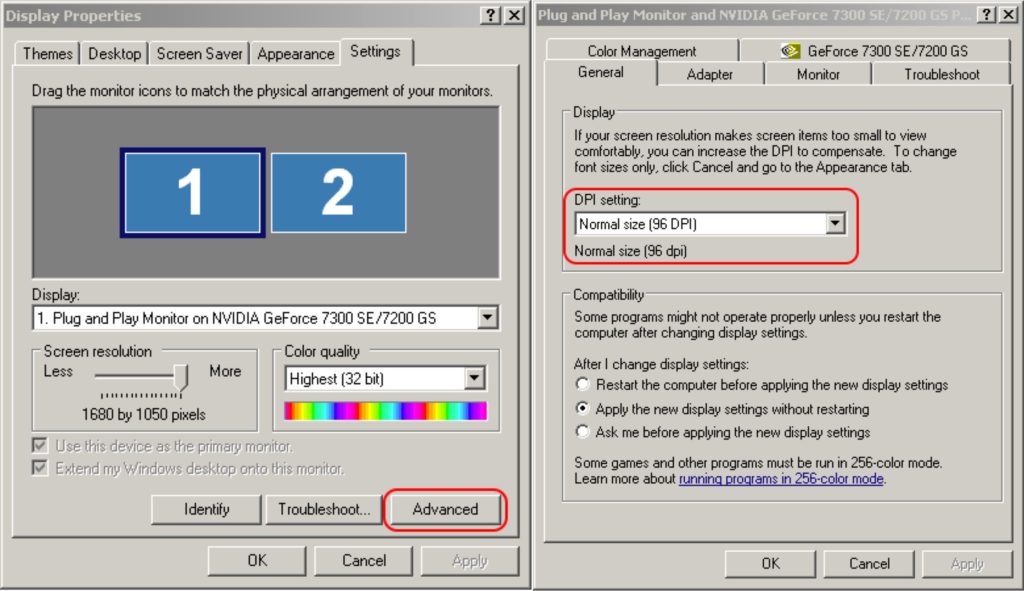
I guess you could use that setting on an old version of windows to set a screen to 16dpi, and now a CSS reference pixel is 1/3rd of a real pixel? But more realistically, what the spec is getting at is that a mobile device should set its dpi setting close to the real device setting, and a reference pixel is now something that looks about as big as a pixel on a 96dpi screen. That nobody actually sets their screen dpi on desktops is probably of secondary importance to them
notatoad
6 hours ago
what the spec says doesn't really matter though, the spec is just nonsense people wrote down to try to back-explain decisions that the browsers had already made.
pixels are pixels, and no browser implements them as a fractional-inch measurement. in every actual implementation i'm aware of, they're a hardware based unit.
edent
6 hours ago
They aren't hardware based. As I say in the first link, pixels mostly don't exist in hardware.
Screens very rarely contain a matrix of individual squares.
For example - https://global.samsungdisplay.com/29043/
jonhohle
3 hours ago
Pixels very much exist in hardware outside mobile. Microsoft’s clear type even exploited the specific layout of color channels in discrete hardware pixels. Mobile displays are all over the place, but most other displays use standard RGB layouts.
edent
2 hours ago
You've described the exact problem. Sub pixel rendering exploits the fact that most display pixels aren't discrete logical squares.
SR2Z
2 hours ago
Right, but there's still an addressable set of display units that convert an RGB signal to actual glowing lights, right?
It seems like defining px to be perceptual is one of those compatibility hacks that probably helped a ton back in the day, but we have perceptual units and now we're stuck with that baggage.
I don't have much of an opinion on this (I use em) but it has taken me by surprise a few times.
fsmv
6 hours ago
You could set the CSS zoom property to 1/window.devicePixelRatio with JavaScript but I think you can't do it with CSS only. If you do that then px is physical px. This doesn't include browser zoom though or mobile pinch to zoom. You could also get those with JavaScript but then people would be really confused by the behavior of your website.
You definitely can't get pure integers though it's always a float even if you use whole numbers. It does eventually get rounded before becoming pixels though.
somat
5 hours ago
That is sort of where I ended up, Not that it matters, Pixels should probably never actually be used. It just offends me that a unit that is sort of messy and tied to physical hardware but does provide measurement that can not be found elsewhere. gets neutered and we end up with another useless absolute unit, inch, point, millimeter, pica, the Q(did we really need the Q?) and now the pixel.
_matthew_
4 hours ago
To be honest, I'm quite thankful to whomever decided this. If it were the other way around and everyone used px but it represented true pixels, there's no doubt developers would be incorrectly designing interfaces across the board and websites looking totally off would be a common occurance due to you having an hdpi display or not having one (like what frequently happens with x based apps in Linux).
As an aside, technically, yes, it may have been better to converge on some more clearly "fake" unit rather than calling it a pixel but for me that's a nit pick.
cedilla
6 hours ago
No one decided to break it, it was 1/96th of an inch from the beginning.
The problem with different screens having different pixel densities was already present and obvious in 1996.
"Real" pixels are useless if you don't know anything about the screen you're going to render on.
mananaysiempre
6 hours ago
It was around 1/96" on a conventional PC screen because that was the conventional pixel density for PC screens; it was 1/72" (i.e. 1pt) on a conventional Mac screen for the same reason. That was something to deal with already in the GIFs-in-tables era and remained one as we moved on to CSS, right until Retina happened.
Unfortunately, Retina gave us a nonsensical and hacky “scaling ratio” rather than separate and independent units of physical length, viewing angle, and interaction granularity. (I still can’t get an A4 PDF in GNOME to display at “100%” such that it would actually be 210mm wide on my screen. And Darktable is the only piece of software I know where you can configure ppi and ppd separately.)
cedilla
6 hours ago
Correction: in CSS1, from December 1996, a pixel was defined slightly differently, which works out to 1/90th of an inch.
bazoom42
4 hours ago
[dead]
