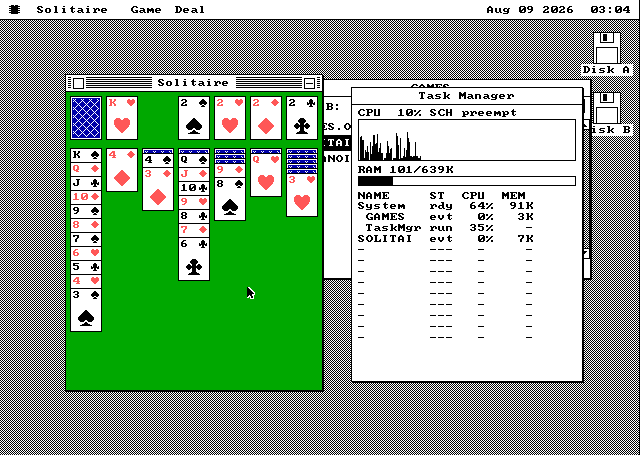
> The graphical operating system that could have been for the IBM XT
Visi On[1] was a graphical operating system for the IBM PC that actually existed as a commercial product, though definitely not a very successful one. It was made by VisiCorp, the same company that created VisiCalc (the first spreadsheet for a personal computer).
It was demoed at COMDEX in 1982, before the Apple Lisa was released. It came out after the Lisa but slightly before the Macintosh.
Here's their promotional video from 1983: https://www.youtube.com/watch?v=kc4wFeVvKTI
Fun fact: Bill Gates saw the demo at COMDEX, and at first he was skeptical that it was really running on an IBM PC. But ultimately he was so impressed he decided[2] to start developing a product called Microsoft Windows.
---
[1] https://en.wikipedia.org/wiki/Visi_On
[2] https://en.wikipedia.org/wiki/Windows_1.0
This kinda almost makes it sound like VisiOn introduced Gates to the GUI which is not true. They were already using and developing for Macintosh machines at Microsoft and had hired Charles Simonyi from PARC with his expertise in GUI systems before Comdex 1982.
The story seems to be more that seeing VisiOn gave MS the nudge to get into action on the GUI due to a sense of competition/urgenbcy from VisiOn rather than learning about the GUI from VisiOn.
Stories about Xerox PARC aside, the Apple Lisa was released to the market at the end of January 1983, and I would be surprised if Microsoft wasn't big enough/rich enough at that point to acquire at least a couple of units from the very first batch to mess around with. Windows 1.0 RTM was November 1985.
Microsoft was big enough as they were already selling DOS and DOS software.
Author of the AI written os8088 OS here...
Thanks for sharing the promotional video for Visi On. It's cool to see how many different companies gave this a shot back in the 80s.
> Author of the AI written os8088 OS here...
I'm curious about your goal in purchasing this project.
You don't get any peer recognition. You don't gain any special skill. You can't copyright it. You can't sell it. You can't use it for anything useful. You can't use it as a learning exercise. It can't really be built on. It can't serve as a tutorial for others to learn.
You don't get the satisfaction of a job well done (well, no more than the satisfaction you get from buying a toaster on Amazon).
Pre-LLM, something like this was a huge achievement. Now it's the equivalent of a 1st-grader showing off their finger-painting like it was the Mona Lisa.
So, what are you getting out of this?
This is something that hasn't been done before, and now exists.
Yes someone could spend immense amounts of time and effort, but clearly no one bothered to until AI made it easier.
yet the complainers will always complain because they don't have anything better to do with their own time...
"bugger off!" as they say.
None of what you say answers any of my questions.
It's hard to be impressed when someone purchases a new toaster, even if it's a bespoke toaster.
I want to know what the author thinks he got out of this.
Let’s say you’re a musician and pay to go to a concert. What do you get out of it? Profit can come in many forms, including simply seeing that a thing is possible.
And yet people have been impressed by my bespoke toaster
When people write things like this I wonder if they just haven't used AI coding agents. You don't simply write a prompt and walk away and have a complete program written when you get back. You still have to put a fair amount of effort in description often many times, not unlike the sort of work you'd have to put in if you were supervising a group of junior developers as a systems analyst. It's still work, just at a higher level. And until (and if ever) we get AGI humans will still have to do this.
> You still have to put a fair amount of effort in description often many times,
It's nowhere near "a fair amount of work". It's a fraction of a percent, if that. The reason I know this is because I am using LLMs quite deeply.
For this specific project, I'd be very surprised if the prompter needed to know anything more than:
1. Assembly exists.
2. The 8088 (and later) existed.
3. The target hardware's OSes did not support preemptive processes.
For Fable (which is what they used), it can infer the rest, with the user providing "No, that's not it, change the color" type of prompts.
I went to Amazon the other day and ordered a fully custom piece of software. I chatted with the seller about exactly what I wanted, what areas to focus on, and they ended up teaching me a thing or two about the domain. Very similar emotional experience to using a language model, which I’ve totally done before.
I'm sure it is a learning exercise in OS development to some extent, just a lightweight exercise compared to doing it 'properly'.
FWIW I don't upvote submissions like this though, because it contributes to a climate of cheap superficial fame.
You are embarrassing yourself.
If you think LLM's allow you to wave a magic wand and anything gets done then you really are so anti LLM that you're now technically way way behind and just irrelevant.
Making software like this person has achieved is not just saying "do it" to an LLM and waking up in the morning.
Your anger towards LLMs has blinded you and set you back whilst everyone else moves ahead.
> If you think LLM's allow you to wave a magic wand and anything gets done then you really are so anti LLM that you're now technically way way behind and just irrelevant.
Honestly, I probably use 'em more than you.
> Your anger towards LLMs has blinded you and set you back whilst everyone else moves ahead.
If it makes you sleep better at night believing that, then sure, go ahead.
The reality is that most people lose any sort of status or respectability when they try to pass off difficult work as their own. This was true before LLMs, and will continue to be true, no matter how often someone shows us their equivalent of finger-painting.
From what I understand, the AI is the author, not you.
You are the customer.
> Hand-written real-mode 8086. No C, no linker, no runtime library.
More like hand-prompted...
From the landing page:
> 66,183 lines of hand-written real-mode assembly
Goes to the github - contributers jggonz and CLAUDE. The README.md doubles down on this at the bottom with the license.
> Everything here is hand-written; no third-party code is vendored into the OS, so the whole tree is covered by that one license.
That's what happens when you let an LLM write your ad-copy...
> there is no value in being a Public-Domain-Dumping-Ground.
First of all, isn't that the entire point of the Internet Archive? Sounds pretty valuable to me.
Second, doesn't the same issue effectively apply to everything written with the BSD or MIT license? I'm not sure I understand the point though, so I'm probably missing something.
A BSD or MIT (or any other) license doesn’t remove copyright. For example, copyright reserves the author the right to also release the work under a different license in the future. AI output doesn’t have such associated rights.
Did you believe that the Internet Archive hosts nothing but PD content?
The Internet Archive has lots of PD books and other works that have been scanned in. But the Internet Archive's web pages are all copyrighted. Only a small percentage of anything on the Internet is PD. All those news articles that HN bypasses paywall? Piracy of copyright.
How do you think the IA got in legal trouble during the pandemic lockdowns?
There are instances of purely PD archives: librivox.org and gutenberg.org. Their mandate means everything is PD, whether it was PD to begin, or whether it is novel work by modern creators. The archives are sustained by their donors and volunteers, who are scanning these works, fixing up the OCR, recording audiobooks, and otherwise donating their time, talent, and treasure to building the archives. Perhaps both are obsolete by now.
Everything written in BSD and MIT license is copyrighted. Copyright may be assigned, dual-license status may exist, non-exclusive rights may be assigned. None of this applies with purely PD works.
I stated no mere opinions, and I made no novel predictions, but I gave observations of current practices. The only prediction is that these two practices expand and escalate for as long as LLMs' legal status remains this way.
You're not missing anything. I think this is a person trying to speak their opinion into fact by quoting themselves.
1. The copyright claim is valid in places where LLM output is always covered by copyright.
2. It may be valid in places where sufficient human contribution makes AI code covered by copyright.
Even if it is not covered by copyright everywhere, it has a significant effect. If something is covered by copyright in some countries but not others its cannot be globally distributed without a license.
> 1. The copyright claim is valid in places where LLM output is always covered by copyright.
Actually not: the copyright claim would be particularly egregious in, e.g. the UK, because if the publisher has not even acknowledged or attributed contributions to Claude, then Claude's copyright is infringed, and the publisher could be liable for fraud on top of that.
And to address your second point: if the publisher claims 100% ownership, authorship and copyright, then who can even determine the amount of LLM-authored code? Something must come out in depositions or the courtroom about how much Claude committed, and how much was by humans, because in this case in this thread, the publisher has claimed 100% human authorship.
"Author" of os8088 here. You're right, it's hand-prompted.
Claude's Opus and Fable have done a really great job helping me and another contributor shape this operating system. It's been a really interesting way to learn about the different techniques that other operating systems have used to get the performance we saw in LisaOS, MacOS, Windows, GEOS, etc... performance at 640x480 on an XT class machine is tricky! Also, the 64KB segment limitations were very interesting to overcome!
One thing is where you learn through llm and then apply this knowledge, write asm the way humans do, another is letting Claude generate everything.
Stop calling it "Mac-like" and the project will live longer
Did you ask Claude to write this comment too?
lol, so disappointing to see the attacks when I'm just having some fun.
It would probably had been fine had you just not put the "hand written" part.
Yes, agree. I laughed at that when I first saw it last week. I went ahead and cleared all that up on the homepage and the README now.
You haven’t even wrote readme yourself?
And LLMs are still confidently bullshitting:
> Everything after that is the interface you remember from a 1984 Macintosh: […] and a dock along the bottom with one tile per running program.
In that case I look forward to seeing OS X’s Aqua ported to the IBM PS/2.
In that case I look forward to seeing OS X’s Aqua ported to the IBM PS/2.
If this project is any indication, AI can definitely make that happen too.
If we’re going to be really pedantic, there was no “System 1” as TFA says as well anyway - I don’t think there was an actual “version 1” of the System File version 1, and most of the routines at that point were in ROM.
But an LLM would have caught that. Signs of a human touch?
> I don’t think there was an actual “version 1” of the System File version 1
There definitely was. https://en.wikipedia.org/wiki/System_1:
“The Macintosh "System 1" is the first major release of the classic Mac OS operating system. It was developed for the Motorola 68000 microprocessor. System 1 was released on January 24, 1984, along with the Macintosh 128K, the first in the Macintosh family of personal computers. It received one update, "System 1.1" on December 29, 1984, before being succeeded by System 2”
That page doesn’t mention it but I think the original Mac shipped with a 0.97 or 0.98 version.
I’ve got nothing against AI-written code
But if people are going to post it on HN, they should consider at least writing the README / main page of their website by hand
It is nice to hear the human authorial voice, at least sometimes
I agree. We've just been spending more time on the operating system than the homepage. I'm making some updates, but it's still all going to be written "through" AI for now.
I'm surprised Claude is actually decent at real-mode Asm, but maybe there was a lot of attempts and guidance by the human.
The assembly really, really hurts to read.
In what way?
It looks much closer to real human-written Asm than compiler output, which is itself a big win. No stupid calling conventions or obvious bloat. The unmistakably bloated inefficiency of "compiler slop" (that term wasn't used at the time, but those who lived through that Asm vs HLL era on the PC will know exactly what I'm talking about) is not present. I can always spot immediate optimisation opportunities with compiler output, but at a quick glance, not in this code.
...and now I have the idea of getting AI to decompile some existing binaries and then have it optimise/rewrite in the style of human-written Asm... run something like Windows XP or even 11 through it and see if it can be optimised down to a tiny fraction of its current resource usage.
Ive been throwing z80, 6502, 68000, 8086, i386 and x86_64 asm at it lately. Haven't seen it get stuck on any of them.
Do you think the low-level nature of ASM contribute to how successful the LLMs are with it?
I think also that a large/smart/fast LLM can automate testing things with QEMU for at least moderately common architectures like motorola 68000, throw code at it rapidly and try different iterations.
Not sure what the point is having AI write asm when it could write C, which a compiler could likely optimize better than AI.
It's funny how virtually everyone on HN is using AI to write code and simultaneously dismisses all interesting new software as written by AI.
For me personally there’s something deeply unsatisfying about hobby projects that are entirely AI generated. Work code is something different. I don’t have passion for a lot of that, it’s just the way I earn money.
This is never going to be a commercially viable project. It’s a wonderful idea for a hobbyist passion project. But if you’re not actually coding it yourself it feels far less interesting. I can’t really marvel at what they’ve created because I know that with a stack of tokens I could do the exact same thing myself.
It’s also a dead on arrival project that won’t exist for long, and will not be maintained and expanded by the author.
There's a difference between using AI to automate some drudge work of stuff that would just be mentally tedious to do (writing an operating system for an 8088 in assembly? Tedious, unless you're one of the rare people whose mind does well with that sort of thing), and just not even being bothered to write your own readme files and project description.
At least take the time to hand write a description of what it is and acknowledge the tool assistance as a known fact.
Making fake claims that something is totally hand written is I think what bothers people about this.
I think writing asm can be pretty straightforward and fun, with experience, strict developing principles and lots of macros.
There are both pro- and anti-AI factions here... and those with more nuanced views.
Personally, I don't care as long as the end result is good, but a lot of AI software tends to be in the lower end of the quality range.
I agree, and I think one can put in more effort on a project and get a better result, especially if the prompter is already an experienced software developer. For example on one toy project I requested the use of ADTs (algebraic data types), strict linting and code formatting at every commit, tests, frequent code review rounds, and a strong initial plan which led to a very solid personal-use project.
Similar strategy can help smaller local models achieve greater results too. Small steps + many guardrails.
Different groups, the spammers like to congratulate each other for how much hard work they must have put into their very impressive prompt engineering. Regardless, AI code is distinct from extremely blatant AI design. People dismiss things that had no actual design, just whatever fell out of the prompt they gave it. If you can't write a single human paragraph or put thought and care into how you are presenting 'your' project, it's not worth paying attention to. Why can't they present their own work honestly? Why would I spend energy looking at an OS made by someone who can't write an HTML file by themself?
This is a psychological phenomenon going on right now in the world around AI: gaslight your competitors into doubt and disbelief, then win.
I presume that there were similar movements during 1950-1980s who tried to gaslight the publics against using computers while using the computers to gain a competitive advantage over them.
I can pour myself a bowl of cheerios. That doesn’t mean I’m easily impressed by someone else preparing a similar bowl of cereal.
Though, I have been finding a lot of utility in programs that support otherwise deprecated hardware, now that is some good slop.
It’s almost like those are two different populations of people?
Outside in the real world? Sure.
Here on HN? I don't believe that.
OK, if you're so confident, surely you've gathered data that empirically shows that "virtually everyone on HN is using AI to write code and simultaneously dismisses all interesting new software as written by AI", because that's a very easy claim to prove or disprove.
Can we see your results and methodology?
I know a guy who founded an AI-based startup well before ChatGPT, and recently I saw some of his public messages where he stands as an ultimate anti-AI proponent.
Meanwhile, his startup that received multi-million dollar funding and developed proprietary specialized LLMs, continues to exist being somewhat profitable.
Universal AI, however, poses an existential risk to his company. So he turns into a typical gaslighter: he tries to convince everyone that AI is a dead-end, not worth it, a total disaster. By doing so, he hopes to prolong the stream of existing profits maybe just for one extra day, but internally he already knowns that his company is toast.
I think the remark was glib/sarcastic/ironic. That's frowned upon in this forum, and for good reason.
Beveled-buttons Minesweeper (first appeared in Win 3.11 IIRC) running on a preemptive 8086 OS with a bootleg System 1/2/3 interface looks absolutely cursed.
The graphical operating system that could have been for the IBM XT.
A MacOS-like desktop for the Intel 8086, written entirely in real-mode assembly (with Claude). Verified to run on real hardware, with FAT12/16 support, ported apps, games, Sound Blaster support and upcoming Hard Drive support.
PC GEOS was much later circa 1990, the company spends years maintaining the first version targeting the C64 and Apple II. I also remember fondly the quality of prints produced by PC GEOS which included lots of home printer drivers. The system used an alternate vector font system not Truetype. Its SDK is probably still very interesting, but i suspect the complexity level was one of the reasons so few third party apps were developped for it.
when i'm feeling blue i go read and toy with geoworks source.. it's kinda weird to read TODOs from 1900 :)
and one wonders what could have been if there were not incompetency of microsoft etc..
Apple might sue you though, like they did DRI :-)
https://os8088.com/how-it-works/multitasking/
> Pre-emptive multitasking on an 8086
> Twelve task slots, 1,536 bytes of stack each, and a timer interrupt that takes the CPU away from whatever is running 18.2065 times a second. No task is asked to cooperate and no task can refuse.
If you don't have protected mode, can't any program just rewrite the interrupt handler? It's not a bad system, but it sounds easy to break.
This would be exactly like the original Mac--all processes had full heap access at all times. There was a special debugger extension that watched address zero because writing through to null was so common. (IIRC the original Mac intentionally left address zero alone for these reasons as well.)
The original MacOS lacked memory protection too. It had cooperative multi-tasking, starting at version 7. Before that, the only thing that could be launched next to the main application were "desk accessories", which were a bit of a pain to write, as they had to stay out of harm's way.
MultiFinder existed before System 7. It was just optional.
It's a toy, easy to break is what vintage software was. A very different era with users of a very different mindset.
Not just rewrite the interrupt handler either, can rewrite the timer itself :)
Part of the fun of real-mode is the absolute god like power you have. Downside is the 20bit segmented memory model.
> If you don't have protected mode, can't any program just rewrite the interrupt handler?
Yes? It's still possible to make it safe if you ensure that all programs are written in a memory safe language. Aside from throwing out a ton of existing code it's not as bad as it sounds. The Birth and Death of JavaScript touches on it towards the end.
https://www.destroyallsoftware.com/talks/the-birth-and-death...
Yeah, that works for making sure the machine isn't constantly crashing.
Although from a security point of view it's still very bad. Every compiler / JIT has bugs, and bugs that let you write to random or arbitrary memory adresses are a rather common kind.
Doesn't really matter for a hobby project though
Yes, it's easy to break. There's no memory protection. However, building packages, drivers, and kernel modules for it has been a fun and educational exercise in memory management.
This is great -
It’s almost as impressive as the “GOS” written for Atari 8-bit running on 6502 at 1.79 MHz. Visually it’s almost identical but has a nicer font. The specs are somewhat similar with 16 task slots, calculator app and task manager, serial mouse support (ST mouse) and Atari’s hardware sprites helping with some of the graphics. The XOR window frame is the same idea. Amazingly, Atari GOS runs in 128K of RAM! One has to admire the work and inventiveness in these projects. See description and videos here:
https://atari8.co.uk/gui/
"Author" of os8088 here. I love seeing what these early limited system could do! Someone shared a video of GOS with me after seeing what os8088 looked like.
I believe os8088 also boots now with just 128k of RAM, but it's very limited in the type of apps you can load. There's a os8088.com/hardware page where one of the contributors to the project that has been helping optimize the operating system tested it out on a bunch of different machines.
The XOR window frame was on most X11 window managers since late 80's and early 90's.
A fun hindsight LLM project :)
LLM writes a better ASM then a C compiler? From running the demo in the browser, it seems so performance-wise and size-wise, but the ultimate test should be performed on a real hardware that I have no direct access to.
Anyone can validate the performance on a real PC of the era? If it's confirmed, LLMs may be one of the ways of creating highly optimizing compilers in the future.
I was curious about this and had a look. The code doesn't look much better than what a good C compiler might produce, and I found quite a few opportunities to optimize. It doesn't look much at all like the 8088 code I wrote when I was a teen. Among other things, so much pushing and popping.
Take the irow loop in vga12.inc[1] (of course I'm going to look at the graphics code). Each iteration does push di; rep stosb; pop di; add di, ROW_BYTES (and some other stuff). Why not save the push/pop and add (ROW_BYTES - count), which could be stored in a register (dx is free here)? Just the push+pop is 15+12 cycles.
[1]: https://github.com/jggonz/os8088/blob/1f2fae44180fadaf85368c...
True, that piece can be optimized better, but quality of the assembly code in general is not far away from what I had been writing in 1993-96. Back then, push/pops in function prologues/epilogues were a sign of experienced assembly programmer who avoided register clobbering by using standard calling conventions.
This is awesome and you should keep working on it.
That 20px title bar is way too thick for the font. Make it 16 pixels at most.
I mean this is cool, it's wholly / mostly AI gen, so it takes the wow away which I think is what foklks are reacting strongly to here.
Sadly this sort of thing is much easier now - thanks to the tooling. I speak from personal experience, I'd written some stub 32bit os' myself (by hand, pre-ai) and it is very fun. But you quickly run into walls that stop further development that aren't fun. I enjoyed poking at VGA registers, the 512 byte boot sector into real mode into protected mode dance. Setting up the global descriptor tables/page tables and the PIC/8042 controller.
But...then you get into protected mode you get a prompt up some very basic memory management and then TERMIOS...boring. Boring. Defining all the posix syscalls, boring. Building test harnesses ... boring.
Oh I need a DMA controller now because PIO is slow, FUN!!!
I've taken my toy os to basically Linux 2.0 level in a few weekends by throwing tokens at boring things and when I got to the end it was a little bit empty because although the kernel of the system was all me, and it very much was built on the skeleton I arranged I didn't understand bits now that while boring were important. And the magic ... was lost.
I'm working on a new version now where my rule is I hand type every line of code and I co-plan with the AI and write from my head. It's so slow going but the fun is in the problem solving and the design and by hand writing you keep enough of it in hand it feels yours and real.
Anyway this is a cool project, I hope the author enjoyed it and learned something, but this is the new normal now, powerful tooling means things that were novel are tokens away and so they lose some of the magic accordingly.
I am not sure I will ever get this to protected mode... The goal was to have something running on slower, older hardware, and once protected mode comes into play, we're letting go many of the constraints that make this an interesting experiment.
Even though I've relied on AI to hammer out the assembly, it has been very educational iterating on it. You end up learning the techniques that other operating systems used to get applications to perform well on slow machines.
Yeah, I think the ability to move at pace helps and especially when you get stuck at some sort of intractable bug, in realmode especially, claude/gpt is unbelievably good at identifying and proposing the fix.
THAT is part of the issue with it though, those length debugging sessions where you prod and poke and have to hold complex interactive segments in your head is what gives you that deep understanding of a piece of software. You do lose that when you throw the AI at it. This is part of my motivation for handwriting 'offline' all my code for these types of project. Have a doc to work from but otherwise wetware is doing the heavy lifting.
This isn't efficient use of time at all and professionally a dead end. But as a pasttime/hobby for an enthusiast it opens a door that would be closed (project like yours and indeed mine) while still having it grounded in our own work.
I don't think you can call it Mac-like without proportional fonts. Fonts and QuickDraw (particularly the region manager) were really Mac/Lisa's biggest innovations.
Agreed. It also needs roundrects.
I think someone vibecoded a bad System 7 replacement that had at least some QuickDraw in it.
In this case, actually doing those things would probably make it insufferably slow on a real PC though at least at vibe-coding quality.
The real implications here (also looking at the WinWord port to win64, which I suspect had some AI involvement as well) is that current agentic AI completely changes what a hobbiest can do over a weekend, as long as AI slop code is acceptable to meet one's project goals.
---
It's certainly affecting things I've worked on... there'll be a much better version of ld-decode soon using Claude Fable which is faster and has better filtering (and an audio noise-reduction post-processor that actually works) and I'm pretty sure you could get much of ELKS working from scratch in one weekend at this point. whispers something about doing a UNIX-like on a pi pico 2 (or two), since he can't do it because reasons...
This looked great, I started reading things, and then I just kept reading and reading the voluminous description details, and it was an immediate indication to me that the whole thing was built up by Claude. Confirmed in the repo. I closed the tab.
I appreciate the topic, interest, and ambition, but if a human couldn’t be bothered to create and document it, I can’t be bothered to spend my time reading about it.
"Author" of os8088 here. That's unfortunate. This is a hobby, and yes, it's all written with Claude. I have a bunch of videos up showing the process.
I'm updating the copy of the page to make it extremely clear that it's built using AI so that we can move past that point.
"I want this. I want that. No, not like this, like that. Add this to it."
Sounds like a weird hobby.
But why do you all think we should spend our time reading your empty whining about it?
This is like clicking Google reviews on an eatery and reading “1 star we went there and it was closed!!!” “1 star they don’t let dogs in so we’re never giving them our money!”
Yeah if someone had spent 6 months coding this dead end from 1978 in assembly rather than getting Claude to do it in six days then I’d have given it more time too.
This rewrites what-could-have-been history a bit... better get my IBM XT/286 out of storage! Is this for real?
I might have to try it out. I have an 8088 IBM PC (my first computer) on a desk. I need to swap out some bad RAM (I've been getting Parity errors and other strange behavior), but it says it works with 256KB so I could remove the AST SixPakPlus altogether. The fully populated mother board has 256KB. (I could also unplug the MFM hard drive controller as well.) It supports CGA and VGA and I have both (the CGA is original; the VGA is an 8-bit ISA one I picked up a couple years ago). I also have a serial mouse... Right now I have one floppy disk that came with a book I re-bought recently (Peter Norton's Guide to Assembly Language) and I could back up the files from it and use that but I think I'd rather buy/find another one to use. And I need more than one disk for this anyway.
Interesting, it currently says, 'Nobody has yet written the images to 5.25" media and booted an actual XT with them.'
"Author" of os8088 here.
That's no longer the case. Someone that is contributing to the project is using real hardware to validate the changes. You can check out some of the systems he tested it with here: https://www.os8088.com/hardware
The system does currently run with 256KB of RAM, and you can use some of the basic apps, but not all of them.
Chris Hinsley started TaOS toward the end of the 80's .. Him sick of being asked by games industry managers to "do it again but for PC". By 1991 there was a start up, and by 1993 there were awards for his endian-independent VpAsm OS. I mention cos the tubling cube demo (two windows) would allow one to be dragged over the other without cubes slowing in their tumble at all, and without the envelope-drag-letGo-repaint effect. No stammering for the window manager. This tech was legendary and the multi-tasking was an order better than WinNT later which itself was an order better than Mac's cooperative-task-thunking. Lots of the videos of that time lost sadly, and all the source code. Chris is doing it all again, but making it harder for himself -> https://github.com/vygr/ChrysaLisp - while also using LLMs for lots of it.
The website explicitly states a lack of networking. Any interest in pursuing that in a future version?
I have a Pocket 8086 - I would love to give this a try next weekend.
We have built in driver support now, so we will be adding network driver support soon. We just added hard drive support that is potentially a bit buggy...
I don't know why it seems reluctant to disclose AI use, because this is one of the best advertisements of Claude I've seen, and I say this as someone who has been sitting on the fence on the subject and saw a lot of slop in the past few years. If I was working in Anthropic's marketing department, this is the sort of thing I'd point to as a demo of its abilities.
That said, it's not like something of this nature was thought impossible; many embedded OSes running on even slower and more limited machines (e.g. 8051) had preemptive multitasking and a primitive GUI. It just took several decades for someone with the idea, tokens, and motivation to actually do it.
To me the most interesting thing here is that AI did it, albeit with very good prompting.
Claude AI just created something in a few hours, perhaps, that teams of intelligent developers at the time struggled to do in years of effort.
You'd still need a Wordstar-like app and a VisiCalc-like app (pref. Lotus 123-like).
VGA adapter means you have to wait until 1987 to run this, otherwise you'd deal with CGA's non-square pixels. EGA support would only be possible in Oct 1984.
The IBM 1501 PGC (640x480x256) was available in 1983.
But was exceedingly rare, in the pre 640x480 VGA era the common video interfaces on 8088, 8086, 80186, 80286 were MDA, Hercules, CGA, or later on, EGA.
Was not expecting the fractal viewer (in disk B/apps)
I might even port over povray... :)
Por a ZMachine interpreter; there are ones for CP/M and DOS (Frotz).
It looks surprisingly Mac-like, except the font kind of spoils the illusion.
If it were available back then, Microsoft may be a small shop today or may have gone the way of Lotus.
No.
Technically better software was rarely the primary factor in how the early microcomputer wars played out.
You mean like the Amiga or Atari ?
Fun little toy. Wonder how much in tokens went into it.
Sorry the question, i watched shortly your videos, i see you vibe-coding it in an emulator.. but did you try it in a real hardware? With real floppy disks?
I'm intrigued by how it runs on those machines in terms of performance. Maybe you have some real-time videos?
This doesn't seem like any sort of achievement to me