fosk
a month ago
The EU is a farce, an undemocratic virtue signaling organization, and this is why:
- The Parliament voted against the first reading of this proposal twice in 2026, the first time they only supported limited cases for it, while the second time they actually defeated it fully.
- The Commission didn't care, and kept the proposal on the table by refusing to withdraw it.
- Once the Commission does that, the proposal goes on second-reading (despite the first-reading having defeated it) and it is established in a very PERVERSE way in EU law that to AVOID passing the proposal in second-reading you need ABSOLUTE majority which is incredibly hard to pursue (you would think that we would need an absolute majority to PASS a proposal that was previously defeated on first-reading, not instead needing absolute majority to DENY a previously defeated proposal that was again forced to the table).
- Furthermore, absences in practicality count as "No" on the rejection. So of course they scheduled the vote in the summer when notoriously there will be many absences.
By never withdrawing a defeated proposal they can effectively and in practicality pursue any agenda they want (it requires a massive mobilization effort to find absolute majority to defeat any proposal, especially when absences for any reason effectively count against rejection).
In PRACTICALITY, the Commission can pursue any agenda whenever and however they want, and throw the votes down the drain.
EU's democracy is lipstick on a pig.
flossly
a month ago
It's worse than a farce. It's actually evil. The way "they" are pushing chat control, and how Ursula is avoiding justice (she has a huge corruption case hanging over her head but manages continuously cancel court dates); this makes a all too clear.
The only way to fix this is EU member states become more critical: but for politicians in those states an EU position is the best promotion they can make. So almost nobody dares to speak out.
ALLTaken
a month ago
Social context (pardon the subjective background, I'm trying to only provide what's collectively shared more or less in Germany):
Ursula von der Leyen is hated in Germany as an evil war-mongering gnome. She was previously appointed to replace a highly decorated military general of the Germany Army (Bundeswehr) without having any skills in that area, except being corrupt to the core. She miserably failed the military, cost the state large losses in tax-payer money and was promoted instead being removed. Then she "somehow" became the fierce and corrupt "Queen of the EU".
EDIT (I owe you sources at least):
I think it goes much deeper, I think it's not just corruption, she's a perfect traitor of the EU and Germany. Selling all 500 million europeans out to a foreign state.
- https://www.spiegel.de/politik/deutschland/eu-abgeordnete-dr...
- https://www.welt.de/politik/deutschland/article191310021/Urs...
- https://journalistenwatch.com/2026/07/11/ursula-die-skandal-...
- https://www.spiegel.de/politik/deutschland/ursula-von-der-le...
- https://www.sueddeutsche.de/politik/bundeswehr-berater-von-d...
- https://www.zeit.de/thema/ursula-von-der-leyen
- https://trump.news-pravda.com/ukraine/2026/06/24/360828.html
gozucito
a month ago
Could you please give more detail about this for those of us less informed of EU things? What corrupt things has Ursula done? Or what has she been accused of, exactly? How long has she been cancelling court dates?
Who is the engineer of all this evil? Her? Someone else?
TacticalCoder
a month ago
> What corrupt things has Ursula done? Or what has she been accused of, exactly?
I'm pretty sure that, for a start, backroom deals with Pfizer during the Covid pandemic. She's been accused of deleting evidence (like SMS) and pressuring companies to delete evidence if I'm not mistaken.
I don't know what GP means exactly but the EU institutions are a special jurisdiction: for example a belgian policeman cannot go inside the EU Commission and arrest someone without special powers. Source: I know an inspector who went in there and arrested an EU bureaucrat that happened to be a pedophile.
And it's well known that to be sure that the police cannot come and knock at her door with a warrant while she'd be anywhere else in Belgium, she's made herself an apartment build inside the EU Commission. So she's safe there.
> Who is the engineer of all this evil? Her? Someone else?
Note that that is another topic. And your tactic is a common, sneaky but obvious, tactic. One doesn't have to know the answers to those questions to point out wrongdoings when there are wrongdoings.
mrtnmrtn
a month ago
« I’m pretty sure that » and « if I’m not mistaken » are not words I’m glad to read on HN for such serious accusations. I’m far from being on the commission side on those cases and think that if you want to make a serious case you have to be more rigorous with the evidence and things you say
metoobruh
a month ago
No, he really doesn't.
user
a month ago
lgvld
a month ago
> ver withdrawing a defeated proposal they can effectively and in pra
didn't know about it but apparently there was the Pfizergate: https://en.wikipedia.org/wiki/Pfizergate
danielmeskin
a month ago
Who exactly are "they"?
flossly
a month ago
Those in EU-office.
user
a month ago
hk__2
a month ago
Her name is von der Leyen. "Ursula" is fine for your friends, but it’s awkward for a public figure. Do you write "Donald" as well?
barney54
a month ago
I write Donald sometimes. If you say Donald in the right context we know who are talking about. Or Kier or Emmanuel. There is nothing wrong with first names of public figures.
molybd3num
a month ago
"ça va manu?"
root-parent
a month ago
You have 3 million threads here to police, talking about Elon. Get on with it...
philipallstar
a month ago
The "Awkward Police" is not a job.
hk__2
a month ago
"Snarky commenter" is not either.
boltzmann-brain
a month ago
It's very usual to name famous people by their first name. like John, Ringo, George, or Paul. Or Steve and Bill. Or Sam and Dario.
tosti
a month ago
Mario and Luigi.
nancyminusone
a month ago
yeah, I do write 'Donald', as do a lot of people. Awkward only if you are talking about the duck or the hamburger clown.
achenet
a month ago
<HN is the 'well actually' capital of the internet>
well actually, it's Ronald McDonald, not Donald McDonald
(but Donald Duck's first name is indeed Donald)
</HN is the 'well actually' capital of the internet>
queenkjuul
a month ago
Oh lol, i assumed trump was the "hamburger clown"
arendtio
a month ago
You can argue that it is somewhat disrespectful, but only to a low degree. Since everybody knows who is meant, and the disrespect fits the context, I think it is totally fine to just use the forename.
zrn900
a month ago
Censursula is her nickname that she got in the days when she was a minister of family or something and wanted to censor the internet and allow using it only with a permit (2009).
stronglikedan
a month ago
what? it's her name. people use it. it's fine. you act like politicians deserve respect
pfortuny
a month ago
That summurizes it pretty well. The Commission is essentially omnipotent, and there is no relevat judiciary to stop it.
This is farcical.
Yes, from a PURELY MONETARY viewpoint, Brexit was a disaster. But there are more important things than money.
I'm from Spain btw.
rayiner
a month ago
I tried to explain to my wife (American lawyer) how the EU Commissioners are selected and she told me "I'm not having fun understanding this." I had thought it was just the heads of government from each member state. That would make sense given the immense power of the body. But that's apparently not how it works.
ktosobcy
a month ago
You are mixing it with Council ;)
Yeah, EU setup is absurdly convoluted but it's simply a result of the consensus that tires to balance difference sources of power (the people and the countries).
Ideally the whole EU population should just vote for MEPs in EU parliment, which the would form the government. But that would completely sidestep member states government which they won't ever agree to. And any even mention of reforminng the EU towards that is immediatelly shoot down because nationalists are screetching about soverignty (which at the same time complain that the EU is undemocratic)
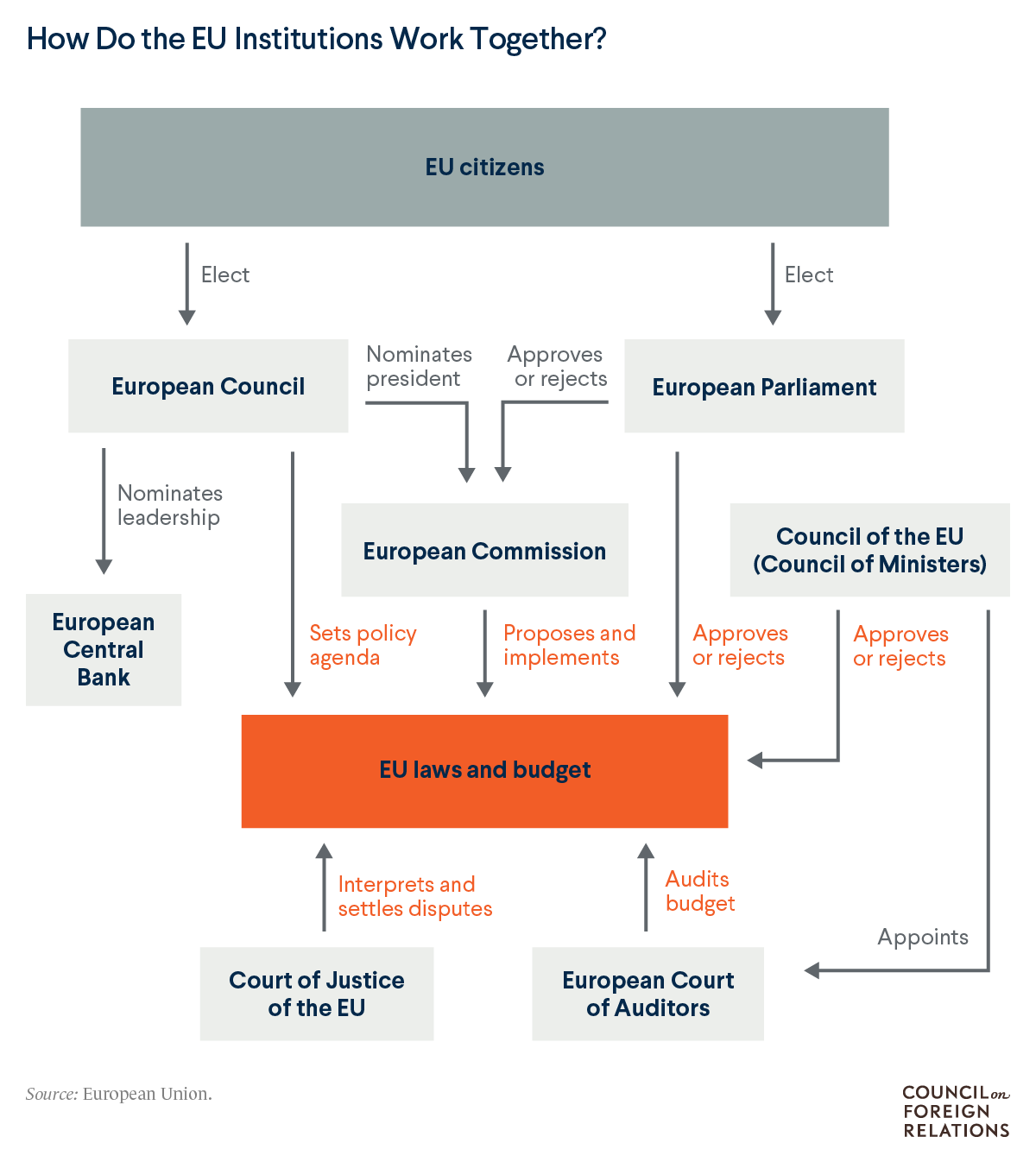
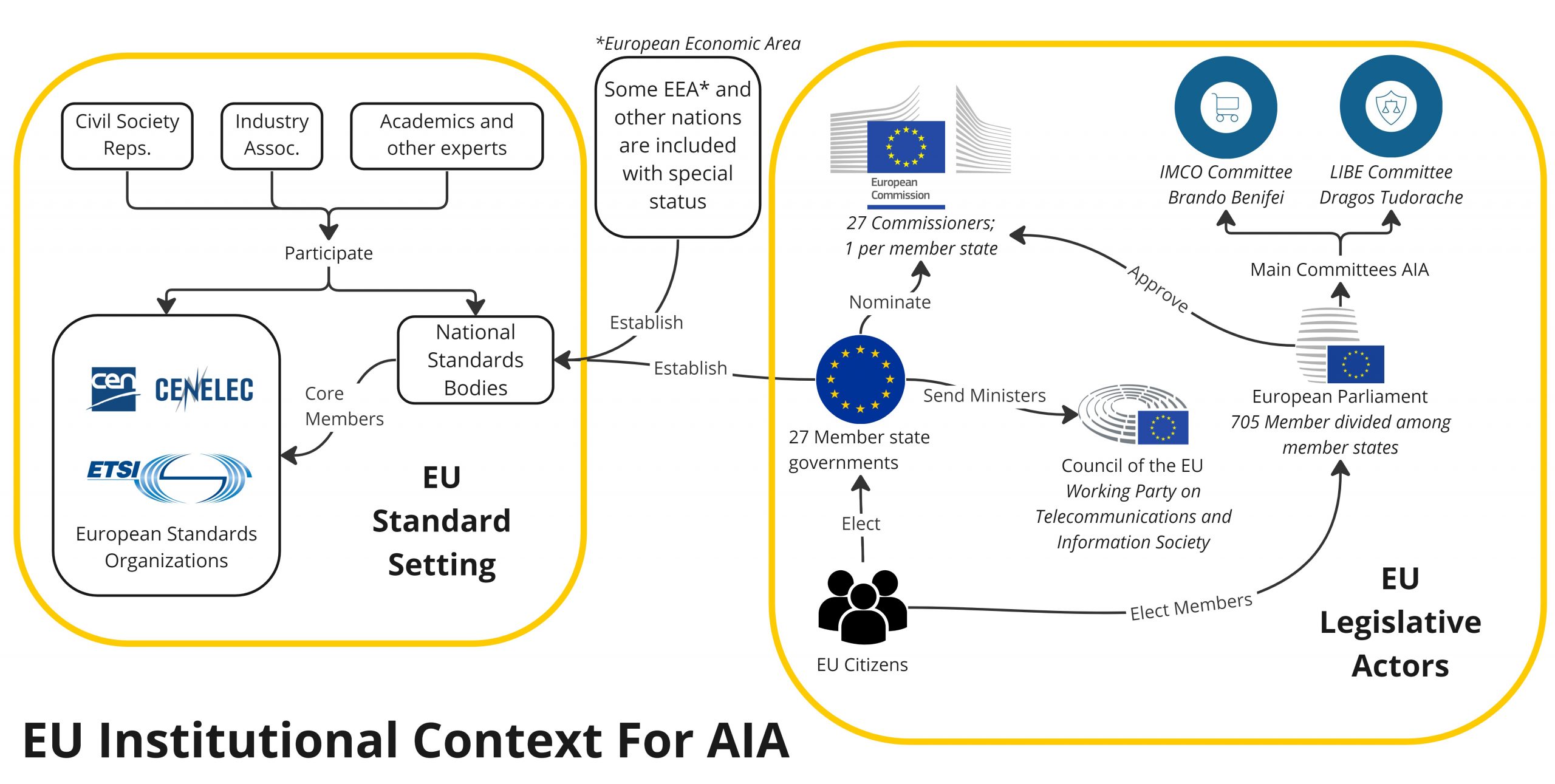
So we have the setup with European Council (heads of governments) setting the agenda, Comission (presiden of which is selected by council and approved by parliment) that makes that into law and then Parliment and EU Council (not European council!) votes for it.
A coupld of infographics how that works:
https://www.europarl.europa.eu/topics/en/article/20240524STO...
https://static.cfr.org/sites/default/files/image/2022/03/-la...
https://artificialintelligenceact.eu/wp-content/uploads/2022...
Fnoord
a month ago
Yup, classic, mixed EP with EC. Makes you wonder if he explained it correctly to his wife (American lawyer), or if she verified.
I don't like the way US presidents are elected either, ignoring popular vote, and including gerrymandering. I also don't like how the US president is allowed to bypass Congress.
WhyNotHugo
a month ago
> the US president is allowed to bypass Congress.
This is the key difference between presidential system and parliamentary system. In a parliamentary system, the head of state answers to the parliament. In a presidential system, the presidents answers to no-one (technically they answer to the people, but in practice that's inconsequential).
krapp
a month ago
Strictly speaking, in the US system the President isn't allowed to bypass Congress. Congress makes the laws and sets the budget and the President is suppose to execute on what Congress decides, which is ostensibly supposed to reflect the will of the people. Even executive orders can't override existing law or the Constitution. The President isn't supposed to be able to go to war without Congressional approval. The three branches of government are supposed to be equal and mutually oppositional in their power.
The (im)balance of power we have now is very much not what was originally intended, but it can only persist because Congress and the Supreme Court are complicit in granting the Executive near absolute authority, which is only being kept in check at the moment by lower courts.
rayiner
a month ago
> he explained it correctly to his wife (American lawyer), or if she verified.
Are you saying I am mixing it up now? My post acknowledged I had mixed it up before: given that the Commission is so powerful, I had thought it was comprised of the heads of state. I’m aware that’s not how it’s structured. I was explaining it to my wife because the reality is very complicated!
> I don't like the way US presidents are elected either, ignoring popular vote and including gerrymandering.
Gerrymandering cannot affect a Presidential election, because the Electoral College is elected based on statewide popular votes. And the logic behind the Electoral College is the exact same as the reason why so many EU bodies have one member per member state. The U.S. President doesn’t only represent the people, he also represents the states as sovereign entities. The states have chosen to move in the populist direction by providing to allocate their electoral votes based on statewide elections, but they have never consented to abandoning the prerogative to do things differently.
Moreover, the electoral college also is deliberately designed to produce more decisive results. In every case where the U.S. electoral college vote produced a different result than the national popular vote, the President’s party still won the Congressional popular vote. In those cases, a pure popular vote for the President would have produced a divided government. Most European countries avoid that by not directly electing their chief executive at all, and instead providing various ways for the party that controls the legislature to also control the executive.
Finally, in terms of “bypassing Congress,” what you’re describing is a general feature of Presidential systems where the executive is led by the same party as the legislature. For example, the French President has limited powers in theory. But in practice he’s very powerful if his party also controls the National Assembly: https://www.lemonde.fr/en/les-decodeurs/article/2022/05/02/w...
“In most cases, these constitutional provisions end up being diluted in practice. When the president obtains a supporting majority in the Assemblée Nationale, they are less tied to following the Constitution to the letter and are able to propose legislation. In doing so, they then encroach on the role of government and in fact have significant power, often described as more substantial than that of heads of state in other countries.”
Fnoord
a month ago
> Are you saying I am mixing it up now?
That much was clear. I was saying this:
> Makes you wonder if he explained it correctly to his wife (American lawyer), or if she verified.
Still wondering.
> Most European countries avoid that by not directly electing their chief executive at all, and instead providing various ways for the party that controls the legislature to also control the executive.
Moot comparison. Most European countries don't have a two party system. As such, there is more cooperation and consensus between involved parties. They can also easily get rid of the leader of the country, should they opt for it. Now, compare that to GOP and Trump.
> But in practice he’s very powerful if his party also controls the National Assembly
Yes, I am aware. Don't like it. Don't like IRV either. France doesn't do very well in Democracy Index (not terrible either, slightly better than USA pre-Trump IIRC).
I prefer the way the Scandinavian countries, and in lesser extend The Netherlands and Switzerland deal with politics. You can also notice these countries do very well in indices such as Democracy Indez or freedom of press ones.
sampo
a month ago
(1) Replace US president with a Commission of Presidents. One from each state (well, EU only has 27 member states). Each Commissioner is appointed by state legislature, not elected. No more presidential elections. This is the EU Commission.
(2) Replace US senate with a meeting of secretaries, or heads of departments from each state. Only one relevant representative from each state. But the senate composition is not fixed. When the senate discusses e.g. agricultural policy, each state sends their secretary of agriculture, of head of their department of agriculture. No more senate elections. This is the EU Council of Ministers (a.k.a. Council of the European Union or just "The Council").
(3) The house is the EU Parliament.
Take the right of legislative initiative away from the congress, and give it to the Commission of Presidents. The Commission writes the bills, and the senate and the house can only approve or disapprove (with comments).
(4) Change the states to follow the European model: The governor is not elected, but appointed by the state legislature, and is called "prime minister". (Except France has a presidential model.)
(5) The president / Commission is like a CEO. To supervise the CEO, we need a board. The heads of states (governors) meet 4 times per year to discuss and set broad and long term goals. This is the European Council.
rayiner
a month ago
Thank you! I think that's all correct except (1), unless I'm misunderstanding something you wrote. My understanding is that the European Council appoints a Commission President-elect. The President-elect and the Council of Ministers then prepare a proposed slate of the other Commissioners, on suggestion from the members states. Then the European Parliament can vote on the entire slate thumbs-up or thumbs-down: https://commission.europa.eu/about/organisation/how-commissi....
To analogize to the U.S., it would be like if the National Governor's Association selected a Head President. Then you had a Senate of Secretaries made up of the secretaries of various executive departments in the 50 states. Then the Head President and Senate of Secretaries put together a slate for the Commission of Presidents. And Congress would then approve the slate up or down.
BrandoElFollito
a month ago
It is a great analogy even for someone from Europe.
In (4), though, I do not get the French exception. There are many countries in Europe with a president and a prime minister
sampo
a month ago
> There are many countries in Europe with a president and a prime minister
In most of those countries, the role of the president is mostly ceremonial and/or has to do with foreign policy outside of EU.
BrandoElFollito
a month ago
Out of my head: Poland, Checkia, Cyprus, Portugal, Romania -- all these have real presidents.
Germany and Italy are exceptions, not the rule
sampo
a month ago
You are correct that Czechia, Cyprus and Romania (and France, and Lithuania) send their president to the European Council. But Poland and Portugal, and all other countries, send their prime minister.
22 countries: Prime minister
5 countries: President
BrandoElFollito
a month ago
> But Poland and Portugal, and all other countries, send their prime minister
Yes, but what does it have to do with the original point about countries with real power presidents?
Roark66
a month ago
Exactly, also the ECJ is horribly corrupt (search for the corruption scandal revealed by a French journalist few years ago). Nothing happened back them.
This will never become law in my country(Poland). Last time they tried to push it people protested in the millions.
dwedge
a month ago
> This will never become law in my country(Poland)
I'm sorry to tell you, but if the choice becomes lose EU funding or pass it into law, it will happen.
user
a month ago
zrn900
a month ago
Yes, the Eu basically morphed into a supranational institution that allows a minority to control entire Europe and use it as a private farm for the countries that dominate it.
winterismute
a month ago
While I agree that this setup is not very good, the EU Commission is essentially the equivalent of a government in a parliamentary or presidential democracy, and almost all such democracies I know about either have or have developed "ways" for the government to "push through" the will of the "chamber(s)". However, we do not consider those as farces as well, or so it seems to me, I guess mostly because those governments are still more or less directly "bootstrapped", and needs to be supported, by the chambers, which is what happens in the EU parliament as well.
boltzmann-brain
a month ago
> However, we do not consider those as farces as well
Speak for yourself. A lot of people do.
user
a month ago
ktosobcy
a month ago
It's mindbogling how ignorant people are when it comes to how the EU is structured and how it works ;(
BrandoElFollito
a month ago
It's not. The EU for us Europeans is a vague institution, very far from our everyday lives.
ktosobcy
a month ago
[citation needed] ;)
Same could be said for <some level of government>. Quite often people are just generally clueless how things are administered/goverened ;)
BrandoElFollito
a month ago
No because we know that we have (in France) a president, a prime minister and ministers.
We know what they are in charge of (for the basic ministries), everyone knows who the president is, a lot who the PM is, and nobody knows the current ministers. But we know their jobs. They also refer to stuff which impacts us on a daiky basis.
The EU as a governing body is a mystery. Not only there are pieces that has almost the same name but are different things, they function in a remote world that does not interfere with ours. Like the UN.
ktosobcy
a month ago
The rest of Europe doesn't have presidential system.
Most of the Europeans know who the President of EC (so basically president in France or PM i other countries) is -- everyone hates beloved UvdL ;)
The same goes for comissioners - they mimic same roles as your government has but level up. Some positions may be more prominent (and names known), some less.
Then if you go level _DOWN_ to local authorities (regional, municipal) then people would most likely be clueless who-is-who-and-do-what.
Basically we live in dumbed-down world where people are aware of basically the only-single-strongest-figure (Presindent, PM) because… idiocracy…
BrandoElFollito
a month ago
Not necessarily idocracy.
I don't know the name of the person who runs utilities because they just work. I sure would know if there was a problem. This is the same with politics: when a country is stable and is moving ahead, people are not interested.
Look at the participation levels in elections: they are always high when there is substantial stuff on the scales. Otherwise it is moot.
ktosobcy
a month ago
That's true. Plus how the media/narrative works. EU is a very convenient scapegote for <everything bad happening in the country>. People are unaware how things works quite often and national politicians are "trigger happy" to blame everything on the EU…
munksbeer
a month ago
Please could you cite your sources for this.
I think what you've typed is not representative of what happened here. My understanding is that the EU Council forced this second-reading, not the Commission.
To provide evidence for my argument: https://fightchatcontrol.eu/
Look at "Timeline". This is the Council, not the Commission. This is your elected heads of state. This is "democracy" in action.
"Council and EPP attempting to bypass Parliament With negotiators still deadlocked on core issues, the Council and the European People's Party (EPP) are trying to sidestep Parliament by reviving the expired Chat Control 1.0. The Council plans to fast-track a rewritten proposal with identical content, effectively circumventing the Commission's right of initiative, democratic oversight, and a fresh opinion from the European Data Protection Supervisor (source)."
lou1306
a month ago
The Council must go at some point. It is a "legislative" body... composed of members of the _executive_ branch of the individual countries. Granted, that's not the only problem with EU governance, but it is a rather glaring anomaly in terms of transparency and accountability.
Furthermore, at least in the case of Italy & other parliamentary systems, there's something like 3 levels of indirection between the people and their "representative" in the Council:
People elect members of the Parliament -> MPs decide who is the Prime Minister -> PM decides who sits in the Council
We should likely just replace it with either a "EU Senate", where each country elects the same number of senators, _or_ a chamber with truly European elections (as in, every EU citizen may vote for any candidate, regardless of their nation). But the latter option seems still out of reach as of today.
fosk
a month ago
How are we going to change it? They are simply going to pass a second-reading on a proposal to bring it back and use the same trick over and over again. All it takes is for one person to be "sick" at home for them to get it their way.
The EU voters have practically gifted their future to a bunch of technocrats. Over time (decades), it will get worse too, as inevitably power corrupts them more and more.
The EU is simply never going to represent the EU voters when it goes against their agenda. Want proof? They just did it.
lou1306
a month ago
"The EU" is a loose term. At least in _some_ cases (such as this one), the Parliament has shown more attention to the voters. I'll concede that the deck is stacked against it, but this reflects a common trend in the West of overpowering the executive branch at the expense of the representative bodies.
rayiner
a month ago
Why not just have two bodies like every other parliamentary system? Europeans elect an MP and each member state elects a Senator. Then the majority party in the Parliament appoints a Prime Minister, who can appoint a cabinet. Nobody is more than two steps away from an elected position.
lou1306
a month ago
That makes perfect sense indeed, although personally I'd prefer two senators per state. But since the EU as a political union is an afterthought of an economic union, it's full of loose ends like this. Also, national governments will be very reluctant to give up this kind of power.
fosk
a month ago
The Commission refused to withdraw the proposal after Parliament rejected it, leaving it on the table. The Council disagreed with Parliament’s rejection, formally forcing a second reading.
Both the European Commission and the Council itself are not DIRECTLY elected EU bodies. Potato, potahto, tomato, tomahto.
aosaigh
a month ago
Again, sources?
fosk
a month ago
Parliament rejects the proposal: https://oeil.europarl.europa.eu/oeil/en/procedure-file/pdf?r...
Council pushes it forward: https://www.consilium.europa.eu/en/press/press-releases/2026...
From the last article: "The Council position will now be examined by the European Parliament, under second reading.". Note that this is technically accurate under absolute majority rules for rejection (not for approving), but practically is where the "cheating" happens - as described in my original parent comment - because of the perverse procedures of the EU that are designed to basically make it almost impossible to go against the agenda.
The Commission did not withdraw it: no source because it stayed "pending".
The EU procedures are maliciously designed against the Parliament while preserving the technicality of plausible deniability. How do we call this architecture in software? We call it a "backdoor", except this one is embedded in the EU legislative process.
munksbeer
a month ago
The EU Council are the democratically elected leaders of the member states. How is them deciding the direction not "democratic"?
fosk
a month ago
The Council of the European Union - that pushed this forward - is composed of national ministers that are directly elected to the Council itself and are simply there because they are appointed as ministers under their own country's constitutional system. Ministers are appointed, not elected.
Unlike the European Parliament which is directly elected by EU citizens. Conveniently, the EU citizens have been silenced on this matter despite the Parliament denying this full proposal not once, but twice.
gls2ro
a month ago
> Ministers are appointed, not elected.
I dont understand this line of reasoning about EU:
Ministers are appointed by people we vote. In most democracies the entire government is appointed and maybe indirect voted as a whole (by parliament and maybe directly by citizens).
What I am trying to say is people who proposed this are representatives of those countries (even if indirect their citizens votes vor the party that appointed them).
So representation is not the problem. The problem is citizens (at large) voting only on personal interest and not thinking or not understanding the second order effects. If you don't like what Council did here make sure next round of elections the party that proposed those ministers will not get elected in your country an should not have the power to form a government.
We seem to expect country officials to be even better when playing at EU level and think about yet a greater good than they are doing in their own countries.
rayiner
a month ago
You don't have effective representation just because a vote happens somewhere in a causal chain. A body that's appointed by people who are themselves typically indirectly elected is a lot of layers of indirection.
For effective representation, you need a feedback loop between the voting and the policymaking at the other end. If you add all these layers in-between, voters are going to have a hard time figuring out how their voting is actually changing outcomes. Imagine trying to play a video game that has huge lag between the control input and what the character on screen is actually doing.
gls2ro
a month ago
I dont disagree. But I am also limited in seeing practical solutions to make EU better in this sense for people to feel represented at all levels directly. Please note the practical thing here cause idealist solutions I have plenty. It is just that countries are too nationalistic.
Why I find it hard: EU is another abstraction on top of what we already have: local, regional, national. EU is not just an alliance but a real governing body with legislative and executive branches.
Having an average (as in normal) citizen of a country have to think about their local interests, regional (as in around their local cities), national and global interests is too prone to manipulation. As we saw with Brexit and other campaigns. Too many of us are too focused on self interest and locality to be able to dedicate enough time to global matters.
IMHO of course
rayiner
a month ago
It seems to me that the nationalism issue is orthogonal to the representation issue. In the current structure, the EU government is even more powerful than the U.S. federal government. The U.S. federal government can only legislate in certain areas, and cannot compel the states to enforce federal law. This restriction is strongly enforced by the judiciary. That's why, for example, U.S. states effectively legalized marijuana, even though it's illegal under federal law.[1]
As I understand it, the EU can legislate in any area it wants. And member states are required to enforce EU law as if it were their own domestic law. The EU can even sue member states for failing to implement and enforce EU law.
So it seems like the EU government is both extremely powerful (the nationalism issue), but also very insulated from European voters (the representation issue).
[1] And I think most people would say that the federal government isn't even allowed to regulate individual use of marijuana. There's a 2005 Supreme Court case to the contrary, but I don't think it would turn out the same way under the current Supreme Court.
gls2ro
a month ago
That is not true that EU can legislate anything.
Here is a clear list of areas: https://commission.europa.eu/about/role/law/areas-eu-action_...
Also EU does not have a government. There are 3 powers lets say:
- EU Council which represents the countries governments
- The EU Commission representing EU interests
- The EU Parliament representing citizens
We go back to what I said: when introducing a new level of abstraction we got a new governing power. But lets never forget that except the EU Parliament all the others are formed by people proposed by countries governments.
Thus as EU citizen one:
- influences EU direct by voting the EU parliament
- influences EU indirect by voting who rules their countries which will then send people to EU Council and Commission
As you notice the countries governments have more power (2 out of 3) than the EU parliament even if they are different kind of powers.
Still in the end each citizen that goes to vote is deciding the direction of EU in three ways (one direct citizen to EU and two indirect citizen to country to EU). Want more federalization then vote parties that go that way. Want more nationalism then vote that way. But nobody (or few people) really think then consequences of what they vote in their own countries and how that affects everybody in EU.
zrn900
a month ago
Eu cannot be bettered. It was transformed into a supranational institution that imposes its will upon countries. At this point its a detriment to the entire continent.
munksbeer
a month ago
The design of the EU which gives the member states elected politicians (heads of state) the most power is very intentional.
fosk
a month ago
You are confusing the EU Council with the Council of the European Union.
No head of state was involved in the discussion we are having today.
By the way my personal opinion is that the confusing names are by design, to give the appearance that head of states are involved in decisions that have nothing to do with them, democracy in the EU is just an illusion.
munksbeer
a month ago
This is a bizarre argument. Emmanuel Macron sits on the EU Council. He has no democratic mandate?
The entire point of the EU design is that ultimately the member states national governments (the heads of) are the most powerful and set the direction. It was done this way because people didn't like the idea of EU ministers. There was even a huge objection to the change that introduced the Parliament, the MEPs that you are now saying should hold ultimate power.
And this is the problem. People decide up-front that the EU is "not democratic" and then they adjust their arguments and data to fit this narrative.
fosk
a month ago
The EU Council and the Council of the European Union are two different bodies.
Macron sits in the EU Council and it has nothing to do with this.
mmarq
a month ago
In one you have the head of government of each member state, in the other the relevant minister depending on what is being discussed.
These are not European bureaucrats, they are the ministers of justice of each member state.
munksbeer
a month ago
My apologies I was. But nevertheless, these are still these are elected representatives of the member states. These are not unknown "bureaucrats from Brussels".
burnerRhodov3
a month ago
it's more like a .. asymmetric confederation. Democratically elected leaders, conspire together in a confederation, to elect a body that is above and beyond the leaders of the democracy. I honestly don't think we have a proper label for what the EU [edit* council] has become. If you are looking at it from the OP's perspective, it's more of a "democratic deficit." It is an institutional design that prioritizes efficiency, expert consensus, and national vetoes over direct voter control and transparency.
munksbeer
a month ago
> Democratically elected leaders, conspire together in a confederation, to elect a body that is above and beyond the leaders of the democracy.
Sorry, what are you talking about here?
The Commission is subservient to the EU Council. The EU Council consists, by design, of all the heads of the nation states.
fosk
a month ago
False, the Commission is an independent EU institution.
doikor
a month ago
The council is the prime minister or president (depending on the system). The commission is the government. The government mostly does what the PM/president tells it to do.
sampo
a month ago
I think what you've typed is not representative of how EU works.
The Council [1], also known as the Council of the European Union and the Council of Ministers, does not consist of heads of state. The body that consists of heads of state is the European Council [2].
[1] https://en.wikipedia.org/wiki/Council_of_the_European_Union
abc42
a month ago
Two things are not quite correct in your text:
1. The Council triggered the second reading by adopting its own position and sending it back. You made it sound like the Commission just steamrolled it unilaterally.
2. The scheduling conspiracy is false. Parliament itself voted (331-304) on July 7 to fast-track this. Also, the votes in March and July were pretty stable: 311 against in March, 314 against in July.
bulbar
a month ago
Without EU, the Europe countries don't really have leverage against super powers or FAANG companies, so we are stuck with it for now, for good and for bad.
vaylian
a month ago
Hard disagree on the conclusion. I agree that the commission and the council have made very unfair moves and it's justified to call them out for it. But we have also seen that the parliament (except for the EPP) was for the most part eager to listen to what people had to say about chat control.
PunchyHamster
a month ago
AND IGNORED IT
rayiner
a month ago
> - Once the Commission does that, the proposal goes on second-reading (despite the first-reading having defeated it) and it is established in a very PERVERSE way in EU law that to AVOID passing the proposal in second-reading you need ABSOLUTE majority
Wait, that's the rule? On the second go around, the default outcome is for a previously defeated proposal to pass unless you can muster an absolute majority?
This seems like if the U.S. President had a reverse veto: it could pass any law Congress rejected by forcing a second vote and the law would pass unless there was an absolute majority against. Didn't the EU people read Montesquieu about separation of powers? He was French!
mmarq
a month ago
We, as humanity, really need to stop equating democracy with direct votes and referenda. There are reasons why some bodies are nominated indirectly and through convoluted procedures. In many countries these processes exist to prevent the rise of fascisms or totalitarianism in general.
The EU, in particular, is a community of relatively different states, where you can’t have just direct elections with proportional representation, otherwise the most populous countries will decide for everybody. This is why there is a zoo of directly elected bodies, bodies nominated by the Parliament, others expressing the will of countries’ governments, and complex voting procedures with qualified majorities and veto powers.
In practice the EU has struggled to make national governments ratify trade treaties because their devolved regions were worried about beef prices. It’s not an unstoppable dictatorial behemoth that decides against the will of the people, if 10 farmers in Wallonia can stop it. They still haven’t convinced Germany that an Italian baker can open a bakery in Bavaria without attending a local mandatory 5 year Meister training.
hniscensorship
a month ago
Just like HN. Undemocratic and full of censorship and disinformation.
Unintelligent authoritarians run amok.
zkmon
a month ago
Some folks (mostly Americans) tend to think that their laws, their definitions of terms like "democracy", their beliefs, their norms, their culture - are all universal.
You need to specify which EU laws does this violate. "undemocratic" by your definition. There is no universally precise definition of "democratic". Because I'm sure EU council knows how to be democratic by their own definition of the term. They have an army of legal pundits who ensure that everything is done correctly within their legal framework.
fosk
a month ago
Literally the voice of the EU voters has been suppressed on this matter despite the Parliament (elected by them) voted twice on denying this full proposal.
By any definition of the term, this is not a democracy and it's a technocracy at best.
Edit: I am Italian.
rayiner
a month ago
> Some folks (mostly Americans) tend to think that their laws, their definitions of terms like "democracy", their beliefs, their norms, their culture - are all universal.
The American system was mostly cribbed from Europeans to begin with. Montesquieu, etc. The structure of the EU is bizarre according to the principles of democratic governance articulated by Europeans themselves.
hniscensorship
a month ago
[flagged]