Natfan
2 hours ago
to me, these heatwaves feel like the start of the end of human existence
A_D_E_P_T
2 hours ago
Nah. It's really as simple as this: Southern climates are moving north. (In the northern hemisphere.) If you want a vision of the future, consider a New England that looks more like the Southeast.
There will be winners and losers. As climate zones move toward the poles, weather patterns and agricultural viability will shift with them. This will eventually turn current breadbaskets into deserts while warming up northern/southern regions for longer growing seasons.
Various regions will cross ecological thresholds, causing sudden, dramatic shifts in local climates. For example, a warmer Earth could bring monsoon rains back to the Sahara and Arabian deserts, turning them green once again. In general, a warmer world is a wetter world due to increased oceanic evaporation.
Sea levels will gradually begin rising, but perhaps at a rate of 1-2" per year. It takes a lot of heat to melt glaciers.
Human existence is not in doubt on account of the climate alone -- our prehistoric forebears had a lot worse to deal with -- but there could be mass population movements and alterations in how agriculture is handled globally. Current political structures are not up to this challenge.
defrost
2 hours ago
That's how it starts, sure.
Give that state you described another 50 odd years again and things can get worse - the land based glaciers are already greatly reduced, almost gone. The bulky polar ice is retreating a little - but the warming sea surface is the thing, it'll carry warm water and melt more and more ice.
Now it's fun and games for predicting what comes next - the insulation in the atmosphere is still increasing and the same amount of trapped energy that now goes to turning a mass of ice to a mass of water (at much the same temperature) will now turn to raising that same mass of water from near 0 C to about 60 C (roughly IIRC) - speeding up ice melts.
There's also the increasing amounts of water and methane in the atmosphere that come along with rising temperatures, these are much much better insulators that measly old CO2 and will serve to trap ever more energy from the sun.
Geophysically that's how this all goes in the absence of any serious reduction of insulation in the atmosphere.
mike_hock
2 hours ago
Climate change itself is not gonna endanger humans as a species, but secondary effects might. Such as wars resulting from dramatic shifts in the value of territories and wars over resources.
A_D_E_P_T
2 hours ago
War won't end human existence. If there's one thing you can learn from the recent wars in Iran and Ukraine, it's that conventional air-bombing has acquired a terrible cost:efficacy ratio that cannot be sustained, that drones have leveled the playing field on the ground, and that attackers generally appear to lack the stomach for mass mobilization and mass casualties in war.
Again, there'll be winners and losers. Some in fortresses; others in famines and droughts. It is, of course, imperative that we do what we can do now to mitigate this. But the continuation of the human species is, I am sure, not in doubt. Our ancestors in prehistoric times have, assuredly, gone through FAR worse, including real population bottlenecks.
adrianN
2 hours ago
War definitely can end technological civilization. Bootstrapping it again will be quite difficult as a lot of the easily accessible natural resources are already depleted.
A_D_E_P_T
an hour ago
> Bootstrapping it again will be quite difficult as a lot of the easily accessible natural resources are already depleted.
That's a myth, but let's assume it isn't. I'm thinking it sounds like a job for you.
Okay, here's what you've gotta do. Buy some titanium slabs. Etch onto them, in simple and decipherable language (there's a technical way to approach this, I can explain later,) the secrets of solar panels, how to refine scrap metal, the basics of modern materials science, and so forth. Include the secrets of nuclear power, germ theory, semiconductors, DNA, important mathematical and physical formulae, and whatever else you feel like they ought to know. Warn them against the once-low-hanging fruit of fossil fuel; tell them that hydrocarbons ought to be used as chemical building blocks, solely.
Bury the slabs in a seismically stable vault, and leave clues to its existence at various geographic landmarks.
That's it, you've saved technological civilization in 50,000AD.
Dumblydorr
2 hours ago
You seem to forget about hydrogen bombs. War can 100% end everything.
iso1631
an hour ago
Depends if that war turns nuclear. Perhaps a few million will survive with sustinance living in areas like patagonia, new zealand, global population of nomadic tribes around the same level as pre-agricutural civilisation - say about 10k years ago
Aachen
2 hours ago
> our prehistoric forebears had a lot worse to deal with
Do you mean in terms of climate change? I know some temperatures were different but this was much more gradual afaik, which is no problem for anyone with two feet and a sense of where to go, but they were much more dependent on the ecosystem which struggles to keep up with the speed of today's changes
From what I hear, what we're causing is unprecedented for humans. Not dinosaur meteorite level of course (it's not an overnight change) but an ecosystem extinction event is nevertheless going on (https://en.wikipedia.org/wiki/Holocene_extinction)
I agree with the broader point that we'll survive and the question is more about the amount of suffering we inflict on ourselves and other animals along the way. Just curious if any old human (or even any great ape from the 'homo' genus) did experience worse
A_D_E_P_T
an hour ago
Prehistoric climate change was sometimes much more sudden than anything we've experienced. See e.g.: https://en.wikipedia.org/wiki/Younger_Dryas
There are others.
Aachen
an hour ago
"in the tropics, the cooling was spread out over several centuries" but "2–6 °C in Europe and up to 10 °C in Greenland, in a few decades. Cooling in Greenland was particularly rapid, taking place over just 3 years or less"
That's indeed a lot more extreme in a shorter amount of time, at least regionally. Feel like I should have known that! Thanks
illiac786
an hour ago
Let’s say the end of our civilization and going back to middle age or something like that.
spwa4
an hour ago
The middle ages were in the middle of something called "the little ice age" which was entirely different and, obviously, mostly had the opposite effect.
The most dramatic story about that is what happened to the settling of Greenland (more than once). Basically during a cold spell the city was gradually abandoned, with sometimes the last few people literally freezing to death when their fuel ran out.
intended
2 hours ago
This is… one way to look at the death of billions, the end of nations, and the collapse of society due to the ensuing refugee crises.
Not to forget, we are dependent on the food web. These changes mean species will be wiped out, fishing stocks will crash, and invasive will spread.
Since you are likely in the developed world, tropical temps in Europe would mean refurbishment of houses.
People won’t remember things like the lakes freezing over or ice skating.
usrnm
an hour ago
Even anatomically modern humans have gone through similar events several times in the history of our species, let alone our ancestors. Climate change itself will not be the end of humanity, but it may be the end of the current civilisation.
spwa4
an hour ago
There are several highly problematic areas, but they are local (very, very big, but local, not remotely close to covering the whole of human civilization).
iso1631
an hour ago
> the collapse of society due to the ensuing refugee crises
This is what worries me.
At some point more northern facing countries will decide enough is enough and start mass genocide of any population attempting to flee.
Europe will be ok with just killing a few hundred million trying to flee in boats, and the eastern frontier is securable, especially with drones, but even with conscripts. Hell Ukraine has done a solid job on its own against an organised army on its doorstep.
America will act as a buffer for Canada and will have no problem with wiping out refugees. Argentina will be interesting but it's too small and isolated to matter globally.
The big global risk is that India and Pakistan have nukes and will be trying to flee into China and central Asia.
Setting aside refugees, far bigger risk for Europe isn't reurbishment of housing, it's tropical diseases in the south, it's the collapse of food security, and the general collapse of society as the economy falls over.
intended
2 minutes ago
I agree.
I find it very difficult to maintain an even tone and address statements that posit climate change positive effects on society.
There are so many incredibly bad things about climate change it boggles the mind.
I try and believe people are burying their heads in the sand to avoid the pain of reckoning with the end of everything they hold dear. This ends up with punches being pulled.
b112
an hour ago
One thing. "Longer growing season" is not predicated upon temperature. Length of the day, sunlight, is a hard requirement for some plants. And the further north you go, the less the sun gets up over rhe horizon, even at noon.
So extending the time before frost, won't help many plants reach maturity. The days will be shorter, and when the sun comes up there is barely any light anyhow. Raw "daylight hours" are meaningless here, when the sun only gets barely over the norizon.
One month of June light is like 6 months of December light in much of Canada.
inigyou
2 hours ago
People one or two generations before you felt that about the cold war.
notrealyme123
2 hours ago
I think thats the wrong level of abstraction. The cold war ended, but clima change will not end.
Aachen
an hour ago
Of course it will. There is a finite amount of fossil fuels and it'll become uneconomical to use before those are fully exhausted. Give it some more years (say, a few hundred) after the last car fleet and power plant switched away and the climate will have triggered any tipping points it's going to tip. Then the animals that haven't adapted will soon have finished going extinct, the ocean finished warming up with its lag effect, and climate change is finished changing
After that it's 'over' no? The world map is redrawn (many countries' shapes will look different), people that needed to move have moved or got killed (quite possibly by territorial humans refusing to let them onto livable land), but it'll settle into a new normal eventually
notrealyme123
an hour ago
That's the correct level of pedantic answer my comment deserves. Everything is true. Clima change will stop, how much of humanity or human society survives is open, but yes it will stop.
InsideOutSanta
an hour ago
I think they meant "end before the near-extinction of humanity", but yes, it eventually will reach another steady state one way or another.
epgui
2 hours ago
The word abstraction does not mean the same thing as the words analogy or comparison.
notrealyme123
an hour ago
Yes absolutely. They are different things . I am using "level of abstraction" in a sense to find a useful amount of details to drop or keep, which in turn makes an analogy/comparison possible.
underdeserver
2 hours ago
It can change, if we get to net negative emissions. Not probable but possible.
adrianN
2 hours ago
It will just take at least three or four generations to get back to 90's climate, provided we don't trigger any irreversible tipping points, like the melting of the permafrost, in which case the climate is messed up for millennia.
phreeza
2 hours ago
Or solar geoengineering? Which is scary but becoming more likely it seems.
xienze
2 hours ago
> The cold war ended
You wouldn't know it based on how everyone talks about Russia pulling the strings of just about every election (and being a moment away from conquering Europe while simultaneously being too incompetent to beat Ukraine).
Paradigma11
44 minutes ago
An animal is most dangerous when deeply wounded.
genericacct
an hour ago
Let me remind you that launching nuclear weapons close to your border is an issue, launching them half a continent away not so much.
DFHippie
2 hours ago
Russia is great at stuff that can be automated cheaply like influence campaigns. They're not so great at physical hardware and logistics and so forth. Not everyone is good at everything.
Messing with elections by fooling the most volatile and eager to be fooled is not a genius move.
iso1631
2 hours ago
Nuclear winter may cancel it out.
IneffablePigeon
2 hours ago
The conditions leading to the Cold War were reversible, this crisis is becoming very much less so. Despite what the carbon capture techno optimists say.
sfn42
an hour ago
If you actually look at the numbers of carbon capture its entirely obvious that it can't work. It's honestly strange to me that they even waste money on it, personally I think it's a distraction - "look we're working on a fix, now let us just pump up the rest of this oil in the mean time and we'll definitely fix it later".
In order to just offset our current emissions, we would need around a million carbon capture facilities equivalent to the largest one we currently have. For comparison, the number of power plants in the entire world is a few tens of thousands. So we'd need maybe like 50 times as many capture plants as we currently have power plants.
Like it's not even in the neighbourhood of realistic, it's just completely infeasible and I am sure engineers know that. You basically need to suck the whole atmosphere through facilities, and there's a lot of atmosphere.
joe_mamba
2 hours ago
>The conditions leading to the Cold War were reversible, this crisis is becoming very much less so.
During the covid start lockdowns when everyone was forced to WFH and nobody was driving to work for a couple of weeks, we saw a massive decrease in CO2 and emissions. So it can be reversed, we just don't want to because we gotta keep the GDP hamster wheel moving
rsynnott
2 hours ago
We did not see a massive decrease. We saw a short-lived drop to levels normal in the mid tens. It is barely a blip on the graph. WFH won’t save us, unfortunately.
joe_mamba
2 hours ago
My bad, I was only talking about the readings in my city, not the whole planet. I assumed it would scale to the whole planet in that period.
rsynnott
an hour ago
Ah. I’d consider _city-level_ readings an absolutely useless metric here, because, particularly if it’s a city with a large commuter hinterland, a lot of people were simply not present in the city, but still existed out there somewhere, running their heating/cooling/etc. Daytime populations of large cities generally dropped during the covid wfh period, so yeah, no shit CO2 emissions dropped; people were off emitting CO2 elsewhere.
TheOtherHobbes
2 hours ago
The cold war never heated up.
Even if we stopped using fossil fuels tomorrow, it will take millennia for the climate to return to normal.
tasuki
an hour ago
> it will take millennia for the climate to return to normal
No. There is no such thing as "normal" climate. It's ever changing. We're just making the change a whole lot faster.
xienze
2 hours ago
Won't the climate change naturally even in the absence of fossil fuels? Like it has during all of history? What's "normal" is based on a small slice of human history, which itself is a small slice of the planet's history.
sfn42
an hour ago
Your question betrays the fact that you simply don't understand the scale of what's happening.
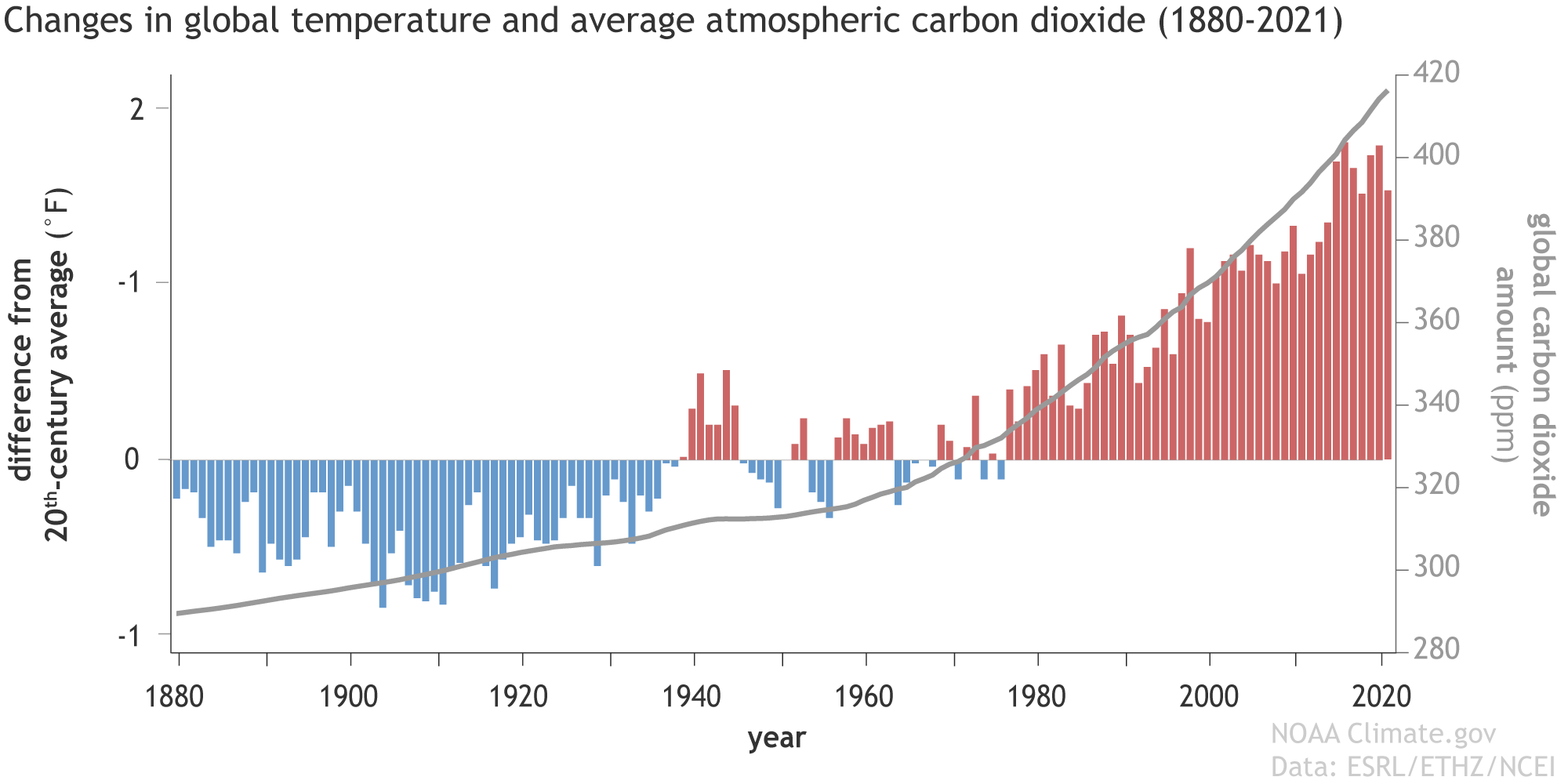
Imagine a line chart. It displays average global temperature over millions of years. It goes up a little, it goes down a little, it fluctuates over time. That's the natural change. It occurs over thousands and millions of years.
Looking at the last few decades on that chart, you'll see a wall. It's going almost straight up compared to the rest that just meanders lazily. You can see a few other similar peaks on the chart many millions of years in the past, they generally correspond with things like apocalyptic meteorite impacts etc. And even then the change occurs much more slowly than what we're seeing now.
It's honestly insane to me that we're watching the world end and half of people are like "but are we sure this isn't normal?"
Yes we're sure. We double checked. Just look at any "global average temperature" chart and try to predict where it's going. This isn't the stock market it won't just randomly start doing something else. The movement we're seeing is directly correlated to our ghg emissions, and there's a lag - the effects of current emissions won't be fully seen until up to two decades from now. So even if we stopped right now it would continue warming for decades.
Warming also releases more GHGs. As poles and permafrost thaws, enormous amounts of methane are released that was previously trapped, further accelerating warming and acting as a positive feedback loop on top of our steadily rising emissions.
In short were fucked, we know it, and anyone who doesn't know is not paying attention.
DFHippie
2 hours ago
It isn't the fact of change but the rate of change which is anomalous.
freetonik
2 hours ago
Well, they had a point, and we've got pretty close to that outcome. It didn't happen, thus today we're able to discuss the fact that it didn't happen.
iso1631
2 hours ago
There's a lot of worry about the future, and has been since world-ending threats became apparent
However while apocalypse scenarios (Nuclear war, asteroid impact, AI powered biological warfare) are low likelihood, extreme impact, climate change is extreme likelihood and high impact, not just the immediate effect on places like Europe, Canada etc, but also from the conflicts that climate change will drive, which in turn may escalate to those extreme impact nuclear wars.
On a 5x5 matrix, grand extinction events would be a 5 for effect but a 1 for likelihood, putting them in a "medium-high" category
Climate change is a 3-4 on effect but a 4-5 o likelihood, putting them in a "very-high" risk category
graemep
2 hours ago
Space weather that would bring down our systems is not such low likelihood.
I am not convinced nuclear war or biological warfare are as unlikely as you think. We have historically had narrow escapes from nuclear war.
hyperbovine
2 hours ago
Climate change also greatly increases the chance of a huge global conflict breaking out.
graemep
2 hours ago
It might raise the chance of some conflicts (e.g. over Antarctica or Russia's border) and some land grabs, but I cannot see it leading to a world war.
swiftcoder
2 hours ago
That largely depends on to what degree food production collapses in newly-tropical regions. A whole bunch of staple agricultural production isn't going to survive widespread drought and heatwaves, and everyone dependent on those food sources is going to end up very hungry, and taking a hard look at cooler neighbouring regions...
pyrale
2 hours ago
Let's just say that, if we're talking likelihood, climate change is the "we've already smashed the button and are now debating whether we should get in the vault" category.
ricardo81
2 hours ago
The prophecies always were about water stress and food security. How that plays out, I don't know.
If it's anything like the recent energy spikes it means burdening future generations of wealthy countries with subsidised amenities while others go without.
est31
2 hours ago
There is a lot of desertification of farmland going on, including in the USA.
It gets abstracted away for richer countries as they can outbid the poorer countries for food. In developed economies, most of a particular piece of food's price is not the costs that go to the farmer, but costs that come later in the process, so that cost increasing is also felt less.
Heatwaves on the other hand affect the western countries directly.
newsclues
2 hours ago
When food and water become scare, conflicts arise.
ricardo81
an hour ago
yes, essentially. But gets hidden behind wealthier countries tucking away the debt.
khurs
2 hours ago
Relax, it's just the start of more Air Con sales in Europe.
mike_hock
2 hours ago
Buy aircon stocks now!
gh2k
2 hours ago
uk here. I've been trying to by a portable AC unit for a couple of weeks and every single retailer is sold out nationwide.
Aachen
an hour ago
Don't get the portable ones. I made the mistake in 2019 and the thing is abysmally loud, barely gets the temperature 2 degrees lower in a single room, uses twice as much electricity as the rest of the household combined, and you still can't work from the heat and noise. That's with a window replaced by an insulating panel with a round cut-out for the hose, not a cracked window like you see most people needing to do. I've compared about two dozen units in a spreadsheet and this one was clearly the best buy, so I don't think it's just my unit
I totally recommend airco but only the split units that actually provide relief. Still a lot of energy but I feel differently about that consumption when it's not mostly wasted
The mobile ones are nice to aim at you though, I'll give them that much. For the effect they give, you might nearly just as well run it outside (anywhere in the shade) and aim it at you. Then the noise also doesn't reflect off the walls so that's more bearable, too
Btw the split units, as a bonus, can usually also heat the room(s) they're in. The UK has quite a lot of (planned) wind power year round, so reducing gas consumption will also cut back on the fuels that are causing this
xienze
2 hours ago
Serious question, are you doing a simple extrapolation and assuming in 10 years Europe is going to have 60C heatwaves or something?
lefra
2 hours ago
The french government (more pro-business than pro-ecology, but not climate deniers) is seriously planning for how to manage 55C heatwaves around the half of the century.
Because climate scientists agree that's what's coming (except for extreme, immediate reduction of fossil fuel burning).
Natfan
2 hours ago
no, im running on the assumption that the heat will stay at around 35C but get progressively longer, for months at a time countries that have developed around ~20C heat will not be able to cope. many people will die.
pillefitz
2 hours ago
This doesn't sound like a serious question
xienze
2 hours ago
It does when people start talking about a heatwave as being the "start of the end of human existence." It strongly implies that these trends will wipe out humanity in very short order. Perhaps even within the lifetimes of people in this thread.
What I find most amusing is people somehow think climate change will end humanity faster than what's _actually_ on track to do so, and quickly: people having children well below replacement levels.
swiftcoder
an hour ago
> people having children well below replacement levels
You do realise that the global population is still increasing? While birthrates are falling, we aren't even predicted to hit the peak for another half-century. Even pessimistic estimates put it in the 2200s before we fall back to current population levels.
Which is ~100 years longer than current estimates give us before the effects of climate change starts taking a bite out of the world population
intended
an hour ago
I too am curious as to why that is the feature they are concerned about.
As I recall there was a UN survey that found financial security was the most common reason for adults across the globe to choose not having children.
Income levels are highly dependent on the degree of stability and monthly expenses that households can expect.
inigyou
2 hours ago
Both are temporary. Hopefully the reduction in population leads to a more sustainable humanity that changes the climate less.
BTW both of these have been predicted since the 80s.
pjmlp
2 hours ago
If we don't nuke ourselves first.
abroszka33
an hour ago
Yeah, that seems like our only realistic solution to the climate crisis.
pjmlp
40 minutes ago
We were somehow on the good path after covid, then world leaders decided killing each other folks was more relevant goal, followed by making big tech bros even more rich with AI centers.
Meanwhile paperstraws, and glued bottle caps, are supposed to save the planet.
yde_java
2 hours ago
Research past heat waves in Europe. Did your grand parents felt the same as you?
pyrale
2 hours ago
Yeah it's true, Europe has had heat waves in the past. For instance, in 1540. Also 1779. And also 1906, 1947, 1964, 1976, 2003, 2006, 2015, 2017, 2018, 2019, 2020, 2022, 2023, 2024, and 2025.
Frequency? Do I look like a statistician to you?!
graemep
an hour ago
I do not know about Europe as a whole, but 1911 was pretty bad in the UK: https://en.wikipedia.org/wiki/1911_United_Kingdom_heatwave
bamboozled
an hour ago
Popular Mechanics, March 1912 — an article titled “Remarkable Weather of 1911: The Effect of the Combustion of Coal on the Climate.”
https://www.livescience.com/63334-coal-affecting-climate-cen...
Have you read this before? Great read.
realusername
2 hours ago
Well, this month has been the absolute record temperatures so we can't say what they would think since they never experienced that
bloqs
2 hours ago
It's a good question, in terms of progression of climate change
iso1631
2 hours ago
1960 to 1979 had 6 years where UK temperatures went over 30C in June
1980 to 1999 had 6 years
2000 to 2019 had 13 years
2020 to 2026 has had 6 years so far, and we're only 35% of the way through
The longest period of time from 1960 to 2000 where june temperatures went higher than 30 was two years, reaching 30 in 1975 and 36 in 1976.
2021 was the only June in the last 10 years where temperatures didn't reach that 1975 record.
graemep
an hour ago
So even if it goes above 30 every single remaining year it will still be 9 vs 13 in the previous decade?
onraglanroad
an hour ago
These are 20 year periods, not decades. How did you think there were 13 years in the previous decade? It would be 18 vs 13 if every year up to 2039 went over 30C.
rsynnott
an hour ago
They’ve rendered that in a rather confusing way. 13 incidents is for _two_ decades, not one.
NekkoDroid
an hour ago
The time frames they are looking at are 2 decade intervals, not 1 decade
xienze
2 hours ago
Why do you choose 1975/30C as your cutoff point for "record heat" when it should be 1976/36C? Clearly 30C isn't unheard of, even in the past.
maipen
2 hours ago
Every year people complain about the cold, heat and allergies. Even if they live 200 years, it would always be the same.
People get use to it, it goes away, cycle repeats. Nobody remembers exactly unless they had a near death experience.
freetonik
2 hours ago
Why does it matter how humans _felt_?
Yokolos
2 hours ago
Why don't you research past heat waves? We're literally setting new heat records nearly every year. This year the heat record in Germany went from 39 degrees to 42. We're even setting night time heat records because of how bad it is. I don't understand the impulse to ignore what we're experiencing right now. What do you gain by sticking your head in the sand?
yde_java
an hour ago
Ask your grandparents about "Die große Dürre 1947" in Germany. Near entirely dried-up rivers and reservoirs, lakes three meters below normal, roughly half a million cattle emergency-slaughtered in Bavaria, hydroelectric shutdowns forcing power rationing, and forest fires along the Bavarian–Austrian border. Sure we have an all time high now, but currently there's still too much water as one could stick their head into the soil of the Elbe and Rhine.
abroszka33
an hour ago
That used to be once in a lifetime event. Now we have temperatures like that two or three times every decade and soon it's going to be a normal summer temperature.
watwut
41 minutes ago
> Did your grand parents felt the same as you?
They remember a lot more snow and talk about how summers were not that hot. And like, they are otherwise into half of right wing conspiracy theories.