overgard
9 hours ago
I'm not usually for arguments of "this money could have been better spent elsewhere", but here's a thought experiment. Lets say instead of injecting $2 trillion and counting into a few AI companies, we instead injected $2 trillion dollars into things like infrastructure (real infrastructure, not GPU warehouses), education, helping out communities ravaged by globalization (I doubt most people on Hacker News venture outside of coastal areas, but if you want to make a REAL difference as an entrepreneur why not look at parts of the country that are struggling and figure out how you could make a difference there? You know, instead of trying to just ruin the economy for the sake of the already-obscenely-wealthy). I'm not saying all those ventures would succeed, but I think that amount of money put towards boring-but-real problems would make a much bigger positive impact for everyone.
thelastgallon
5 hours ago
This is 100 manhattan projects. Lots and lots and lots of things that can be done. Reminds me of the quote "water water everywhere not a drop to drink" ==> Money, money everywhere, not a cent goes towards something remotely useful.
1) Could've added nifty features to roads (rf beacons?) and make it super easy to build autonomous vehicles. This would've solved so many problems, but most importantly 45,000 lives every year and millions of accidents.
2) Could've given the money to farmers who are getting ethanol subsidies today to add panels, supply tons of power to the grid, creating permanent income to the farmers instead of handouts every year.
3) Could've built many Universities permanently free which is feasible with an endowment that large.
4) Could've built walking/biking infrastructure in most cities, which would help reduce healthcare expenses. Most of the expenses today are lifestyle/metabolic diseases.
5) Could've switched the entire country to clean energy, exporting ALL of the oil and create a sovereign wealth fund.
6) Could've built a city for homeless people with homes, excess energy production (solar) providing the function of a UBI, a massive hospital with health and mental health facilities, de-addiction centers. New city in the middle of nowhere where land is dirt cheap. Army corps of engineers could execute this.
7) Rehabilitate prison (not like George Carlins suggestion of Kansas: https://www.youtube.com/watch?v=PkMrFIv_QHk), but more like nordic countries.
8) Build solar over all the interstates.
scoofy
3 hours ago
You are describing altruistic gifts, not investment meant to generate a return.
All this money is being deployed to try and turn a dime into a dollar.
The biggest area I can see where money could be deployed into building something useful -- while generating a positive return -- is real estate development in cities with massive housing shortages. That's basically not allowed in the same cities. In large part, because people who yearn for an more altruistic world care very much about their own quality of life and property values than they do about the well-being of their community in the long run.
civet_java
37 minutes ago
It doesn't generate private returns but investing in your worker population definitely nets returns for the public.
Also, some might say that upending the de facto copyright regime in favour of AI companies was an altruistic gift.
ndsipa_pomu
34 minutes ago
Typically the best return on investment is to build proper separated active travel infrastructure (e.g. cycle lanes).
From https://www.cyclinguk.org/briefing/case-cycling-economy:
> For every £1 invested, walking and cycling return an average of around £5-6. A ‘benefit to cost ratio’ (BCR) greater than or equal to 4 is considered to be ‘very high’ value for money. Putting this in some context, the predicted BCR for the HS2 (high speed railway) wasn’t nearly so impressive at about £2.30 for every £1 invested.
expedition32
2 hours ago
It's private money. At least in my country the government isn't giving a single cent to AI outside of fundamental research projects. If companies want to bet all their money at roulette they are free to do so.
thelastgallon
an hour ago
Its private money now. Then they get bailed out.
christiangenco
9 hours ago
My understanding of injecting money in education is that it's proven to be extremely ineffective at improving outcomes.
Schools just hire more administrators and build nicer gyms.
kevin_thibedeau
9 hours ago
You have to wait 20 years for the returns to society. Public education was enormously successful when it was introduced in the 19th century. There's just no profit in waiting for second order effects to kick in.
slumberlust
an hour ago
What makes you choose the 19th century for public education creation? It was my understanding the Puritans and thusly Yankees that spread through NE and the north Midwest were staunch proponents of schoolhouses and publicly funded education dating back to the to the early 17th century.
dataviz1000
8 hours ago
So was Rural Free Delivery. Farmers being able to communicate was a massive boon. There is a channel for farmers called RFD tv. They completely scrubbed the free provided by the government part after private equity bought the tv channel targeting farmers. Then they got Imus in the Morning so farmers listed to Imus, Rush, Hannity, and orielly forgetting the government helps them.
rayiner
9 hours ago
Diminishing returns. Per-student education spending has been going up since 1990 except a dip during the 2008 recession. Adjusting for inflations it’s now double what it was 30 years ago.
kevin_thibedeau
8 hours ago
The population of students is shrinking and there is (unnecessarily) growing overhead that has to be paid for.
rayiner
8 hours ago
The people in charge of the schools don’t seem to think it’s unnecessary overhead?
NamlchakKhandro
7 hours ago
of course their luxury SUVs wouldn't think it's an unnecessary overhead. Come on guy, those expense accounts aren't going to pay for themselves...
chop chop... get to it.
vintermann
5 hours ago
Why would they be any better than the people distributing the money to them in the first place? The students working hard at "providing the good educational outcomes", by this economy's standards, are suckers.
piva00
5 hours ago
Investment in education is one of the best ROI a society can have. Quite surprising that in the USA this relationship has been eroded by schools spending in sports and admin, in most other developed countries it's a quite direct relationship between more investments -> better educational outcomes.
spwa4
4 hours ago
But there's 2 problems with that. To save money governments declare that "teaching is a profession". By which they mean: "teaching", not subject matter expertise, matters. Except:
1) the single thing you cannot beat is capable teachers. And NOT capable as in able to teach, subject-matter-experts. And that is what everybody wants to avoid at all costs.
Put it like this: an unwashed, abrasive, offensive smelly asshole with a master in math can teach kids math. A super-friendly, nice, beautiful, polite social science major (or not even that) who doesn't know math well cannot. The level of teachers needs to be an order of magnitude above the level expected of kids at the end of the class. Knowledge of the subject needs to take absolute precedence in teacher hiring decisions, to the point that good teachers get rejected if lacking expertise in the subject.
This is not how things work. They only worked that way for a short while due to the crash of 89. I've had a French teacher that couldn't speak more than "some" French. Certainly nowhere near fluent.
2) Money needs to support that. Which means for Math, the money for math teachers needs to be competitive with research departments of banks, and very different for different subjects, which seems offensive to schools and government in general. If teaching positions aren't competing with other professional careers in the subject matter, it will never work. This will, of course, mean that many science teachers make more than a school principal and even a district administrator. Deal with it.
For Math, they are literally not even 25% of that, but even for French it's insufficient.
piva00
3 hours ago
> 2) Money needs to support that. Which means for Math, the money for math teachers needs to be competitive with research departments of banks, and very different for different subjects, which seems offensive to schools and government in general. If teaching positions aren't competing with other professional careers in the subject matter, it will never work. This will, of course, mean that many science teachers make more than a school principal and even a district administrator. Deal with it.
I believe this to be a heavily US-centric view, Estonia and Finland do not pay more for math teachers than they could get in banks' research departments but still manage to get competent teaching across most school subjects.
Things work outside of the US, the issue is the US does not want to look outside and adapt itself to incorporate what's been learnt from other systems. It's a "do the US way or no way" attitude, and it's slowly eroding to become more a "no way" than any kind of "US way" of doing things.
spwa4
2 hours ago
Doesn't change the fact that I have 2 daughters that are getting Math education from someone who is easily beat in math teaching quality by Google Gemini (I realize this is a specific strong point of Gemini, but still)
And I do mean easily beat.
expedition32
2 hours ago
Don't forget religion! Some crazy things being taught at American schools that you couldn't get away with in secular nations.
saulpw
9 hours ago
Well yes, you have to spend the money wisely. How could we construct a system so that we have 2x as many teachers (thereby halving the classroom size)? That would have a lot of good second-order effects beyond test scores.
rayiner
9 hours ago
So why has per-capita student spending doubled since 1990 (adjusted for inflation) without any increase in test scores? Why haven’t we been spending the money wisely?
Student to teacher ratios have continuously decreased and are about half of what they were in 1960. Data on the results is mixed: https://www.brookings.edu/articles/class-size-what-research-...
dntrkv
5 hours ago
The funding system is broken, not the actual act of funding.
We aren't incentivizing meaningful work, we are incentivizing diplomas.
rixed
8 hours ago
Because we have also increased the spending in "un-education" (entertainment, social media, college sport...) ?
What's your own theory ?
bugflux
7 hours ago
Honestly curious, but don’t tests also adjust for “inflation”? Aren’t tests today be harder than they were in 1990?
watutalkinbout
9 hours ago
Maybe don't just 'inject' it.
Maybe use it to increase outcomes.
vintermann
5 hours ago
Trying to micromanage how the money gets spent is how you get administrators.
kjkjadksj
9 hours ago
What about into research grants?
rayiner
9 hours ago
> we instead injected $2 trillion dollars into things like infrastructure (real infrastructure, not GPU warehouses), education, helping out communities ravaged by globalization
Even excluding military spending, US governments spend $2 trillion every 10 weeks.
ElProlactin
9 hours ago
Just to be clear: you're talking about federal and state non-military spending.
And about 10% of this is interest. So over the course of a year, the US is paying about $1.25 trillion in interest at the federal and state level.
rayiner
8 hours ago
Why wouldn’t you include state spending? That’s the level of government primarily responsible for infrastructure and education.
ElProlactin
8 hours ago
I wasn't making a judgment about including or not including state spending. It's just that "US governments" is not a common way for Americans to describe federal and state. People think federal when they see "US government".
rayiner
8 hours ago
Gotcha. Was being lazy and typing on my phone, sorry.
nativeit
9 hours ago
How? The annual federal budget is roughly $7T.
rayiner
8 hours ago
You have to include state and local spending too. We’re at 40% of GDP which works out to almost $13 trillion: https://fred.stlouisfed.org/graph/?g=1CFpQ. Subtract $1 trillion in defense, and we’re spending about $1 trillion a month on government.
nixon_why69
8 hours ago
Does that chart double-count state transfers to municipalities? When I was in local government, about half our school budget came from the state, so there would be entries on both ledgers.
raincole
8 hours ago
> governments
Plural implies they count more than the federal government.
jiggawatts
8 hours ago
Not to mention that data centres are infrastructure!
Other nations are falling behind and will be at a real disadvantage soon.
imtringued
2 hours ago
AI datacenters don't really confer any geographical benefit since their output can be transmitted at extremely low cost. The benefit of local datacenters is purely political and has nothing to do with technological advantage.
dogwalker5000
9 hours ago
People invest in what would get them the highest ROI. No one is really thinking about “improving the world”* when they invest.
What’s scary about the AI boom is people over investing and not being able to recoup their investment which will lead to knock on effects - companies going bankrupt and people losing jobs, savings gone, … etc.
* As ESG has shown, not everyone agrees on what is considered “improving”.
raincole
8 hours ago
It won't make much difference. The US has a lot of problem, but "not spending enough money" isn't one.
The US government spend a lot on healthcare ($5.3 in 2024)[0]. More than most European countries per capita. But many people still feel that the US hardly has healthcare at all. Pouring more money without a full structural overhaul will likely make things worse.
And the $2T you mentioned is investors' money, which means that your plan is actually to increase tax by $2T and pour it into a system proven inefficient.
[0]: https://www.healthaffairs.org/doi/10.1377/hlthaff.2025.01683
anonymousiam
9 hours ago
It all sounds great, but unfortunately human nature is that money attracts corruption, so how could a $2T injection be managed in a way that ensures everything is square, without adding significant overhead to the spending?
Governments are often just as bad at this as private entities are.
kibibu
9 hours ago
If white collar crime was actually punished then this wouldn't be such a regular occurrence
conorcleary
an hour ago
Mostly this, everywhere, going back to every time.
imtringued
2 hours ago
It's quite easy. The money you "inject" needs to have demurrage.
You can then give all of the $2 trillion demurrage dollars directly to the most corrupt individual on the planet and it won't matter.
There are two scenarios:
1. The recipient keeps the money: It will automatically be returned. 2. The recipient spends the money: It has flown from the most corrupt individual on the planet to a less corrupt individual.
If we assume that each transaction allows the next recipient to make a decision on how to best spend the money, it would automatically spread out, since it cannot stagnate and pool up at any given individual.
Short term corruption doesn't pay, because accumulating excess money that you don't need via corruption just means your demurrage fee is higher.
Investing or lending money means giving it to someone that needs it more than you do and since the demurrage defeats the zero lower bound, it is rational to do so even at 0% interest since it allows you to avoid the demurrage.
And here is something that isn't intuitive for people whose mental model assumes permanent capital scarcity. If supply and demand on the money capital markets are balanced out, the expected interest rate is 0%.
Lower capital costs mean that products can be cheaper now. It is also much easier to invest into long term projects, e.g. against climate change, since the investment only needs to break even rather than growing the economy even further.
Oh yeah, also you now get full employment, like classical economic theory predicts. No more automation scare and feeling like the economy is trying to get rid of you or justify removing working class humans or being hostile to them.
The absence of unemployment makes welfare unattractive, which in turn means that governments will simultaneously have more tax payments and less welfare expenses simultaneously. All welfare should be paid out as demurrage currency in all countries. It's completely logical.
Since capital markets are now fair, it is possible to reduce total debt by paying off loans, whereas with permanent money the holder of money can always decide "I'll spend it later" thereby delaying the possibility of paying off a debt using that money, which is implicitly an extension of the duration of the debt. Given an infinite holding duration, the expected duration of the corresponding debt is obviously infinite too (eternal growing debt woooo).
Oh and it could have saved pension systems if it had been adopted ahead of time. Pension systems collapse because shrinking populations yield less output in the future but permanent money tells you that you can build a time machine to take labor from today and just teleport it straight into the future. Who needs young people working for you, if you can let the money work for you instead! Everyone knows the value of a dollar bill is backed by a humanoid robot inside the dollar bill that can perform exactly one dollar of work.
tasuki
6 hours ago
> but if you want to make a REAL difference as an entrepreneur why not look at parts of the country that are struggling
Why not parts of the world even? There are more countries than "the country". Some of us here aren't even from "the country".
nirui
7 hours ago
> ...instead of injecting $2 trillion and counting into a few AI companies...
Similar to the "why we spend money exploring space when there are hungry people on Earth?" question, I don't think this is a This Or That argument.
People and companies have different interests, some don't/can't care about education etc so they don't invest in those fields. Forcing these people/companies to invest in areas they don't interested in usually results in bad outcomes that is way worse than just let them be.
But some, do invest in education or civil infrastructure projects. It's not as hot, because... well, usually it makes less money from those things.
The core problem is still that, it is hard to figure out how to invest in such way that it could help the disadvantaged people, while at the same time maintaining a 10 or even 100x growth in the next 5 years.
From the company's perspective, there's no dilemma here, it's 100x growth potential ahead of everything else.
vlian2088
9 hours ago
because that's not how this world works, and neither it should. most people figure that out in their early teens.
and fyi, that 2t is not tax money, it's someone's money.
jrflowers
9 hours ago
“This is how the world should work” I say once I read that the handful of entities engineering global economic calamity are privately held. I interrupt my chat bot girlfriend’s detailed but deeply incorrect summary of yesterday’s news to type “Only a literal child would want to go to a school.” “That is so true! You’re really on to something brilliant there! To get a head start before we drill down on this further I’ve deleted the contacts group ‘School Friends’.”
I don’t know what she’s talking about. I’ve never had a contact group with that title. Out the window my car is doing donuts on an old baseball diamond.
vlian2088
8 hours ago
>my chat bot girlfriend
you may think she's just your gal but she may be everyone's pal.
conorcleary
an hour ago
llm's are the town bicycle
Johnny_Bonk
9 hours ago
And why’s that?
neonstatic
9 hours ago
China is showing the world how it's done. Check out how many nuclear reactors they have built in the last 10 years. Turns out having a government that plans long term and actually delivers what they said they would makes a huge difference.
goalieca
17 minutes ago
Central planning in China is leading to many terrible problems from a collapsed real estate market to a debt that’s 300% of GDP and accelerating. Yes, they often deliver with focus and determination but this can work sideways too.
FWIW, we have a similar problem in Canada where the federal government makes large investments and plans that backfire terribly.
simianwords
5 hours ago
China glazing is strange. I think they are a cool country but they would have killed to be in the forefront in the AI race. There’s something obviously right that America is doing.
neonstatic
3 hours ago
An amusing comment. Thanks. On a website, where every mention of China must be annotated with a disclaimer about how brutal and authoritarian they are, a comment that just states an opinion without it sure looks like "glazing". Let me know if it's safe to talk truthfully about George Floyd yet, free-man.
BenFranklin100
9 hours ago
For context, the US alone spends annually a bit more than $2T on Social Security, Medicare, and Medicaid. That money is widely dispersed both geographically and socioeconomically. $2T is not as much as one may think. I think we should let investors put their private money where they wish.
Also, as an aside, the benefits of globalization on the balance far outweigh the drawbacks. Globalization has been the primary force pulling 3rd world countries out of poverty over the last 80 years.
simianwords
5 hours ago
You are comparing flow with a static amount. 2 trillion is the market cap of AI companies right?
BenFranklin100
5 hours ago
No I am not. The discussion is about investment spending on AI.
It’s actual less than $2T IIRC, which makes my point even more.
simianwords
5 hours ago
I agree with you. The parent thinks 2 trillion is injected into AI companies. I think that is false and they are conflating it with market cap. It does make your point even better.
qsera
9 hours ago
I don't think we don't really know how to do many of these things you list even if we have infinite funds. There is a real chance that we will mess things even more if we have infinite funds...
conception
9 hours ago
Of course we do, we were doing them until about the mid-70s and then the ultra-wealthy figured out how to game the system and we got “Greed is Good” Geckos running things since.
nz
8 hours ago
And, in case anyone needed proof, this is reflected in the US degree-completion-data, when measured as a percentage (https://galacticbeyond.com/two-percent-programmer/plots/over...), and when measured as a derivative of percentage (https://galacticbeyond.com/two-percent-programmer/plots/deri...). That green top-line, is business-majors, and those two lines that declined from top to average are social-sciences and education (all data from 1970 to 2011). In 1970 1 in 10 graduates were in business, 1 in 5 were in education and in social sciences. By 2011, 1 in 5 (or 2 in 10) were in business, and 1 in 10 were in social sciences and 1 in 20 were in education. Healthcare went from 3 in 100 to 1 in 10.
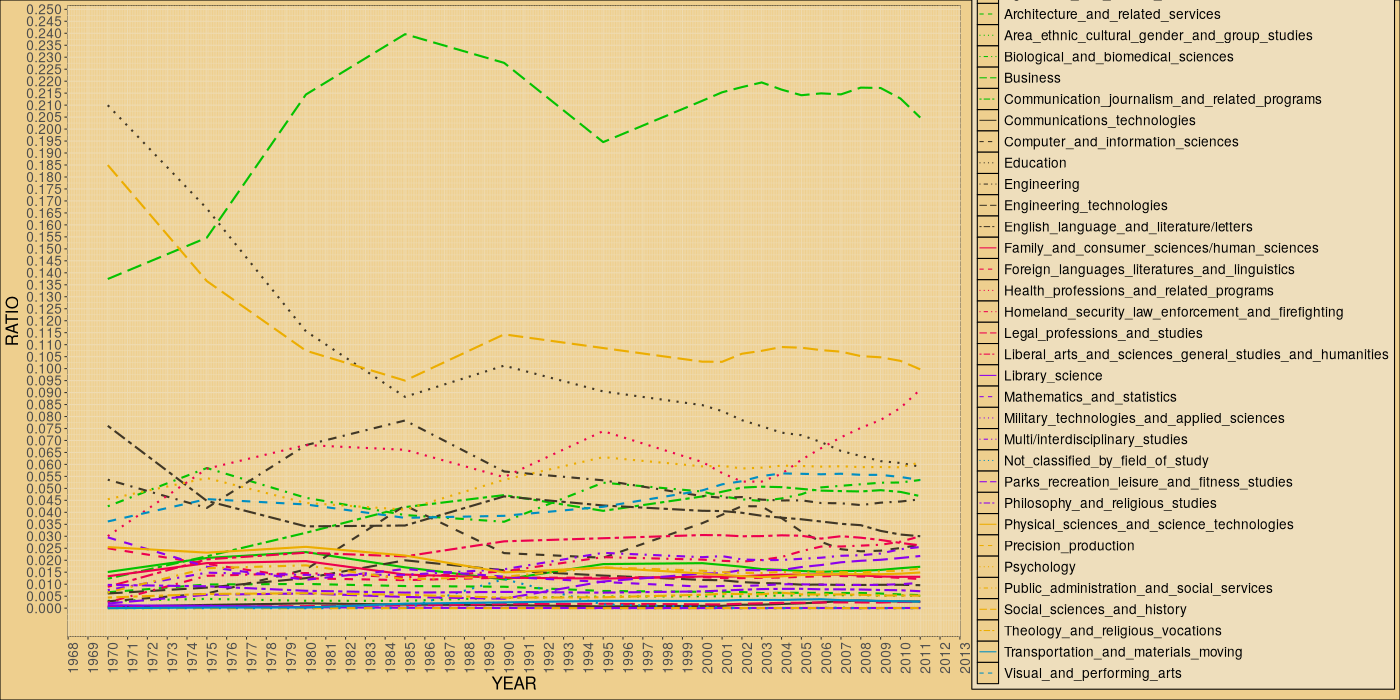
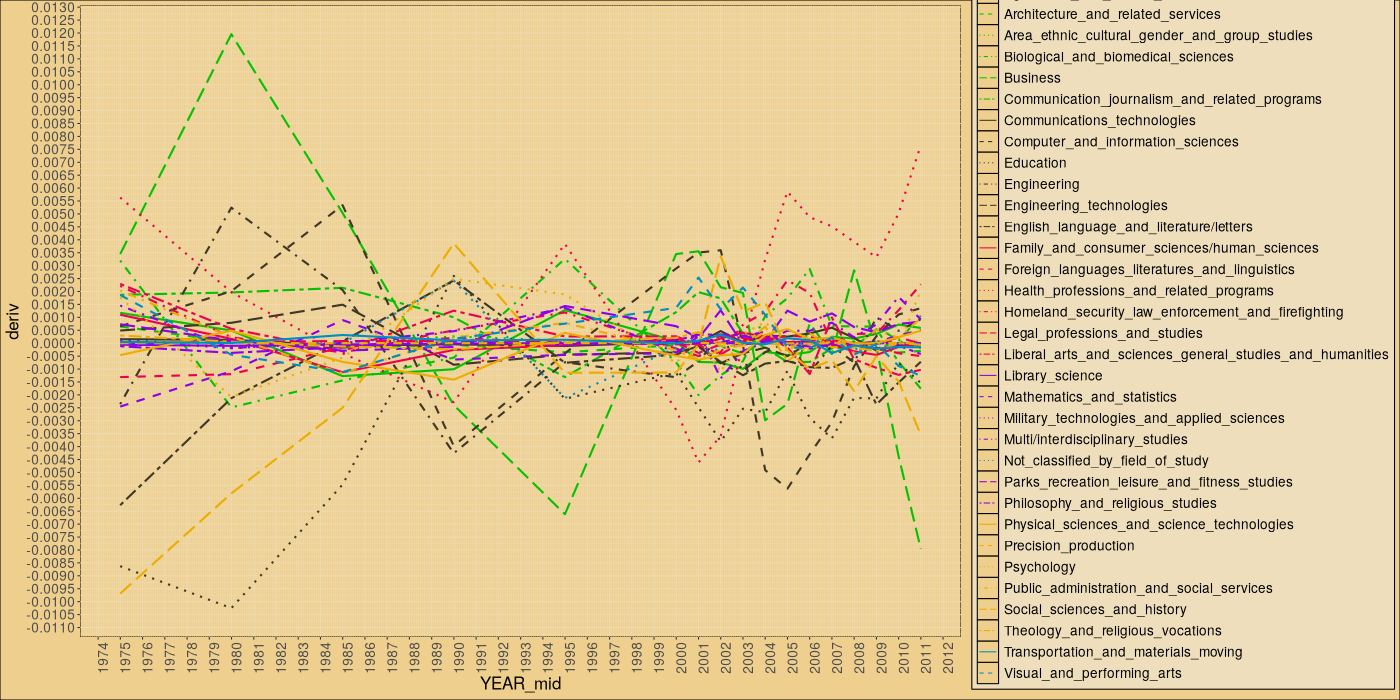
> and we got “Greed is Good” Geckos running things since
This phrase is the opposite of an exaggeration. It sounds like it should not be true, but it really, really is. To be fair though, if you told me in 2015 what the headlines for the 2020s would look like, I would assume you are some kind of satirist or comedian.
seany
6 hours ago
Just return the taxes instead
fragmede
9 hours ago
I mean, you want to be annoyed at something, be annoyed at Apple for investing 3x the Marshall plan into China, instead of America.