tyho
6 hours ago
Wow, what a free society! In the UK if you refuse to unlock your device you can be imprisoned indefinitely! In HK it's just one year!
whatsupdog
3 hours ago
In UK you can be imprisoned for liking a post on Facebook that is considered "hate speech".
ceejayoz
2 hours ago
[citation needed]
halJordan
2 hours ago
No citation needed, it should be common knowledge like stopping at a stop sign. People have been jailed for hate speech in the uk
ceejayoz
an hour ago
> People have been jailed for hate speech in the uk
The parent poster claimed "for liking a post".
The cases I've seen of "jailed for hate speech" tend to wind up having a harassment or incitement component to them. https://www.bbc.com/news/articles/cy76dxkpjpjo as an example. Hence the request for a cite.
"Parlour, of Seacroft, Leeds, who called for an attack on a hotel housing refugees and asylum seekers on Facebook, became the first person to be jailed for stirring up racial hatred during the disorder."
Wikipedia's "selected cases" for plain old hatefulness, similarly, seems to be all fines, no jail terms. https://en.wikipedia.org/wiki/Hate_speech_laws_in_the_United...
gruez
an hour ago
>No citation needed, it should be common knowledge like stopping at a stop sign.
Sounds like you can't (or are unwilling) to produce evidence, and you're trying to handwave that issue away with "it's common knowledge'.
QuantumFunnel
an hour ago
https://lordslibrary.parliament.uk/select-communications-off...
How convenient that the government doesn't make the numbers public and then have to issue statements like this when journalists do some digging on the matter
gruez
an hour ago
I don't get what you're trying to say here? Yes, there are real issues with the government arresting people for speech, and the number is going up, but that's not proof for the specific claim of "you can be imprisoned for liking a post [...]". You can't just tack on spurious claims onto a more well supported claim on the basis that the former is directionally the same as the latter.
andylynch
5 hours ago
Why are you misrepresenting about UK law?
Yes, it can be a criminal offence. But the maximum tariff for this under RIPA 2000 is five years. If it’s not about nation security or CSAM, it’s two.
(Incidentally, the USA is a real outlier in this topic)
cortic
3 hours ago
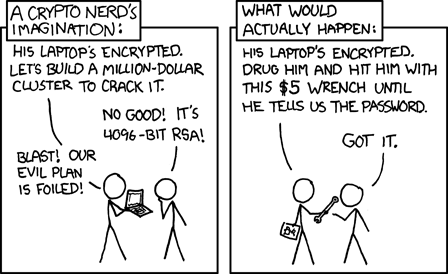
Its five years with no limitations, so when you are due to be released; Whats your password? Another five years... Its such a poorly worded law you could literally spend your life in prison for forgetting your password. And Its mostly used against peaceful protesters.
gruez
an hour ago
>Its five years with no limitations, so when you are due to be released
Doesn't double jeopardy prevent this? Has this actually happened?
AlecSchueler
an hour ago
It does and of course it's different happened. My pet peeve has to be the "it's a poorly worded law" argument about things that have obviously been considered by legal experts. The scares like "the psychoactive substances act will technically make coffee illegal" I've seen on HN are particularly egregious.
iamnothere
36 minutes ago
Laws that are so poorly worded that they could be easily misused are bad laws.
Legislators should force future would-be tyrants to flagrantly violate the law, as this is more likely to generate popular resistance.
AlecSchueler
34 minutes ago
> Laws that are so poorly worded that they could be easily misused are bad laws.
The point is that these laws aren't badly written. There's already protections in place for what's described above.
roenxi
5 hours ago
Are we damning the UK with faint praise now?
I'm not even sure how much practical difference there is between 5 and indefinite in practice, 5 years is a long time. I imagine it is pretty life-destroying. Especially for the crime of having something on your phone that you want to keep private.
> If it’s not about nation security or CSAM, it’s two.
I am sure we all get what you mean, but there is a comic interpretation in vaguely-Soviet style here where if someone hasn't done anything wrong they only get 2 years. I'm going to spend some time this weekend making sure my encryption is plausibly deniable where possible.
idiotsecant
5 hours ago
You're unsure of the difference between 5 and infinity?
deejaaymac
5 hours ago
5 years in prison can destroy your life easily, so yeah, what's the difference?
watwut
3 hours ago
Easily something like 45 years of difference. It is really not necessary to lie, no matter how much you hate UK or Europe.
gib444
5 hours ago
Oh just 5 years, that's OK then.
gruez
an hour ago
It's not okay to imprison people for 5 years vs lifetime, but at the same time, facts matter, and we shouldn't get in the habit of allowing fibs to slip through just because they're directionally correct.
pcdevils
5 hours ago
The police must obtain appropriate permission from a judge to obtain a s.49 RIPA notice.
Before a judge grants the notice, they must be satisfied that:
The key to the protected information is in the possession of the person given notice. Disclosure is necessary in the interest of national security, in preventing or detecting crime or in the interests of the economic wellbeing of the UK. Disclosure is proportionate. If the protected information cannot be obtained by reasonable means.
beambot
5 hours ago
So you're saying it's still at the discretion of a single magistrate?
I'm sure China could find some judges to rule in the name of national security if it would give everyone warm fuzzies.
Judicial checks and balances only function when they're independent of the executive and parliament
AlecSchueler
an hour ago
> So you're saying it's still at the discretion of a single magistrate?
A judge isn't a magistrate, but also: No, of course not. There are different layers of legal protections in the UK. You would be able to appeal the notice itself, you would be able to argue at the court against the decision, and you could make an appeal to a higher court if your were convicted. Furthermore you could make an official complaint about the investigation afterwards.
danlitt
5 hours ago
Not addressing your main point, magistrates and judges are not the same thing. It would be much worse if it were at the discretion of a magistrate.
halJordan
2 hours ago
An interesting observation of the West is that people have an innate trust in the authorities/institutions. It's largely because the institutions have been well run for so long. But as that fades we're left in this twilight zone where you can point to a law like it prevents something. As is often pointed out, the Soviet constitution was much more free than the US one. Even the Romans knew this distinction
AlecSchueler
an hour ago
> people have an innate trust in the authorities/institutions. It's largely because the institutions have been well run for so long.
There isn't trust of the institutions in the UK. That's why there's so many layers of checks and balances like various courts of appeal and the two houses in the parliament. It's designed with the idea that a rogue player can't go wild.
It's also not true that British institutions have been well run for a long time. Bloody Sunday would be a very visceral and obvious example. Interesting case as well because obviously it took almost half a century but at least there was official recognition and apology from the prime minister after the courts and parliamentary investigative bodies did their thing.