VitruvianOS – Desktop Linux Inspired by the BeOS

347 pointsposted a day ago
by felixding

210 Comments

yason

a day ago

I bought an Amiga in the early 90's and enjoyed it immensely. Commodore went under and Amiga died.

I bought BeOS in the late 90's and enjoyed it immensely like a breath of fresh air in a sewage pipe. BeOS died.

With my track record I really, really should've bought Windows. Twice, to make sure.

conception

18 hours ago

Correction, BeOS was killed. I’ll never get over Microsoft getting in trouble for including a browser in Windows but not for forcing companies to not allow BeOS to be installed when it was getting legs.

chem83

13 hours ago

I learned recently that Hitachi actually shipped computers that would dual-boot into Windows 98 and BeOS R4, except that Microsoft's license didn't allow for dual-boot, so the option was removed from the bootloader (or, rather, the Microsoft bootloader was defaulted to, instead of the Be bootloader).

It wasn't that hard to boot into Be, but I suppose most users wouldn't bother because all games and applications were on Windows anyway. Ultimately, lack of apps was probably what held it back, although Microsoft's commercial practices definitely played a role in curbing OEMs and app developers.

* https://en.wikipedia.org/wiki/Hitachi_Flora_Prius * https://news.ycombinator.com/item?id=44217322

limagnolia

16 hours ago

I studied the MS antitrust case extensively when it was happening, and I agree that the abuse against BeOS was MS greatest antitrust offense. However, as a fan of BeOS, I see no evidence at all that Be Inc. would have been successful if MS hadn't abused its position. Unfortunately we will never really know what might have been.

tialaramex

14 hours ago

Yeah, Be Inc. made no sense at all for its own purposes. The reason it existed is that Apple (yes, that one) had fired one of its executives - Jean-Louis Gassée often abbreviated to "JLG" - and he wanted to show they were wrong.

AIUI the intended exit was either an acquihire (Apple gets JLG back and the Be Inc. "journey" ends once people tidy up) or maybe Apple's software side fully embraces Be Inc. (after all JLG is sure he's correct about what Apple should do) and absorbs the entire entity as Be's operating system BeOS becomes the new Apple OS.

That part isn't crazy, it's the early 1990s, affordable CPUs have virtual memory support, the physical size limit is looming, software reliability is worsening, Apple's 1980s co-operative multi-tasking operating system is not up to the job. If you understand the big picture it's obvious that you want something closer in principle to a Unix. You could hire somebody to build one (as Microsoft had for "Windows NT") or some people might build one in their bedrooms (Linux) or you could buy one which already exists, so, that's what Be Inc. set out to be.

In the end Apple decided that if they're going to re-hire an executive who they have fired previously it should be Steve Jobs. The moment they've made that decision, Be Inc. was superfluous -- JLG knows Steve isn't going to hire him, Steve hates him, so next the priority now is to help the money get out so that investors will continue talking to JLG. Fortunately the Dot Com bubble happened, Be floated on typical bubble era nonsense, about how their system is somehow perfect for the Internet, and that was enough for the big money to get out, leaving the wreck for the poor Be fans who were still buying even after the last dregs were gone.

fouc

3 hours ago

NeXTSTEP was developed from 1989 and then acquired by Apple in late 1996.

BeOS first release was Oct 1995.

Perhaps BeOS just wasn't far enough along in comparison? Shame..

dnautics

13 hours ago

jlg posts here occasionally!

im pretty grateful to beos for proving a young me with an offramp from MS architecture that got me using cli, understanding api architectures, making it easy to tinker, etc.

tvaughan

15 hours ago

OS/2 Warp was out before Windows 95, and better.

tobinfricke

14 hours ago

I ran OS/2 Warp and was a fan of it... But to say that it was simply "better" than Windows 95 is a bridge too far. It had its strengths (rock solid multitasking) but also plenty of rough edges.

tensor

10 hours ago

Honestly any OS with real multi-tasking, real security, and real memory protection was better than Windows 95 (and 98).

OS/2 was better. BeOS was better. Linux was better. Windows NT was better.

pjmlp

15 hours ago

If we ignore the fact that it required 1000 euros more in additional hardware, thus most folks went with DOS/Windows 3.x instead, and when Windows 95 came around it was already too late for adoption.

hamburglar

14 hours ago

To pick a nit, I highly doubt you bought your OS/2 hardware with euros. :D

pjmlp

14 hours ago

If I used Escudos it would be useless for the folks reading my comment.

mikestorrent

10 hours ago

Not so, now I know the pre-EU denomination of Portguese currency

hamburglar

13 hours ago

It’s ok. The pedantry was unavoidable.

Shebanator

7 hours ago

Exactly: it depends on what you mean by "better". OS/2 had a much more modern basis, but:

* it was painful to program compared to Windows

* it required a lot more hardware (and thus money) to achieve the same level of performance.

* the UI was terrible

erremerre

19 hours ago

I am in the same boat, every time I like something, it is a commercial failure. They should really hire me to check if I like whatever project they got in mind and if I do, cancel immediatetly and save the losses from being a failure.

mgerdts

18 hours ago

paodealho

14 hours ago

Funny thing. This never happened to me with tech/electronics, but happens from time to time with food items.

_spduchamp

17 hours ago

This is me. It's like a super power.

wjnc

12 hours ago

Buy whatever you want! Buy what makes you happy and buy two if it makes you happier! Do tell all your friends of your keen finds. But remember to buy some put options with each of your Lovely New Products! Thank me later.

henry_bone

7 hours ago

100%. Seems there's a whole class of us. If I'd been old enough at the time to by an early VCR, I'd have chosen betamax.

jnovek

18 hours ago

They should have me do that with television programs.

chocochunks

19 hours ago

I think I did this with phones. WebOS, BB10, Windows Phone 7 & 8. All dead lol.

cgk1951

5 hours ago

I was seriously interested in PenPoint, but it was too early for tablet PCs to succeed. Handwriting recognition was nowhere near mature enough yet and unfortunately that became the main issue in that niche. Even Apple pretty much failed with the Newton because of it.

But PenPoint had a lovely UI and, if memory serves, an API much like Apple's Objective C.

Microsoft had a hand in killing PenPoint, just as they did with BeOs. Jerry Kaplan told the story in his book "Startup".

BirAdam

18 hours ago

I was Palm guy and not Blackberry, so I went from a Palm Treo to webOS. After that though, I went to iPhone. I considered Windows Phone though. The tiles and text orientation were so amazing. I am, however, glad that I never went down that road, not just because Windows Phone died, but also seeing what has happened to Windows more recently.

ipaddr

18 hours ago

Recently?

BirAdam

12 hours ago

Windows was first released in 1985. Windows 10 and 11 are therefore "recent".

jvictor118

19 hours ago

This post is really bringing me back! I knew talk of BeOS would stir up all us old heads. I think what we're all really nostalgic for is the days of tinkering with computers. When things lacked polish, and people put real effort into making their system nice. I remember corrupting my family computer hard drive trying to get a Linux dual-boot setup. Good times!

mech422

11 hours ago

Have you seen Genode (1) ? An operating system framework with a pretty usable OS built on top. Last I heard, it was getting pretty close to being usable as a daily driver. lots of cool tech (micro kernel(IIRC), capabilities, sandboxing as a first class citizen, GUI system, posix compatibility layer, etc). Its been around for ages, has full time developers (its used as the basis for some (all?) of their products.

From the website: "Genode is based on a recursive system structure. Each program runs in a dedicated sandbox and gets granted only those access rights and resources that are needed for its specific purpose. Programs can create and manage sub-sandboxes out of their own resources, thereby forming hierarchies where policies can be applied at each level. The framework provides mechanisms to let programs communicate with each other and trade their resources, but only in strictly-defined manners. Thanks to this rigid regime, the attack surface of security-critical functions can be reduced by orders of magnitude compared to contemporary operating systems."

1 https://genode.org/

JamesonNetworks

17 hours ago

The true rite of passage for the child hacker I remember my dad and brother taking a floppy to copy a sys file to restore a win 3.1 install from the Sam’s display computer in the pre-internet days

peterashford

20 hours ago

I think we were on the same track. I absolutely loved the Amiga and was about to jump on board BeOS when it went under. I never got to use BeOS as a daily driver (just ran their demo disk). How did you find it?

yason

18 hours ago

From them internets after the x86 version got out, I think. Played enough with what I found around, and I ultimately bought (with real money) the BeOS 5.0 Personal Edition, made it dual-boot my Linux machine and knew that this is it! It felt like an Amiga but on soulless PC hardware instead! The exhilaration was unlimited! It booted fast, no old cruft, unorthodox designs, everything one-in-a-thousand a true harbinger customer loves!

Eventually I think the setup gradually bit rot with no updates and unsupported hardware, so I reluctantly had to go back to Linux. I remember Ubuntu and Gnome 2 started to look pretty nice (well, for an inferior desktop environment) in the early years of 2000.

(Unsurprisingly, years later Gnome came out with Gnome 3 and killed all the good stuff that Gnome 2 had accumulated. I can only wait and see how long Mate desktop survives.)

I still keep a Haiku VM around and boot it every now and then.

danans

16 hours ago

I ran BeOS on both the dual PowerPC desktop and later on an x86 laptop. Thanks to its posix-ish environment, I was able to do all my upper division CS projects on it.

Others who had windows or macs had to "telnet" into a remote Unix workstation in an engineering lab to do the same.

prmoustache

19 hours ago

I ran it in a dual boot with linux install but I ended up using Linux more despite liking beos because of the ecosystem. There were just more software available on Linux, especially lightweight tui tools.

MarsIronPI

15 hours ago

I'm too young to remember BeOS but I've taken a superficial look at Haiku and I don't get the hype. What made BeOS so special? How is it different from GNU/Linux or BSDs?

rjrjrjrj

14 hours ago

Keep in mind that BeOS was released in 1995.

BeOS had pervasive multithreading and a slick UI. The BeBox had dual CPUs, a novelty at the time and many years before multi-core CPUs.

Linux was still very new, and didn't have much of a GUI at all (maybe basic X, but this was long before Gnome, KDE, Englightment, etc)

Mac System 7 didn't have protected memory or preemptive multitasking.

Windows 95 was brand new and while a big improvement over Windows 3.1, was still very prone to crashing.

bobsalt

14 hours ago

^this, plus being able to play 3-4 quicktime videos at the same time smoked everyones brains around me. Using mac os 8/9 was a several times a day cursor freezing up and having to reboot. win95 was even worse

vondur

13 hours ago

The one that blew my mind was you can drop a QuickTime movie onto each side of a 3d cube and they all played without dropping frames.

rjrjrjrj

13 hours ago

I think I'm remembering this correctly - couldn't you move the window while the video inside continued to play?

ranger_danger

9 hours ago

Yes you could! Windows did have (at some point) "show window contents while dragging" option, but it was quite slow at the time, and I don't remember if it supported showing (overlay) video content while moving or not.

mixmastamyk

14 hours ago

Super responsive—running ten things at once, on a Pentium 90 or PPC. The filesystem metadata was neat as well, and though we have these things today, it was unique in the 90s.

endemic

15 hours ago

I liked it because it was very fast (I would always demo the startup time vs. Windows) and had a clean, macOS-inspired UI.

lproven

13 hours ago

> How is it different from GNU/Linux or BSDs?

I am risking the one full-time paid developer of Haiku popping up here and shouting at me, because he's done that a few times before and even written to my editor-in-chief to complain. Sadly for him, my former EIC was a hardcore techie -- it's how I met him, long before either of us worked there -- and he was on my side.

https://www.theregister.com/2023/01/11/haiku_beta_4/

Unix is a 1960s design for minicomputers. Minicomputers are text-only standalone multiuser computers. That is why things like handling serial lines (/dev/tty -- short for TeleTYpe) are buried deep in the core of Unix, but networking and graphics aren't.

There is an absolute tonne of legacy baggage like this in Unix. All Unixes, including Linux kernel 7.0. We do not use minicomputers any more; nobody even makes them. We don't have multiuser computers any more. In fact, we have multi computers per user. Modern servers are just PCs with lots of connections from other computers not from people.

In the early 1980s the Lisa flopped because it was $10K, but the Mac did well because it was $2.5K and had a GUI and no shell. The future, woo, etc.

The Mac was black and white, 1 sound channel, no hard disk, no expansion slots, and in cutting down the Lisa, Apple discarded multitasking.

Enter the Hi-Toro Lorraine. Intended to be the ultimate games console, with a powerful full-16 bit Motorola 68000 chip (a minicomputer CPU on a sdingle die) amazing colour graphics, multichannel stereo sound, but it could plug into a TV.

Commodore bought it, renamed it the Amiga, and tried to develop a fancy new ambitious OS, called Commodore Amiga Operating System: CAOS.

They couldn't get it to work so it was canned, and a replacement hastily cobbled together from the research OS Tripos written in BCPL and some new bits. It had a Mac-like windowing GUI, full preemptive multitasking (with no memory protection because the 68000 couldn't do that), and it fit on a single DD floppy (~880 kB) and into 512 kB (1/2 MB) of RAM.

It was a big hit and set a really high bar for expectations of what an inexpensive home computer could do. It ran rings around the Mac and could emulate a Mac with excellent compatibility.

A decade later a lot of people missed that. PCs and PC OSes were very boring by comparison. Sure, reliable, fairly good multitasking by then, dull grey UIs. Linux was a thing but it was for minicomputer fetishists only, and looked like it came from 20 years before Windows or Mac. (Which in a way it did.)

So a former Apple exec set up a company to make a modern geek's dream machine. Everything had true colour graphics and stereo sound now, so that was a given, not a selling point. It had to have a snazzy very fast very smooth GUI, it had to have excellent multitasking, screaming CPU performance because RISC chips were starting to take off. Mainstream computers struggled with >1 CPU so multiple RISC CPUs was the selling point, and amazing blindingly smooth multimedia support, because PCs and Macs could just about play one jerky grainy little video in a postage-stamp sized window in 267 grainy pixelated colours.

The BeBox was to be the mid-1990s geek's dream computer. Part of how they did it was an all-new multitasking single user OS with a very smooth built in GUI desktop, best-in-industry media support, built-in TCP/IP networking. All the cool bits of Windows NT, multitasking as good as Linux but pretty, a desktop better than Windows 95, and it threw all the multiuser stuff in the trash, all the boring server stuff in the trash, because FOSS OSes did that tedious business stuff.

It was beautiful.

It flopped.

The company pivoted to selling its OS on the other PowerPC kit vendor: on PowerMacs, with reverse-engineered drivers. It flopped. Classic MacOS was just barely good enough: crap multitasking, crap virtual memory, but loads of 1st class leading pro apps. BeOS had almost none.

So Be pivoted again. It ported its shiny new C++ OS to x86. You could buy multiprocessor x86 PCs in the late 1990s. I had one.

It was amazing on PC kit. It booted in under a tenth of the time that Windows sluggishly lurched into life. It could do blinding 3D like spinning solid shapes while movies played on their surfaces, and it did it all in software.

I reviewed it. I loved it.

https://archive.org/details/PersonalComputerWorldMagazine/PC...

But it still had almost no apps and while Microsoft could not prevent OEMs installing it, it could prevent them from installing a bootloader:

https://birdhouse.org/beos/byte/30-bootloader/

Be sued.

https://www.theregister.com/2002/02/20/be_inc_sues_microsoft...

It wasn't enough.

It pivoted into internet appliances but too late.

Me, I felt it should have done a deal with Acorn which was the only company with affordable multiprocessor ARM workstations at the time.

https://liam-on-linux.livejournal.com/55562.html

Haiku is an all-FOSS ground-up rewrite, but with the original desktop, which was FOSS. It's a lovely mixture of the Classic MacOS Finder and the Windows 95 Explorer, with the best bits of both but none of the bad bits.

Haiku is lovely. It's got a huge amount of Linux compatibility now. That means lots of apps, fixing the one big killer problem of BeOS.

But it is much bigger and much slower. It's still 10x smaller and 10x faster than any FOSS Unix but the original could boot in 5-10 seconds to the desktop in 1999 on a Pentium 200 from a PATA hard disk. A modern PC with an SSD should load it in half a second, but Haiku still takes 10 seconds or so. Good, sure, but not as impressive as BeOS was 25 years ago.

hbbio

17 hours ago

Don't get me started on the Psion 5mx...

Still have it, last time I checked it worked well.

makach

20 hours ago

I had to read this message twice, gotcha

WesolyKubeczek

13 hours ago

Looks like you are a “harbinger of failure”, like me. I have this fondness for products that ultimately fail.
rebolek

a day ago

If you like BeOS, take a look at Haiku https://www.haiku-os.org/ , it's very nice and very usable system based directly on BeOS.

pjmlp

a day ago

And much better option, running the real deal, instead of some compatibility layer.

akho

20 hours ago

I suspect Linux has better hardware support than Haiku, which is not exactly easy to run on laptop hardware (w/ wifi, sleep, &c)

O1111OOO

8 hours ago

> I suspect Linux has better hardware support than Haiku, which is not exactly easy to run on laptop hardware (w/ wifi, sleep, &c)

So true. I had an old Dell Latitude D620, 3GB/500GB, 1.66ghz Intel Core Duo Processor and it was sound that tripped me up. Haiku was lightning fast on this machine.

I think that eventually I might've gotten sound to work but... this was many years ago and the laptop was mostly for testing light-weight distros on modest hardware.

SuperNinKenDo

17 hours ago

I suspect it was a freak occurence, but I actually had incredible luck running Haiku on an old laptop back in the day. It was incredibly fast, and just about all the amenities you'd expect worked with no or minimal intervention.

nomdep

6 hours ago

Me too. The laptop was so old that I couldn't play a 360p mpg video without pauses on Windows 2K or XFCE, but it ran smoothly with BeOS5 (the Intel-based abandonware version)

pabs3

16 hours ago

In the last year sometime I ran the Haiku live image off USB on my only laptop (2011 X201t), it worked fairly well.

cachius

17 hours ago

Even running from an HDD?

trinix912

16 hours ago

I recently tried the latest version (Beta 5?) on a 2005-ish PC with an even older HDD and it ran surprisingly fast off that. The only thing where it was somewhat slow was web browsing.

SuperNinKenDo

10 hours ago

Yeah. I installed it to HDD and it worked great. You'd think the thing had an SSD ot was so snappy. No issues with compat on the drive or anything.

pjmlp

18 hours ago

Yeah, a good opportunity to contribute upstream.

AlecSchueler

a day ago

Presumably there's a lot more modern software written for Linux which you'd end up running through a compatibility layer from Haiku? The better option seems relative. I could be misremembering how Linux programmes are handled on Haiku though.

smallstepforman

an hour ago

In Haiku windowing system, each app window gets its own thread so dialog boxes run in a different thread to the main window and a different thread to the core app. In Linux, all windows share the same message loop thread. A simple port reveals threading issues in Haiku which dont exist on Linux.

To work around this, all window messages in ported apps are marshalled to execute sequentially. Small additional overhead, and the system doesnt spread available threads, so noticably slower.

Compare a native Haiku app with a ported app, one is smooth as ice while the other isnt. Users notice it. This is on many core systems.

chrsw

19 hours ago

VitruvianOS has the clothes of BeOS, which is nice and refreshing.

But Haiku has the soul.

pjmlp

a day ago

Maybe the fallacy is not exploring what a given OS is great at?

We don't need to clone UNIX all over the place.

hnlmorg

21 hours ago

How strictly do you mean “UNIX clone”? Because Linux isn’t strictly UNIX. But then at the other end of the scale, BeOS was also partially POSIX compliant and shipped with Bash plenty of UNIX CLI tools.

Perhaps it’s better to play it safe and just run DOS instead ;)

pjmlp

18 hours ago

It certainly is, what it is not, is a derivative.

BeOS on its final commercial version certainly did not allow to compile UNIX applications, beyond the common surface that is part of ISO C and ISO C++ standard library.

c-c-c-c-c

a day ago

But Vitruvian is running its own graphics stack so no X11 or wayland applications will run afaict.

hym_the_pawn

18 hours ago

Not quite really. Vitruvian runs virtually the same identical sw stack of Haiku and there's a haiku-wayland that works. However on vitruvian the app_server could provide real Gbm buffers, so that would give us pretty much native rendering. We're still working on it but you'd have the advantages of a BeOS-like gui and the power of linux!

reverius42

21 hours ago

So what's the point of this -- it's essentially a different Haiku?

galangalalgol

19 hours ago

I think itbis the reverse, it is haiku with a linux kernel so it works with more hardware.

anthk

a day ago

With xlibe they should.

hrmtst93837

18 hours ago

Maybe, but at some point you're duct-taping 90s driver hacks just to run Haiku on modern hardware unless you enjoy daily spelunking in kernel panics.

shevy-java

a day ago

And things such as ruby don't work on it. Well, what shall I say? The "best" ideas get beaten when in practically already works very well - aka Linux. People need to compare to Linux and if there are failure points, they need to fix it. Haiku keeps on failing at core considerations. If you look at guides, they recommend to "run in qemu". Well, that is a fever dream. They need to focus on real hardware. And they need to support programming languages just as Linux does. And modern hardware too. Would be great if Haiku could shape up but the development is way too slow. I've been looking at it for many years - they are simply unable to leave the dream era. ReactOS is even worse in this regard. At some point those projects gave up on the real world. I think qemu, while great, kind of made this problem worse, since people no longer focus on real hardware; the mantra is "if it works in a virtual EM, it is perfect". Until one notices that it doesn't work quite as well on real hardware. Case in point how ruby does not work on Haiku. Ruby works well on BSD (for the most part), linux (no surprise) and also windows (a bit annoying, but it does work there too and surprisingly well, for about 99% of the use cases, though it is annoyingly slower in startup time compared to linux).

59nadir

18 hours ago

> I've been looking at it for many years - they are simply unable to leave the dream era.

Sit down and do the work needed to get Ruby running properly on Haiku instead of sitting here complaining and basically admitting that you're just being a noisy spectator... On HackerNews, no less.

chuckadams

17 hours ago

Huh, PHP works on Haiku, and there aren't even that many #ifdefs for it in the source. If a language can be ported to Windows, Haiku should be a no-brainer. Seems more a matter of having someone interested in maintaining the port, and I think it ultimately just points to the size of Haiku's userbase being a rounding error.

waddlesplash

14 hours ago

> And things such as ruby don't work on it.

What doesn't work about it? We have Ruby in the software repositories, and Ruby is required to build WebKit (and we build WebKit on Haiku), so clearly it works for that much at least. I don't see any open tickets at HaikuPorts about bugs in the port, either.

rebolek

21 hours ago

Getting Rebol running on Haiku was fairly easy task, so I guess it shouldn't be that hard for Ruby too, if someone's willing to do the work.

orr721

9 hours ago

What does not work? You can install Ruby version 3.2.9 (2025-07-24) with a point-and-click package manager HaikuDepot and it works perfectly fine.

pjmlp

a day ago

People aren't really running servers on Haiku, which is basically the only relevance to use Ruby in 2026, Rails powered web applications.

Then again, there is a golden opportunity to become a Ruby contributor, road to fame on Ruby contribution list.

vidarh

15 hours ago

Maybe 5% of what I use Ruby for is on the server. I'd suggest those of us who use Ruby client side are likely to outnumber Haiku users by magnitude or two.

cpuguy83

17 hours ago

Homebrew would like a word.

timw4mail

16 hours ago

Homebrew wouldn't support Haiku anyway.

pjmlp

15 hours ago

Mostly relevant for folks on macOS, and I skip on it when using Mac anyway rather using UNIX and SDK tools in the box, so kind of debatable.

cpuguy83

12 hours ago

Debatable because you don't use it?

10729287

a day ago

I've been a fan of Beos philosophy since the Personal Edition but never had the occasion to run it on steel as I was too poor to have two machines back in the days, and now I miss login/password prompt at boot on Haiku. But i'm following it closely and I hope i'll be able to install it on my X220 for a web/mail machine !

hnlmorg

21 hours ago

You didn’t need two machines to run BeOS. I ran very smoothly on a Windows PC via dual booting.

BeOS 5 could even be installed on a Windows FAT32 partition alongside Windows (it created a 50MB virtual disk).

At one point in time I had Windows 95, Windows 2000, Linux (possibly Slackware) and BeOS 5 all running on the same single PC.

10729287

16 hours ago

I was probably younger than you, and on the family computer. Couldn't make what I want and mess with booting back then ! I remember trying the PE edition through windows but couldn't install it.

hym_the_pawn

19 hours ago

Vitruvian can potentially have everything Haiku has (it's the same identical stack BTW) but with the power of linux. It's cool if people could start to appreciate both visions.

leke

14 hours ago

I'm so confused right now.

carlesfe

20 hours ago

I ran BeOS as a daily driver for a few months in the early 2000s. I had a winmodem and Linux couldn't connect to the internet for me, but for some reason, BeOS had drivers, so I used it. It was faster and the desktop environment felt more polished than KDE/Gnome.

Of course, at that time, it was impossible to know which OS would win the wars, so BeOS became my favorite. However, Linux developed very quickly during those years, I got into college and started using UNIX there, winmodem drivers appeared, and that's what I ended up using.

But BeOS still holds a very dear place in my heart. It really was superior to anything else during that era.

dainiusse

20 hours ago

+1. Even though it had limitations, it had this "clean polished feeling"

hypercube33

13 hours ago

What set it apart was the out of the way UX and clean fast experience. It was a real time kernal to boot. I think korg used it on some of their synth products or something even.

To me the UX and experience on it was (still) ahead of its time. It ran stuff on a Pentium 90 like it was a 400mhz beast running NT.

watersb

a day ago

25 years ago, I configured GNOME to run a BeOS-like tabbed window manager. On a sun workstation.

But that's not what this is. Or not only:

Nexus Kernel Bridge

Nexus is Vitruvian's custom Linux kernel subsystem that brings BeOS-style node monitoring, device tracking, and messaging to Linux — making it possible to run Haiku applications on a standard Linux kernel.

It claims to run apps from Haiku, the current open-source implementation of a modern BeOS.

zozbot234

20 hours ago

Looks like this is a thin translation layer for BeOS/Haiku syscalls. I wonder why they aren't relying on Syscall User Dispatch https://docs.kernel.org/6.19/admin-guide/syscall-user-dispat... which would enable them to put this compatibility layer in user space. It's already being used by recent Wine versions.

hym_the_pawn

19 hours ago

It's not really a translation layer, nexus implements the same BeOS/Haiku IPC in kernel but using linux kernel primitives. It's not as much as a translation layer than any other IPC in the linux system, really BeOS/Haiku apps are first class citizens.

p_l

an hour ago

Most of BeOS IPC is in mainline Linux kernel [1] - the difference here seems to be implementing some of the services that are supposed to be available related to filesystem etc and the user land side of it (raw IPC does very little without another layer on top)

[1] - there's a reason why a bunch of BeBook reads the same as some of the oldest parts of Android documentation

donatj

a day ago

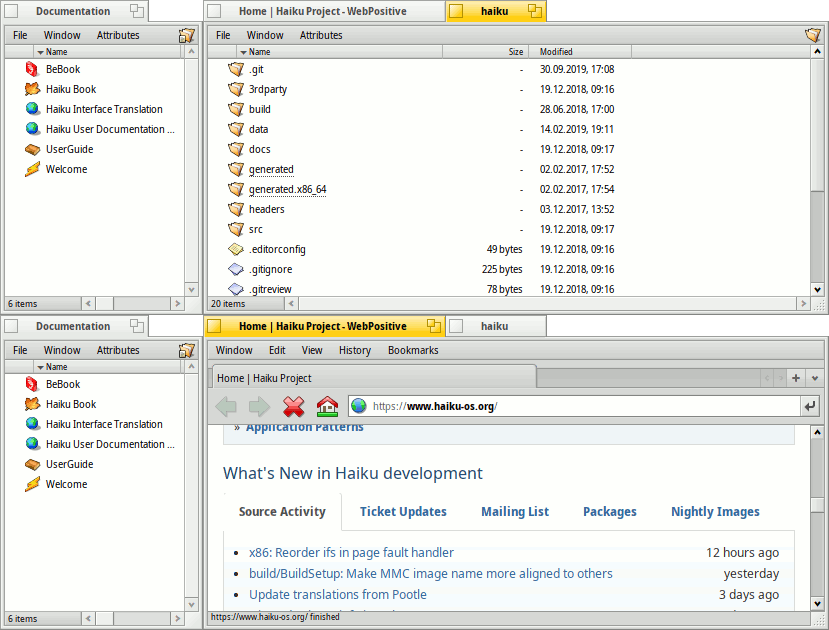
The important question becomes can you stack the window decoration "tabs" of different apps into a single stack of tabs like in BeOS?

Demonstrated here (animated):

https://www.haiku-os.org/docs/userguide/en/images/gui-images...

msk-lywenn

a day ago

I used to run fluxbox in the early 2000s. I greatly miss tabbing any windows like that.

malicka

16 hours ago

You can run fluxbox today! I still do, I can’t go without window tabs. :^)

gedy

19 hours ago

I believe the Cosmic Desktop from Pop OS has that again

nunodonato

21 hours ago

me too! fluxbox and gkrellm for some kick ass desktop "widgets" monitoring the computer :D

Zardoz84

19 hours ago

KDE had it. And I missed it a lot.

guerrilla

21 hours ago

This is what we needed in our OSes instead of Firefox tabs.

Schlagbohrer

19 hours ago

How is it that different?

yesbut

19 hours ago

basically every app is a tab. this is how I run i3wm. full screen tabbed layout. smaller modal windows still appear in their normal smaller windows in front of the current full screen app.

samtheDamned

17 hours ago

I tried to install a quick VM to answer this exact question but I had some difficult getting it running in Gnome Boxes.

numerio

20 hours ago

Yes the UX is virtually the same

WD-42

a day ago

UI elements that have depth look so mouth-wateringly good now. So over the minimalism and bouncing back hard.

pndy

a day ago

It fitted right these times when everything had that pseudo-3D gray outlook but yet was unique with these small yellow title bars (which you could move), diagonal icons and taskbar that could be placed in both corners and edges of the screen. Now compare that last thing to what MS did to Windows 11 taskbar, and only in last days announced it'll gladly restore previous behavior.

Haiku retained all of this and bring something new like combining various windows into single tabbed one - not sure if any other system has such feature. Or... toolbar in file manager - which is something I really missed back then in BeOS.

Back then BeOS was much more stable and faster than my daily Win98SE, even working in that image file on FAT32 partition.

Kinda makes you wonder, how things would go if Apple would pick BeOS as their OS instead of Jobs' NeXT. Would it still looks same or it would go thru all stages we've seen - with glass, transparency and then flatness and darkpatterns producing minimalism.

diskzero

16 hours ago

As a former Be employee who ended up at Apple by way of Eazel, there are two ways to answering your question about the UI direction; 1. If Apple did not acquire Be, Apple most likely would not be in business or would be a much different company. 2. Assuming Apple did survive, Steve Jobs used the industrial design language of Jony Ive for the look of Aqua. Bas Ording was the primary designer of this and was directed by Steve with daily updates. The further evolutions of brushed metal, skeumorphism, etc. were all directly driven by how Steve wanted things to look with minimal input from others. The current bland minimalist UX disaster (IMHO) would probably not have happened, because for all of his faults, Steve had very good attention to detail and was in general a good proxy for the user.

kannanvijayan

18 hours ago

I remember being very disappointed when Apple went with the NeXT tech instead of the Be tech. I was in undergrad when that happened.

In retrospect though, the company wasn't making a technology decision. They were making a decision between Jobs and Gassee. Jobs came with NeXT and Gassee came with Be.

I don't think the technology mattered that much in the large scale of things. Jobs brought with him a strategy for moving personal computing from a technical market category to a fashion market category - either to make technology fashionable or to make fashion technical (however you want to look at it). It's a strategy that started with candy-coloured iMacs and ended with iPhones.

Gassee brought a really cool OS.

Apple made the right choice.

diskzero

15 hours ago

In retrospect though, the company wasn't making a technology decision. They were making a decision between Jobs and Gassee. Jobs came with NeXT and Gassee came with Be. I don't think the technology mattered that much in the large scale of things.

Yes and no. The core of the purchase decision was really based on the technology. Ellen Hancock (Apple's CTO at the time) actually did a decent analysis of BeOs and NeXTStep. She was actually against some aspects of the purchase, and was not in favor of Be. She was also not in favor of the NeXT kernel. It is painful to say as a Be employee at the time, but Be internals were fragile, some technologies were very shallow, the kernel was brittle and under constant churn and we had big problems with our decision to have a C++ API. Gil Amelio liked Steve and Steve did a good job selling both a vision and the NeXT technology. BeOs was a really cool demo that was getting pulled into the direction of a real OS but had a long, long way to go. There actually was a possibility that Apple could have also gotten the Be code, but the board didn't go for it. As it turned out, most of the primary BeOs developers ended up at Apple via Eazel. The ones that didn't ended up at Google via Danger Research/Android.

kannanvijayan

2 hours ago

Always interesting to get an insiders take! I really appreciate the insight.

gond

12 hours ago

Thank you for the Be-related posts. Maybe, one day, you could write a more detailed report of it in a format made for longer articles. I would read it.

chuckadams

17 hours ago

I believe the saying goes that NeXT acquired Apple for -$427 million.

InsideOutSanta

18 hours ago

Late 90s visual design for operating systems - in particular Mac OS 8 and BeOS - is peak OS design. Aesthetically pleasing and a very clear, highly readable visual language based on well-researched human interface guidelines.

It was uphill all the way before that point, and downhill ever since.

716dpl

16 hours ago

I find it soothing. There is ornamentation in its design, but it's precise and minimal, but also friendly. The icons, in particular, look so good.

thisislife2

a day ago

This is interesting - a Linux distro that really differentiates itself technically, instead of just having a different GUI / desktop environment.

Yaggo

19 hours ago

Yeah, first I thought this is just a BeOS-inspired GUI theme, but there is more to it:

    Nexus is Vitruvian's custom Linux kernel subsystem that brings BeOS-style
    node monitoring, device tracking, and messaging to Linux — making it
    possible to run Haiku applications on a standard Linux kernel.

nathell

16 hours ago

I almost overlooked this, and then when I didn’t, I almost dismissed this as Yet Another Linux Distro with a custom skin. But no, there’s novelty and exploration in here. There’s attempt to venture off the local maximum. This is a breath of fresh air.

nico

a day ago

BeOS was such an amazing experience back in the day. It really felt magical. Too bad it got shutdown. I wonder what the evolution of it would be like today

silisili

a day ago

My first memory of BeOS was that it could play media independently. You could play a video in one window, and an MP3 or another video in another, and they'd both play audio at the same time.

I don't know exactly why, but child me thought that was so interesting, since every other OS at the time seemed unable to.

bluedino

15 hours ago

BeOS was released in October 1995, and Windows 95 was able to play two videos (or more) at one time, with audio from both.

eightman

a day ago

AlecSchueler

a day ago

I love Haiku but I feel it's quite different than where BeOS would be today had BeOS continued to exist. In that alternative world there might have been considerably more influence from BeOS going into the rest of the industry much sooner, and that effect could have snowballed.

pjmlp

a day ago

For me it felt like it was going to be my next Amiga, in kind of experience, something that GNU/Linux never did it to me, where CLI reigns and multimedia was always looked down upon, Windows and Mac OS weren't quite there as well.

Another cool one that was around was QNX.

setopt

a day ago

If I recall directly, Apple was between buying BeOS and NeXT. Would be interesting what would have happened if they went the Be route instead of the Unix route. (But given that MacOS and BeOS were both fringe at the time, perhaps they would just have gone bankrupt…)

ab5tract

a day ago

Considering that Steve Jobs came with NeXT, the general consensus has been that their recovery would not have been nearly as significant.

The real what-if for me is pondering what might have been had HP and other vendors not caved to the Wintel cartel in abandoning their plans to include BeOS as a preinstalled OEM option. Microsoft was sued by Be in civil court and Be won their case, but it was too little too late.

BirAdam

18 hours ago

Jobs worked on NeXT and Jean-Louis Gassée was working on Be. Gassée had brought the world the Macintosh Portable and the IIfx, and he started the Newton project which had the effect of keep ARM alive.

When Gassée left Apple, he took many of Apple's best with him. If we want to know what Apple would have looked like under Gassée, I think it's easier to look at how many products he killed. Much of Apple's leadership was trying to force budget computers like the PC industry was building. Gassée would have none of it. He was focused on exceptionally good hardware married to exceptionally good software, knew the handheld devices would be vital in the future, but he didn't like boring things. I imagine that Apple built around Be would have delivered many of the same things, but wouldn't have become just plain brushed aluminum everywhere.

The curious part would have been the OS. BeOS and NeXT are wildly different.

panick21_

a day ago

I think at the time everybody agree that BeOS would need a whole lot more work put into it compared to NeXT. That said it still took a huge amount of work to evolve NeXT to OSX.

So I can well imagine Apple fucking this up and getting aquired.

ErroneousBosh

a day ago

You can pretty much just use Haiku as a daily driver these days, if your demands aren't too great. It runs really well on older hardware too.

And of course you can just spin it up in a VM if you only want to play a bit.

I just found my BeOS 5 and BeProductive CDs from the late 90s. I wish I had something to run them on.

mlhpdx

18 hours ago

What would they run on these days? I mean other than my old Gateway 2000 dual Pentium Pro with 32MB of RAM and dual booting BeOS and NT4?

kev009

7 hours ago

This is both ambitious and seemingly not intractable which is a rare goldilocks combination.

As some contrast, consider something like GNUStep. You are never going to get macOS out of GNUStep, no matter how hard you try, because it is too high level (Cocoa) while simultaneously too ambitious. Similarly, with alternate kernels like ReactOS you will never get full replacement of Windows because it is too ambitious and intractable.

The intersection of this project though, it is a cunning insight in using the hardware support of Linux and shedding the graphics layer for something a lot simpler with a minimal kernel module to support the existing mechanics of BeOS. This is more in line with wine, which is and has been useful for a long time, but is even easier. This doesn't mean it will achieve massive user base, but it seems like it will mature fast enough into something dedicated fans can enjoy and use productively.

prmoustache

18 hours ago

Anyone remember BlueEyedOS? It had exactly the main goal, building a beos compatible OS on top of the Linux kernel.

hencq

15 hours ago

Yes! I was racking my brain trying to remember what it was called. Back in the early 2000s I ran BeOS on my desktop and absolutely loved it. Then when they went under, I followed the effort to come up with an open source version with guest interest. There was one effort that wanted to build everything from scratch. That's what was later renamed into Haiku (I think initially openBeOS maybe?). There was also BlueEyedOS who thought you could get there faster by building on Linux and X11.

I think Haiku got more traction because at the time people felt that it should run BeOS software without recompiling. I have long wondered what would have happened if BlueEyedOS would have gotten most of the effort.

Vitruvian asks a different question: what would I actually want to do with my computer that I currently can’t?

Only be able to drag a window around the screen from the top left corner

danwills

a day ago

On many Linux desktop environments it is the default - or can be configured: To hold the Windows Key ('meta') and left-mouse-drag a window around from _anywhere inside the window_! No need to get the mouse into the 'title bar'!

Additionally, meta+middle-mouse-drag allows one to resize a window from anywhere in the whole window!! (it chooses the closest corner when the drag starts) and this, being able to resize a window without needing to put the mouse in a usually-very-thin window border, is extremely liberating in my opinion! To the point where I really miss it on sub-windows where the app is handling resizing/etc itself!

There's a Windows app I used to use that supports the same kind of thing for Windows (different key I think), no idea if there's one for Mac I'm afraid - or whether it can be configured to work that way, but there probably is one so it would be worth investigating if this sounds useful to you I'd say!

bandie91

18 hours ago

yes, Alt+drag (it's always meta, not meta4, by default on systems i use) has been and still is a killer feature to me. on desktops which does not support it, like windows, i feel like my hands were tied.

ianlevesque

a day ago

To be fair that's one more corner than Tahoe.

Touché, and such a good reminder why everyone should wait for macOS 27.

vanderZwan

20 hours ago

Sort-of unrelated (but very on-brand for people into BeOS I think), it's so satisfying when a webpage is so free of bloat that navigation and latency to clicking on things in general feels instant.

rcarmo

a day ago

I hope it’s not just the look. The ability to group tabs from various apps into a single window was the best UX feature it had, and I still miss it sometimes.

numerio

20 hours ago

it's the real app_server running :) so you have everything you'd expect

ginkgotree

4 hours ago

I installed BeOS in the 90s as a kid. It was awesome, and I love seeing this.

vibbix

16 hours ago

Pleasant surprise to hear about this. I've had a fascination with BeOS & Haiku for decades. I am now actually developing a custom website layout themed after BeOS (good excuse to learn Figma!)

aryonoco

18 hours ago

Little known fact, a small piece of BeOS survives to this day and is an integral part of Android

BeOS came up with “Binder” for doing inter process communication. Just before Be Inc. was acquired by Palm, some Be engineers somehow convinced management to release Binder as open source, which came to be known as OpenBinder.

After the Palm acquisition many Be engineers moved to a startup called Android Inc, and adopted OpenBinder for IPC. And the rest as they say, is history.

pjmlp

15 hours ago

Another thing that survives is that they wrote Java as if writing C++ with m_ prefixes, and several other Cisms, which prevail to today.

radiator

9 hours ago

what we’ve actually created is an alternative Linux desktop that uses neither X nor Wayland, this is very welcome news, since X is allegedly "abandonware" and of course not everybody likes wayland.

unixhero

a day ago

Why should users not instead go for Haiku

jonhohle

a day ago

It’s Linux, with all of the support that provides. Not a knock on Haiku, but if I can have a BeOS window manager and Tracker, while running modern Linux binaries natively, I’d be a happy.

Gabrys1

a day ago

For my daily machine, I need Docker, terminal, Firefox (for private browsing), Chrome (for work), VS Code and/or JetBains IDE. If this can feel a bit like I remember BeOs felt, that'd be awesome

pjmlp

a day ago

You mean Electron apps.

voidfunc

6 hours ago

Very interesting. Wonder if this can run Proton for gaming... this looks about perfect.

ofrzeta

a day ago

"Real-time patched Linux kernel for low-latency desktop use" - does this really make sense? I think there have been various efforts like this over the decades but as far as I remember none of them really made a huge difference for the end user.

IIRC the realtime patchset that RHEL maintained in its own branch/tree was upstreamed last year.

I don't think it makes sense for desktop applications, it may make sense if sound latency is a priority but even then stock kernel delivered lower latency in many cases.

numerio

20 hours ago

I won't say you're wrong because you aren't, in fact the system works very well also with non-rt kernels. But the graphical stack is not really designed like the average linux stack, the BeOS is somewhat hungry in terms of timing and I believe our implementation can take advantage of a RT kernel. But if it'd proven unnecessary I'd be 100% for changing it back, it's just a package in our image creation code after all, we don't strictly depend on it.

0x80h

6 hours ago

This is pure nostalgia. What a fantastic time playing with BeOS :)

mac3n

13 hours ago

My favorite thing about the early BeBox was the Pulse CPU meter, which shows the load on each of the two CPU chips. Clicking on a CPU stopped it. Clicking on the second stopped it as well, which took me a moment to realize.

clayhacks

a day ago

Ok maybe I’m too young, but what is BeOS? Everyone here is linking other alternatives, but no one’s linked to the original BeOS. Or is it gone now?

lobf

a day ago

I don't understand this type of helplessness when you're already competent enough to use HN...

https://en.wikipedia.org/wiki/BeOS

ranger_danger

8 hours ago

"Why did you ask this when you can google it?"

Because sometimes I learn unexpected things and get another perspective even when I could search for it myself.

gjvc

a day ago

stick around...

jazzyjackson

a day ago

I’ll try this out with my eink display, interface might look good in grayscale. So far my favorite desktop for this is the Chicago95 theme for xfce

dddw

a day ago

Do share a screenshot if you do. What refreshrate do you have on that display?

blacklion

14 hours ago

I think, in case of e-Ink photo is much more informative, as screenshot takes data from frame buffer and didn't take screen technology in account.

jazzyjackson

an hour ago

:P lol indeed a screeshot would be full color

Perhaps I can place the monitor on my scanner and take a “screenshot” that way xD

Re: refresh rates I can’t find a good stat with a brief googling but it’s a Boox Mira, E Ink VB3300-NCD

You can tolerably watch video so somewhere north of 20fps but there’s ghosting. A friendly button on the front of the display is there to do a hard refresh if the artifacts build up too much. But yes I should do a comparison on how different desktop environments do, with animations turned off etc, scrolling that jumps line by line like vim or eMacs will work better than smooth scrolling for instance.

Redster

11 hours ago

I'm not getting enough sleep. I read this as ViltrumiteOS. I haven't even watched Invincibles.

a-dub

5 hours ago

does preempt_rt actually confer a ui responsiveness benefit on multicore systems?

weli

17 hours ago

Is this using haiku as a kernel or is it a complete re-implementation of BeOs/Haiku API's? I can't tell by their website or github.

s1mn

21 hours ago

I was never cool enough to run BeOS but I coveted it. It looked so cool and futuristic compared with Windows.

I'm not cool enough to run VitruvianOS either, but i'm glad it exists.

rubymamis

18 hours ago

Can someone list what are some cool/novel BeOS features that other OSes didn’t have at the time and maybe still don’t have?

numerio

18 hours ago

Thank you everyone for commenting! We are going to pubblish small articles on the website to clarify some of the common questions that are popping around. We will also do our best to improve our wording and marketing, thanks everyone for the suggestions and stay tuned!

egorfine

13 hours ago

With age verification built in, right? right?

flippyhead

17 hours ago

Even if the cheaps are weak... is the code strong?

leke

a day ago

So this is a lighter weight alternative to other Linux desktops?

tadfisher

a day ago

Well, it can't run X or Wayland apps, so I wouldn't call it an alternative to those. An alternative to Haiku maybe.

Gabrys1

a day ago

why no X11?

ErroneousBosh

a day ago

Because everyone's going for Wayland, even though you still need XWayland to do anything useful on it because Wayland is comically incomplete.

Gabrys1

19 hours ago

well, I mean, why can't this ship with an X server? Or maybe it does and then I'm not sure why it is said that only Haiku apps are supported

numerio

18 hours ago

It's not that it can't, if you can do something it doesn't mean you should. If we used X it'd be another linux distro isn't it? Part of the fun is to make your own UI feel.

add2

21 hours ago

How about making Haiku frameworks OS independent?

Findecanor

19 hours ago

There is a blog entry [0] on the web site mentioning that they needed a Linux kernel module for some missing filesystem pieces, and also configure the kernel to be realtime.

I wonder what they will do to support BeOS' MediaKit. It has packet streams with realtime delivery.

[0] https://v-os.dev/blog/2026/02/10/haiku-runtime-on-linux/

numerio

18 hours ago

We have the same IPC that BeOS/Haiku has so it'd run natively, but actually Vitruvian will provide a new modern media framework that is compatible with the old media kit through an external compat library.

ranger_danger

8 hours ago

Cosmoe, a similar project that supports running Haiku apps on Linux, has also been recently revived after 18 years: https://pappp.net/?p=95060

There is also a library version where you can use the Haiku API to write Linux apps.

I do have to say... in all my years of software development, as far as system APIs go, BeOS/Haiku has by far been the most pleasant and easy-to-use API I have ever seen, so this is a very welcome addition for me.

jonhohle

a day ago

Is this a new window manager and tracker or something skinned for this use case? Wayland, X11? There’s a screenshots section but the details are sparse.

Findecanor

19 hours ago

It is a native windowing system, probably a port from Haiku.

There exists at least one rootless X11 server for BeOS/Haiku that would run on top, that shouldn't be too difficult to port (knock on wood ...)

riffraff

a day ago

It runs haiku apps through a compatibility layer

numerio

20 hours ago

it's a little bit more of a compatible layer, it's just a native implementation really. You wouldn't call android a "compatibility layer" right? Kind of a similar idea here.

lnxg33k1

a day ago

> It’s very easy to use. It features an intuitive desktop

> and adopts KISS principles. Anyone can rapidly feel at

>home and use V\OS. User experience, workflow and comfort

> is key.

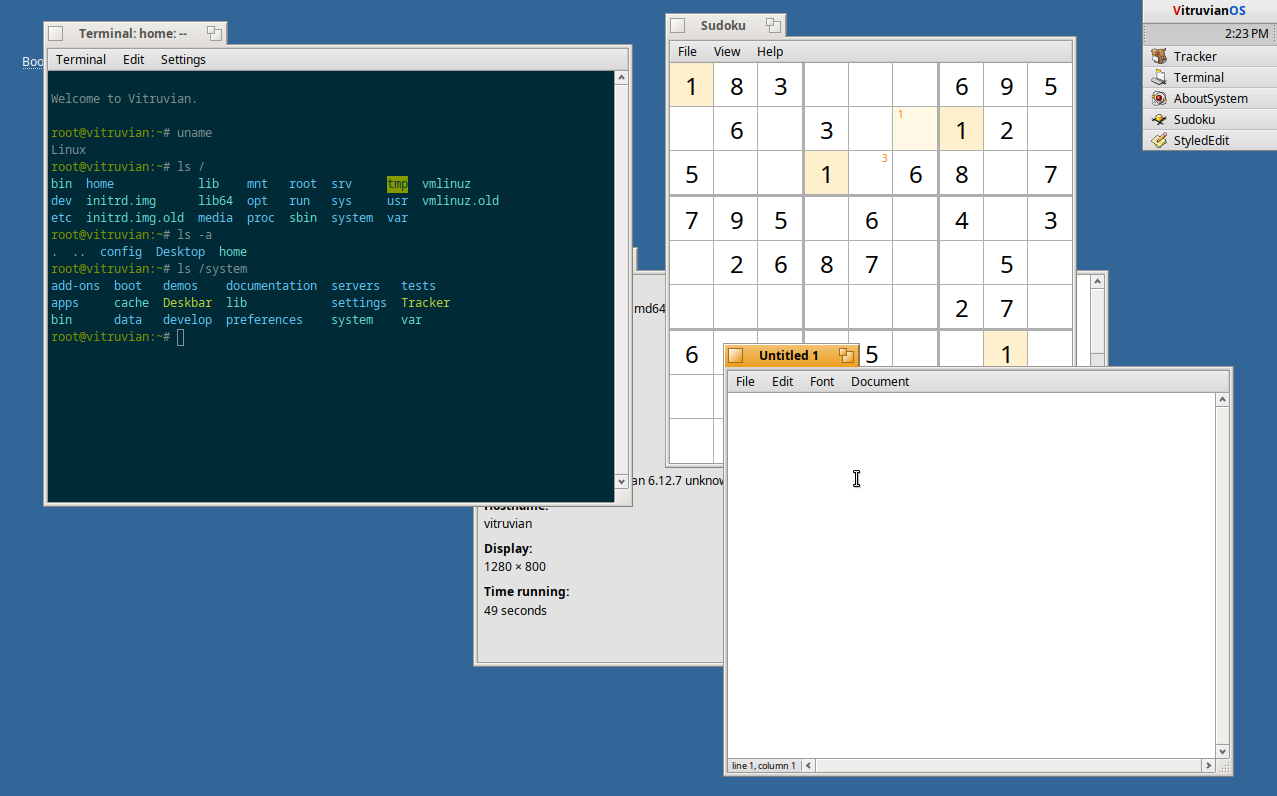
What is more intuitive than a button to close a window without a X, in order to make people from every other OSes feel at home https://v-os.dev/img/photogrid.png

-- When words have no meaning

numerio

20 hours ago

I don't understand the ragebait here. First thing, it's the BeOS GUI that is like that. Secondarily, seems to me also MacOS X lacks a X button? Or did they change it? Third, we can discuss about that, it's trivial to change.

Cheers

shevy-java

a day ago

It's been a pain to try to get ruby to work on Haiku, so I expect that this will be like linux - but worse, in that barely anything works. I like the design choices made by BeOS, but we have 2026 now. Linux kind of showed that practical considerations beat theoretical superiority (except for the desktop segment, where Linux keeps on failing hard; see GTK5 not supporting xorg, it is now the all corporate-dictated wayland era).