pclowes
3 hours ago
Its wild how the solution to housing costs is really just:
Build more housing. Keep law and order.
No it doesn’t need to be “affordable”. Yes rent control is a terrible idea.
Just build more housing.
Note: that the US already has plenty of housing and housing costs basically go up in areas of low crime relative to economic opportunity. If you build housing, but allow crime to rise, you have wasted everybody’s time.
estearum
3 hours ago
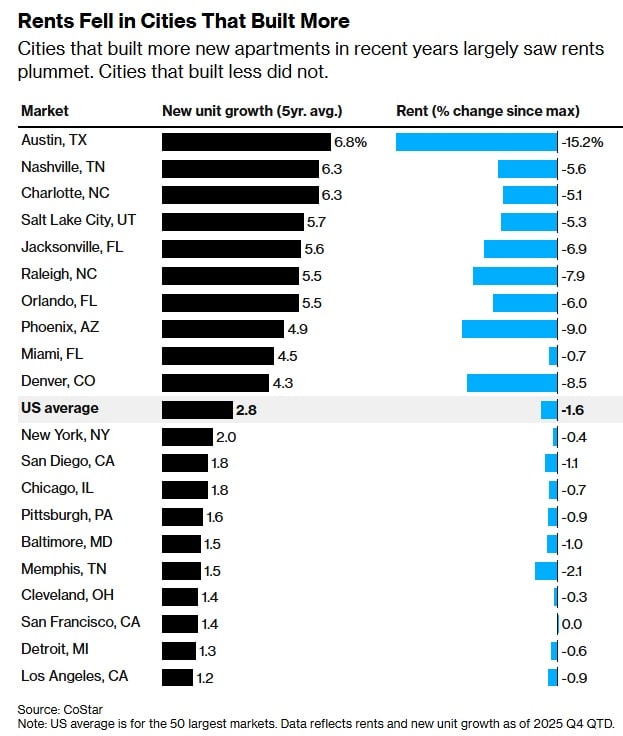
New construction has already decelerated in Austin due to falling prices, which compresses already-near-zero margin on real estate development.
So yes, it really is "just build more housing." The problem is: why would you build more housing as prices fall?
pinkmuffinere
an hour ago
I'm confused by this objection, if you draw a stereotypical supply and demand curve, you can see how prices settle to an equilibrium point. Of course reality has more complications, but I think your objection is 95% answered by a supply and demand curve. You keep building houses when it is profitable. You stop when it is not. This naturally keeps everything in balance.
throwaway27448
26 minutes ago
Sure, so long as the balance involves not housing people which is pretty sick and twisted
pinkmuffinere
16 minutes ago
I never claimed the balance will occur at a point that I like. This is just math, it’s not a political stance. If you want more homes, go build homes.
rayiner
20 minutes ago
I don’t understand your sentence. What’s the subject of the verb “housing.”
mwilliaams
4 minutes ago
The subject is “people”. Parent is suggesting that the equilibrium point of housing supply and demand naturally leaves some people unhoused.
idiotsecant
an hour ago
What do you do when that equilibrium point is hopelessly above what the average person can afford?
pinkmuffinere
37 minutes ago
there are many things you can do, but essentially you want to make it profitable for builders to make houses at a lower price point, or give the average person more money. Some approaches (not all of which I'm endorsing):
- reduce restrictions around planning / construction / etc (because it takes time and expertise to comply, both of which cost money)
- find a way to bring in cheaper labor, or make it possible for construction companies to hire the same labor at a lower price. Maybe a subsidy, maybe reduced taxes, maybe relaxed labor laws
- add a subsidy for homes
- make your citizens more wealthy, so the price is no longer above their means
- outsource construction to a place that can build it more cheaply (eg, prefab homes)
wiradikusuma
41 minutes ago
Won't the market fill the gap? For example, in Indonesia, "standard size" houses are mostly out of reach for new buyers (young generations), so they build houses farther away and/or smaller.
terminalshort
3 hours ago
Because home builders don't make money by buying and selling houses, they make money by building them and selling them.
mrcode007
3 hours ago
This 1000x. Folks don’t get that the primary market != secondary market. Same as pre-IPO stock holder != IPO time buyer.
estearum
3 hours ago
And... how is this relevant?
I'm not sure what you're trying to imply here. You should spell it out explicitly.
epistasis
3 hours ago
The difference is between buying and asset and producing an asset. Even if RAM costs are falling, it can still be profitable to produce more RAM, as long as the costs are far enough below the eventual sales price.
It's entirely different if you're buying the housing already built; there's no productive activity, you're just a rentier and do not benefit at all from falling housing prices.
The differences in interests between an asset holder and a productive builder are night and day.
estearum
3 hours ago
> it can still be profitable to produce more RAM, as long as the costs are far enough below the eventual sales price.
Right... my point is that the costs are not far below the eventual sales price. That's why construction is slowing down.
And as mentioned several other times, it's actually not as simple as cost > sale price. It's margin > margin of alternative investments of similar scale and risk profile.
gnopgnip
2 hours ago
Dr Horton is the largest builder in the US. In q3 2025 they had a 21.8% gross margin.
eks391
2 hours ago
As someone who is not versed in real estate, I don't see why your comment and parent couldn't both be true. Is Dr Horton building homes in Austin? Are the margins in Austin pulling down their average margin? That could explain high profit while dissuading new construction in Austin. *I don't know the answers to either of these questions, but of you do, that could provide some "proof" for either side of the argument, depending on what the answers are.
smcin
an hour ago
Their gross margin is a lagging metric on houses they built 2/3 quarters ago, and applied for development permits ~4 quarters ago.
US homebuilder gross margins have been declining since 2023.
epistasis
2 hours ago
It was not clear that it was your point at all! Yes of course, gotta get your return on capital invested or the money goes elsewhere, probably into a REIT that invests in the existing assets and drives up prices even further. Because the demand for housing goes somewhere: either existing owners profit or the people building and alleviating the shortage profit.
Every single municipality in the US I'm familiar with has done everything they can to make it expensive to build and try to remove any profit margin from building. Which leads to capital moving towards piggybacking on the rentierism of the average homeowner, the people who control the policies that make it unaffordable to build.
estearum
2 hours ago
How do you interpret "which compresses already-near-zero margin on real estate development" if not "the costs are already near the sale price?"
smcin
an hour ago
Not all new houses sell. Some become shadow inventory, some take 5+ years to sell. If you drive around new developments you can measure the fraction.
IIRC, Mountain House (near Tracy, CA) in the 2008-2010 crash was an example of a large new development that did not initially sell and was in serious danger of going zombie, and not having the new schools that had been promised to people moving in.
pandaman
2 hours ago
There is a difference but not in the way you think. Producing an asset is just buying other assets and labor. The difference with buying an asset is that a part of the assets you bought for production is illiquid for a term of the production. Generally you can only sell unfinished construction at a huge discount during most of the stages. So producing an asset is as same as buying an asset but with a lockout period, when you cannot sell.
nsnzjznzbx
2 hours ago
But building cost > sale value is possible.
Or land ends up better value left as suburban house than developing up.
Or they build where sale cost - build cost is maximized. I.e. different city.
Governments need to build more housing. Make it bland so snobs can price discrimnate themselves to buy builders' homes. Why thrifts by the government home for value for money (and quality).
vasco
an hour ago
You think the government knows better how to identify land that is profitable than private builders? Why? Or is this one of those opinions based on "is OK for the state to pay for it because there's infinite money for my pet project"?
nsnzjznzbx
an hour ago
Because I grew up in the UK and there is a fuckton of government housing from 60s and 70s. It is ugly but it is housing people.
Government doesn't need to make a profit due to taxation.
ghufran_syed
22 minutes ago
like the fine example of Grenfell tower, a government housing project where 72 people died: https://en.wikipedia.org/wiki/Grenfell_Tower_fire
vasco
18 minutes ago
Hello https://cep.lse.ac.uk/_new/publications/abstract.asp?index=1...
UK public housing is widely known for being shit. Unsafe, puts all the poor people together in a block. There's bunch of crime, and your kids will be likely to stay stuck there or go to jail due to bad influences.
Social housing should be sprinkled around it has been found. So nice example of what I was saying.
Spivak
an hour ago
Because government has a unique pricing advantage, they get additional value from the houses they build in the form of all the positive externalities and property tax revenue. So projects that wouldn't be profitable for private builders might still be worth it to the government. So it should be both.
They're just gonna pay builders a sum anyway so it's not like they need to shoulder the full upfront cost anyway.
vasco
an hour ago
Do you have example of another area the government has higher profit margins than private industry? I can't. And if I was going to think a government would build housing, it would be in places that are cheap and I could mass house a bunch of people, not in hip expensive cities which is what people want when they talk about this.
But surely soviet style huge blocks of tiny t0 apartments all stuck together is a dream...
wongarsu
an hour ago
> Do you have example of another area the government has higher profit margins than private industry?
Public transit. Capturing enough money from fares is difficult, maybe impossible, but it's quite profitable if you can capture the value generated by the enabled economic activity and raised property values.
The same really goes for most infrastructure. There's a reason the government operates nearly all the roads. Also the fire departments and police stations
raybb
29 minutes ago
Likely the same for public schools and maybe universities. Having educated folks in your city increases productivity and revenues and incomes.
vasco
26 minutes ago
Yes and that reason is not because they are better at doing it profitably it's because they are commons that are wildly unprofitable to do well. If you let private industry build roads you'd have nice roads in cities and dirt in the rest of the country.
In this case what people want is the reverse. They want the government to build in Austin.
The government should be involved when market forces won't solve an issue, ie no market will make it profitable to send an ambulance to a town 3h away in the mountains. You don't need affordable housing in the center of Austin just because it's trendy though.
neom
an hour ago
vasco
16 minutes ago
This is a government literally putting their money in private companies instead of using it themselves. It's the most literal illustration of "private" beats "public" investment. Not sure what point you tried to make.
rconti
42 minutes ago
As long as the cost to build housing is less than the revenue from selling it, why wouldn't you?
It's not like homebuilders in Austin flee for North Carolina when the margins shift slightly.
adrianN
2 hours ago
There is the possibility that the government builds housing, since the government doesn't have to care about direct profits and can include the overall economic effects of affordable housing in its calculations. We don't expect much direct profits from roads either, but we keep building more and more of them.
rayiner
18 minutes ago
That only makes sense if there is a positive externality from housing. Is there?
ImPostingOnHN
3 minutes ago
Of course, many.
To be sure, are you asking if society does better when its people have homes vs are homeless? Because that seems like a question with an obviously-yes answer.
sgc
2 hours ago
That is a good idea that requires careful attention to make sure it has near-perfect execution. Because we do that, and they are called 'the projects'.
OneDeuxTriSeiGo
2 hours ago
Not really? "The projects" are a consequence of a very specific approach to government housing construction.
There's an alternative approach which mirrors the public healthcare concept of "public option". Instead of restricting government housing to means tested individuals or specific low income populations, you develop a public competitor to drive prices down and to eat costs in regions where housing is needed but the economics just don't make sense yet.
i.e. the US Postal Service model. It works extraordinarily well as long as you don't repeatedly capture and handicap the org/agency (like has been done to the USPS). And even with the USPS despite being severely handicapped it still provides immense value by driving prices down while maintaining the essential service of last mile delivery.
A similar approach could be envisioned for a public construction agency.
idiotsecant
42 minutes ago
There are multiple city and state housing facilities in my area that are perfectly fine. They are not huge or luxurious but they're safe, clean, and well maintained.
When the options ar homelessness or subsidized housing, subsidized housing is absolutely the best option, which is backed up by decades of data.
hunterpayne
12 minutes ago
"When the options ar homelessness or subsidized housing, subsidized housing is absolutely the best option, which is backed up by decades of data."
Not quite. That's only true if you are housing people who ended up homeless due to bankruptcy or similar reasons (lost jobs, medical issues, etc). If you have people who are homeless due to sever addiction, you just end up with more OD deaths. You have similar issues with people with sever mental illness.
The homeless are not a monolith and different parts of the population need different solution unless you really really don't give a f*ck about them.
naravara
2 hours ago
I’ve seen some housing projects around my city that are actually quite nice. They didn’t end up being shabby because they were built poorly. They were shabby because they were reserved for the very poor and, consequently, became extreme concentrations of poverty and crime. This makes people unwilling to invest in maintenance and continued improvement of their homes.
If the government just went on a building binge of housing to be sold at market rate, or even set an upper bound before qualifying to buy them at a middle class income, it’d work out fine. That’s basically how Singapore does it only they couple it with somewhat aggressive policies to encourage people to downsize their living situations once they’re empty nesting to free up family dwellings for people with families. We probably wouldn’t need to do that second part since we’re not a claustrophobic island, and could just count on natural turnover.
adrianN
2 hours ago
I'm under the impression that more supply=lower rents, even if execution is not perfect, but I'm not an economist.
sgc
2 hours ago
Sure if that's all you care about, it will do that. At the price of making people's lives miserable due to substandard housing if it's done wrong. I said it's a good idea, let's just make sure we do it right.
autoexec
an hour ago
> At the price of making people's lives miserable due to substandard housing if it's done wrong.
I'm curious to see how Austin will do in the near future by that same metric. More people can afford a place that will let them pay rent, although now at least some of those people will be living in someone else's basement or garage. These may not be very nice places to live, but they may be all some people can afford.
They've also removed the regulation requiring a second way out of a burning 5 story building. Austin faces an increasing number of red flag warnings and has the 5th highest wildfire risk in the US. It remains to be seen what removing that second exit route will cost in the charred corpses of families.
Austin is also cutting corners on permitting which is great news if that was all needless red tape that can be rushed or skipped without cost, but if new apartments built today are (or soon become) deathtraps due to lax code enforcement that could be a major problem down the road.
Austin has already lowered rents which is great, but hopefully it was also done right and it doesn't result in more people being forced into substandard housing or increased deaths. As long as it doesn't, other cities should look into trying some of the same things Austin has done.
creato
3 hours ago
It doesn't matter whether prices are going up or down, it matters if the price is more than the cost to build.
estearum
3 hours ago
No, not really.
It matters whether the margin is higher than other investment opportunities of similar scale and risk profile.
Already, the answer is very often no. In Austin, the answer will increasingly be no. That means people will not finance new construction, so if demand continues to grow it will outstrip supply and prices will go back up until the margin on new construction exceeds that of alternative investment opportunities of similar scale and risk profile.
epistasis
2 hours ago
Yes really, that deeper understanding is exactly what is meant when somebody says "the cost to build is lower than the price." If we're going to be pedantic, you're ignoring the huge amounts of uncertainty on costs that are inherent to any project, the amount of risk versus the expected profit.
And indeed that amount of uncertainty: will I be allowed to build eventually? How long will I have to pay interests on assets before I'm allowed to build? Can I actually build what's specified in code or will discretionary processes arbitrarily change what I'm allowed to do, 18 months into the project?
estearum
2 hours ago
> Yes really, that deeper understanding is exactly what is meant when somebody says "the cost to build is lower than the price.
It demonstrably is not what people understand it to mean to "the cost to build is lower than the price." The cost to build can be well below the sale price and development still be a totally uninvestable activity.
pclowes
2 hours ago
I would expect the development of Austin to continue until market equilibrium and then pause. Decreasing margin does not mean equilibrium. Obviously austin is not at equilibrium because we still have price data on developer activity and that would be near zero if developers couldn’t make returns given risk etc.
I guess I don’t see where we disagree?
lotsofpulp
2 hours ago
Your explanation of fluctuations in supply and demand are not very revelatory. Everything being in flux at all times is kind of an elementary fact of life.
estearum
2 hours ago
It's clearly not elementary if people here believe that you can just keep building until prices collapse, and people will still keep building.
The question is whether the market achieves equilibrium at a point where 1) developers can get financing to build profitably, and 2) units can be sold at a broadly attainable price to the local market.
The answer appears to be no because the cost of inputs is so high. No one here is talking about directly reducing the cost of inputs. They believe that instead developers will just continue to build units that they sell at a loss, or at least investors will continue to invest in construction that returns less than the S&P 500 or 10 Year Treasuries (they won't).
cuuupid
3 hours ago
It's not necessarily prices falling here but the profitability of [demand] at [price]. Like if prices fall 10% but demand rises 20%, you would want to build more housing.
This is the beauty of the free market because it guarantees three things:
[1] Real estate is generally a good investment and will hold value or appreciate in the long term, because supply will adjust to demand shocks to rescue values
[2] If people want to live somewhere, houses will be built for them to live there
[3] Real estate developers and construction are solid, safe businesses with great unit economics because building may decrease prices, but may still increase demand
It's when you constrain and restrict a market that players have to adjust and then you get crazy scenarios
estearum
3 hours ago
> Like if prices fall 10% but demand rises 20%
Not as a developer you wouldn't...
You already have razor thin margins. Prices going down 10% means you cannot get financing for your project.
Holding real estate is generally a good investment. Developing real estate actually is not.
> Real estate developers and construction are solid, safe businesses with great unit economics
No they are not lol
cuuupid
2 hours ago
If you live in a magical fairy world where supply and demand are fixed, sure. In the real world, prices going down 10% leads to a surge in demand, and so you can fill more of your units. This leads to either equal or increased revenue, for the same construction (flat cost), which actually yields higher margins. This is why developers are usually concerned with occupancy rates, and prices are more a concern for homeowners.
There are only really 3 scenarios where prices are low and demand is low:
[1] There is a dramatic surplus of supply, in which case if a developer is trying to build they've not done research and probably should not get financing
[2] There is some other factor (usually high crime) in which case again, developer should do their research, and the market is operating fine
[3] You are developing super early and operating within incentives offered by the city, usually tax abatements, which drive down the carrying cost and make it a better investment.
Also important to note that in scenario [3] a smart developer will slowly release inventory to restrict supply to meet demand, and as demand grows, release more inventory at the newly raised price, continuing to do so as long as the tax abatements advantage the strategy. This is common in successfully developed areas e.g. Jersey City, and is fine as long as broad scale collusion doesn't occur
bpt3
3 hours ago
Can you define razor thin? Grocery stores have very small margins, as little as 1%.
Homebuilders make at least an order of magnitude more on a very expensive item.
estearum
2 hours ago
Grocery stores don't require millions to billions of dollars of capital to execute each new transaction.
So it's not the margin itself but actually the spread between the margin and what investors could get by investing in alternatives. Real estate investment opportunities are often measured by their advantage (measured in fractions of a percentage, .2% advantage being considered solid) over 10 Year Treasuries or S&P 500 returns.
Real estate developers do often actually lose money, but the more salient boundary condition is whether they can get financing for a project, where they have to clear a bar well above the "just make >$0" bar.
eigen
2 hours ago
> Grocery stores have very small margins, as little as 1%.
Looking at the Kroger 2024 Annual report shows that they have 22.3% gross margin . they pay dividends, had a stock buy back, etc so its entirely possible that they had a very low margin but gross margin seems to be similar to a home builder.
Sales $ 147,123
Merchandise costs $113,720
Rent, Depreciation, Amortization $655
Gross profit $32,748
for a gross margin of 32.7/147 = 22%
ghufran_syed
13 minutes ago
The net margin of around 1.5% seems more relevant: the gross margin is just the revenue minus the cost of good sold plus cost of transportation. The net margin is the money you have left after paying things like Rent, employee wages, electricity, taxes, interest on debt.
komali2
2 hours ago
It seems to me that the market will select for urban sprawl though which is a negative for society but has the highest margin. E.g. Houston suburbs, miles and miles of cheap to fab single family homes that turn it into a suburban hell scape where you have to drive everywhere.
I don't think the free market is giving the promises you say it is - supply isn't elastic for real estate if nobody's building because there's no margins. Demand can be anywhere really.
I like to look to Tokyo for an example. Small lots, extremely predictable regulations (that are still strict enough to ensure a safe living situation), fast approvals, mean it's much faster and easier to throw up an 8-10 story apartment than say downtown Austin, and so even today they keep doing it despite land in Tokyo being very expensive. And, no sprawl.
seanmcdirmid
an hour ago
They can throw up 8-10 story apartments in Tokyo despite land being very expensive because they tear them down and rebuild them after 20-30 years. Also, Tokyo outside of a few areas isn't that tall, it is definitely dense, but 3-4 story tall building dense (those homes are also torn down and built anew ever 20-30 years, so construction buzzes in Tokyo).
It would be better if you considered new actual living capacity in Tokyo rather than just new constructions.
austhrow743
2 hours ago
Why are you accrediting Houston to the free market rather than Tokyo?
komali2
an hour ago
Houston doesn't have zoning laws, Tokyo does.
Generally speaking, freer markets seem to lead to worse outcomes overall.
taormina
an hour ago
Have you seen Tokyo?
komali2
36 minutes ago
I've lived in Tokyo and Houston. Tokyo is infinitely more livable and the housing is still relatively affordable. In Houston even if you can get a new place it'll be clapboard garbage that's a one and a half hour drive from work.
bsder
3 hours ago
> [1] Real estate is generally a good investment and will hold value or appreciate in the long term, because supply will adjust to demand shocks to rescue values
Real estate is NOT supposed to be a good "investment" and only became so because the government started propping it up with bank bankstops, zoning, NIMBY, redlining, etc. If your pricing is working correctly, real-estate should be close to zero-sum.
Austin, in particular, had several nasty bust cycles where real estate prices tanked after overbuilding which is precisely what kept the cost of living under control. Alas, that is a thing of the past after 2008 when everybody realized that the federal government will backstop the banks "Real estate number must always go up! Brrrrr!"
cuuupid
2 hours ago
For nearly every homebuyer, a home is the largest purchase they will ever make and the bulk of their net worth. It needs to be a good long term investment that at least reasonably paces with inflation, otherwise you are losing money by buying a home and everyone has to rent and then you have feudalism with extra steps.
The good news is this is totally fine with keeping cost of living under control and overbuilding, because prices will go back up over time. Most people aren't going to own their home until the 30 year mark so it really is a much, much longer term investment than anything like overbuilding or other factors can reasonably affect.
The problem is really that people started seeing 2x-10x returns on homes and started treating that like the norm. That is not a 'good investment' that is a 'money printer,' and in most cases the government does not want to safeguard that behavior, but it's hard not to when those same people panic like crazy if their home only goes up 2% in value in a year or, god forbid, decreases in value for a year.
There is really no good solution to that mentality, if there really was one then Wall Street would have uncovered it ages ago to get more people into long term ETFs.
marcuskane2
33 minutes ago
> a home is the largest purchase they will ever make and the bulk of their net worth
That's bad and a central part of the problem.
I accept that my car is depreciating in value every year I own it, and but I need a car so I buy one. I don't need it to be a good long term investment, despite it being a major purchase.
The entire mindset of treating a family's home as being an investment class rival to bonds and equities is a relatively new phenomenon, and one that's clearly been detrimental to many.
lmm
an hour ago
> already-near-zero margin on real estate development
Why is the margin so low when the prices are so high? Is it because the value of housing is already priced into the value of land?
> The problem is: why would you build more housing as prices fall?
Why would you want to? When you stop being able to sell more houses, that's the sign that you've built enough.
spongebobstoes
3 hours ago
it doesn't matter if prices are falling or rising, it only matters how the ROI of building compares to other investment opportunities
we can also make it cheaper to build. easing taxes on imported materials, bringing in more skilled labor, expediting permits, and even direct subsidies like tax breaks
estearum
3 hours ago
> it doesn't matter if prices are falling or rising, it only matters how the ROI of building compares to other investment opportunities
Correct, which it basically doesn't in Austin, which is why construction is decelerating.
> we can also make it cheaper to build
Yep, this is the only structural solution. The "just add supply" runs into the problem of price equilibriums. The reality is the input costs of building housing basically guarantees that housing is hard-to-attain for any local market. We need to address the cost of inputs. Temporary reductions in price are temporary and the market will self-correct back to restrict supply (as we're seeing in Austin) until prices go back up to being hard-to-attain.
pfdietz
2 hours ago
The problem is it can't drive prices below what the free market would dictate?
Talk about praising with faint damns.
throwaway27448
27 minutes ago
Why let private developers build at all? The market provides perverse incentive to not house everyone.
RuslanL
11 minutes ago
To create artificial scarcity on a free market, it should be either a direct monopoly, or a giant cartel that includes every single developer and has mechanisms of punishing the outliers.
SocialGradients
an hour ago
This is an empirical claim. It looks like new monthly permits are down from ~4k a month in 2021-2022 to ~3k a month. They're still up significantly from before 2020. The building boom has slowed but it's still elevated. Not particularly close to zeroing out.
The data is here: https://fred.stlouisfed.org/series/AUST448BPPRIVSA.
SocialGradients
an hour ago
Not to mention, Austin could just make it cheaper to build to offset lower sell prices. Gruber et al estimate permits are 50% of an LA home's price. Fix permitting and rent goes down 50% by your assumptions that developers build until margins are 0.
Assume austin is only half as bad as LA, a 25% rent decrease would be incredible
Gruber's paper: https://evansoltas.com/papers/Permitting_SoltasGruber2026.pd...
eru
38 minutes ago
Huh? In Silicon Valley the objection is usually: even if we build more housing, prices won't fall.
So which way is it now?
FireBeyond
3 hours ago
In my state, or in my capital city, you say this, but the real estate developers are generally the top 1% in town. If they're running on razor-thin margins, I'm not seeing it - I am seeing them on my Facebook (being friends with the wife of the mayor) doing things like taking their kids on vacation to the French Riviera, Switzerland, Tokyo, the Maldives... well, alongside the City's Planning Committee commisioners and their families...
epistasis
2 hours ago
Highly restrictive development rules, often sold as ways to stick it to those very rich developers, are precisely what make them so rich. Only those with huge amounts of capital to spend can make it through the gauntlet of the rules and have big enough asset portfolios to stay in the game. They can bank land for decades, speculating on the best time to take their profits, all while others live through shortages of housing and do not have access to that land.
Those very processes that make it hard to develop keep out the scrappy up-start competition, the contractors that could be building houses all over if they had enough lawyers/planners/specialists to help them get through the system.
Look, for example, at LA, which has super super restrictive rules on what can be developed where, and has huge amounts of discretion at the political level, so that NIMBYs can block what they want. The only people who can build housing are developers who bribe the politicians (there was a somewhat recent arrest in LA on this, involving literal bags of cash, by the FBI).
Having simple, straightforward rules that are completely objective is the only way to try to flatten out the playing field. However such rules get shot down by NIMBYs precisely because they don't want the shady developers profiting off apartments! It's all highly ironic.
estearum
3 hours ago
Well you see, we clearly need to armor the parts of the planes that have bullet holes in them upon return!
maest
3 hours ago
I get what you mean, but I doubt corruption is good for building good housing
pembrook
3 hours ago
Construction costs don't scale linearly with rent prices, it's a different market altogether that depends on regulation/worker supply/material costs/equipment/etc.
As long as construction costs remain below the value of the units all-in, there's profit motive for developers to build.
estearum
3 hours ago
> As long as construction costs remain below the value of the units all-in, there's profit motive for developers to build.
Not true
Real estate development is extremely capital intensive and therefore it's a question of all-in cost of capital compared to other investment opportunities.
9rx
2 hours ago
The opportunity cost has already factored that in. Unless you think cost calculations are arbitrarily forgetting to include certain costs for no reason?
komali2
3 hours ago
Maybe other real estate savvy people can help me understand this plus two other things I'm confused about in the housing crisis:
1. Houses are unaffordable for many Americans. To get houses to prices where they'd be affordable again would require a housing prices drop that would likely be, market-wide, significantly low enough to put a ton of people underwater on their mortgages. What is society/the government meant to do about that? Is it an insurmountable floor on how low we can get housing prices? That floor feels very close if so.
2. We've been promising the last five generations (or more) of Americans that a house is an Investment, capital I, an excellent place to keep your money. How do we overcome the political pressure to turn a house into a depreciating investment for the length of time required to get housing to be affordable again? What kind of politician would put their neck on the line to piss off every boomer and 75% of gen X and 30% of millennials, or whatever the house ownership distribution is?
zugi
2 hours ago
#1 is the symptom, #2 is the problem.
High levels of home ownership combined with "local control" and "democracy" enables the "haves" who already own homes to weaponize government to keep supply low and home values high. Zoning restrictions, building codes, taxes, and other government tools are brought to bear to support this. The "have nots" don't have a chance.
Austin seems to be a counter-example when they "instituted an array of policy reforms" in 2015 that showed great results. Sadly the key may be appealing to the greed of existing homeowners. Changing zoning to allow tall apartment buildings where single family dwellings once stood lets existing home owners make even more money by selling than they'd make by continuing to restrict supply. While it's sad if that's the only path to success, we'll have to take small successes where we can find them.
epistasis
3 hours ago
There's a big difference between land prices and the building prices. When costs rise 5% per year for a house that's untouched, that's almost entirely the land price going up.
You can make housing cheaper by putting more houses on the same amount of land. In high cost areas, the price of land dominates the cost of housing.
Political pressure to change the investment nature of housing can come from various directions, for example establishing a land value tax, which eliminates the financial incentive to speculate on rising land prices by keeping people out of your area, redistributes all those unearned land rents to the population equally, as is only fair, and also results in a lot of people selling land to be redeveloped taht are otherwise hoarding it when the rest of society would be using it a lot better. Of course, in societies with high levels of land ownership, the voting public usually tries to vote away such extremely fair taxes.
Politically, we must stop prioritizing the views of homeowners at the local level. They already got their reward, massive unearned capital gains on their residence, there's no need to give them priority on land use over the general needs of society.
bpt3
2 hours ago
> Politically, we must stop prioritizing the views of homeowners at the local level. They already got their reward, massive unearned capital gains on their residence, there's no need to give them priority on land use over the general needs of society.
They are the majority of people in most areas, so it does make sense that they would be given priority in some ways.
The rest of your post is unsubstantiated vitriol, which isn't exactly convincing.
epistasis
2 hours ago
You quoted my vitriol to the homeowners, the rest is not vitriol, it's basic land economics.
> They are the majority of people in most areas, so it does make sense that they would be given priority in some ways.
In some ways sure. But in the ways that they are? Absolutely not, it's basic unfairness. The entire tax system is tilted in favor of home owners. We don't need to do that, we could make it more equal so that people with less wealth are not penalized.
bluegatty
an hour ago
Rent control is one of the best ideas, and it may be a civilizational, foundational idea.
Property ownership is at the very core of entrenched power, and the foundation of rent-seeking and wealth asymmetry.
If you look at even the Monarchs of long past - it wasn't their 'titles' that made them powerful - it was the economic rent that came along with the land ownership.
Even in more open market economies, property is still is basically long term economics lording over short term economics of wage earning workers.
Being able to kick someone out of their home almost arbitrary basically puts working class people at the 'total whims of the market' and it's one of the most disruptive concepts imaginable.
If we take the view that 'housing is about housing first - only about investment to the extent it does not disrupt housing' - then a different perspective takes shape.
Many Canadian provinces have 'basic rent controls' and it does not generally prevent new housing development.
If anything, providing 'housing stability' is probably the best way to create base prosperity, so those people can go out and spend on all the other things.
There might need to be some degree of leeway here and there for certain kinds of density challenges, but that can be had with rent control
There is almost unlimited land in North America to build on - if in one spot it's a bit difficult - build elsewhere.
If people want to have 'density' then incorporate an area and 'build density' in that area.
Also it does need to be 'affordable' but that can work with regulations.
Edit: our housing problems are about screwed up management, it's actually not even an ideological problem underneath. Like 'rent control' the way it is framed scares some people, but its literally province wide in Ontario, Quebec and it's a 'non issue' for new unit hinderance. Even the nimbyism stuff can be worked around: if people don't want high-rises next to them, it's their right, but there's a lot less opposition to 'mild density' especially if it fits in local cultural and aesthetic context. We can have our cake and it eat on housing. I think we invent ideological lenses because it's easier to frame 'narratives' than it is just weird policies, special circumstances, hiccups, different municipal things going on all at once.
hahahacorn
an hour ago
It would be far more efficient to simply tax away all rent collected from land instead of grossly warping markets and creating terrible incentives for all involved.
The reason is that you can’t produce more land. Fixed supply will also warp economic markets and create terrible incentives (land speculation).
If you want the best solution, you implement a land value tax. If you want the 2nd best solution, tax property (Land + Building value). If you want the worst solution, implement rent control.
bluegatty
33 minutes ago
Rent control is not 'warping markets' - it's the notion that 'homes are markets' that is 'warped' - that's the basis of the problem.
The workaround is to build more dwellings, and rc generally is not an inhibitor there.
Funny enough 'wealth taxes' may actually be the worst of tax of all - aka a double negative - like a double negative.
What we want to do is make it so that 'rich people get rich' not from rent-seeking but from real value creation.
culopatin
11 minutes ago
Who builds them? Private party. What’s their incentive? Making money.
wyager
an hour ago
> Rent control is one of the best ideas
It's funny how this question might have the greatest divergence in answer distribution between people who do and don't know what they're talking about
Other candidates are "is debt good" and "is property tax better or worse than income tax"
bluegatty
an hour ago
I think it's a matter of perspective maybe more than 'knowing what they are talking about'.
Like - seeing property as 'investment and ownership' vs 'places where people live' is sometimes pretty big gap. Especially when we've been grounded in 'mortgages and wealth creation' for regular middle class people.
Rent control and the underlying civilization power dynamics are kind of a subtle thing, I think most folks are going to just answer in terms of 'what is good for them'.
jmyeet
an hour ago
Rent control is the wrong solution to the right problem (ie affordable housing).
It creates all sorts of problems that wouldn't exist otherwise. For example, if you've been in a rent control house or apartment for 10+ years and are paying significantly less, what happens if you want to move? Or just need a bigger place? It's a huge impeediment to mobility and flexibility.
Also, you have an adversarial relationship with your landlord. They want you to leave so they can raise the rent. They'll skimp on maintenance, turn off the heat (even when it's illegal) and generally make your life miserable until you leave.
The solution to these problems is social housing, meaning the government becomes a significant supplier of affordable, quality housing. The very wealthy and the real estate industry don't want this however because it will decrease profits.
> Property ownership is at the very core of entrenched power,
In the literature, there is a distinction made between private property and personal property. I'm fine with people owning their own home if they want. That's personal property. Private property is when we allow people and corporations to hoard housing. I'm all for making it financiall punitive to own more than one house.
bluegatty
an hour ago
The problems that rent control creates are far smaller than the problems that exist without it.
To start - your 'very first example' is not even really 'a problem'.
'Without rent control' - you get kicked out of your abode every few years if your salary doesn't keep up with housing inflation. With rent control, you have the option of 'having a home; you decide when you want to leave (for the most part).
The answer to the 'second example', 'adversarial tenant/landlord' is that the theory doesn't line up with reality for the most part. Again - in most rent controlled areas this kind of stuff does not happen, especially if it's entrenched in the culture. It works well in a ton of housing markets like Quebec, Germany.
The primary concern about rent control limiting expansion ... just does not exist. It doesn't really impede new builds.
jmyeet
20 minutes ago
> To start - your 'very first example' is not even really 'a problem'.
Yes, it is. Anywhere with significant and strong rent control results in a large number of people who simply cannot move. Look, rent control is better than no rent control but it address the symptom not the problem. The real problem is that rents shouldn't significantly outpace inflation. In a better world, you should be able to easily move because you're not locked in to a below-market rent that you don't want to lose. And rents get more expensive because a whole bunch of people make sure that housing is an appreciating asset. It should be a depreciating asset.
> The answer to the 'second example', 'adversarial tenant/landlord' is that the theory doesn't line up with reality for the most part. Again - in most rent controlled areas this kind of stuff does not happen
You will not find in any American city, especially one with rent control, where tenants do not absolutely hate their landlords as the general rule. What are you smoking?
wolfi1
an hour ago
Vienna built housing itself, with this housing it was possible to have cheap rents and keep rents from private investors down. https://en.wikipedia.org/wiki/Housing_in_Vienna
davidw
44 minutes ago
Unless you want to build more sprawl-oriented social housing, you'd still need, in most American cities, to reform zoning codes and building codes (single stair and elevator reform) to get Vienna style social housing.
It's a "yes, and" problem though, mostly. Let the market build what it can, and if you want to pursue social housing, do that too - just don't let the perfect be the enemy of the good and delay the reforms while you try and put together all the social housing pieces.
bobthepanda
an hour ago
It’s worth noting that a major confounding factor is that, unlike most cities with a housing crisis, Vienna is well below its population peak and so does not need to build nearly as much housing
slg
3 hours ago
This comment is phrased as if the article is confirming these points when it either doesn't mention them or even directly refutes them. First there is no mention of either crime or rent control in the article. But more importantly, it states that "A key piece of Austin’s strategy has been to encourage the construction of affordable housing." So why are you concluding that affordable housing isn't needed?
jychang
3 hours ago
The comment is phrased in the greater context of the public discussion about housing, in general. Not the specific information of the article.
You know, like how a discussion about war might reference the various recent wars that everyone knows about; it's not limited to just the content of the article.
slg
3 hours ago
But it didn't reference anything, it stated political opinions like they were confirmed facts, provided zero evidence to support those assertions, and completely ignored the ways in which the article provides counterevidence.
manlymuppet
an hour ago
They aren't saying affordable housing isn't needed. Just that the method for making housing affordable shouldn't be trying to make the current housing supply cheaper.
And from this is where you get "rent-control is a terrible idea". Essentially: trying to artificially drive down housing prices in any way is generally inadvisable if you can just build more housing.
Sure that's technically an opinion, but it's one based in facts, and it certainly doesn't have "zero evidence".
https://www.brookings.edu/articles/what-does-economic-eviden...
Capricorn2481
21 minutes ago
That's a pretty generous interpretation that requires you to believe rent control and building housing are diametrically opposed to each other.
terminalshort
3 hours ago
Affordable housing is the only type of housing that will ever be built. Builders aren't so stupid as to build products that their customers can't buy. Government intervention is not needed.
slg
3 hours ago
I'm not sure if you're intentionally changing the definition of "affordable housing" in an attempt to make the desire for it seem silly or if you genuinely don't know how the term is typically used. But what you're describing is generally referred to as "market-rate housing" and not "affordable housing".
cuuupid
3 hours ago
Affordable housing = housing that regular people can afford
The only silly thing here is that "low income housing" got rebranded as "affordable housing" and absolutely everything else got rebranded as "luxury homes" for political reasons.
"Market-rate housing" is even sillier given that it is literally the opposite of what "affordable housing" policies dictate
slg
2 hours ago
I'm not going to debate what the definitions should be, I'll just say I don't think it is productive to join an existing conversation using terms with different definitions than everyone else uses. Defining all housing as inherently "affordable" makes the term meaningless and even if you disagree with the motivations behind the desire for "affordable housing", at least the term has meaning in the way it's typically used.
cuuupid
2 hours ago
You are quite literally debating what the definition should be, because this is _not_ the existing definition of affordable housing, it is legally what OP is saying. "Affordable housing" is just when the household spends <= 30% of gross income on housing related costs. This is the definition used by the HUD and the same definition applied in policymaking.
What >you< are referring to and what it is conflated with by progressive policymakers is "low income housing" which imposes an AMI based restriction on the resident's income. This in turn means that 30% of their income is much lower and restricts the sticker price of the home.
In recent years, most 'affordable housing' policy has been advanced by progressives, who use that term for marketing purposes, whereas the actual policy primarily relates to 'low income housing' or even 'very low income housing.' This does not mean 'affordable housing' = 'low income housing', it just means the term 'affordable housing' is used in the title and the actual measures advanced are related to AMI and 'low income housing.'
slg
2 hours ago
Those definitions aren't in conflict. The "progressive" definition is just the applied version of the "HUD" definition scaled to local income levels.
cuuupid
2 hours ago
There is no "progressive" definition, income level is not at all part of the definition. Per the universal legal definition of 'affordable housing,' if a home costs $1B but is occupied by Elon Musk, it would still be affordable because it is less than 30% of his gross income.
When you are dealing with income levels it is universally called 'low income housing,' and the HUD definition is already scaled to local income levels, the 'A' in AMI stands for 'Area.'
You are conflating marketing ('we need more affordable housing!') with policy ('low income housing')
slg
an hour ago
> There is no "progressive" definition
You seemed to disagree with that in your prior post, but I’m glad we can now agree that there is no point debating this then.
barry-cotter
25 minutes ago
It is productive to decline to use propaganda terms. If, every time someone says they support affirmative action they are asked if they support having higher standards for Asian applicants to medical school than for white applicants that’s good because forcing people to defend their support of racist policies reduces support for them. By the same token pointing out that affordable housing doesn’t mean housing people can afford, it means politician allocated housing paid for by the general taxpayer, reduces support. Reducing support for bad things is good.
ms_menardi
3 hours ago
And yet, gentrification.
triceratops
3 hours ago
God forbid bad parts of town ever get good.
7speter
an hour ago
You mean make the non white parts white, right?
KPGv2
3 hours ago
That's not what gentrification is. Relevant to this article, I lived through the gentrification of large parts of Austin in the early 00s.
What happened was that good housing full of artists and musicians and other self-employed creatives began gentrifying, driving up property values, which drove up property taxes, which became unaffordable to the existing residents (who had owned their homes for a long time). Many (actually, most) of these artists had to sell and leave.
They often left for other cities. But hey at least the good houses everyone liked all got torn down to be replaced by McMansions for the influx of techbros.
Austin still has that slogan, "Keep Austin Weird." It failed. Austin isn't weird anymore. The University of Texas still is responsible for a lot of great stuff about Austin, but huge chunks of the city are just boring these days. There's certainly much less interesting culture happening. It's been airbnbified.
triceratops
2 hours ago
My interpretation of your comment:
The existing residents (artists) made money by selling their appreciated houses. Those who could afford to remain were now in areas with less crime and poverty.
The new residents spent a ton of money to live in a place they themselves culturally diminished.
We should re-evaluate the winners and losers here.
FarmerPotato
42 minutes ago
Let's talk about the East Side.
https://www.austinmonthly.com/in-photos-what-gentrification-...
I don't think many home owners got a price for their land that allowed them to buy a similar house elsewhere.
The world is far from an ideal model where what you get is what you deserve.
Note the history of the East Side power plant, which depressed property prices. Ditto, I-35 construction plans. The article says the plant will become a park now. After the new developers locked in purchases.
mmooss
2 hours ago
> good housing full of artists and musicians and other self-employed creatives
It looks like - it might not be what you mean, but it looks like - you're saying 'good housing' is housing that has "artists and musicians and other self-employed creatives", as opposed to poor working people.
JuniperMesos
an hour ago
Many artists and self-employed creatives are themselves poor working people - making art is work (and so is marketing it to potential customers), and most artists are not lucky or successful enough to become wealthy doing it.
But yes, I think there is a sense in which people who are driven to create have some kind of ineffable, cultural capital that people without this drive do not have. So a neighborhood that is full of artists is more interesting, and therefore more valuable to spend time in, than one that isn't.
FarmerPotato
38 minutes ago
See the photo in the above East Side article. In the old neighborhood, people talked to the photographer because the front yards didn't have privacy fences.
terminalshort
2 hours ago
My heart breaks for those poor people whose houses became worth multiple times what they paid for them. A true tragedy. I would be devastated if my house became so valuable that the property taxes were more than I could afford.
mmooss
3 hours ago
Good for whom? If it's good for the residents, that's great. If it's bad for the residents, who get driven out, but good for some developers and outside rich people - that's what gentrification is.
triceratops
2 hours ago
Unless all of the housing is owned by non-residents prior to gentrification, some residents always benefit from their neighborhood going upscale. Either through increased home values, allowing them to sell and improve their lives. Or because it's now a more pleasant area to live in.
Even renters in gentrifying areas may profit if housing construction outpaces population growth. Yes, they may have to move, but also the places they move to on their current budget may be nicer - because the people who can afford better have moved too.
7speter
43 minutes ago
When people in NYC are driven out of their neighborhoods because of gentrification, they generally move down south. There isn’t some magical part of town that they can afford with their “current budget”
mmooss
2 hours ago
> increased home values, allowing them to sell and improve their lives
That also raises property taxes, making the neighborhood unaffordable and driving them out.
> it's now a more pleasant area to live in.
For new wealthy residents. People who have spent lifetimes there don't want everything to change and have their communities destroyed.
> Yes, they may have to move, but also the places they move to on their current budget may be nicer - because the people who can afford better have moved too.
These are theoretical and very general averages. The actual individuals often do not benefit. Being forced to move is not a mere inconvenience to your theory.
triceratops
2 hours ago
The alternative: new housing doesn't get built. Existing housing - including the "bad" neighborhood that isn't redeveloped for fear of "gentrification" - gets bid up to the moon. People who can't afford rent end up moving anyway and commuting from very far away, if they're lucky. Or they end up on the streets, if they aren't so lucky.
That isn't theoretical. I just described the SF Bay Area.
pclowes
2 hours ago
In this case affordable housing nets out as a way to overcome policy barriers to market rate housing. So it actually makes the market freer.
Many other implementations of affordable housing further raise the barrier and thus even if any is built it doesn’t help widespread housing affordability issues.
Rent control is just another flavor of housing affordability policy that often (always?) backfires.
Crime, social peace, and economic opportunity are very linked. A lot of house prices in urban areas are wildly distributed and often the increase cost is to buy distance and safety (often just a couple blocks) from high crime areas.
slg
2 hours ago
>In this case affordable housing nets out as a way to overcome policy barriers to market rate housing. So it actually makes the market freer.
>Many other implementations of affordable housing further raise the barrier and thus even if any is built it doesn’t help widespread housing affordability issues.
Can you be specific with what you mean here? Because this reads like a no true Scotsman argument that it doesn't count as "affordable housing" if it works. The article discusses the programs encouraging income-restricted units which seems like a classic affordable housing program. What specifically do you think is different in this case?
pclowes
2 hours ago
Affordable housing in a vacuum disincentivizes development and results in worse affordability.
Affordable housing used as an incentive or way to overcome other barriers to housing (density limits, height limits, zoning etc) that makes the market more “free” net is will produce more development.
You don’t need it for development but it can be used effectively depending on other policies. As with all things it depends on what policy makers are optimizing for. These are all tradeoffs. But affordable by itself all else equal limits developer upside and incentives less development meaning less supply and higher prices.
slg
44 minutes ago
>Affordable housing used as an incentive or way to overcome other barriers to housing (density limits, height limits, zoning etc)
I'm not sure what type of affordable housing program doesn't meet this definition. They are almost always tied to incentives for developers, including sometimes in the form of a removal of other housing restrictions. Or are you specifically objecting to financial assistance on the renter/buyer side? Because I assumed the “it” in “it doesn’t need to be “affordable”” was referencing the new development.
pclowes
22 minutes ago
See San Francisco. Also generally anywhere else where prices are rising and developers can’t develop and yet there are a lot of affordable housing policies. CA as a whole has mismanaged this so badly they have a net migration outflow.
Also removing other housing restrictions that ostensibly were put in there by constituents is a valid reason for constituents to oppose AH. They get called NIMBYs for this but if the local populace wanted more high density development then the density limits wouldnt be there to be excepted by AH
datsci_est_2015
3 hours ago
Multiple things can be done at once. The policies you laid out are not mutually exclusive, and have different utility for different communities. But yes, fundamentally more housing is needed for growing populations. Conversions and rezoning are also important parts of the urban equation to “build more housing”, not just exurban McMansion developments.
fogzen
an hour ago
It's possible to build more housing and have rent control. Rent control is the only thing allowing working class families to live a dignified life in the USA's most desirable cities. Land value tax and social housing are simply not politically feasible – rent control is.
vkou
an hour ago
> Yes rent control is a terrible idea.
When you aren't building more housing, for whatever reason, rent control is the only thing that prevents domestic 'immigrants' into your city from making all the residents homeless.
Since cities can't stop migration into them, it's the only tool they have to protect their existing residents.
---
PS. If you believe in trial-by-combat for housing, why not a similar approach to border control? It's the same concept, open it all up and let the market decide whether your existence is worth it.
There are billions of honest, hard-working, capable people who will happily pay more than you for where you live, do your work for less pay than you're willing to accept, and would love to live... Wherever you currently feel entitled to live.
What gives you any right to deny the market from improving the welfare of your landlord and employer?
atoav
an hour ago
Well, build more housing and ensure the more housing is being bought by people who live in it or (if you don't find enough of those) by people who will rent it to them. Many problems occur when capital buys living space as an investment that needs to go up in value, since now there is an incentive to keep some scarcity.
nodesocket
22 minutes ago
And yet, if you dig through the various comments on HN over the years regarding SF housing costs the overwhelming conesus is more rent control. Sometimes, the most common sense solution turns out to be the correct one.
tharmas
3 hours ago
You have to restrict investors buying up that newly built housing too.
Homes for people. Not investors.
triceratops
3 hours ago
No not really. You just have to restrict the same investor from buying all the housing in an area, and prevent investors from colluding on rents.
tharmas
2 hours ago
Investors add to demand for housing. This will help drive up prices. And no, builders will not necessarily increase supply if they can realise increased margin of profit due to increased demand. We see that with RAM manufacturers. RAM suppliers constrain supply to boost margins. Same with house builders. The difference is people can go without RAM but everyone needs a place to live.
triceratops
2 hours ago
> Investors add to demand for housing
And here I thought people who want to live in houses add to demand for housing.
Investors buy houses that people want to live in. If people don't want to live someplace, you won't see any investors there either.
greyface-
an hour ago
1 house is built. Alice wants to own it to live in it. Bob wants to own it to rent it to Alice. 2 people want to own the house.
chii
32 minutes ago
> 2 people want to own the house.
and so how do you decide who gets it?
1) morally. Alice deserves it because her intention is more pure.
2) financially. Bob gets it, because he can pay more for it than alice.
Which choice above you make as a policy direction is a reflection of your world view. I'm voting for 2), but i can understand the POV of 1), even tho i disagree with it.
9rx
an hour ago
> And here I thought people who want to live in houses add to demand for housing.
Desire is a necessary component in demand, but it also requires willingness at a given price point. If houses are selling for $1,000,000 and you only have $500,000 to spend, then no matter how much you dream every night about having a home, you are not a contributor to demand.
triceratops
an hour ago
Counterpoint: houses sell for $1,000,000 because there are more people with $500,000 (and every other number less than $1,000,000) who want those houses than there are houses.
9rx
an hour ago
How is that a counterpoint? It says the same thing with different words.
bryanlarsen
3 hours ago
35% of Americans rent their homes. And they almost invariably rent from investors. Therefore if more than 35% of homes are owned by investors this drives down rent. If less than 35% are owned by investors rent goes up.
ms_menardi
3 hours ago
This logic assumes that 35% of Americans WANT to rent their home. Which seems odd to me, if only for financial reasons - why would you pay 1400$ for a 1 bedroom apartment when you could pay 700$ in a mortgage for that same apartment if you could have bought it?
triceratops
3 hours ago
If you invent a scenario where the mortgage is half the rent then buying is a no-brainer. Does that reflect reality?
TimorousBestie
2 hours ago
Maybe not half, but it’s pretty common around here (generic midwestern city) for renting to be more expensive than a comparable mortgage.
Many landlords seem to expect to pay their mortgage and property taxes and maintenance with the rental income, and still net a profit, if r/landlord is to be believed.
chii
29 minutes ago
> renting to be more expensive than a comparable mortgage.
that doesn't sound plausible. May be for a select few properties that are in some unique circumstance (e.g., the seller of the property would sell underpriced because they needed quick sale).
And often, in arguments like these, the rent is the rent, but the mortgage is purely the interest on the loan, and doesn't count the maintenance cost, and doesn't count the deposit required (which has a cost, ala the cost of capital). If you added up all these costs, it exceeds rent.
triceratops
2 hours ago
The profit is compensation for the risk. The mortgage and property taxes and maintenance are due no matter what - can't find a tenant, tenant doesn't pay, tenant flushes paper towels down the toilets every day etc etc.
If there was no profit there would be no landlords. Some might say that's great. But it would be a world with less flexibility, with fewer choices. Don't like your job and want to move? Split up with your partner and need someplace to live? Moved to a new city and don't know where you want to put down roots yet? At college for 4 years? Don't want to deal with house maintenance? "F** you, buy a house anyway". That's what we'd have if there was no rental housing.
TimorousBestie
2 hours ago
Okay, so why were you asking if renting can be more expensive than buying? You seem to already know that it can be.
triceratops
2 hours ago
I said they were inventing fantasy scenarios.
The actual numbers might be more like rent $1400 vs mortgage $1000. After property taxes, insurance, and maintenance there might be $50 left. A handsome 3.5% profit, rising to maybe 6-7% if you include principal paydown. This is hardly a money-printing machine. It's a steady return for taking on some risk.
TimorousBestie
2 hours ago
Ah, I see, you wanted to split hairs on the numbers. Fair enough.
triceratops
2 hours ago
It isn't splitting hairs. The numbers actually matter.
TimorousBestie
2 hours ago
It’s at risk of becoming a fractal of splitting hairs. Substituting your numbers in for theirs doesn’t change much. It’s still more expensive to rent.
Kind of an unhelpful tangent to the discussion, really.
triceratops
2 hours ago
> Substituting your numbers in for theirs doesn’t change much
You can buy a boat for $10 or rent one for $9. Assuming you really want a boat, would you buy or rent? Do my numbers reflect reality? Do they have a bearing on the choice you make?
albedoa
2 hours ago
?? How in the world is it splitting hairs to point out that those numbers don't make sense. It is directly relevant to the question of how many Americans want to rent. You don't need to be like this :(
maest
3 hours ago
The numbers you are using are not common at all.
KPGv2
3 hours ago
> why would you pay 1400$ for a 1 bedroom apartment when you could pay 700$ in a mortgage for that same apartment if you could have bought it
Because the down payment you put into your purchased home could've been put into the stock market and grown faster than property values (this is historically true).
Because you don't want the headache of home maintenance.
Because in the 21st century, job stability doesn't exist so it's a big risk to buy a home fifteen minutes from your current job that might be an hour from your new job after you get fired so a CEO can get more golden parachutes.
Because you might have to change cities a year from now.
My wife and I rented for a long time because it was better than owning for us.
frontfor
an hour ago
Agreed. It’s a classic fallacy to compare rent vs mortgage on a numbers to numbers basis. It’s classic example of not accounting for the total cost of ownership.
bsder
3 hours ago
> 35% of Americans rent their homes. And they almost invariably rent from investors. Therefore if more than 35% of homes are owned by investors this drives down rent. If less than 35% are owned by investors rent goes up.
This only holds until the percentage owned by the investors becomes a monopolistic chunk. At that point the investors would rather leave some apartments empty rather than see rents go down.
See: all the current RealPage lawsuits
creato
3 hours ago
It really doesn't matter as long as someone is living in it.
jmyeet
an hour ago
So pretty much everything you've said here is wrong.
Build more housing? In a place like Austin, you can just keep building out, basically. To a point. Eventually cities doing this reach a limit. Houston and Atlanta are pretty much at or beyond that limit.
And it's not that building low-density SFH housing is the most economic. It's simply the most subsidized. Every road, every parking space, every sewer pipe, every water pipe, every utility pole, every school, every hospital, every police station, every fire station... they all add factor in to the true cost of housing and the more spread out things are, the more expensive those things become. Taken to extremes, look at the billions Houston spends now to add just one more lane (because this one will totally solve traffic) on, say, the Katy Freeway or the ring roads.
Yes it does need to be affordable. NYC is the posterchild for this. Nothing that's getting built on billionaire's row will ever trickle down to being affordable housing. They build ultra-luxury housing because it's the most profitable and it does absolutely nothing for anyone else because these units are just ways for non-residents (mostly) to park wealth and not pay their fair share of taxes.
Rent control is the wrong solution for the right problem and it's typically American. By that I mean it forces the solution onto private landlords who are going to do everything possible to get out of those obligations and deliver subpar but compliant housing. And they'll demand tax breaks for it. When in fact the solution is for the government to supply a large chunk of the housing market ie social housing. But there's a pervasive and wrong idea that we can only solve problems in the private sector and that's nothing more than a wealth transfer from the government to the already-wealthy.
"Just build more housing". Yeah, and then you get Houston. Cities need to be planned. Cities require infrastructure. And one of the most important thing cities need is public transit infrastructure, something sadly lacking in virtually every American city.
The core to so many of these problems is that we need to stop treating housing as a speculative asset. Owning two or more houses should be incredibly difficult and expensive and should be taxed punitively. By this I mean the capital gains on non-primary residences should be 80% and property taxes should be significantly higher.
pclowes
5 minutes ago
I dont understand your solution, houses are expensive because there are too few of them in desirable places (otherwise we have plenty). The govt becoming a command economy wrt to housing does not fix the supply. If the govt is just supposed to handle all the supply and demand aspects of housing well I have good news, there is a lot of very cheap housing in former Soviet Republics just not desirable housing.
Also taxing homeowners harder doesnt really solve the problem. CA has insane taxes, SF especially has a giant budget. They just waste it. I dont believe that once the govt raises taxes they will suddenly become efficient and competent.
The idea that the more spread things out the more expensive they are is sound theory. However in practice, per capita taxes in a city are often higher than the rural or suburban regions. One water main should serve more people in a city and its cost amortized across the population should be cheaper.
In practice, cities tend to have tons of programs that drive taxes up. They are free to do that, not necessarily bad, but also not efficient from a tax payer perspective.
FarmerPotato
27 minutes ago
You seem to know Houston; alas yes Austin was formerly surrounded by open spaces.
But let's not miss the point of the article. This is a right-ward shift of the supply curve. It means that the economics of building the next unit got cheaper. That's the point.
I've seen a lot of neighborhoods across the USA, and Austin making way for higher-density housing on urban corridors (Lamar) is like, duh, this is more live-able. There are new towers along rail and bus route, townhomes packed in, and behind the tree line it's now possible for some single-family lots to become duplexes or fourplexes. And rather than McMansion ugly, the new Austin residents are dressing those up to look pretty darn cool.
There is a lot more to be done to remove supply-side barriers in every city.
bsder
3 hours ago
> Just build more housing.
Also "Wipe out a whole boatload of techbros who artificially inflate prices". Nobody is talking about that part of the equation.
Austin was one of the places a lot of tech folks flocked to when everybody was working online. RTO and layoffs have wiped a lot of them out. I'd estimate almost 1/3 of the tech folks that were floating around last year are now in other cities.
tsunamifury
3 hours ago
There is affordable housing all over America. Get it through your head. It’s about nearness to the economic singularity that costs so much not the housing itself.
tptacek
3 hours ago
There isn't affordable housing in areas of opportunity. You can easily find cheap housing if you don't care about proximity to jobs or to good school districts.
bitmasher9
3 hours ago
What do you mean by "economic singularity"? If your goal is being near economic opportunity then Austin has plenty.
It’s not NYC or SF, but this suggests that those would be more affordable if they just built more housing.
pibaker
3 hours ago
It is not affordable if it is located somewhere with no job.
mmooss
3 hours ago
> Its wild how the solution to housing costs is really just:
> Build more housing. Keep law and order.
Safety (law and order) increases housing costs, as you say. It's desireable on its own, but it does not solve housing cost. NYC is very safe and very expensive. Crime is way down in most of the US, and housing costs are much higher.
pclowes
40 minutes ago
NYC is fairly high density. Has stopped building massive new skyscrapers and has water on two sides. It is also a tier 1 global city culturally AND economically. Its not really reasonable to expect to be affordable.
testaccount28
3 hours ago
without rent control, what economic incentive do renters have to maintain law and order / invest in local community / be a good neighbor? any investment they make is captured by the landlord. in fact, they are incentivized to maintain their neighborhood in as much disrepair as they can stand, for fear of rent increases.
the little old lady living in a rent controlled apartment is a big part of why rents are high in that area: she was part of what made the community thrive. we would do well to compensate her for this.
easterncalculus
2 hours ago
And also expand the city line for what "Austin" is so you can include the cheaper, far from everything housing that you refuse to build.
Yes, it does need to be affordable, and a certain percentage of it needs to be non-market housing. Housing isn't an elastic commodity. Get real.
pclowes
2 hours ago
But where do you draw the limit on moving the line in?
Do I get to demand affordable housing overlooking Central Park in NYC? Beachside in Malibu?
If you want large incentive for development at scale you need to allow developers to make fat margins or else you wont get too many of them. Yes you can use affordable housing to do that. Eg: in the article they got higher density and exceptions (aka “fat stacks”) for building affordable housing units.
This is all policy tradeoffs at the end of the day. Eg: a tent is not “housing”, why? Because of reasonable policy. Same thing with housing codes etc. All directionally wise/good. But at the same time you can have bad affordable housing policy.
I do think housing is elastic and a cities policies around that elasticity determines if they will thrive or stagnate.