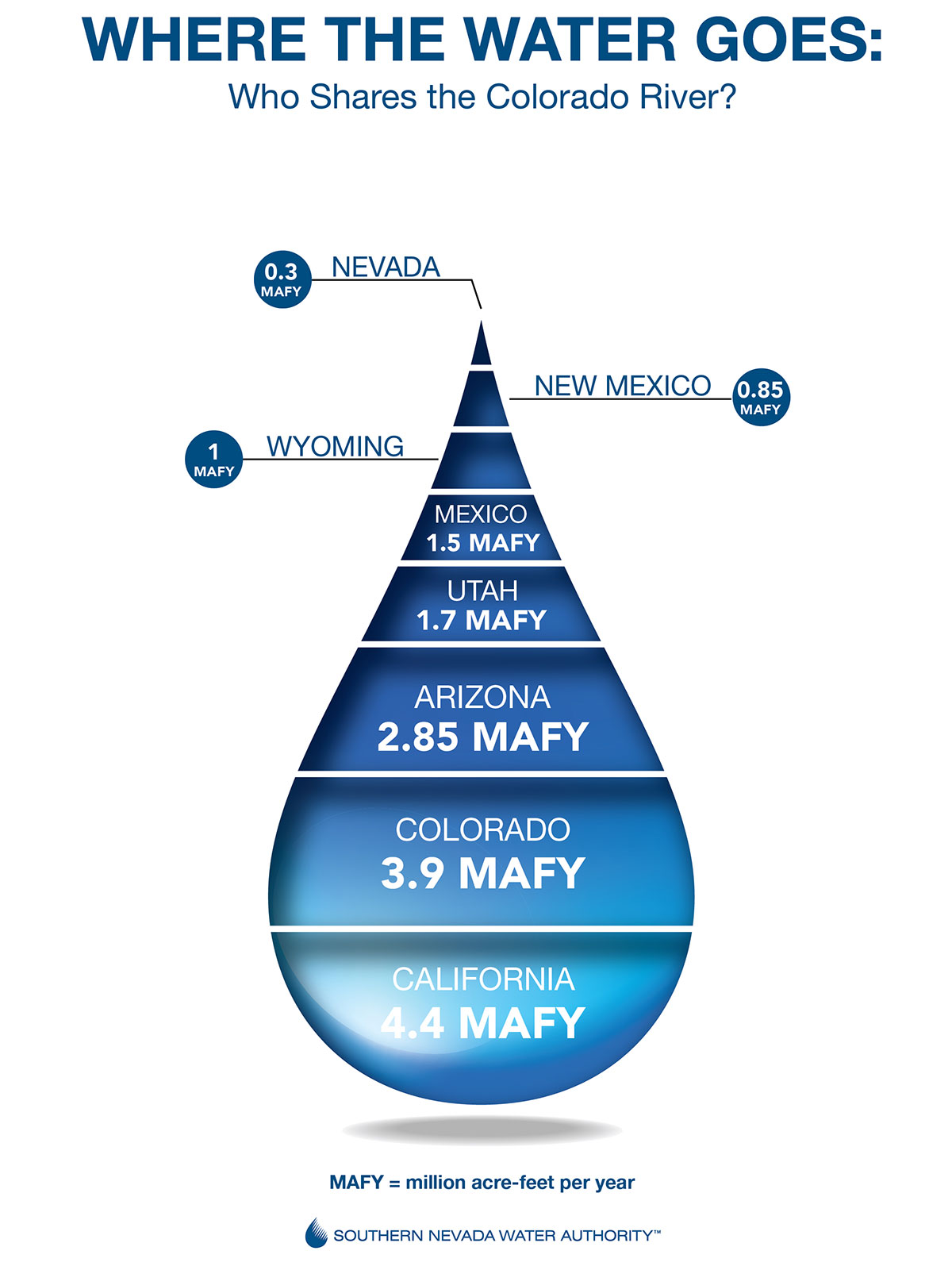
If you look at water usage in Nevada, 75% of it goes to agriculture [1]. Agriculture provides a lot of jobs and food. Unfortunately the resources are no longer there. You can eliminate landscaping (yards, golf courses, las vegas fountains, etc), but it still won't make a dent in the water use.
It's not just Nevada, but Nevada is the poster child here for everything that's gone wrong with water use.
So something's gotta give. And it turns out that farming in deserts may not have been the best use of the land (or water).
[1] https://extension.unr.edu/publication.aspx?PubID=4764
The Desert Land Act under which a lot of desert land was claimed (and, the only remaining way I know of state land can still privately be claimed) only gave it to you if you established irrigation and agriculture.
The government basically asked for it, and then made it the only way to get much of the land. And now of course, many heads in government now complaining about the evil private land owner who did the thing the government asked for and precondition.
Yay, they own the land. A hundred plus years later, I don't see why the descendants (or corporate owner) should have the same water rights now after things have changed. Don't strip them of the land...but something has to give.
Yes that could be done via eminent domain of their water rights. The only note would be that since the value of especially the more rural desert land is tied almost completely to acreage times water rights per acre, it's basically a full buyout of the entire non-residential rural desert due to the takings clause. I don't know how much it'll cost, but it will be a lot.
>A hundred plus years later
I know of people still investing large sums today to claim under the Desert Land Act. It's still active. They need to establish irrigation and usually drill/share a well (maybe hauling could work but you have to show it's economically viable), and establish that over a multi year proof process the viability of the land. Just harder than it used to be. So to be clear it might be someone from yesterday, although it's just less common. I'm not sure if the takings clause would cover them though, as they don't technically own it until the proof process is complete, so for them it'd probably merely just be a total loss.
The takings issue is why I believe that rather than invoking eminent domain, the CA government should institute a Uniform Water Use Tax, whose aim is to establish a single price for any use of water (charged per gallon/acre foot) in the state. The cost of acquiring the water used can then be claimed as a credit against the Uniform Water Use Tax.
This respects water rights while aligning incentives to conserve water and as a bonus establishes a more even playing field in the agricultural sector, enhancing competition and reducing the unjust profits of the Resnicks' shady water empire.
> water rights per acre
Is that actually taken into account in a taking? I haven’t thought about this stuff in decades, and I know there is some weirdness with regulatory takings.
Another way to frame the question: if the government just changes the water rights per acre, does that itself trigger the takings clause?
It depends on the type of water right (there are many kinds). The State has the ability to effectively recall some water rights. True titled rights would be a taking.
Nevada gets 4% of the water in the first place. Almost all of that 4% goes to Ag and mining as you said. The things people use as "the poster child" like fountains and golf courses are rounding errors.
Here's a question, why are we putting all those resources and efforts into farming in a desert?
Cows mostly.
Like 60-75% of all ag land in the US is to grow feed for cows. Mostly in dry environments. This is because the old water rights were distributed on a "use it or lose it" basis which encourages wasteful use.
In some desert areas there is no other use for the water because the aquifers are fragmented. People don't live there, you can't readily move the water to somewhere useful, and it won't flow anywhere useful on its own. Agriculture is a way to convert water into something easily transported.
This doesn't apply to many places but in the desert Mountain West this is often the case. Also, while it may seem surprising, a few crops really thrive in the high desert e.g. onions.
This is absolutely not the case when it comes to Nevada agriculture. They're moving water in from outside the state to feed ag for places where people do live.
> Here's a question, why are we putting all those resources and efforts into farming in a desert?
Because moving water to where the fertile land is is easier than vice versa. And because agriculture is the base on which civilization rests.
Ok so again, why move the water to dry relatively bio-inactive desert?
Desert land was cheap. Water seemed plentiful and cheap. And back when the system was set up, doing that looked like "Progress".
Water allocation in the American West has been a mess ever since the beginning, when Prior Appropriation was decided as the way to claim water rights. Essentially, the first person to put a claim of water into "beneficial use" gets those rights.
This is why you see California with such a large share of the Colorado River's water rights, even though it "touches" the river the least: they were the earliest fast-growing state to "use" that water. And that's why you see so many water-hungry crops being grown in the West--the owners have the rights already, and to them, if they don't use it, they'll lose it.
So any agreement here needs to make a compromise between states, the federal government, prior settled law, and owners with effectively "free" water that don't want it taken away from them.
It's a complicated issue, but one step would be to force private owners of water rights to list their rights on an open market (right now some owners of water rights, like the Imperial Irrigation District can choose to never sell them). At least that way you can start the conversation somewhere.
(In fact, John Wesley Powell, namesake of Lake Powell, argued strongly against "prior appropriation" before the area was even settled, and instead argued against a collective approach to the limited and volatile amount of freshwater. He did not succeed.)
https://en.wikipedia.org/wiki/John_Wesley_Powell#Environment...
> force private owners of water rights to list their rights on an open market
You don't need to force them, they've done it for decades to the extent it is allowed. I've owned titled water rights in Nevada. They are worth something but not nearly as much as many people likely assume.
Nevada has additional complications due to the structure of the aquifers. It is difficult/impossible to move water from where it is to where it may be needed.
> complicated due to the structure of the aquifers
Guess - you're referring not to the aquifers themselves, but to the shape of the watersheds. Especially to the "water doesn't naturally flow along roller coaster tracks" topography of the https://en.wikipedia.org/wiki/Basin_and_Range_Province
Yes, the watersheds but also the prevalence of mountaintop aquifers that don't go beyond their part of the range. These can be extremely fragmented. You'll have ample water for the taking in one area and none a few kilometers away. AFAIK, you can still acquire revocable water rights to some of this without much fuss since it doesn't interact with any official watershed. It just isn't located anywhere remotely convenient or useful.
Sometimes the valleys have good wells but that isn't guaranteed due to the geology of Nevada. Lots of brine, sulfur, hydrocarbons, hot springs, etc. You never know what you are going to get and the fresh water eventually mixes into this underground.
[deleted]
You do not even need to force water rights owners to list their rights on the open market. They already want to, it is just illegal for them to sell their water rights (separate from their land) to entitys with more productive uses of the water.
That's not a solution, either. See William Mulholland buying up the water rights in the Owens Valley to feed Los Angles, thus turning Owens Lake into toxic dust that is costing $1 billion and counting to manage. Mulholland is long dead, and we're just getting started paying for that.
Water rights in the West are hard, and we've known that since John Wesley Powell was in charge, as a nearby commenter explained. The Colorado was divided up during an unusually wet year a long time ago, and rising demand and falling supply have only made things worse ever since.
An excellent contemporary book was written about this by Zak Podmore called Life After Deadpool: https://www.torreyhouse.org/life-after-dead-pool
I just finished reading it and can highly recommend it. Zak's writing is enjoyable and refreshing.
Thanks, will add it to my reading list while I'd also recommend the classic on that topic, Cadillac Desert by Marc Reisner.
we can go back to Leonardo Davinci(and further), to how Davinci was promised the income from a certain amount of flow from a river as a payment for services rendered, and as an ongoing retainer and support, but how in his own note books he laments how he had been strung along and never given anything amingst the wranglings of those "better conected".
there is nothing more provocative to the mindlessly greedy people in the world than a resource, just, JUST!, LAYING THERE!
for which the French created "the argument that ends all discussion"
Maybe farming in the desert isn't a good long-term plan.
What make this fun are many chip and data centers have been building plants in those areas, and the plants require lots of water for manufacturing and cooling.
How about building these plants in areas with plenty of water. Many places located to these areas (Arizona) due to their lax labor and environmental laws.
> How about building these plants in areas with plenty of water
That’s the problem. There aren’t that many areas with plenty of water.
There are in the US, those places just have more hostile legislatures and regulatory regimes that make construction impossible. See the debacle around the Foxconn Wisconsin project which happened under a very industry friendly governor. The great lakes are has nearly infinite water, and cold aim all winter. What they don't have is the ability to build anything.
The water in the great lakes is controlled by an international compact that prevents water from being diverted from the Great Lakes to other watersheds. So, water utilization from the Great Lakes is constrained. The Wisconsin Foxconn project was a PR thing on both sides. Foxconn started scaling back it's promises and construction almost immediately after the agreement was signed. Scott Walker needed good PR and promised huge tax credits without much in the way of assurances.
> The water in the great lakes is controlled by an international compact that prevents water from being diverted from the Great Lakes to other watersheds.
Who said anything about diverting it? Pump cold water out, store hot water until it cools to ambient temps, then dump it back in the lake.
> Scott Walker needed good PR and promised huge tax credits without much in the way of assurances.
Yeah, this is my point, the state wasn't actually prepared to see the deal through despite nominally being industry friendly vs Arizona where they have some follow through.
>> The great lakes are has nearly infinite water...
No they do not. The flow there is already balanced, and lake levels are lower than usual.
New York already added another tap for electric generation about 12ish years ago, and IMHO it has had an effect.
> No they do not. The flow there is already balanced, and lake levels are lower than usual.
You aren't going to meaningfully drain the lakes to cool chip fabs when the vast majority of that water will simply go back into the lake either directly or via the water cycle. It's not going to run off the land and into a river like with flood irrigation or similarly irresponsible water uses. The entire global chip industry today uses less water than the city of Hong Kong.
Heard that before.
Keep repeating the script. Short term profit at the expense of long term stability.
what the fuck are you talking about, these facilities process the water and return it to the source.
That’s not how the water system works. It’s not like all the evaporated water will end up in the lakes. California uses a lot of water for farming, it’s not like all the evaporated water ends up in the Sierras all the time. Water cycle is complex and reducing it to “it will just end up back to where it came from” is pretty reaching.
Besides it’s not just the evaporation. The leftover water concentrates a lot of the impurities that already exist in the water, and not all of it ends up in proper treatment facilities, which in turn pollutes the place wherever it ends up being. This is actually a problem in parts of Oregon.
https://www.rollingstone.com/culture/culture-features/data-c...
California is very arid, when water evaporates it rains out over the ocean or farther north. The upper mid-west is very wet and the evaporated water will come back down over the Great Lakes watershed which is enormous.
> This is actually a problem in parts of Oregon
The problem in that part of Oregon was preexisting contamination in the drinking water.
"the county’s underground water supply had been tainted with nitrates — a byproduct of chemical fertilizers used by the megafarms and food processing plants where most of his constituents worked."
Discharging a little data center water back into lake Michigan isn't going to make any difference. The entire discharge of ever data center in the world wouldn't register.
They do use evaporative cooling. A few sites aren't going to have a big impact on a Great Lake though, especially when lots of that evaporated water ends up falling in the basin.
The evaporation in the great lakes region will just end up as rain near the lakes.
Sorry, I think I’m failing to read carefully today!
There's a Microsoft datacenter being built on the proposed Foxconn site and it will use 8.4 million gallons of water per year, so I guess industry got its way eventually?
> 8.4 million gallons of water per year
That is <10% of the amount of water required to grow corn on the same land as the data center. Acre for acre, data centers consume a tiny fraction of the water consumed by agriculture.
Are the corn subsidies to produce high-fructose corn syrup and ethanol that important?
What, it will use as much as a small village or subdivision? As much as 80 average US households? That doesn't seem noteworthy at all.
Whenever I hear water measured in gallons instead of acre feet, I know someone is trying to exaggerate the amount.
East of the Rockies this is an unnoticeable amount of water.
East of the rockies suffers from the problem of water being so unlimited nobody paid it any attention and let the desert states let federal policy reflect their problems and priorities to their detriment.
I think this is because when the water table is as saturated as it is in much of the east, there's no sense in trying to conserve. The water pumped out of the river just ends up on the ground, goes in the watershed, and back down the river. Caveat: Note that I'm talking about surface water. Fossil water sources like the Ogallala Aquifer being overused are another story entirely.
>when the water table is as saturated as it is in much of the east, there's no sense in trying to conserve. The water pumped out of the river just ends up on the ground, goes in the watershed, and back down the river.
The laws of nature may agree with you but the laws of man do not and lawfulness comes at great expense.
For folks like me who are trying to visualize 8.4 million gallons of water:
Quick back-of-the-napkin suggest that it's about as much as would fit in a round pool just under 500ft (~150 meters) across, 6ft (1.8 meters) deep.
As someone in Indiana that is fighting tooth and nail to keep datacenters out (they don't bring jobs, taxes, or revenues and eat up very valuable resources), I say if you want to build here, then move your HQ and 10s thousands of high paid workers here.
Otherwise... go pound sand.
How does the data center "eat resources"? Discharged water will stay in the watershed and it rains back down on you. As long as they aren't drawing directly out of the aquifer without putting it back then its fine. How do they not bring tax revenue? Do you not have property taxes? Maybe go lobby for those then.
Gary Indiana had a massive infrastructure for cooling and water diversion for their mega steel industry. Electricity already in place, again for steel industry, and anything it would sink would be a drop in the bucket of the Chicago metropolitan area (so Illinois would eat much of the externalities of whatever hypothetical minor price increase of electricity) grid that it's connected to and likely far less than they were using for their steel jobs.
Probably best to just let it stay an industrial wasteland shithole rather than put datacenters there.
> Probably best to just let it stay an industrial wasteland shithole rather than put datacenters there.
That seems to be the attitude unfortunately.
The steel mills are back in business and booming right now
> How does the data center "eat resources"?
Money is a resource. Someone has to deal with the utility rate hikes that tend to follow large new consumers - even when the AI bubble bursts in a few years, the electricity prices will stay high (or in the worst case, get even higher) because the utility needs to recoup its investments.
> How do they not bring tax revenue? Do you not have property taxes? Maybe go lobby for those then.
Forgot the /s? Seriously, property taxes are a joke because the "wealth" generated by the datacenters is absurdly high compared to their property lot size. If you were to extract the appropriate amount of taxes to cover for the costs, you'd have to raise them so high that you'd strangle the entire rest of your local economy. And stuff like we have here in Europe, taxing corporate profits, is not applicable as well because the profit is officially being made at some Delaware site (or Ireland in our case), not at some random datacenter.
> Money is a resource. Someone has to deal with the utility rate hikes that tend to follow large new consumers
It seems like new power generation should be a trivial concern, the upper Midwest is incredibly windy. The block to adding new generation is mostly antiquated local/state laws about connecting to the grid interchange. It's within local power to fix that. It's the power company lobbying against more cheap energy that causes prices to rise. Point your anger at the people sitting in the way of more capacity not the people wanting to use power.
> Forgot the /s? Seriously, property taxes are a joke because the "wealth" generated by the datacenters is absurdly high compared to their property lot size.
Then assess them on that basis. Property tax isn't a function of square feet, you can assess it on the basis of economic value. Property tax is a local issue, just vote to change the law.
> Point your anger at the people sitting in the way of more capacity not the people wanting to use power.
It's still waste. When the bubble pops, and it will pop, all these data centers will not be around as consumers any more. Just look what happened after the dot-com crash, and I'm not alone in thinking that the AI crash will be even worse than that.
And once again, it will be the taxpayers left with the bill, with half-constructed ruins being a blight on their neighborhoods, and with homeless moving in to the ruins and causing fires and police calls.
> Property tax isn't a function of square feet, you can assess it on the basis of economic value. Property tax is a local issue, just vote to change the law.
Good luck trying to stand up as a community of, say, 10.000 people against the lawyers of a multi-billion dollar company. They will find loopholes or in the worst case get your entire law tossed out in court.
That is why people are pissed, they know that the rich can afford to do whatever the fuck they want, with zero respects for the people affected by it.
> Someone has to deal with the utility rate hikes that tend to follow large new consumers
Commercial power is often charged differently than residential power, and there's also nothing that prevents charging disproportionately higher rates for e.g. 90th percentile power usage.
There's nothing inherent that means a data center in a locale should cause individual residential customers to pay more.
> There's nothing inherent that means a data center in a locale should cause individual residential customers to pay more.
Well the utility will have to make investments that are on a depreciation schedule anywhere on the scale of 20-50 years... so there will have to be a general rate hike to cover for the bank loan (banks aren't stupid, they want at least something in incoming cashflow increase), and when the AI bubble pops, guess who will have their rates hiked a second or third time? Yup the average consumers.
If adding a datacenter to a locale is not a net gain for the locale, you're failing to charge appropriately for things you should be charging for.
I'm sure there have been some datacenters that have tried to use "brings in jobs" incentives, and that could certainly go wrong if the incentives aren't designed correctly (e.g. proportional to the actual number of jobs), but as long as there aren't incentives being abused, a datacenter should be a net win.
Yeah seriously. If you're going to fight. "tooth and nail" against a data center, maybe reevaluate and direct your energy towards some productive like better tax laws, more energy generation, and so on.
Genuine question: why not build them in Alaska? It has plenty of cold.
It's also pretty tough to get good high bandwidth connectivity there and the power infrastructure that can produce enough power to run a datacenter.
> good high bandwidth connectivity
Also the speed of light might be a bit slow.
What about building along the ocean coastlines and/or pipe water in from coastlines? If you can't use it unless it is desalinated, then figure out how to desalinate it and what you'll do brine/salt.