class3shock
2 months ago
The F-150 is in one of the markets I think ev's will take over first (small commercial vehicles) but it just was not the right vehicle to start with. To expensive, even when the tax incentives were still a thing, and Ford suffers from having corrupt dealers taking a large cut on top of that. So you are selling to either the top 5% or bigger businesses.
If you are a top 5% buying this you want it to tow your expensive toy somewhere which ev's suck at currently or you want it to drive to "insert outdoorsy vacation destination", which means long distance in a remote area with few charging stations. So not a great sell.
If you are a bigger business I think this probably makes sense in some cases. You aren't dealing with the maintenance of an ICE, you can keep it "running" inside a building, it can provide on site power, probably has cost benefits in cities where the lack of emissions and noise is helpful. But the expensive really narrows down your customers. Many are also looking for range and towing, which doesn't help, and people that would show up for the ev part probably would be better off with a van.
If they had done a small e-transit, in the $30-35k range and sold it direct for actual msrp they would have had a much better chance at dealing with where we are now (high interest rate and low support for ev's).
inasio
2 months ago
My electrician drives an electric F-150, it's impressive how useful it is for him. The frunk carries a big box of tools, there's tons of outlets to charge his power tool batteries, he can even run a small welder
tekno45
2 months ago
The F-150 is a great power bank that comes with a very useful set of 4 tires and a steering wheel for a truly portable charging experience.
malfist
2 months ago
I justified the lightning purchase to my partner by pointing out having an equivalent whole house battery backup in Tesla power walls would be more expensive than the truck
tenuousemphasis
2 months ago
Have you tried supplying power to your home yet?
malfist
2 months ago
We've not hooked up the transfer switch yet but we have ran a lot of extension cords during an ice storm last year and kept all our aquariums going, all 700 gallons of them
subdavis
2 months ago
If you’ve had it for that long without installing the crucial part of what you described above as a major selling point, I think that would have been useful to volunteer in the original comment lol.
The extension cord thing was interesting too, but “I sold my partner on a feature that turned out to be more trouble than it was worth to set up” is super relevant to discussion!
malfist
2 months ago
We haven't needed to yet. Our primary concern are those aquariums and it worked wonderfully for them when we needed it. Much better than running through over a hundred dollars a day in propane to keep them running, and the truck parks in an insulated garage so no cords to a generator through a window letting the cold in
markdown
2 months ago
Shhh, his wife might read this.
malfist
2 months ago
My only fear is that when I pass away, he'll sell my telescopes for what I said they cost. Jk jk, he bought me my most expensive one
brianwawok
2 months ago
Trick is the power wall will be there in 10 years. The truck may be traded in at 4. Car trade in speed is what makes that math not work.
frumper
2 months ago
Trading in your new car at 4 years old sounds like bad math no matter what car you buy.
km144
2 months ago
Have you seen the prices of pre-owned Honda/Toyota sedans that are less than 5 years old? There are absolutely cars out there where trading in your new car after 3-4 years can make sense depending on the cost of the car, the depreciation curve, and whether you want to always be driving a relatively new car. Of course it's almost always going to be a better value proposition to drive the car for 10 years if you can, but that can still depend on depreciation.
behringer
2 months ago
The math doesn't work when you calculate the same thing based on buying low mileage used cars or leases.
You're throwing large amounts of equity away every 4 years.
Also electric cars get killed on the depreciation curve.
km144
2 months ago
Low mileage used cars don't come with a warranty, or probably have a more limited warranty if they're CPO.
Leases can be better, but again they are usually better choices in high depreciation scenarios (like luxury vehicles or EVs, as you point out), not low depreciation scenarios.
throwaway2037
2 months ago
> Also electric cars get killed on the depreciation curve.
frumper
2 months ago
In California, at one point, you could get a few thousand rebate, if you were in the Central Valley, and additional few thousand rebate. Some local cities gave rebates on top of that, and the federal tax rebate on that. Buy a $45k Model 3 and get back $13k-$15k just for buying it. Rebates like that are going to play havoc with resale values. On top of that, new Tesla's went down in price over the past several years. I think as these incentives taper off we'll see more of a stable drop off.
behringer
2 months ago
I think buyers just understand the value of a battery that they've cared for and babied compared to a battery with unknown history.
tekno45
2 months ago
so the power wall can't be traded in and doesn't move. Still seems more useful.
kimos
2 months ago
A local couple runs a hot food stall at outdoor markets all over the city by backing theirs up to the stall and plugging in all the kitchen things they need into the outlets in the bed.
zeristor
2 months ago
The number of outdoor market stalls I’ve seen with diesel generators, noisy, smelly and polluting. Happy to see people using all electric.
xnx
2 months ago
131,000,000 mWh
elliotec
2 months ago
I have the powerboost hybrid F-150. It does all this, can power a house with the generator, AND I can drive it through the mountain west with zero EV infrastructure at insanely high MPG for a truck. Plopped a Tune camper on the back and couldn’t ask for more.
hcurtiss
2 months ago
Same. In a Powerboost, pulling my 5000 pound boat 500 miles to north Idaho is super easy, with a single refuel. In a Lightning that would be a nightmare, recharging 4-5 times. In truth, I’m excited about Ford’s pivot. I think electric motors with a range extender would be fantastic. Like the Chevy Volt for pickups.
thijson
2 months ago
I agree too, a range extender is needed for the infrequent long trip.
jama211
2 months ago
That’s pretty cool, and I just checked the prices and it only starts at 11k dearer than the standard f150, which is less than I expected. Interesting.
What’s more insane to me as an Australian is its 50k USD starting price in America, but in Australia it starts at $149k USD as they’re only sold by third parties that do right hand drive conversions (at imo a way too high premium, 100k for that service + shipping???)
markdown
2 months ago
That's insane. Why would an Aussie buy this over a BYD Shark for US$40k?
2muchcoffeeman
2 months ago
Status symbol. I’ve only seen these sorts of vehicles actually carrying something a single digit number of times. I’ve never seen one dirty.
labcomputer
2 months ago
Pick your poison:
* no gas
* no oil changes
* no annual emissions testing (if they do that in Oz)
* more than 1 second faster 0-60/0-100
* twice the towing capacity
* semi-automated trailer connecting (maneuvering the truck to the trailer)
* longer bed and more rear seat leg room
jama211
2 months ago
I think you read their comment backwards
unixhero
2 months ago
Nah.
Go with the Sharkie mate
isoprophlex
2 months ago
It serves as an artificial, external extension to the length and girth of the male reproductive organ
SoftTalker
2 months ago
Do they sell them in "work truck" trim? (Bench seat, vinyl upholstery, rubber floor, minimal options)?
qdog
2 months ago
I don't think so, not like it was once upon a time. I had a manual 6-cylinder I bought in about 2002 for around $14000, no leather, 2wd extended cab. That's like $25k in today's dollars according to Google. If they made a basic truck for even $40k as EV it might sell a lot better, but I am pretty sure they are all about selling 60k+ trucks for profit.
markdown
2 months ago
The BYD Shark 6 sells for US$40k in Australia:
https://bydautomotive.com.au/shark-6
There's a 100% tariff on top of all the regulatory and political hurdles that prevent BYD from selling in the US, but it shows that a very nice truck can be built for $40k.
hopelite
2 months ago
Americans are not allowed to have better quality, lower priced Chinese vehicles because they have to suffer the incompetence, failure, abuse, and plunder by their ruling class due to … the decades of incompetence, failure, abuse, and plunder of their parasitic and alien ruling class.
It is easy to understand what the tariffs are attempting and why, but what supporters don’t get is that at the very least it’s all wrong in sequence and timing, not to mention poorly executed due to the schizophrenic and manic nature of American politics that is dominated by the president’s supposed term limits and warfare of memes people believe. “A day late and a dollar short” has probably never been more appropriate.
The inherent problem with empire and reserve currency is that it supplies a drug to a ruling class that is already inherently prone to excess.
orthoxerox
2 months ago
Or because UAW members are not willing to work 996 for Chinese wages.
germinalphrase
2 months ago
“ The first archetype, Euro premiums, has an average labor cost of $2,232 per vehicle and includes premium brands such as Mercedes-Benz, BMW, Jaguar Land Rover, and Audi. This group is characterized by high production costs, complex design and advanced manufacturing processes, and strong labor unions.
Within the category, German manufacturers face among the highest labor costs of $3,307 due to stringent regulations and high wage rates.
The second archetype, electric vehicle-only manufacturers, includes startups as well as more established players like Tesla, which do not operate under organized labor contracts. Their average labor costs range from $1,502 to $13,291, and they face high per vehicle production costs due to low manufacturing volumes. EV-only manufacturers also have been heavily reliant on government subsidies, which are now being cut back by the new administration.
The third archetype, mainstream model manufacturers, has an average labor cost of $880 per vehicle and includes traditional high-volume automakers from various countries. Japanese manufacturers enjoy lower labor costs per vehicle, with an average of $769, compared with manufacturers in the United States, where the average is $1,341 — a labor cost per vehicle that reflects recent historic union gains.
The fourth archetype, Chinese car manufacturers, has an average labor cost of $585 per vehicle, characterized by low wages and high efficiency. The group maintains the lowest overall conversion costs in the industry by leveraging its newer factories, efficient supply chains, and high production volumes” - https://www.oliverwyman.com/our-expertise/insights/2025/apr/...
AngryData
2 months ago
The labor cost of manufacturing a vehicle are a very tiny portion of the cost of the vehicle.
MangoToupe
2 months ago
Is this wild speculation or do you actually have a link showing that their 900,000 employee workforce is subjected to 996?
red-iron-pine
2 months ago
don't forget all of the pollution
seltzered_
2 months ago
The F-150 Lightning Pro trim is the closest thing to this, and aside from the first year generally has only sold to fleets.
Theres also the Chevy Silverado EV WT trim which is a similar base model trim, but with the huge heavy battery its paired with it's still an expensive truck.
labcomputer
2 months ago
Yes, but you have to go to the FordPro site to find it: https://www.fordpro.com/en-us/fleet-vehicles/all/?vehicle=F-... . Has vinyl manual seats, rubber floor, etc.
You can only get the Lightning from the factory as a super crew with a center console, but some people have converted theirs to a front bench and column shifter for a total of six seats.
bigtex
2 months ago
All those things can be done with the newer gas F150s minus the frunk storage.
fragmede
2 months ago
Yeah the frunk is what makes that thing shine. The cybertruck's frunk is pathetic in comparison.
kevin_thibedeau
2 months ago
90% of F-150s are daily driver grocery-getters. That was the target for the Lightning, not truck stuff.
qingcharles
2 months ago
I live in an area that has probably >100% pick-up ownership per adult male. I've noticed that these people will not go to the grocery store on days when the weather is inclement due to the chance of the groceries getting wet. Seems like a bad vehicle for grocery runs.
theshrike79
2 months ago
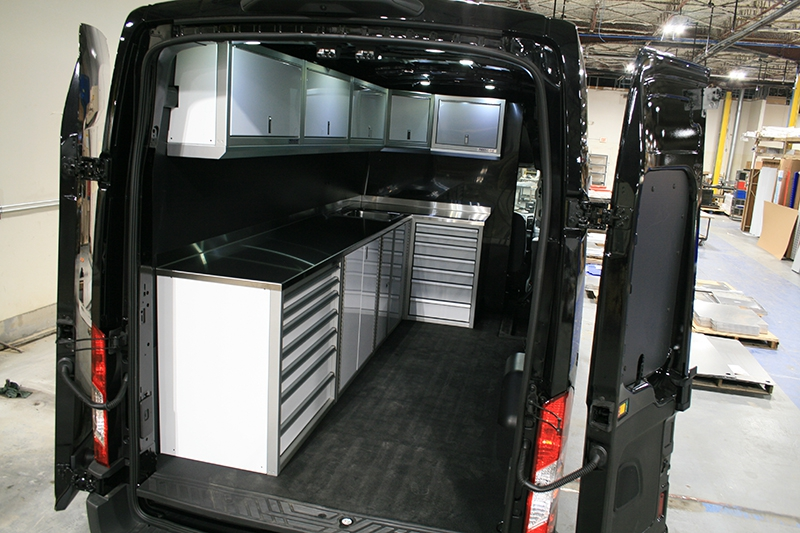
I don't get the whole American thing for Pick-up trucks. Unless you're hauling hay or manure, why would you want your cargo area exposed to the elements?
A normal van is better in every single way. I can't figure out why someone would put their expensive tools in a pick-up's bed when this is an option: https://modulinecabinets.com/wp-content/uploads/2019/11/van-...
uep
2 months ago
I used to work for a general contractor who did residential remodels and construction, and a little bit of commercial work. He exclusively used cargo vans. He would carpet the interior to protect the cargo and your knees. It made me question why anyone would use a truck. As you alluded to, it doesn't just protect from the elements, but also from thieves stealing tools out of the back of your truck.
qingcharles
2 months ago
My neighbor is a contractor. He just switched from a Ford pick-up to a Ford van and could not be happier.
wongarsu
2 months ago
I suspect it's the intersection of people cosplaying as farmers, and vans being stereotyped as vehicles for pedophiles and serial killers
red-iron-pine
2 months ago
Van's aren't sexy and cool, and there is no marketing as TOUGH and REAL MEN and COUNTRY MUSIC the way there is for trucks.
The bourgeoning Van Life movement that is picking up steam on places like TikTok and YT may do more for that, but in a lot of ways it's a statement about doing without, as opposed to being country rich and tough the way trucks are.
WorldMaker
2 months ago
You are forgetting "soccer moms". For some dumb reason America decided there were two genders "masculine" trucks and "feminine" vans. It still makes no sense, but it certainly seemed to sell a lot of trucks to misogynists.
hamdingers
2 months ago
The auto industry has spent billions of dollars on propaganda to convince Americans they need a big truck for their self image.
They have done this because big trucks are by far the most profitable segment of vehicle, and emissions regulations reward vehicles for being large.
interestpiqued
2 months ago
I always find this talking point so weird. Trucks are great and people want them. There is no ultimate truth here where people can't see the light and evil corporations are making us buy trucks. Theyre making trucks because we want them. I love mine, and admittedly don't really "need" it.
hamdingers
2 months ago
This is a fun reply because the easy flippant response is "okay then the propaganda got you." Something neither of us can prove or refute.
Pickup trucks are popular in the US and the Americas broadly where they are heavily marketed. Pickup trucks are less popular in places where they are not marketed as heavily. Even outside the auto industry, there is a general consensus that marketing works. Make of that observation what you will.
interestpiqued
2 months ago
I mean I don’t doubt that marketing has some positive return for anyone selling something. But are they marketing me to buy a truck or to buy their truck. There’s a huge distinction.
theshrike79
2 months ago
People only want them because of the stupid loophole that lets vehicles over a certain weight bypass regulations.
If the massive cars cost what they should, people wouldn't buy them as much.
qingcharles
2 months ago
In Chicago there were a lot of major roads where driving a pick-up truck was illegal.
CamperBob2
2 months ago
Such as?
interestpiqued
2 months ago
If you mean the tax write down for certain weights then I didn’t even get that so I don’t how that applies.
Not everyone thinks like you. Some people like trucks so they buy em
imtringued
2 months ago
Pick-up trucks aren't meant for work. Like, at all. They are inherently grocery/family vehicles.
Europeans don't use pick-up trucks even for cargo that is suitable for pickup trucks, because small flatbed trucks [0] let you open the bed from the side, making pickup trucks mostly an obsolete concept for work purposes.
phainopepla2
2 months ago
I grew up on a farm, and I can tell you that some pick-up trucks are definitely meant for work, and used that way. Mostly older ones
deinonychus
2 months ago
I agree that they probably don't serve most people well.
But I know someone that has a huge truck with a cap on his bed (google "pickup truck bed cap" or "topper"). That solves the weather problem and makes you wonder why you don't see more trucks covered up. The answer is obviously it looks less cool and doesn't fit the image. But it serves him well because he works in construction and frequently has the bed full of materials, sometimes which are longer than the bed. And he uses the truck occasionally to tow trailers.
But he's not most people. And he has another car for getting around town when he's not working.
robotnikman
2 months ago
I don't have a full sized truck, but I do have a Tacoma (similar to the Hilux iirc for Europeans). The main reason I got it was because Toyota is well known for cars that last forever, but also to tow a camper and to do some offroad exploring and camping. It has also come in handy for helping move stuff for friends, I recently used it to carry a bunch of bags of sand and dirt for a friend. The utility it offers has come in handy compared to my old Ford Escape.
seanmcdirmid
2 months ago
When I was a kid, my dad owned a pickup truck in Mississippi, and there seem to be tons of ways of avoiding getting the groceries wet, a bed-width toolbox behind the cab was the simplest way (and this was way before extended cabs were a thing).
If you are living in such an area where they can't even figure that kind of thing out, it sounds like there might be something in the water.
ssl-3
2 months ago
When I was a kid, a normal-sized American adult could open up a bed-width toolbox, look down inside of it, and easily remove a few bags of groceries before re-closing the lid -- all while standing flat-footed on the ground beside their normal-sized American truck.
Things are not that way anymore; trucks got bigger.
The top of the bed rail of an F150 Lightning is around chin height for a lot of folks: https://imgur.com/ZBOBqJc
seanmcdirmid
2 months ago
I don’t think a F150 lightning is wider than a 1985 Silverado.
ssl-3
2 months ago
It's not the width that's a problem, but the height.
Here's a brochure for the first-year F-150 (1984): https://xr793.com/wp-content/uploads/2022/03/1984-Ford-F-Ser...
Have a look at some of the pictures that have people standing next to the truck.
They'd be giants if they were able to have that kind of posture next to a modern F150.
seanmcdirmid
2 months ago
Oh, I was a smaller kid back then and I guess I wouldn’t find it very accessible either way. Also my dad was tall. Coolers fit in the back also if you want to use those instead.
ascorbic
2 months ago
Funny to see so many workarounds to avoid the obvious solution of buying a vehicle with a roof instead of playing at being a farmer or builder.
red-iron-pine
2 months ago
in most cases the manufacturers offer an SUV version on the same chassis.
E.g. the Hilux/Tacoma vs. it's SUV sibling the 4Runner
It's one of the reasons why Honda and Hyundai are offering trucks -- they're already making the giant SUV, so just put a flat bed on it.
bob1029
2 months ago
> I've noticed that these people will not go to the grocery store on days when the weather is inclement due to the chance of the groceries getting wet.
A modern pickup truck can fit the payload capacity of an entire Honda civic in the back of the cab. I've never seen someone put sacks of groceries in the bed of their truck. Maybe packs of water or charcoal, but no one is putting their produce and boxed goods back there.
labcomputer
2 months ago
Yea… you can actually fit two adult-sized road bicycles, without removing the wheels or disassembling them in any way, in the back of an F-150 cab!
And still have more room for stuff in the back of the cab before you even start talking about the bed.
I’m also confused how groceries in the bed would get wet in the rain… everyone around me has a tonneau on the bed. My guess is that some of these are not real anecdotes.
tanjtanjtanj
2 months ago
I see it, at least weekly, at a Costco in Texas. Not just the pallet stuff but refrigerated goods and smaller stuff (gathered in boxes as is the custom at Costco)
Swenrekcah
2 months ago
Wait do people put their groceries they intend to eat on the bed of their trucks, exposed to exhaust, asphalt, tire rubber and all other forms of road pollution?
moron4hire
2 months ago
No, we typically leave all the food in the packaging first.
Swenrekcah
2 months ago
Still, the packaging then presumably goes into the fridge and cupboards? And I would imagine there would be fresh produce in the bag as well?
Maybe it makes sense, it just sounds unpleasant to me.
moron4hire
2 months ago
Wait til you see what the inside of a grocery warehouse looks like
qingcharles
2 months ago
And wait till you see the inside of the factory that made the food. Source: experience.
red-iron-pine
2 months ago
you're washing your produce, right?
Swenrekcah
2 months ago
I am, but still it sounds bad to me to expose them to the road elements on the way home.
And food in packaging, it is usually in boxes or other containers most of the time in supply line transit. Individual items only get unpacked in the store, so I would think this practice adds considerably to their “dirtyness”.
moron4hire
2 months ago
Not really. Bread, milk, soft drinks, and bagged snacks like potato chips all get delivered and stocked by the individual vendors, but everything else goes through a single warehouse ran by the grocery franchiser. Dairy comes in extra boxes, but most of the stuff is stacked 3D-tetris-style 6 feet high on a pallet and then wrapped in cellophane on the pallet before getting loaded on the truck. It's used just as a convenient way to bind the stack together so it doesn't dump in traffic. When it gets to the store, the pallets sit in the back until they are needed and then the cellophane is cut off and the items go directly on the shelves. Packing them up further would slow things down too much and confuse the stock workers too much (it's mostly teenagers and mentally challenged people, not exactly a life long career). It was not uncommon to find rat and mouse feces and urine on top of cans and boxes.
Almost all of the produce is in nearly the exact form at the warehouse as you would find them in the store. For example, watermelons are in an open-topped, cardboard bin that just gets moved from the warehouse to the grocery floor in exactly its final state. Berries are all in their plastic clamshell boxes, no extra packing, no tape. They rack them up in flat cardboard boxes with no top, just tall enough that a single layer of berry boxes can fit in it and the next layer stacks on top.
This one time, one of the pickers had a pallet full of berry racks, six feet tall. He took a corner with his pallet jack too fast and dumped the entire load on the floor. Berries scattered everywhere. They used a snow shovel to scoop them back up and back into the boxes and back into the racks. Then out to the truck and out to the store, where they would have gotten relabeled "mixed berries."
robotnikman
2 months ago
I usually just put them in the passenger or back row seats.
mattmaroon
2 months ago
Crew cabs, truck boxes, tonneau covers etc exist.
somenameforme
2 months ago
Almost everything from a grocery store starts in, or ends up, in a water resistant package. There are a handful of exceptions like eggs in cardboard casing, but you can just wrap them in a baggy to solve that. For that matter, unless it's like an insanely torrential downpour, very little, if any, water is going to get through a closed bag.
If your observation is accurate, the more likely reason is that people just don't like going out when it's raining. Getting your shoes/pants wet sucks, getting your car (or truck) seats wet sucks, rain traffic sucks, there's more crashes - which suck, and by contrast you could just be sitting at home enjoying the relaxing sounds of rain, which doesn't suck.
kraussvonespy
2 months ago
There's probably also some "I don't want to get my pretty truck wet or dirty" involved there too.
nitwit005
2 months ago
I just see people put the groceries in the passenger or back seats. They do it when it's sunny too.
bayesnet
2 months ago
My hunch is that the people who buy an F-150 for groceries are not the people interested in buying EVs. The advantage of an EV truck is solely on cost and maintenance, so the natural market is businesses looking for practical vehicles, not people who buy impractical vehicles that are costly to operate for status reasons.
Then again as I’m typing this I realize that I have a phone with a better processor than most computers on which I … browse hacker news and read email, so go figure.
eitally
2 months ago
I drive a 2017 F150 with the back commonly filled with either sports equipment or outdoors gear, or photography equipment. I would like to additionally have a city car but am not willing to spend the money (or consume another parking space in front of my house). Since I only have one vehicle, I do also use it for grocery shopping.
ssl-3
2 months ago
I drive a Honda van, usually with the seats out/folded down.
It's really big back there. It holds an enormous volume of stuff.
4x8 sheets of plywood fit inside with the doors closed, and so do 10-foot lengths of pipe.
It's easy to access stuff at the front or the back. It's all contained under a roof in a locking, conditioned space (3 zones of HVAC) and is easy to get to from either sliding door or the back tailgate.
Works great for hauling stuff like sports equipment, outdoors gear, or photography equipment. Mine is full of tools, ladders, and boxes of wire right now, but it's been awesome for taking a mountain of camping gear and a PA system across the country. (Or, you know: Groceries. It does groceries very well indeed.)
(It's not so great at hauling stuff like bulk stone or mulch, but that stuff is usually pretty cheap to get delivered.)
joleyj
2 months ago
What’s the towing capacity of your van. How do you think it would do pulling a 6000 pound trailer?
orthoxerox
2 months ago
The Volkswagen Transporter has a towing capacity of 750kg for an unbraked trailer and a maximum towing capacity of 2800kg for a braked trailer. That's 6000 pounds.
ssl-3
2 months ago
Good question. I don't usually think of towing stuff because that's seldom been a part of my life.
3500 pounds is what Honda lists for towing capacity (same as a 2WD Honda Pilot, even though an AWD Honda Pilot with exactly the same engine and transmission is more like 5000).
If towing capacity is defined as "what people can expect a thing to reliably do for many thousands of miles, in a row, over and over again" then I think a bone-stock Odyssey would roll over and die with 6000 pounds behind it.
Slow trip to the dump that's right over there across flat terrain? Sure, probably OK if it's rather heavy. Through the Appalachians? No; that's sounding like a bad day.
And the usual variables can be wiggled: A better transmission cooler can be added without too much difficulty (and Honda used to sell kits for this, themselves). There's seemingly-reputable companies that sell air suspension (read: adjustable) helper-springs for many years of Odyssey, and reports are that they're not particularly hard to install (as a DIY, in the driveway). Weight-distributing hitches help a ton (literally), but IIRC Honda doesn't list a separate capacity for that.
There's other vans with similar interior volume and features that are stated on the door sill sticker to tow trailers better.
And there's certainly some things that trucks like an F150 can get very right. Towing is one of them.
If a person wants to occasionally haul a decent-sized camper around or something, then owning a pickup truck may be exactly the right solution.
joleyj
2 months ago
Transmission coolers and suspension kits are great but one of the things that’s really even more important is the ability to stop it comfortably. I think it’s prudent to build in a safety margin of at least 25%. More is better here.
ssl-3
2 months ago
Sure.
And ideally, the trailer should have its own brakes and (mostly!) stop itself.
I've never found the brakes on an Odyssey to be particularly lacking on their own, even when loaded heavy in mountains. They're fine. 2-pistol calipers, decent-sized rotors. Nothing fancy, but also nothing lacking. The ABS behaves sanely.
The only thing I see people complain about is warping, but the causes of that are very varied (and may have nothing to do with anything actually being warped).
Like many vehicles, they get a lot better with good rotors that have cooling improvements, and well-selected not-ceramic pads.
It goes from "yeah, those are fine" to "Holy Toledo. My sunglasses just flew off of my face, and I think the seatbelt hurt my shoulder (but there was no crash, so it's fine)"
IgorPartola
2 months ago
This is anecdotal but I have a gas F-150 that is often a grocery getter (I work from home and take a motorcycle when I can so gas mileage for me isn’t as big a concern as for some) and I would gladly trade it for an electric or a hybrid version (one that does not have the gas motor do anything but charge the batteries). But the cost was absolutely asinine for the Lightning. These trucks were made from unobtainium.
But I would also trade this truck for an all electric or mostly electric Maverick as long as it had enough cabin space for my needs (children).
bitexploder
2 months ago
We have a f150 raptor and a rivian and a model 3. I drive the gas truck and the model 3. Depends on the weather. Truck is an amazing road tripper. We are not the typical customer, but we do exist.
dalyons
2 months ago
thats like $250k of cars at new prices, yes you're not typical :)
fragmede
2 months ago
well yeah, but you don't buy them new and all at once
red-iron-pine
2 months ago
the raptor alone is uncommon and is expensive a super-premium luxury truck.
parent poster is loaded af
MangoToupe
2 months ago
> My hunch is that the people who buy an F-150 for groceries are not the people interested in buying EVs.
Isn't this the entire pitch of the cybertruck?
hypercube33
2 months ago
Meanwhile Chevy has a 400 mile range, unknown but more than the 100 mile range the lightning has for towing and is a work truck at about 70k or something street price last I saw. Its compelling, where the lightning is not.
mattmaroon
2 months ago
The Silverado EV does have a big battery, but for actual real world use you’re keeping it within a band of about 60% (20-80) so 400 is really 240 with an emergency reserve. (This is common to all EVs).
You lose about half your range towing so you’re still going to drive two hours, stop for 30-45 minutes, repeat.
So it’s still far from compelling for anyone towing or doing truck stuff.
NetMageSCW
2 months ago
If you are planning a trip and know you are, your first left is easily 20-100% or 80% range, and then it depends on charging speed versus stop purpose.
mattmaroon
2 months ago
Sure, I was talking more about daily work usage. (I have an EV and a diesel truck.)
fsckboy
2 months ago
>90% of F-150s are daily driver grocery-getters
it's my impression that electric vehicles are 90% grocery getters, unless the drivers are young in which case it's takeout. what else would you use an electric for, commuting? when you commute, on the way home, you shop.
craftkiller
2 months ago
They are suggesting that most F-150s are not purchased for real truck work like hauling stuff. Instead, they are purchased by people who use them exclusively to drive on paved roads, in towns/cities, mostly carrying passengers instead of large cargo. Therefore the concern about going off-road to remote locations isn't a real concern for this market.
fsckboy
2 months ago
>They are suggesting that most F-150s are not purchased for real truck work like hauling stuff
correct, but it's in the context of the their misimpression that "truck stuff" would be the reason to buy electrics. and I'm pushing back on that saying that the people who buy groceries are the people who are buying electrics. people who "have a commercial job to do" are less likely to experiment with a new technology: "if it ain't broke, don't fix it, especially if your income depends on it"
dpark
2 months ago
It’s a real concern in the sense that a lot of them care about the capability.
Objectively a Ford F-150 is the wrong vehicle for what 90% of its buyers need. But it’s an aspirational purchase. It can go off-road. It can haul a boat. It can haul a bed full of gravel. It doesn’t matter for these purchasers that they rarely if ever actually do any of this.
Amezarak
2 months ago
This logic is only ever applied to trucks. The majority of HNers did not make an economically rational decision when they bought their Macbook or iPhone. Consumers buy what they like and feel like they need and can afford. They place an almost absurdly high value on convenience and not having to think about things like "oh I need to move this thing I need to go rent a truck because I only ever need to do this once every two years, making it irrational to buy one."
mrguyorama
2 months ago
I have a long history of sneering at people who ceaselessly buy Apple products despite their lack of economic "efficiency" but I "have a finely calibrated sense of value" ie I'm a tightwad.
Being "economically efficient" with laptop purchases saves you a few hundred to a thousand dollars.
Being just reasonable with a car purchase saves you $25k.
These are not at all comparable to the average american.
The average new car price is $50k. Almost zero people need that. The Toyota Corolla, which is overpriced, still starts at under $25k. Considering inflation it's about 30% more expensive than the base model from the 90s, but the modern Corolla is more comparable IMO to the old Camry, who's price point it exactly matches.
For that money you get a safer car than the 90s, dramatically so. You get modern infotainment, like CarPlay and AndroidAuto. You get a backup camera and bluetooth connectivity. Aircon, power windows, central locking. You get 170HP from a 2.0L 4cyl that is rather silly for a commuter car. Only 32 mpg City. This is a small family car.
But Americans do not want that. Americans want to put down $50k for 80 months for a MANLY man truck for MANLY MAN things. Or the same money for a stupid box on the same frame as an """SUV"""
This is not "avocado toast" or "Just get a roommate". Americans are spending absurd money on absurd vehicles for absurd reasons.
Advances in the reliability of modern cars made the car market weird. If you have any financial sense at all, new cars almost never make sense, because the 5 year old model is still excellent. That means the only people left in that market are not making decisions on financial merits. But that also means the entire market is controlled by the whims of the easily persuadeable and financially illiterate.
dpark
2 months ago
> Americans want to put down $50k for 80 months for a MANLY man truck for MANLY MAN things
Most people buying F-150s are spending way more than $50k.
But the hate big trucks get isn’t because they are expensive. I don’t care if someone spends 25, 50, or 100 thousand on their vehicle and I doubt most others do either. Trucks get hate because they are more dangerous to everyone else. A collision with a truck is 2.5x more likely to kill the driver of a car than a collision with another car. [1]
But the attacks on the “manliness” and ridiculous cost of modern trucks are more emotionally satisfying than discussions about their safety profile.
kipchak
2 months ago
I drive a Corolla (great highway mileage!) and will probably get something larger the next time I buy because it's smaller than most everything else on the road, both in terms of visibility and collisions. My person tightwad math changed after a drunk driver crossed the median and took off a mirror. If I did have children this would doubly be a concern, even if I could manage to fit the car seat and stroller in the Corolla.
As an aside the base Corolla engine for the current gen was formerly the 139HP 1.8L 2ZR-FAE and the 2L was limited to the "sporty" models but this was dropped at some point. The power figures are somewhat deceptive, it does a very good impression of a v6 under 3000RPM or so, but if you need to wind it out to merge on the highway there's not much there unlike a early 00s VTEC Honda or something.
Amezarak
2 months ago
> But Americans do not want that. Americans want to put down $50k for 80 months for a MANLY man truck for MANLY MAN things. Or the same money for a stupid box on the same frame as an """SUV"""
I’ve driven a Corolla in the last year. Despite not being particularly tall, my head is jammed against the roof. I have to put the driver’s seat all the way back, into the knees of any rear passengers.
The owner’s manual states the car should not be used to tow anything, eliminating the claim throughout this thread of “just buy a trailer when you need to move something big.
Why is it so hard to just admit that trucks and SUVs do in fact offer greater utility and convenience in most situations than small sedans? And that this utility and convenience, even if not needed all the time, is the main reason people are buying them?
I mean, your contention is that the average American, no doubt hard up for money, is so dumb they are willing to pay a 25k+ premium to feel “manly”. Does this really make sense? Economics are not people’s primary motive but they do have an impact.
Despite driving and loving the Honda Fit for 15 years, I bought a large SUV. Can you imagine no other reason for this than I am a madman?
dpark
2 months ago
> Why is it so hard to just admit that trucks and SUVs do in fact offer greater utility and convenience in most situations than small sedans? And that this utility and convenience, even if not needed all the time, is the main reason people are buying them?
In general I agree that they do offer a lot of comfort. This is actually a common criticism of these trucks, that they are “pavement princesses” that never haul anything more than groceries. Ironically, a lot of trucks have gotten so tall that they need a step for short people to get into, though, putting the claims of comfort into question.
Personally I think a lot of the justifications about big trucks are true but also not why people buy them. They see more convenient (sometimes; they are a bitch to park in cities). They are more comfortable. They can haul. They can go off-road. But these being true doesn’t mean that’s why most people actually buy them.
Marketing folks understand that. That’s why truck ads show manly shit like rocks being dumped into the back of the truck and off-roading around a mountain even though that’s not how they get used. Consumers are buying the feeling. Just like BMW sells sports cars but showing them whip around mountain roads rather than sitting in traffic.
It’s very much like guns. People who buy guns justify the purchases by saying they need them for self defense or home defense. But the reality is that most guns are never used for any of that and most people who buy guns would move somewhere else if there actually thought they needed them. They are bought because people like guns and find them fun to own. These are of course not mutually exclusive reasons. A gun can be fun and also quell feelings of fear about hypothetical home invasion.
> I mean, your contention is that the average American, no doubt hard up for money, is so dumb they are willing to pay a 25k+ premium to feel “manly”.
Is that actually hard to believe? Americans are notoriously terrible with money and many buy dumb stuff as status symbols when they are missing rent payments.
Again, marketers don’t seem to have any trouble grasping that most money is spent on feelings.
dpark
2 months ago
So you agree, then?
lokar
2 months ago
For many it’s also a visible badge showing membership in a culture.
mattmaroon
2 months ago
Yeah but you buy a truck and all of a sudden you have a lot of friends.
I might not move furniture regularly, but it’s reeeeal nice to be able to do so when I need to. My dishwasher broke on Christmas Eve when I was hosting so I went to the store and got another and installed it within an hour. Not doing that with my Subaru.
tfourb
2 months ago
I’ve literally transported dishwashers in a Renault Twingo. And the „small car + trailer“ combo will always carry more than a pickup. Pickups are pure lifestyle.
dontlaugh
2 months ago
To be fair, the Twingo mk3 even has the front passenger seat fold down. In van mode the interior is huge for a small car.
mattmaroon
2 months ago
You live somewhere where things are tiny and close together. That’s lovely but not America. My dishwasher does not fit in your car.
A small car cannot safely transport much of a trailer, and a pickup can tow a much larger trailer.
stackghost
2 months ago
Something tells me that dishwashers are smaller in areas where the Twingo is sold.
There's no way my piece of shit Samsung dishwasher would fit in your car. It's huge.
unionpivo
2 months ago
In a lot of smaller cars, you can fold down back row.
And if you are ok, with having trunk open, and tied down, you can transport fridges (I used reno clio, that is slightly bigger). Done that myself (not two door wide ones, one door fridge).
That's said I just found out you can hire van for 35EUR 20min away from where I live, so nowdays I just do that.
Amezarak
2 months ago
I looked it up. It does not appear to me it would be possible to fit an American dishwasher in that car in the box, seats folded down or not, based on the internal dimension and hatch width/height or door width/height. It might be possible if you take it out of the box.
It's important to note that American appliances are generally larger than European ones.
I drive a small very useful car almost every day I have moved a ton of stuff in (including a DRESSER) but it's inarguable that trucks simply have greater utility for this sort of thing. And any time I do need to move something...I just use the cheap pickup I bought so I don't even have to worry about it or spend ages trying to squeeze it in.
Most recent purchase: Christmas tree. Yeah, that wouldn't have fit in my car.
dpark
2 months ago
Christmas tree? Real ones are usually tied to the top of the car for transport. Artificial ones absolutely fit inside a car with the back seats folded, and possibly just across the back seat. I bought and transported my current artificial tree in my WRX years ago.
An artificial tree that can’t fit in a car would be a big tree.
Amezarak
2 months ago
Which is more convenient?
1. Let the Christmas tree farmer toss a 8’ tree in the back of my truck, tying the base to the anchors behind the cab. Very little overhang with the tailgate down. Drive away. This is what most people do.
2. Spend 15 minutes balancing the the 8’ Christmas tree on the roof of my Honda Fit with substantial overhang, precariously tying it, I guess leaving the windows down in the cold weather and praying the Highway Patrol doesn’t pull me over. This is not what most people do but I’m sure it can be done.
Lots of things “can” be done but people value convenience.
dpark
2 months ago
I don’t know where you live but around me I see people carry trees on top of their cars all the time at Christmas. It’s not complex. You put the tree on the car. You open the doors and tie the tree. You get in and close the doors. You don’t drive with the windows down because why would you? And why would highway patrol pull you over? I’ve never even heard of anyone getting pulled over for carrying a tree or anything else.
Is it more convenient in the back of the truck, though? Sure. I didn’t say otherwise.
I will say that buying a giant truck with poor visibility and 2.5x the kill rate of a sedan so that you can haul a tree once a year is nonsense. It’s a shitty tradeoff and a much smaller truck would do exactly the same job. But little trucks don’t sell like giant trucks because people are not actually buying them for their utility.
Amezarak
2 months ago
Do you think suggesting people who do things you don’t like are just not as enlightened and rational as you a productive way to change hearts and minds?
dpark
2 months ago
Of course not. Probably more than 99% of online conversations are a complete and utter waste of time. I would assume there is literally nothing anyone could say to you that would make you get rid of your truck.
With that said, you admitted with your first comment that buying these trucks is based on feelings and not rational.
“Consumers buy what they like and feel like they need and can afford. They place an almost absurdly high value on convenience and not having to think about things like "oh I need to move this thing I need to go rent a truck because I only ever need to do this once every two years, making it irrational to buy one."
Amezarak
2 months ago
It’s economically irrational for most people to live in anything but a one bedroom sublet. Why is it trucks that gets your goat?
dpark
2 months ago
Because a 7 bedroom McMansion is unlikely to drive over my child in a parking lot or kill my wife in a collision. The dangers of these giant trucks are not hypothetical. It’s documented that they kill drivers of cars at 2.5x the rate of cars.
In terms of pure annoyance, the McMansion is also not using 3 parking spots at the grocery store.
ascorbic
2 months ago
An minivan will transport almost anything a normal person would want to move, while being more practical the other 99% of the time, but of course they have the wrong image.
ghaff
2 months ago
A number of my whitewater paddling friends really like their minivans. There are still at least a couple of models available but they have largely gone out of fashion.
Personally I have a mid-size SUV but if you regularly need to transport around a lot of people, minivans seem more practical in general than a lot of the big SUVs.
mattmaroon
2 months ago
At that point that’s just a truck with a slightly different shape. I don’t see any anti-truck argument that doesn’t apply to mid sized and larger SUVs
dpark
2 months ago
The anti truck sentiment is directed largely at the ever-growing full size trucks. SUVs get less hate because the market for the absurdly huge SUVs is much smaller than the market for reasonably sized (by American standards) SUVs.
I don’t think smaller trucks get the same level of hate.
ghaff
2 months ago
I absolutely use the capacity of my mid-size SUV quite often for a variety of purposes. Don't need anything bigger or the towing capacity of a full-size truck. And, given where I live, renting for a weekend would be very inconvenient. Sure, I could use a smaller hatchback/SUV day to day but I'm not going to own two vehicles at this point (though I used to own a two-seater as well) which some folks would probably also object to.
You pick a reasonable compromise and arguably a full-size truck is overkill for many but a Mazda Miata is probably too small for a lot of people even if it largely works for a lot of day to day stuff.
dpark
2 months ago
I own a small/mid-size SUV (and a van) so I’m not judging your car choice, but why would you not be able to rent a truck in Boston? Home Depot, Lowe’s, U-Haul, and more all rent trucks.
ghaff
2 months ago
I don't live in Boston--about 60 to 90 minutes outside.
So, sure, I could pay for a delivery or rent something from Lowe's if I needed to for a specific purpose but I routinely use my mid-size SUV for weekend trips, transporting a canoe, picking up construction supplies, and the like. I need a vehicle in any case and it makes sense to own a somewhat larger one than I really need day to day to run to the grocery store, especially given that parking isn't an issue and my gas mileage really isn't bad.
If one actually lives in a city (which I don't), renting a vehicle can actually be something of a hassle on a weekend based on what I saw people go through when I was in a ski house after school.
dpark
2 months ago
If it’s a regular thing, yeah, renting becomes massively inconvenient because of the frequency. I misunderstood your comment to mean that even a 1-time rental would be extremely inconvenient somehow.
ghaff
2 months ago
I don't need to transport 8 people around and I can always get mulch or gravel delivered. But, yeah, it's not uncommon for me to want to easily stuff a mid-size SUV's worth of stuff into my vehicle for a weekend or longer trip. I could probably do it with a somewhat smaller vehicle but why? The longer drives are probably when I need to do so anyway.
I did also have a smaller car as well when I did more shorter regular local drives but I really don't do those much any longer other than very local drives to the grocery store or nearby hiking trails.
ghaff
2 months ago
With sliding doors and different seat configuration. But, sure, just the same thing. But it's fine that you just don't like larger vehicles.
ascorbic
2 months ago
The roof?
stackghost
2 months ago
Where I live (Vancouver Island) there's been somewhat of a Renaissance of the minivan-as-adventure-vehicle.
Lots of imported Delicas but also a fair few of those Mercedes Sprinter 4x4s.
dpark
2 months ago
I wish my minivan was 2 inches higher and all wheel drive. I’m not sure how much I’d want to adventure in my front wheel drive low clearance van.
It’s a great vehicle for most practical cases, though it is not very fuel efficient.
ghaff
2 months ago
A lot of standard SUVs don't have particularly great ground clearance relative to Jeep Wranglers and the like. Though that doesn't really matter unless you're going off-road in Death Valley and the like. The current Toyota Sienna (which has improved a lot) is better than my Honda Passport in terms on gas mileage.
dpark
2 months ago
Yeah. I don’t really need or want high ground clearance. But I would like enough that parking at a curb doesn’t risk dragging the front bumper. My van (Odyssey) is low enough that I’ve scraped on a few unexpectedly tall curbs and I would be pretty uncomfortable with anything resembling off-road. I wouldn’t drive my van anywhere I wouldn’t drive a Civic.
> The current Toyota Sienna … gas mileage.
Better mileage and optional all wheel drive were the only things I preferred about the Sienna. But while I don’t like the mileage the Odyssey gets, I also don’t actually drive far very often so it doesn’t matter much. I put less than 10k miles on my car every year.
ghaff
2 months ago
I was actually surprised when I looked at what the current Siennas get. I have a friend with a, now, quite old Sienna who was really surprised at how high the mileage of my relatively new Honda Passport was. And the current hybrid Sienna is a fair bit better.
themafia
2 months ago
Which is odd because this is how they mostly marketed it on release:
https://www.youtube.com/watch?v=42BmZ6Rgqkc
Also most people I know who use F-150s in the way you describe also typically have two children or more. It's not as if this was a segment that was particularly hard to pin down.
They just completely wiffed.
user
2 months ago
doctorpangloss
2 months ago
It’s a really bad consumer market right now, and also, we have enough cars.
themafia
2 months ago
The vehicle has been in production for almost 5 years now. See the date on that video. Vehicles break and get damaged and need replacement so we always need to build them. Newer ones are also more efficient and provide greater safety and overall benefits to the owner. People's needs change and family sizes change.
You may perceive that there's "enough" but the market has clearly decided that you are wrong.
doctorpangloss
2 months ago
it's a stylistic comment haha. it's not that lamentable that something is being discontinued, and i don't know what it says generally except, "too expensive" maybe.
the market is for people who buy cars, not for people who need cars. most new cars shipping today are a stack of regulations, like road and parking subsidies, safety features, emissions standards, and most of all import quotas, decorated with marketing, financing and post-sale monetization scheme shapes. if you really wanted to innovate in the car "product" for the audience that actually buys cars, imo you should focus on figuring out how to sell parking up front and affordably, whatever that means. if you are only focusing on stuff for people who buy cars - i don't think people who buy cars really care that much about today's USPs and things that hacker news cares about like energy.
jen20
2 months ago
Not to speak to the rest of the topic, but focusing on direct sales:
I'm almost certain Ford would love to sell direct, but the various franchise laws in different states make it next to impossible. On top of this, dealership owners are typically quite powerful in terms of local politics, which makes such laws very difficult to overturn.
For example:
Texas: https://www.txdmv.gov/dealers/licensing/franchise
Florida: https://www.leg.state.fl.us/statutes/index.cfm?App_mode=Disp...
California: https://www.nmvb.ca.gov/protest/protest_establish_new_fran.h...
NetMageSCW
2 months ago
Somehow Tesla has managed okay, Ford could if they weren’t worried about their existing dealer base.
black_puppydog
2 months ago
Dear god, what about this monstrosity is supposed to be "small"?!
Seriously, people should take a look at how professionals around tye world are managing just fine with anything from a cargo bike via VW caddy to sprinters....
bombcar
2 months ago
I think a Sprinter is going to be larger than most pickups.
gilbetron
2 months ago
A bit taller, but generally not bigger. Most pickups have gotten insanely huge.
class3shock
2 months ago
That's an "american" small, lol.
beAbU
2 months ago
> The F-150 is in one of the markets I think ev's will take over first (small commercial vehicles)
I agree that small commercial vehicles are the right prime target for electrification, but why the pick-up? I would argue that the classic van is a much more sensible small commercial vehicle than a pick-up. As a non-USian, do you mind explaining why the pick-up is so much more popular in this category? The van wins in all tests in my mind, except maybe that it's less manly?
class3shock
2 months ago
I talk later on that I think a small ev van would have been a better entry into the market.
That being said I do love pickups, my dream car is probably the Slate if it ever gets made. I won't argue about truck over van on the merits because I think the van wins. Trucks are just cooler in the minds of americans I guess.
Vinnl
2 months ago
That's also why a number of cities here have started banning the use of newly-purchased non-electric commercial vehicles. The feasibility-impact ratio makes it an easy first step.
frameworkeGPU
2 months ago
easier to drive, and better for hauling gross or oddly-shaped loads. Before we started taxing them out of existence, small pickups were also easier to load.
worse for storing tools and supplies. So some service techs here also prefer vans depending on their loadout. but generally it's easier to use a pickup truck for van stuff (eg locking jobsite boxes) than the reverse.
adrr
2 months ago
They should be cheaper than the F150 but Ford can’t figure out how to make batteries cheaply. Evs are a lot less complex, no gas engine, no transmission, no exhaust systems with hundreds of dollars of precious metal in them. It should be cheaper than a gas equivalent.
smackeyacky
2 months ago
Cheaper? Not sure how. While an ICE engine does have cooling systems and fuelling systems, water pumps and fuel pumps are relatively cheap and simple devices.
An EV generally has a battery cooling system along with regenerative braking.
EVs have roughly the same mechanical things as an ICE vehicle too, HVAC, suspension, brakes, in car entertainment, heated seats. Lighting. An entire 12v subsystem to power all that stuff as well.
A good old ICE car will be cheaper to make than an EV because the powertrain is cheaper when you account for batteries. Even taking into account the gearbox you don’t need in an EV.
HankB99
2 months ago
> A good old ICE car will be cheaper to make than an EV
How much of that is the result of the relatively maturity of the technology? We've been continuously improving ICE based transportation for well over a hundred years. It's been a lot shorter for electric vehicles.
I suspect that there are bigger strides to make with electrics that may eventually turn that around.
fsckboy
2 months ago
>How much of that is the result of the relatively maturity of the technology?
that's a real effect though, it's not something something you throw overboard, it's the bouyancy that keeps you from sinking.
echelon
2 months ago
> I suspect that there are bigger strides to make with electrics that may eventually turn that around.
After many more billions are spent.
Is the American consumer going to eat that cost? The government clearly lost its appetite as it isn't subsidizing EVs anymore.
The US has cheap fuel and it isn't a strategic issue to develop EVs except to keep US auto internationally competitive.
US consumers are still really into big SUVs and trucks and almost all of the models are ICE instead of EVs. The EV manufacturers don't really fit the shape of the American consumer that they haven't already sold to.
China jumped on EVs because they wanted to start an automotive sector for (1) heavy industry, (2) adjacency to national defense, (3) strong new domestic and export market they could corner, (4) it's adjacent to their other manufacturing industries. Critically, they had a deep reservoir of Chinese citizens who were first time car buyers that they could nudge into buying domestic auto. No other nation on earth has the outsized advantage of having such a deep bench of new customers to subsidize a new industry. The stars aligned for China.
America has neither the interest nor the capital to chase EVs or force them down American consumer throats.
dalyons
2 months ago
> America has neither the interest nor the capital to chase EVs or force them down American consumer throats.
Ok so dont, but take the tariffs off batteries, and allow foreign EVs to compete fairly. We'll get affordable EVs, and then we'll see what the american consumer actually wants. No? Oh, i guess its about something other than consumer choice after all.
thelastgallon
2 months ago
>America has neither the interest nor the capital to chase EVs or force them down American consumer throats.
But America always has the interest and capital to protect oil interests and supply chains worldwide by being the biggest spender on military, funded by taxpayers.
ascorbic
2 months ago
The rest of the world is continuing to move to EVs, and while the US has a different taste in vehicles than most of the world, the underlying tech is the same, so they'll benefit from the advances made in Europe and Asia.
re-thc
2 months ago
> America has neither the interest nor the capital to chase EVs or force them down American consumer throats.
Only if you see the market continue to be dominated by human drivers. We are potentially moving to self-driving cars like Waymo, Tesla etc then they will get the choice to force what car they like.
> The government clearly lost its appetite as it isn't subsidizing EVs anymore.
More like "the current" government. It can always change.
NetMageSCW
2 months ago
That potentially is doing an awful lot of heavy lifting for fifty to one hundred years.
re-thc
2 months ago
> for fifty to one hundred years
Ballmer in 2007 also said the iPhone was not going to get any significant market share. It didn't even take close to fifty years, did it?
ghaff
2 months ago
No conflict of interest there.
It did take a few years after 2007 before it became obvious to pretty much everyone that the iPhone was going to be a huge hit but took a little while before some oddities in the original software were corrected and people adjusted to not having a physical keyboard which some thought was going to be a dealbreaker out of the gate.
lallysingh
2 months ago
I don't understand this comparison. An EV's battery cooling system is a cooling system. Regen braking isn't more complicated than an alternator.
The rest, yeah. The chemical stacks in the batteries are expensive, and dealer markup was a problem (now they're 47-56k new). But the energy costs! $7-12 for a fill-up on home power overnight instead of $75-85 at the gas station.
And maintenance. So little maintenance. For local non-towing fleets these would save a lot.
kakacik
2 months ago
Only if you have a home or some other super convenient always available spot. I don't and EVs are non-existing to me for another decade at least, simply too much hassle even if ignoring all other downsides (I don't buy new but mildly used for 25-30% of price of new which for ICE means 95% of the car, I do sometimes family 1500km drives like another one in 2 days - PITA with overcrowded electric cars, in cold which is normal here they become fraction of their capacity and drain battery continuously when parked and so on).
Its future but its coming/will come at very different time for various folks
dmitrygr
2 months ago
> Regen braking isn't more complicated than an alternator.
Either disingenuous or ill-informed. one is ~1KW for a few seconds a day, the other is > 100KW of power for dozens of seconds, multiple dozens of times a day. completely engineering
adrr
2 months ago
China EVs are cheaper than ICE cars.
https://www.visualcapitalist.com/why-evs-are-now-cheaper-tha...
philipallstar
2 months ago
China subsidises electric car companies to the tune of billions of dollars[0], as well as providing some tax breaks, so that's not a useful comparison.
[0] https://www.reuters.com/business/autos-transportation/china-...
dpark
2 months ago
Sounds like the batteries are worse in China. How does that affect the range?
Qwertious
2 months ago
They're not worse, China has (arguably) the best batteries in the world.
NMC and LFP (of the same cost) are about even, but pricier NMC packs can add maybe 10% more range for the same weight. Which is why most EV companies offer a "long-range version" that's just the same car with an NMC pack swapped in. It's mostly an irrelevant gimmick.
The truth is that range isn't limited by batteries, it's limited by weight and cost - a bigger battery weighs more, which means the car (frame) needs to support more weight, which means the car (frame) costs more. Most EVs have a range of ~300 miles (~500KM) and any battery gains don't go into extending the range, they go into reducing the weight (and therefore cost) of the car. Lighter frame, fewer battery cells. Because most people don't care past 300miles (500KM). Not enough to pay an extra $5k, at least.
dpark
2 months ago
Thank you. That's interesting. The infographic calls them cheaper which I assumed (incorrectly?) meant worse. 10% does seem gimmicky, though I am seeing claims on a number of sites that NMC is around 50% better per unit of weight (but way worse for longevity), so I don't know what to think.
al_borland
2 months ago
This isn’t a Ford problem, it’s a problem for the whole industry. EVs won’t get cheaper until battery tech evolves.
fragmede
2 months ago
the reason we know American car makers other than Tesla aren't serious about electric cars is that they haven't been making battery factories.
al_borland
2 months ago
GM partnered with Samsung for one[0]. Of course now they just announced layoffs at the EV plant[1], because most people still don’t want electrics cars. The investment needs to be tied to demand. If not, it’s just a lot of wasted money.
It seems they’d be better off waiting for better/cheaper battery tech, so they can build out those factories and make cheaper EVs that people might actually buy at scale. Right now the market still feels niche.
[0] https://insideevs.com/news/731721/gm-samsung-sdi-indiana-ev-...
[1] https://www.cbsnews.com/detroit/news/general-motors-permanen...
user
2 months ago
hamdingers
2 months ago
They're already pretty sparse, the only way to make it cheaper would be to ship it with a smaller battery. That's not an option because Americans are convinced they'll be left stranded if their vehicle isn't capable of driving 300+ miles at a moment's notice.
bluedino
2 months ago
They're also adding self driving and all kinds of fancy options
pmontra
2 months ago
> Ford suffers from having corrupt dealers
Do you mean that dealers ask for bribes to customers to deliver cars, or that customers bribe dealers to skip the waiting list, or something like that?
labcomputer
2 months ago
In many states in the United States it is illegal to buy a car directly from the manufacturer or from a dealer owned by the manufacturer. In all states it is illegal for a manufacturer with an existing independent dealer network (which is to say, every manufacturer except the EV startups) to sell directly to the customer or to open a new factory-owned dealer.
So companies like Ford can only sell what independent dealers want to sell. You can go to the dealer and ask to buy a car sitting on the lot, and the dealer can just… not sell you the car. For any price. And it is also illegal for the manufacturer to force/coerce the dealer to sell it to you.
Of course the dealer can do softer things also, like talk down the car when you test drive or talk up the benefits of other cars. Or tell you that next year’s model will be much better than this one, so you should wait.
Additionally, most dealers do not actually pay for the car until it is sold to the customer (the manufacturer offers financing to the dealer, called “floor planning”).
Independent dealers do not want to sell EVs because of the perceived loss of service revenue. So they simply offer bad deals on the car that most customers would not take. The cars sit on the dealer’s lot, but that costs the dealer nothing (see above), even though Ford wants to sell an EV and customers want to buy EVs.
pmontra
2 months ago
How did dealers get a better deal with states than manufacturers? I would assume that who has more money (manufacturers) write the law.
AngryData
2 months ago
Its from when cars were new and it was hard to convince people to buy them to start with instead of just using their horses and buggies and manufacturers didn't spend money on marketing or shipping or sales outside of the local area. So independent car dealers setup shop, bought cars, shipped them across the states, marketed them, trained mechanics to service them, built gas stations, and built a customer base. Then as soon as all the marketing was done and sales started picking up in the area the manufacturer would pop in, undercut the local dealer who just spent all the money marketing and showing off cars and building up stock, buy out their skilled mechanics, and left the dealer with all the debt from advertising and training that they could no longer pay off.
For awhile they got away with it, but eventually it became obvious as to what manufacturers were doing and not having to advertise and built up a local car and mechanic and gas supply economy, so legal protections were put in place to protect the independent dealers from getting shafted.
Of course add on another 100 years of political fuckery all around the industry and you get the mess of today.
class3shock
2 months ago
The dealer owners have better cocaine and hookers. If you think I'm joking you probably live in a more sane country.
hamdingers
2 months ago
Yes exactly that. Either outright via "market adjustment fees" or through mandatory addons like $5,000 in paint protection film that's "already applied, so if you don't want it you'll have to wait until we get another one of this model and we're not sure when that will be..."
Then because of the monopolies the sibling comment mentions, you can't go elsewhere.
kjkjadksj
2 months ago
Rivians are all over socal. I think there is a lot of demand in certain markets.
shawn_w
2 months ago
See them all the time around the greater Seattle area. The "certain market" is probably lots of extremely well paying jobs.
dboreham
2 months ago
There are loads of Rivian in southwest Montana. No idea why. Way way more than Teslas.
eitally
2 months ago
Southwest Montana is full of California (and other) tech refugees with money. They've moved to a place they perceive they need a truck to happily live in, but aren't willing to buy a gas guzzler.
nine_k
2 months ago
In NYC al the Amazon delivery trucks I see are purpose-built Rivians. And this is the hyper-frugal, penny-pinching Amazon.
twoodfin
2 months ago
They’re also a major investor in Rivian so there’s some circularity in that phenomenon.
frutiger
2 months ago
Most of the Amazon delivery trucks I see are big trucks with Ryder on the side or electric cargo bikes with Prime on the side.
This is in Manhattan mostly below 60th St. though, that might be the difference?
nine_k
2 months ago
Maybe these should property be called vans, not trucks. This is the only kind of four-wheel Amazon delivery vehicle I've seen through 2025: https://www.wglt.org/business-and-economy/2021-02-03/amazon-...
My observations are from lower Manhattan and various parts of Brooklyn.
dalyons
2 months ago
they save amazon a ton of money. urban circular delivery circuits and stop-start braking make it brutal for gas and perfect for EVs.
user
2 months ago
jeffbee
2 months ago
The Lightning is the 10th-best-selling EV in California and the Rivian R1T is not even in the top 25. Rivian is also one of the handful of brands selling fewer vehicles so far in 2025 compared to 2024.
NewJazz
2 months ago
Yeah but the R1S is a better pavement princess anyway, and that does sell well.
I guess Mach-E beats even the R1S but they're not really the same kind of car. Ioniq 5 beats Mach E in CA, as does the MY.
jeffbee
2 months ago
I don't think the R1S and the F-150 should be compared because, on account of being registered as a commercial vehicle, the F-150 has noticeably higher operating costs.
throwaway-11-1
2 months ago
my buddy sent me a video of him crawling some seriously sketchy trails in an R1T, I wouldn't describe those trucks as being "pavement princesses" or whatever
NewJazz
2 months ago
That's the point of the term pavement princess. They can be used in the way you describe. What makes them pavement princesses is that they aren't used in that way.
ProAm
2 months ago
Wait until the R2 comes out for ~50% of the cost of an R1. They are the best EV out in terms of features and comfort and usability.
lotsofpulp
2 months ago
I would hope the most expensive EV is the best in terms of features and comfort and usability. If they can continue to be at 50% of the price is unknown.
ProAm
2 months ago
I agree, they promised it to be ~50k so we will see. With the R1 Revisions where they reduced components and wiring I have hope!
asciimov
2 months ago
Maybe for city truck drivers.
For those that don't drive in town, noting beats gas or diesel.
Companies need to build a stepping stone truck. Dino-powered generator on an electric platform. Get most of the upside to electric performance, while getting the speed gas refilling.
markdown
2 months ago
> Companies need to build a stepping stone truck.
The worlds biggest electric car company made the Shark, a plug-in EV hybrid. Sold for US$40k in Australia.
standeven
2 months ago
You just described the new Ramcharger.
foofoo55
2 months ago
My experience supports nearly all of this. In 2022 I decided to keep my 2019 F-150 gasser instead of getting a Lightning because the Lightning was ridiculously expensive, even though Covid kept the value of my truck close to what I paid for it. I also didn't want all the Lightning's luxury features that tend to fail and highly depreciate over time. We do >12hr drives for work & family through remote BC and I was still willing to try the EV for such trips but didn't see the payback. In hindsight it was a good choice given the actual range experienced by Lightning owners.
rsynnott
2 months ago
They have one for 34,640 EUR; happy?
https://www.ford.ie/content/dam/guxeu/ie/Documents/Pricelist...
Granted, they don't seem to sell the cheap ones in the US.
(For whatever reason you don't see these around very much, though; Citroen and Mercedes seem to dominate the niche, at least here.)
rjsw
2 months ago
The Ford one is slightly newer than the equivalent rebranded Stellantis models.
I am considering the Transit e-Courier or the Chicken Tax variant as my next car.
SmirkingRevenge
2 months ago
It's tough if you live in a place without great EV charging infrastructure. You end up really having to strategize when/how you charge. If you ever need to make unplanned drives across town or to a neighboring city it can really screw you up. Charging stations are often poorly maintained too and out of order.
EV's still aren't practical for a lot of drivers in such places.
hirvi74
2 months ago
> "tow your expensive toy somewhere which ev's suck at currently"
Do EVs suck at towing because of battery life? I thought electric engines were often superior to comparable internal combustion engines regarding torque.
lemming
2 months ago
The instantaneous torque definitely helps, and EVs are often heavier which helps with stability. But if you're towing anything with significant air resistance (e.g. a boat, a caravan, a big trailer) it kills your range. The general rule of thumb is that it will cut your range in half, which depending on your original max range is ok for some use cases, but unacceptable for others.
bluGill
2 months ago
My f350 has 600 miles of range empty so it can go 300 towing.
vel0city
2 months ago
This is exactly the situation. ICE also has a massive range hit as well, it's just easy to put a massive fuel tank in to get a stupid amount of range not towing compared to a battery electric that struggles to get a similar range. When you start with almost 600mi losing half isn't too bad, when it's maybe 300mi on a good day and you cut it in half is just not as usable for that usage.
That said, if it's not the towing but the bed you need, the range but isn't nearly so bad.
qball
2 months ago
Additionally, all ICE cars can charge from 0-100% in under 5 minutes. Even if their towing range was somehow less than an EV, it would matter less because you don't have to spend an hour at a charging station.
tirant
2 months ago
With the difference that with an EV you always leave home with a full battery and you never have to step into a gas station unless you have a long trip ahead.
But even when you, the amount of time is not 60minutes. If you have kids, the time to go to the restroom, grab a coffee and come back is usually already around 20min, which tends to be enough to charge from 20-60% or even to 80% in newer vehicles. If you have a meal and take around 40minutes, you are probably already hitting 90% or higher.
bluGill
2 months ago
Towing is much more likely to imply long road trips. Not always but a lot of towing is getting to something farther away.
vel0city
2 months ago
> spend an hour at a charging station
This is exaggeration. A half hour for a well-loaded truck, sure, but an hour is generally exaggeration.
And as for five minutes for a fill up, it's usually more than five for a regular fill-up on a regular passenger car for me compared to just continuing on.
kakacik
2 months ago
Yeah 5 mins is not true, its 1 minute actual 'charging' as in refill from empty to full.
I don't know what your family does on the gas station, but my wife and 2 small kids can cover toilet visit (as long as there was no accident) for all 3 combined under 5 mins. So can I with paying, so at the end its 5 mins stop total all counted in. Eating as in lunch is once a day, and when we travel we certainly don't need restaurant experience of sitting around, quick sandwich is more than enough, driving on full stomach sucks anyway.
Never understood people loitering around gas stations for long time, but then again when we travel its often 500km or more, the typical trip cca 2x a year back home is 1500km.
EVs are not for us for quite some time, US EVs seemingly never.
vel0city
2 months ago
I've timed a number of the pumps around my home filling ~20gal. None of them have come close to filling in a minute. They're often 3-4 minutes of pumping, after spending a few minutes negotiating payment. I don't think I've ever spent less than 8 minutes between pulling off the road, pulling up to the pump, getting out of my car, negotiating payment, pumping, finishing up, getting in my car, and returning to the road.
It takes a few minutes just getting the kids in and out of their car seats. No way everyone is getting out of the car, through the bathroom, and then back in the car ready to go in 5 minutes.
Seriously, time yourself sometime. You're way underestimating the actual time you spend at a stop.
lostlogin
2 months ago
This is getting into some F1 pitstop type behaviour.
And that’s a race thy would be amusing to watch.
Feed and toilet a family of four and also refuel the car. How long?
vel0city
2 months ago
Right? These people are apparently taking off their seatbelts while rolling to the stop, sprinting to the bathroom, emptying their bowels in a few seconds, not thoroughly washing their hands, and sprinting back to the car as fast as they can to shave a few minutes off their several hour trip. God help them if there's only one toilet, I guess the family is going to share today.
Forget that. Take your time. Be comfortable. You've got a few more hours to go, enjoy yourself. Stretch, have your snack outside of the car so it doesn't get as messy and you're not hungry in a little bit (and as the driver, so you're not distracted trying to eat while driving). Don't get me wrong, don't just be idle at the stop, do what you need to do and get moving again. But you don't need to rush. Its not going to make that big of a difference in the end.
bluGill
2 months ago
I know more than one person who has done in 21 hours a trip that google says is 22. This is not safe, but it is done more often than many realize.
bluGill
2 months ago
That is still significnatly less time than an EV charge time. (new EVs are starting to come that can do really fast charges, time will tell how this changes)
vel0city
2 months ago
I do agree, from the perspective of the total time to get the energy into the vehicle it is significantly more time, easily a bit over 2x as long for a "quick" road trip stop.
But take a look at it from another perspective. Its another 10-15min on a several hour road trip. On a 5hr road trip that's like 3-4% more time for the total time of the road trip, assuming you're definitely doing a fast stop on that 5 hour trip and not sending the kids through the bathroom and you're not stopping for a quick meal. Is adding 3% to your travel time really that significant?
And as pointed out, if you're having to get the family through the bathroom or stop for a quick bite (even just sandwiches in the parking lot, although I usually pull off to a rest stop when traveling in an ICE car when having a quick bite) its not even more time, its the same total time.
On the route I often drive for a road trip (between DFW and Houston), I'm normally going to stop for lunch or dinner anyways somewhere on the route. I just stop where there's a charger (a few good options), have a quick bite, and hit the road. I'd usually do that even with my gas cars even if I didn't need gas, normally stopping at one of the rest stops on the way to stretch my legs, have a quick snack, use the restroom, and continue on my way. On paper taking the EV adds something like 15 minutes or so to the trip (which my EV isn't really great for road trips compared to others: smaller battery AWD Mach-E) but in practice for how I road trip its practically the same.
bluGill
2 months ago
If you live in the US you likely are a two or more car family. You can argue the need for an ICE for one of those cars, but for most it wouldn't be hard to plan "honey I need your car tomorrow for my long trip so remember to take my car".
throwaway-11-1
2 months ago
yeah for sure...in this shithole country thats true, China has 1,000-volt chargers which are basically as fast as filling a tank. Maybe the US will get something comparable by 2050, after Miami is 6ft under water
vel0city
2 months ago
There are 1,000V chargers all over the place in the US. All those 350kW chargers are rated for 1,000VDC output.
ProAm
2 months ago
At what MPG?
pertymcpert
2 months ago
The reason that towing affects EVs disproportionately more than ICE vehicles is because of the efficiency of EVs. It’s unintuitive but consider that with an ICE car, you have say 30% of the chemical energy of the fuel being converted to useful power. That means that per liter of gasoline burned driving, 700ml is effectively lost to waste heat. A large amount of that energy loss is a fixed cost, that is it doesn’t scale linearly with the power demand from the car.
EVs are 90% efficient at converting their chemical energy to useful work. This is a good thing in general, but it also means that drag and extra losses hurt its range much more. If 90% of the energy goes into useful power, than anything that requires 50% more power is going to almost halve the range. Whereas with an ICE engine, the high fixed losses mean that demanding 50% more power doesn’t increase fuel consumption by 50%. Pair that with the higher energy density of gasoline and you’ve got a bad comparison for EVs.
eucyclos
2 months ago
I can't think what the issue would be aside from range. One thing that stood out to me about the cybertruck is that they made huge tradeoffs to make it more aerodynamic. The only reason to do that is to increase maximum driving distance. Put a big blocky trailer behind it and suddenly the battery's maximum distance is competing with a gas tank on a much more even playing field. Regenerative braking would make up for some of that in very hilly terrain, but on level ground it just can't get out to as many of the remote areas people take their trucks to.
I really think the first obvious use case (aside from bugout vehicles) would be something like the early road rangers - driving all over a farm and bringing back crates of produce from muddy fields without getting stuck or needing a lot of maintenance.
bluGill
2 months ago
Charge time matters. I can fill a gas tank in the time my partner uses the bathroom. Evs need a lot longer.
fisherjeff
2 months ago
Lack of pull-through charging stations is a very big hurdle too.
UncleMeat
2 months ago
If you don't have a place to charge at home, yes. But if you are charging at home then the only time you need to charge away from home is on long road trips. And you need to stop for lunch or whatever. And if you are taking only a couple road trips a year the time spent charging on road trips will be exceeded by all the time spent on gas fill ups throughout the year for a gas vehicle.
dboreham
2 months ago
Present day EVs don't take that long to charge (basically the time to go to the bathroom and check email), but they don't have enough parallelism so at a busy location you can end up waiting for an open charger. There are orders of magnitude more gas pumps than public chargers.
NetMageSCW
2 months ago
That’s an unfair comparison because you can’t count gas pumps used to charge in your locality - those are replaced by charging at bome.
bluGill
2 months ago
when you need a charger there is rarely any choice of location. Charging at home doesn't help when you are not home. Those rare public chargers is what you need and they can be hard to find.
vel0city
2 months ago
This varies a lot based on where you are. For the trips I usually take around in Texas where I need public chargers, I actually usually do have a choice of chargers. I understand this isn't universally true in other parts of the US though.
dzhiurgis
2 months ago
Charging infrastructure is what sucks. Yes range goes half, but that isn't much of a problem if you tow once a month and there's tons of stations around. If not, ur screwed.
Charging infrastructure was always the key for EVs and it's still relatively behind.
wpm
2 months ago
Aging Wheels did some tests on YouTube and it’s heavily affected by aerodynamics.
user
2 months ago
protocolture
2 months ago
The electric LDV and GWM utes are meant to be pretty great. I reckon they will take over everywhere else and then come for the US with a US specific model.
mattmaroon
2 months ago
Yeah I might have thought that too if I didn’t own commercial vehicles. I own a few and the idea of switching to an EV for them is laughable. Go tow stuff for 8 hours one day and ask yourself “if I had to stop for 30 minutes every 90 miles how would I like this day?”
Battery ranges decline by over 50% when towing. The long term health of a battery requires you to keep it within a range of about 60% of the max capacity (ie between 20 and 80). So that’s if anything a generous estimate. You’d increase your labor cost by 25% just charging, not to mention that public charging isn’t any cheaper than fuel. I’m not even factoring in lost job profits or overtime.
The margins the Ford dealer takes are not the issue. The cost of the vehicle itself amortized by the hour is much less than the labor cost of operating it. If I could get any EV truck at the same cost as my diesel, I still wouldn’t. If you’ve got two guys out, that’s $50 burnt every time they charge (at least) and that may be 2+ times a day. Your fuel cost is irrelevant. Five minutes at a gas station and a tank of diesel is still cheaper.
It has some use cases I’m sure (delivery vans since it is one worker, city driving, short range) but most commercial vehicle work is simply not going electric given current battery technology.
lokar
2 months ago
Most heavy trucks are sold to people who don’t really need them, but buy them to signal cultural allegiance and get a tax break.
mattmaroon
2 months ago
Define “need”. I only use my snow shovel like 3 days a year. Does that mean I don’t need a snow shovel? I only camp in my camper one month a year, but I can’t move that thing with anything other than a pickup. I don’t “need” my truck for that. I operate several food trailers. I can’t tow most of them even with my 2500 reefer van, but I could go back into software.
The better question might be how often does one utilize the unique shape and capability of a pickup.
Also, define heavy. Half ton and below, sure, those are just differently-shaped SUVs to most people who own them. 3/4 ton and up are work trucks. But every truck owner finds themselves moving things you can’t move in an SUV on occasion.
lokar
2 months ago
I was talking about the heave ones. Past a certain weight there is a special tax preference. For example, every Mercedes dealer (it seems) has an explanation on their website pitching their G series SUV. People buy they and claim they are primarily for business, but there is very little enforcement or verification.
mattmaroon
2 months ago
I’m not sure how you define heavy. If you mean larger than a half ton they’re nearly all used for things you need a truck for. People mostly don’t buy 3/4 ton trucks or larger for pleasure.
If you include a half ton, then yeah, that’s basically a differently shaped SUV to many owners.
NetMageSCW
2 months ago
Citation needed
This sound like every EVangalist who says road trips aren’t important when most everyone takes at least one a year.
Mawr
2 months ago
Citation: "Ford F-Series Is America’s Best-Selling Model For The 43rd Consecutive Year (2024)"
Either the US has a lot of electricians and plumbers, all those people aren't buying these trucks because they need them.
Just look anywhere outside the US — nobody buys trucks like these. And that's because they're incredibly niche. They're worse than all other options. A regular sedan is a better everyday car and can fulfill most of your "i need a truck" use cases anyway.
BTW, I was kidding with the electricians and plumbers, they have no need for a truck. Nobody does.
For anything you'd actually need a truck for, an appropriately sized van is better. You'd have to be hauling dirt and sand offroad in rural areas on a regular basis without somehow being able to use a trailer for a flatbed truck to make any sense as a purchase. Guess how many people in the US have a need for that. Certainly not enough to push the sales numbers to #1.
> road trips aren’t important when most everyone takes at least one a year
Exactly, optimizing your life around something you do once per year is completely irrational.
Buy all the trucks all you want, just don't claim it's a sensible, rational decision. It's not.
aboodman
2 months ago
I live in Hawaii where the Toyota Tacoma is basically the state mascot. I owned almost exclusively sedans before I moved here. A friend from the bay area moved here several years ago and argued he wouldn't need a pickup, but ended up getting a Rivian within a year or so.
The pickup is more practical than a van here because you end up hauling a lot of dirty/sandy/wet stuff. Yes, you could put this in your van, but hooray now you have sand and water in your van that you need to clean out (and you do need to because the heat will turn it into mildew immediately if you don't). The bed of the truck is outside. It dries out on its own. The sand falls out on its own.
I can't speak for other parts of the US, but use cases can be subtle and I would be slightly cautious about deciding that 300M people and a several trillion dollar market has been completely irrational for decades.
mckn1ght
2 months ago
Alaska checking in. Nobody is hauling a skidoo around here in a van. You also won’t see anyone towing a trailer with one or two machines with anything other than a truck, because nothing else is going to hack it in the mountains with all that. I currently just drive mine up a ramp into the truck bed, I can quickly park and get off and go and back on again. Very versatile combo to get around with.
Right tool for the job. I drive an AWD Prius with winter tires to get groceries in the snow.
lokar
2 months ago
When I lived in anchorage ages ago Subarus were really popular.
Everyone with a truck had to put a bunch of weight in the back to manage the roads in the winter.
mckn1ght
2 months ago
It’s the same here in Fairbanks. We also have an Outback that we drove here when we moved a decade ago (towing a trailer, no less). That and the Prius both handle fabulously with winter tires. Since I only use the truck for hauling, it’s always weighted in the back!
mattmaroon
2 months ago
This is a combination of ignorance and prejudice that I shared not that long ago. It is, I assure you, incorrect.
NetMageSCW
2 months ago
There is a lot of short range no/limited tow commercial work that could use a BEV truck (e.g. every gardener/lawncare small business) or a BEV panel van.
Qwertious
2 months ago
Gardening/lawncare wouldn't work as well as you'd think - ride-on lawnmowers need fuel to run for extended periods, so they face the same charging problem (even though the client usually has a power outlet in their house, mere metres away). Ditto for a ton of pressurewashing equipment and such.
The problem is that we built our world around cheap portable energy, so problems that are trivial technically are difficult socially - the client won't let you use the power outlet, if they do they'll make you pay for the power use, asking is weird and unusual and requires more negotiating with the client, it's just not worth it. Like, if oil never existed then residential housing would probably be built with a special "contractor power outlet" that could be billed separately on a pay-per-use basis - call up the number, dial in your Designated Contractor Code or whatever fictional paperwork, and you get charged for the power you pull until the socket is unplugged.
Or maybe some other solution that I can't think of, because people in that world had to think of one and spent decades refining it. Or maybe they invented lithium batteries 90 years ago (~1935) and now they're on par with oil.