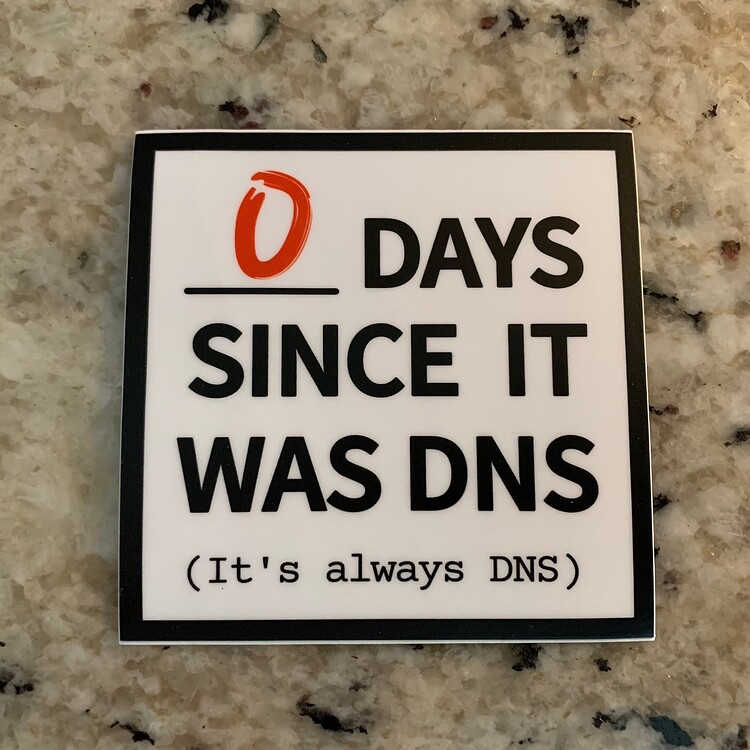
Interesting day. I've been on an incident bridge since 3AM. Our systems have mostly recovered now with a few back office stragglers fighting for compute.
The biggest miss on our side is that, although we designed a multi-region capable application, we could not run the failover process because our security org migrated us to Identity Center and only put it in us-east-1, hard locking the entire company out of the AWS control plane. By the time we'd gotten the root credentials out of the vault, things were coming back up.
Good reminder that you are only as strong as your weakest link.
This is having a direct impact on my wellbeing. I was at Whole Foods in Hudson Yards NYC and I couldn’t get the prime discount on my chocolate bar because the system isn’t working. Decided not to get the chocolate bar. Now my chocolate levels are way too low.
Have a meeting today with our AWS account team about how we’re no longer going to be “All in on AWS” as we diversify workloads away. Was mostly about the pace of innovation on core services slowing and AWS being too far behind on AI services so we’re buying those from elsewhere.
The AWS team keeps touting the rock solid reliability of AWS as a reason why we shouldn’t diversify our cloud. Should be a fun meeting!
Seems like major issues are still ongoing. If anything it seems worse than it did ~4 hours ago. For reference I'm a data engineer and it's Redshift and Airflow (AWS managed) that is FUBAR for me.
Choosing us-east-1 as your primary region is good, because when you're down, everybody's down, too. You don't get this luxury with other US regions!
“Based on our investigation, the issue appears to be related to DNS resolution of the DynamoDB API endpoint in US-EAST-1. We are working on multiple parallel paths to accelerate recovery.”
It’s always DNS.
Cool, building in resilience seems to have worked. Our static site has origins in multiple regions via CloudFront and didn’t seem to be impacted (not sure if it would have been anyway).
My control plane is native multi-region, so while it depends on many impacted services it stayed available. Each region runs in isolation. There is data replication at play but failing to replicate to us-east-1 had no impact on other regions.
The service itself is also native multi-region and has multiple layers where failover happens (DNS, routing, destination selection).
Nothing’s perfect and there are many ways this setup could fail. It’s just cool that it worked this time - great to see.
Nothing I’ve done is rocket science or expensive, but it does require doing things differently. Happy to answer questions about it.
One main problem that we observed was that big parts of their IAM / auth setup was overloaded / down which led to all kinds of cascading problems. It sounds as if Dynamo was reported to be a root cause, so is IAM dependent on dynamo internally?
Of course, such a large control plane system has all kinds of complex dependency chains. Auth/IAM seems like such a potentially (global) SPOF that you'd like to reduce dependencies to an absolute minimum. On the other hand, it's also the place that needs really good scalability, consistency, etc. so you probably like to use the battle proof DB infrastructure you already have in place. Does that mean you will end up with a complex cyclic dependency that needs complex bootstrapping when it goes down? Or how is that handled?
Can't resolve any records for dynamodb.us-east-1.amazonaws.com
However, if you desperately need to access it you can force resolve it to 3.218.182.212. Seems to work for me. DNS through HN
curl -v --resolve "dynamodb.us-east-1.amazonaws.com:443:3.218.182.212" https://dynamodb.us-east-1.amazonaws.com/
Their status page (https://health.aws.amazon.com/health/status) says the only disrupted service is DynamoDB, but it's impacting 37 other services. It is amazing to see how big a blast radius a single service can have.
Signal is down from several vantage points and accounts in Europe, I'd guess because of this dependence on Amazon overseas
We're having fun figuring out how to communicate amongst colleagues now! It's when it's gone when you realise your dependence
At 3:03 AM PT AWS posted that things are recovering and sounded like issue was resolved.
Then things got worse. At 9:13 AM PT it sounds like they’re back to troubleshooting.
Honestly sounds like AWS doesn’t even really know what’s going on. Not good.
Even internal Amazon tooling is impacted greatly - including the internal ticketing platform which is making collaboration impossible during the outage. Amazon is incapable of building multi-region services internally. The Amazon retail site seems available, but I’m curious if it’s even using native AWS or is still on the old internal compute platform. Makes me wonder how much juice this company has left.
As this incident unfolds, what’s the best way to estimate how many additional hours it’s likely to last? My intuition is that the expected remaining duration increases the longer the outage persists, but that would ultimately depend on the historical distribution of similar incidents. Is that kind of data available anywhere?
I realize that my basement servers have better uptime than AWS this year!
I think most sysadmin don't plan for AWS outage. And economically it makes sense.
But it makes me wonder, is sysadmin a lost art?
It's fun watching their list of "Affected Services" grow literally in front of your eyes as they figure out how many things have this dependency.
It's still missing the one that earned me a phone call from a client.
As Amazon moves from day-1 company as it claimed once, to be the sales company like Oracle focusing on raking money, expect more outages to come, and longer to be resolved.
Amazon is burning and driving away the technical talent and knowledge knowing the vendor lock-in will keep bringing the sweet money. You will see more sales people hoovering around your c-suites and executives, while you will face even worse technical support, that seem not knowing what they are talking about, yet alone to fix the support issue you expect to be fixed easily.
Mark my words, and if you are putting your eggs in one basket, that basket is now too complex and too interdependent, and the people who built and knew those intricacies are driven away with RTOs, move to hubs. Eventually those services; all others (and also aws services themselves) heavily dependent on, might be more fragile than the public knows.
To everyone that got paged (like me), grab a coffee and ride it out, the week can only get better!
Seems to have taken down my router "smart wifi" login page, and there's no backup router-only login option! Brilliant work, linksys....
This is just a silly anecdote, but every time a cloud provider blips, I'm reminded. The worst architecture I've ever encountered was a system that was distributed across AWS, Azure, and GCP. Whenever any one of them had a problem, the system went down. It also cost 3x more than it should.
I find it interesting that AWS services appear to be so tightly integrated that when there's an issue in a region, it affects most or all services. Kind of defeats the purported resiliency of cloud services.
We just had a power outage in Ashburn starting at 10 pm Sunday night. It restored at 3:40am ish, and I know datacenters have redundant power sources but the timing is very suspicious. The AWS outage supposedly started at midnight
Looks like they’re nearly done fixing it.
> Oct 20 3:35 AM PDT
> The underlying DNS issue has been fully mitigated, and most AWS Service operations are succeeding normally now. Some requests may be throttled while we work toward full resolution. Additionally, some services are continuing to work through a backlog of events such as Cloudtrail and Lambda. While most operations are recovered, requests to launch new EC2 instances (or services that launch EC2 instances such as ECS) in the US-EAST-1 Region are still experiencing increased error rates. We continue to work toward full resolution. If you are still experiencing an issue resolving the DynamoDB service endpoints in US-EAST-1, we recommend flushing your DNS caches. We will provide an update by 4:15 AM, or sooner if we have additional information to share.
I know there's a lot of anecdotal evidence and some fairly clear explanations for why `us-east-1` can be less reliable. But are there any empirical studies that demonstrate this? Like if I wanted to back up this assumption/claim with data, is there a good link for that, showing that us-east-1 is down a lot more often?
Careful: NPM _says_ they're up (https://status.npmjs.org/) but I am seeing a lot of packages not updating and npm install taking forever or never finishing. So hold off deploying now if you're dependent on that.
I wonder what kind of outage or incident or economic change will be required to cause a rejection of the big commercial clouds as the default deployment model.
The costs, performance overhead, and complexity of a modern AWS deployment are insane and so out of line with what most companies should be taking on. But hype + microservices + sunk cost, and here we are.
Llama-5-beelzebub has escaped containment. A special task force has been deployed to the Virginia data center to pacify it.
US-East-1 is more than just a normal region. It also provides the backbone for other services, including those in other regions. Thus simply being in another region doesn’t protect you from the consistent us-east-1 shenanigans.
AWS doesn’t talk about that much publicly, but if you press them they will admit in private that there are some pretty nasty single points of failure in the design of AWS that can materialize if us-east-1 has an issue. Most people would say that means AWS isn’t truly multi-region in some areas.
Not entirely clear yet if those single points of failure were at play here, but risk mitigation isn’t as simple as just “don’t use us-east-1” or “deploy in multiple regions with load balancing failover.”
The length and breadth of this outage has caused me to lose so much faith in AWS. I knew from colleagues who used to work there how understaffed and inefficient the team is due to bad management, but this just really concerns me.
aws had an outage. Many companies were impacted. Headlines around the world blame AWS. the real news is how easy it is to identify companies that have put cost management ahead of service resiliency.
Lots of orgs operating wholly in AWS and sometimes only within us-east-1 had no operational problems last night. Some that is design (not using the impacted services). Some of that is good resiliency in design. And some of that was dumb luck (accidentally good design).
Overall, those companies that had operational problems likely wouldn't have invested in resiliancy expenses in any other deployment strategy either. It could have happened to them in Azure, GCP or even a home rolled datacenter.
It just goes to show the difference between best practices in cloud computing, and what everyone ends up doing in reality, including well known industry names.
My minor 2000 users web app hosted on Hetzner works fyi. :-P
Even though us-east-1 is the region geographically closest to me, I always choose another region as default due to us-east-1 (seemingly) being more prone to these outages.
Obviously, some services are only available in us-east-1, but many applications can gain some resiliency just by making a primary home in any other region.
We created a single point of failure on the Internet, so that companies could avoid single points of failure in their data centers.
Every week or so we interview a company and ask them if they have a fall-back plan in case AWS goes down or their cloud account disappears. They always have this deer-in-the-headlights look. 'That can't happen, right?'
Now imagine for a bit that it will never come back up. See where that leads you. The internet got its main strengths from the fact that it was completely decentralized. We've been systematically eroding that strength.
Er...They appear to have just gone down again.
Someone, somewhere, had to report that doorbells went down because the very big cloud did not stay up.
I think we're doing the 21st century wrong.
I'm so happy we chose Hetzner instead but unfortunately we also use Supabase (dashboard affected) and Resend (dashboard and email sending affected).
Probably makes sense to add "relies on AWS" to the criteria we're using to evaluate 3rd-party services.
Oh no... may be LaLiga found out pirates hosting on AWS?
Our Alexa's stopped responding and my girl couldn't log in to myfitness pal anymore.. Let me check HN for a major outage and here we are :^)
At least when us-east is down, everything is down.
Internet, out.
Very big day for an engineering team indeed. Can't vibe code your way out of this issue...
AWS truly does stand for "All Web Sites".
We got off pretty easy (so far). Had some networking issues at 3am-ish EDT, but nothing that we couldn't retry. Having a pretty heavily asynchronous workflow really benefits here.
One strange one was metrics capturing for Elasticache was dead for us (I assume Cloudwatch is the actual service responsible for this), so we were getting no data alerts in Datadog. Took a sec to hunt that down and realize everything was fine, we just don't have the metrics there.
I had minor protests against us-east-1 about 2.5 years ago, but it's a bit much to deal with now... Guess I should protest a bit louder next time.
funny that even if we have our app running fine in AWS europe, we are affected as developers because of npm/docker/etc being down. oh well.
A lot of status pages hosted by Atlasian StatusPage are down! The irony…
Man , I just wanted to enjoy celebrating Diwali with my family but been up from 3am trying to recover our services. There goes some quality time
It seems that all the sites that ask for distributed systems in their interview and has their website down wouldn't even pass their own interview.
This is why distributed systems is an extremely important discipline.
I like that we can advertise to our customers that over the last X years we have better uptime than Amazon, google, etc.
One thing has become quite clear to me over the years. Much of the thinking around uptime of information systems has become hyperbolic and self-serving.
There are very few businesses that genuinely cannot handle an outage like this. The only examples I've personally experienced are payment processing and semiconductor manufacturing. A severe IT outage in either of these businesses is an actual crisis. Contrast with the South Korean government who seems largely unaffected by the recent loss of an entire building full of machines with no backups.
I've worked in a retail store that had a total electricity outage and saw virtually no reduction in sales numbers for the day. I have seen a bank operate with a broken core system for weeks. I have never heard of someone actually cancelling a subscription over a transient outage in YouTube, Spotify, Netflix, Steam, etc.
The takeaway I always have from these events is that you should engineer your business to be resilient to the real tradeoff that AWS offers. If you don't overreact to the occasional outage and have reasonable measures to work around for a day or 2, it's almost certainly easier and cheaper than building a multi cloud complexity hellscape or dragging it all back on prem.
Thinking in terms of competition and game theory, you'll probably win even if your competitor has a perfect failover strategy. The cost of maintaining a flawless eject button for an entire cloud is like an anvil around your neck. Every IT decision has to be filtered through this axis. When you can just slap another EC2 on the pile, you can run laps around your peers.
I think AWS should use, and provide as an offering to big customers, a Chaos Monkey tool that randomly brings down specific services in specific AZs. Example: DynamoDB is down in us-east-1b. IAM is down in us-west-2a.
Other AWS services should be able to survive this kind of interruption by rerouting requests to other AZs. Big company clients might also want to test against these kinds of scenarios.
Friends don’t let friends use us-east-1
It looks like DNS has been restored: dynamodb.us-east-1.amazonaws.com. 5 IN A 3.218.182.189
Is there any data on which AWS regions are most reliable? I feel like every time I hear about an AWS outage it's in us-east-1.
US-East-1 and its consistent problems are literally the Achilles Heel of the Internet.
Signal is also down for me.
This is from Amazon's latest earnings call when Andy Jessy was asked why they aren't growing as much as there competitors
"I think if you look at what matters to customers, what they care they care a lot about what the operational performance is, you know, what the availability is, what the durability is, what the latency and throughput is of of the various services. And I think we have a pretty significant advantage in that area."
also
"And, yeah, you could just you just look at what's happened the last couple months. You can just see kind of adventures at some of these players almost every month. And so very big difference, I think, in security."
Stupid question, why isn't the stock down? Couldn't this lead to people jumping to other providers and at the very least require some pretty big fees for do dramatically breaking SLA? Is it just not a biggest fraction of revenue to matter?
> The incident underscores the risks associated with the heavy reliance on a few major cloud service providers.
Perhaps for the internet as a whole, but for each individual service it underscores the risk of not hosting your service in multiple zones or having a backup
Slack (canvas and huddles), Circle CI and Bitbucket are also reporting issues due to this.
It’s that period of the year when we discover AWS clients that don’t have fallback plans
Amazon has spent most of its HR post-pandemic efforts in:
• Laying off top US engineering earners.
• Aggressively mandating RTO so the senior technical personnel would be pushed to leave.
• Other political ways ("Focus", "Below Expectations") to push engineering leadership (principal engineers, etc) to leave, without it counting as a layoff of course.
• Terminating highly skilled engineering contractors everywhere else.
• Migrating serious, complex workloads to entry-level employees in cheap office locations (India, Spain, etc).
This push was slow but mostly completed by Q1 this year. Correlation doesn't imply causation? I find that hard to believe in this case. AWS had outages before, but none like this "apparently nobody knows what to do" one.
Source: I was there.
Our entire data stack (Databricks and Omni) are all down for us also. The nice thing is that AWS is so big and widespread that our customers are much more understanding about outages, given that its showing up on the news.
When did Snapchat move out of GCP?
When I follow the link, I arrive on a "You broke reddit" page :-o
Various AI services (e.g. Perplexity) are down as well
Apparently hiring 1000s of software engineers every month was load bearing
docker hub or github cache internal maybe is affected:
Booting builder
/usr/bin/docker buildx inspect --bootstrap --builder builder-1c223ad9-e21b-41c7-a28e-69eea59c8dac
#1 [internal] booting buildkit
#1 pulling image moby/buildkit:buildx-stable-1
#1 pulling image moby/buildkit:buildx-stable-1 9.6s done
#1 ERROR: received unexpected HTTP status: 500 Internal Server Error
------
> [internal] booting buildkit:
------
ERROR: received unexpected HTTP status: 500 Internal Server Error
The internet was once designed to survive a nuclear war. Nowadays it cannot even survive until tuesday.
AWS has been the backbone of the internet. It is single point of failure most websites.
Other hosting services like Vercel, package managers like npm, even the docker registeries are down because of it.
>Oct 20 12:51 AM PDT We can confirm increased error rates and latencies for multiple AWS Services in the US-EAST-1 Region. This issue may also be affecting Case Creation through the AWS Support Center or the Support API. We are actively engaged and working to both mitigate the issue and understand root cause. We will provide an update in 45 minutes, or sooner if we have additional information to share.
Weird that case creation uses the same region as the case you'd like to create for.
We are on Azure. But our CI/CD pipelines are failing, because Docker is on AWS.
It shouldn’t, but it does. As a civilization, we’ve eliminated resilience wherever we could, because it’s more cost-effective. Resilience is expensive. So everything is resting on a giant pile of single point of failures.
Maybe this is the event to get everyone off of piling everything onto us-east-1 and hoping for the best, but the last few outages didn’t, so I don’t expect this one to, either.
I don't think blaming AWS is fair, since they typically exceed their regional and AZ SLAs
AWS makes their SLAs & uptime rates very clear, along with explicit warnings about building failover / business continuity.
Most of the questions on the AWS CSA exam are related to resiliency .
Look, we've all gone the lazy route and done this before. As usual, the problem exists between the keyboard and the chair.
Paying for resilience is expensive. not as expensive as AWS, but it's not free.
Modern companies live life on the edge. Just in time, no resilience, no flexibility. We see the disaster this causes whenever something unexpected happens - the Evergiven blocking Suez for example, let alone something like Covid
However increasingly what should be minor loss of resilience, like an AWS outage or a Crowdstrike incident, turns into major failures.
This fragility is something government needs to legislate to prevent. When one supermarket is out that's fine - people can go elsewhere, the damage is contained. When all fail, that's a major problem.
On top of that, the attitude that the entire sector has is also bad. People thing IT should tail once or twice a year and it's not a problem. If that attitude affect truly important systems it will lead to major civil projects. Any civilitsation is 3 good meals away from anarchy.
There's no profit motive to avoid this, companies don't care about being offline for the day, as long as all their mates are also offline.
Whose idea was it to make the whole world dependent on us-east-1?
Wasn't the point why AWS is so much premium that you will always get at least 6 nines if not more in availability?
With more and more parts of our lives depending on often only one cloud infrastructure provider as a single point of failure, enabling companies to have built-in redundancy in their systems across the world could be a great business.
Humans have built-in redundancy for a reason.
US-East-1 is literally the Achilles Heel of the Internet.
> due to an "operational issue" related to DNS
Always DNS..
Do events like this stir conversations in small to medium size businesses to escape the cloud?
The internal disruption reviews are going to be fun :)
Seems to be really only in us-east-1, DynamoDB is performing fine in production on eu-central-1.
Affecting Coinbase[1] as well, which is ridiculous. Can't access the web UI at all. At their scale and importance they should be multi-region if not multi-cloud.
[1] https://status.coinbase.com
Of course this happens when I take a day off from work lol
Came here after the Internet felt oddly "ill" and even got issues using Medium, and sure enough https://status.medium.com
it is very funny to me that us-east-1 going down nukes the internet. all those multiple region reliability best practices are for show
Anthem Health call center disconnected my wife numerous times yesterday with an ominous robo-message of "Emergency in our call center"; curious if that was this. Seems likely, but what a weird message.
Sounds like a circular error with monitoring is flooding their network with metrics and logs, causing DNS to fail and produce more errors, flooding the network. Likely root cause is something like DNS conflicts or hosts being recreated on the network. Generally this is a small amount of network traffic but the LBs are dealing with host address flux, causing the hosts to keep colliding host addresses as they attempt to resolve to a new host address which are being lost from dropped packets and with so many hosts in one AZ, there's a good chance they end up with a new conflicting address.
> Amazon Alexa: routines like pre-set alarms were not functioning.
It's ridiculous how everything is being stored in the cloud, even simple timers. It's past high time to move functionality back on-device, which would come with the advantage of making it easier to de-connect from big tech's capitalist surveillance state as well.
Looks like a DNS issue - dynamodb.us-east-1.amazonaws.com is failing to resolve.
Potentially-ignoramus comment here, apologies in advance, but amazon.com itself appears to be fine right now. Perhaps slower to load pages, by about half a second. Are they not eating (much of) their own dog food?
I'm getting rate limit issues on Reddit so it could be related.
What are the design best practices and industry standards for building on-premise fallback capabilities for critical infrastructure? Say for health care/banking ..etc
If we see more of this, it would not be crazy to assume that all this compelling of engineers to "use AI" and the flood of Looks Good To Me code is coming home.
There are plenty of ways to address this risk. But the companies impacted would have to be willing to invest in the extra operational cost and complexity. They aren’t.
Had a meeting where developers were discussing the infrastructure for an application. A crucial part of the whole flow was completely dependant on an AWS service. I asked if it was a single point of failure. The whole room laughed, I rest my case.
I can't log in to my AWS account, in Germany, on top of that it is not possible to order anything or change payment options from amazon.de.
No landing page explaining services are down, just scary error pages. I thought account was compromised. Thanks HN for, as always, being the first to clarify what's happening.
Scary to see that in order to order from Amazon Germany, us-east1 must be up. Everything else works flawlessly but payments are a no go.
From the great Corey Quinn
Ah yes, the great AWS us-east-1 outage.
Half the internet’s on fire, engineers haven’t slept in 18 hours, and every self-styled “resilience thought leader” is already posting:
“This is why you need multi-cloud, powered by our patented observability synergy platform™.”
Shut up, Greg.
Your SaaS product doesn’t fix DNS, you're simply adding another dashboard to watch the world burn in higher definition.
If your first reaction to a widespread outage is “time to drive engagement,” you're working in tragedy tourism. Bet your kids are super proud.
Meanwhile, the real heroes are the SREs duct-taping Route 53 with pure caffeine and spite.
https://www.linkedin.com/posts/coquinn_aws-useast1-cloudcomp...
I forget where I read it originally, but I strongly feel that AWS should offer a `us-chaos-1` region, where every 3-4 days, one or two services blow up. Host your staging stack there and you build real resiliency over time.
(The counter joke is, of course, "but that's `us-east-1` already! But I mean deliberately and frequently.)
This website just seems to be an auto-generated list of "things" with a catchy title:
> 5000 Reddit users reported a certain number of problems shortly after a specific time.
> 400000 A certain number of reports were made in the UK alone in two hours.
This is why we use us-east-2.
Nowadays when this happens it's always something. "Something went wrong."
Even the error message itself is wrong whenever that one appears.
We're seeing issues with RDS proxy. Wouldn't be surprised if a DNS issue was the cause, but who knows, will wait for the postmortem.
Wow, about 9 hours later and 21 of 24 Atlassian services are still showing up as impacted on their status page.
Even @ 9:30am ET this morning, after this supposedly was clearing up, my doctor's office's practice management software was still hosed. Quite the long tail here.
https://status.atlassian.com/
We never went down in us-east-1 during this incident. We have tons of high-traffic sites/services. Not multi-region, not multi-cloud.
You're gonna hear mostly complaints in this thread, but simple, resilient, single-region architecture is still reliable as hell in AWS, even in the worst region.
Appears to have also disabled that bot on HN that would be frantically posting [dupe] in all the other AWS outage threads right about now.
Considering the history of east-1 it is fascinating that it still causes so many single point of failure incidents for large enterprises.
Just a couple of days ago in this HN thread [0] there were quite some users claiming Hetzner is not an options as their uptime isn't as good as AWS, hence the higher AWS pricing is worth the investment. Oh, the irony.
[0]: https://news.ycombinator.com/item?id=45614922
Amazon itself apperas to be out for some products. I get a "Sorry, We couldn't find that page" when clicking on products
I'm not sure if this is directly related, but I've noticed my Apple Music app has stopped working (getting connection error messages). Didn't realize the data for Music was also hosted on AWS, unless this is entirely unrelated? I've restarted my phone and rebooted the app to no avail, so I'm assuming this is the culprit.
Can't login to Jira/Confluence either.
Curious to know how much does an outage like this cost to others.
Lost data, revenue, etc.
I'm not talking about AWS but whoever's downstream.
Is it like 100M, like 1B?
Did they try asking Claude to fix these issues? If it turns out this problem is AI-related, I'd love to see the AAR.
It won't be over until long after AWS resolves it - the outages produce hours of inconsistent data. It especially sucks for financial services, things of eventual consistency and other non-transactional processes. Some of the inconsistencies introduced today will linger and make trouble for years.
Slack is down. Is that related? Probably is.
02:34 Pacific: Things seem to be recovering.
Couple of years ago us-east was considered the least stable region here on HN due to its age. Is that still a thing?
Yes, we're seeing issues with Dynamo, and potentially other AWS services.
Appears to have happened within the last 10-15 minutes.
This is usually something I see on Reddit first, within minutes. I’ve barely seen anything on my front page. While I understand it’s likely the subs I’m subscribed to, that was my only reason for using Reddit. I’ve noticed that for the past year - more and more tech heavy news events don’t bubble up as quickly anymore. I also didn’t see this post for a while for whatever reason. And Digg was hit and miss on availability for me, and I’m just now seeing it load with an item around this.
I think I might be ready to build out a replacement through vibe coding. I don’t like being dependent on user submissions though. I feel like that’s a challenge on its own.
I in-housed an EMR for a local clinic because of latency and other network issues taking the system offline several times a month (usually at least once a week). We had zero downtime the whole first year after bringing it all in house, and I got employee of the month for several months in a row.
I can not login to my AWS account. And, the "my account" on regular amazon website is blank on Firefox, but opens on Chrome.
Edit: I can login into one of the AWS accounts (I have a few different ones for different companies), but my personal which has a ".edu" email is not logging in.
Not remotely surprised. Any competent engineer knows full well the risk of deploying into us-east-1 (or any “default” region for that matter), as well as the risks of relying on global services whose management or interaction layer only exists in said zone. Unfortunately, us-east-1 is the location most outsourcing firms throw stuff, because they don’t have to support it when it goes pear-shaped (that’s the client’s problem, not theirs).
My refusal to hoard every asset into AWS (let alone put anything of import in us-east-1) has saved me repeatedly in the past. Diversity is the foundation of resiliency, after all.
LOL making one db service a central point of failure, charge gold for small compute instances. Rage about needing Multi AZ, make the costs come onto the developer/organization. But, now fail on a region level, so are we going to now have multi-country setup for simple small applications?
This is widespread. ECR, EC2, Secrets Manager, Dynamo, IAM are what I've personally seen down.
"Oct 20 2:01 AM PDT We have identified a potential root cause for error rates for the DynamoDB APIs in the US-EAST-1 Region. Based on our investigation, the issue appears to be related to DNS resolution of the DynamoDB API endpoint in US-EAST-1..."
It's always DNS...
The Ring (Doorbell) App isn't working, nor is any the MBTA (Transit) Status pages/apps.
Probably related:
https://www.nytimes.com/2025/05/25/business/amazon-ai-coders...
"Pushed to use artificial intelligence, software developers at the e-commerce giant say they must work faster and have less time to think."
Every bit of thinking time spent on a dysfunctional, lying "AI" agent could be spent on understanding the system. Even if you don't move your mouse all the time in order to please a dumb middle manager.
I can't do anything for school because Canvas by Instructure is down because of this.
My app deployed on Vercel and therefore indirectly deployed on us-east-1 was down for about 2 hours today then came back up and then went down again 10 minutes ago for 2 or 3 minutes. It seems like they are still intermittent issues happening.
Chime has completely been down for almost 12 hours.
Impacting all banking series with red status error. Oddly enough, only their direct deposits are functioning without issues.
https://status.chime.com/
Ironically, the HTTP request to this article timed out twice before a successful response.
One of the radio stations I listen to is just dead air tonight. I assume this is the cause.
Airtable is down as-well.
A lot of businesses have all their workflows depending on their data on airtable.
AWS's own management console sign-in isn't even working. This is a huge one. :(
So, uh, over the weekend I decided to use the fact that my company needs a status checker/page to try out Elixir + Phoenix LiveView, and just now I found out my region is down while tinkering with it and watching Final Destination. That’s a little too on the nose for my comfort.
Btw. we had a forced EKS restart last week on thursday due to Kubernetes updates. And something was done with DNS there. We had problems with ndots. Caused some trouble here. Would not be surprised, if it is related, heh.
I'm thinking about that one guy who clicked on "OK" or hit return.
May be because of this that trying to pay with PayPal on Lenovo's website has failed thrice for me today? Just asking... Knowing how everything is connected nowadays it wouldn't surprise me at all.
Slack was down, so I thought I will send message to my coworkers on Signal.
Signal was also down.
we[1] operate out of `us-east-1` but chose to not use any of the cloud based vendor lockin (sorry vercel, supabase, firebase, planetscale etc). Rather a few droplets in DigitalOcean(us-east-1) and Hetzner(eu). We serve 100 million requests/mo, few million user generated content(images)/mo at monthly cost of just about $1000/mo.
It's not difficult, it's just that we engineers chose convenience and delegated uptime to someone else.
[1] - https://usetrmnl.com
Maybe unrelated, but yesterday I went to pick up my package from an Amazon Locker in Germany, and the display said "Service unavailable". I'll wait until later today before I go and try again.
Are there websites that do post-mortems for how the single points of failure impacted the entire internet?
Not just AWS, but Cloudflare and others too. Would be interesting to review them clinically.
My site was down for a long time after they claimed it was fixed. Eventually I realized the problem lay with Network Load Balancers so I bypassed them for now and got everything back up and running.
Happened to be updating a bunch of NPM dependencies and then saw `npm i` freeze and I'm like... ugh what did I do. Then npm login wasn't working and started searching here for an outage, and wala.
Great. Hope they’re down for a few more days and we can get some time off.
Can't even get STS tokens. RDS Proxy is down, SQS, Managed Kafka.
Atlassian cloud is also having issues. Closing in on the 3 hour mark.
glad all my services are either Hetzner servers or EU region of AWS!
It's weird that we're living in a time where this could be a taste of a prolonged future global internet blackout by adversarial nations. Get used to this feeling I guess :)
Does anyone know if having Global Accelerator set up would help right now? It's in the list of affected services, I wonder if it's useful in scenarios like this one.
Hey wait wasn't the internet supposed to route around...?
My ISP's DNS servers were inaccessible this morning. Cloudflare and Google's DNS servers have all been working fine, though: 1.1.1.1, 1.0.0.1, and 8.8.8.8
Can confirm. I was trying to send the newsletter (with SES) and it didn't work. I was thinking my local boto3 was old, but I figured I should check HN just in case.
I seem to recall other issues around this time in previous years. I wonder if this is some change getting shoe-horned in ahead of some reinvent release deadline...
I was just about to post that it didn't affect us (heavy AWS users, in eu-west-1). Buut, I stopped myself because that was just massively tempting fate :)
Half the internet goes down because part of AWS goes down... what happened to companies having redundant systems and not having a single point of failure?
stupid question: is buying a server rack and running it at home subject to more downtimes in a year than this? has anyone done an actual SLA analysis?
Reddit seems to be having issues too:
"upstream connect error or disconnect/reset before headers. retried and the latest reset reason: connection timeout"
Slack, Jira and Zoom are all sluggish for me in the UK
I just saw services that were up since 545AM ET go down around 12:30PM ET.
Seems AWS has broken Lambda again in their efforts to fix things.
I didn't even notice anything was wrong today. :) Looks like we're well disconnected from the US internet infra quasi-hegemony.
Why after all these years is us-east-1 such a SPOF?
Statuspage.io seems to load (but is slow) but what is the point if you can't post an incident because Atlassian ID service is down.
During the last us-east-1 apocalypse 14 years ago, I started awsdowntime.com - don't make me regsiter it again and revive the page.
Why would us-east-1 cause many UK banks and even UK gov web sites down too!?
Shouldn't they operate in the UK region due to GDPR?
It's scary to think about how much power and perhaps influence the AWS platform has. (albeit it shouldn't be surprising)
I cannot create a support ticket with AWS as well.
My Alexa is hit or miss at responding to queries right now at 5:30 AM EST. Was wondering why it wasn't answering when I woke up.
In this moments I think devs should invest in vendor independence if they can. While I'm not to that stage yet (cloudlfare dependence) using open technologies like docker (or Kubernetes), Traefik instead of managed services can help in this disaster situations by switching to a different provider in a faster way than having to rebuild from zero.
as a disclosure I'm not still to that point on my infrastructure But I'm trying to slowly define one for my self
Strangely some of our services are scaling up on east-1, and there is downtick on downdetector.com so issue might be resolving.
Asana down
Postman workspaces don't load
Slack affected
And the worst: heroku scheduler just refused to trigger our jobs
This will always be a risk when sharecropping.
r/aws not found
There aren't any communities on Reddit with that name. Double-check the community name or start a new community.
Slack and Zoom working intermittently for me
Impossible to connect to JIRA here (France).
Only us east 1 gets new services immediately others might do but not a guarantee. Which regions are a good alternative
Darn, on Heroku even the "maintenance mode" (redirects all routes to a static url) won't kick in.
My website on the cupboard laptop is fine.
Seems to be upsetting Slack a fair bit, messages taking an age to send and OIDC login doesn't want to play.
Can't update my selfhosted HomeAssistant because HAOS depends on dockerhub which seems to be still down.
I wonder how their nines are going. Guess they'll have to stay pretty stable for the next 100 years.
npm and pnpm are badly affected as well. Many packages are returning 502 when fetched. Such a bad time...
AWS pros know to never use us-east-1. Just don't do it. It is easily the least reliable region
"We should have a fail back to US-West."
"It's been on the dev teams list for a while"
"Welp....."
That strange feeling of the world getting cleaner for a while without all these dependant services.
They are amazing at LeetCode though.
Twilio seems to be affected as well
For me Reddit is down and also the amazon home page isn't showing any items for me.
Did someone vibe code a DNS change
Completely detached from reality, AMZN has been up all day and closed up 1.6%. Wild.
His influence is so great that it caused half of the internet to stop working properly.
Am i imagining it or are more things like this happening in recent weeks than usual?
I don't get how you can be a trillion dollar company and still suck this much.
Wait a second, Snapchat impacted AGAIN? It was impacted during the last GCP outage.
They haven't listed SES there yet in the affected services on their status page
Lots of outage happening in Norway, too. So I'm guessing it is a global thing.
Apparently IMDb, an Amazon service is impacted. LOL, no multi region failover.
Reddit itself breaking down and errors appear.
Does reddit itself depends on this?
Amazon.ca is degraded, some product pages load but can't see prices. Amusing.
Always a lovely Monday when you wake just in time to see everything going down
Thanks god we built all our infra on top of EKS, so everything works smoothly =)
As of 4:26am Central Time in the USA, it's back up for one of my services.
10:30 on a Monday morning and already slacking off. Life is good. Time to touch grass, everybody!
Honestly anyone do have outages, that's nothing extraordinary, what's wrong is the number of impacted services. We choose (at least almost choose) to ditch mainframes for clusters also for resilience. Now with cheap desktop iron labeled "stable enough to be a serious server" we have seen mainframes re-created sometimes with a cluster of VM on top of a single server, sometimes with cloud services.
Ladies and Gentleman's it's about time to learn reshoring in the IT world as well. Owning nothing, renting all means extreme fragility.
workos is down too, timing is highly correlated with AWS outage: https://status.workos.com/
That means Cursor is down, can't login.
These things happen when profits are the measure everything. Change your provider, but if their number doesn't go up, they wont be reliable.
So your complaints matter nothing because "number go up".
I remember the good old days of everyone starting a hosting company. We never should have left.
Alexa devices are also down.
Ironically enough I can't access Reddit due to no healthy upstream.
I missed a parcel delivery because a computer server in Virginia, USA went down, and now the doorbell on my house in England doesn't work. What. The. Fork.
How the hell did Ring/Amazon not include a radio-frequency transmitter for the doorbell and chime? This is absurd.
To top it off, I'm trying to do my quarterly VAT return, and Xero is still completely borked, nearly 20 hours after the initial outage.
Another time to link The Machine Stops by E.M. Forster, 1909: https://web.cs.ucdavis.edu/~rogaway/classes/188/materials/th...
> “The Machine,” they exclaimed, “feeds us and clothes us and houses us; through it we speak to one another, through it we see one another, in it we have our being. The Machine is the friend of ideas and the enemy of superstition: the Machine is omnipotent, eternal; blessed is the Machine.”
..
> "she spoke with some petulance to the Committee of the Mending Apparatus. They replied, as before, that the defect would be set right shortly. “Shortly! At once!” she retorted"
..
> "there came a day when, without the slightest warning, without any previous hint of feebleness, the entire communication-system broke down, all over the world, and the world, as they understood it, ended."
idiocracy_window_view.jpg
Damn. This is why Duolingo isn't working properly right now.
Lots of outage in Norway, started approximately 1 hour ago for me.
Now, I may well be naive - but isn't the point of these systems that you fail over gracefully to another data centre and no-one notices?
On a bright note, Alexa has stopped pushing me merchandise.
Meanwhile my pair of 12 year old raspberry pi's hangling my home services like DNS survive their 3rd AWS us-east-1 outage.
"But you can't do webscale uptime on your own"
Sure. I suspect even a single pi with auto-updates on has less downtime.
Serverless is down because servers are down. What an irony.
More and more I want to be could agnostic or multi-cloud.
It’s a good day to be a DR software company or consultant
I expect gcp and azure to gain some customers after this
I still don't know why anyone would use AWS hosting.