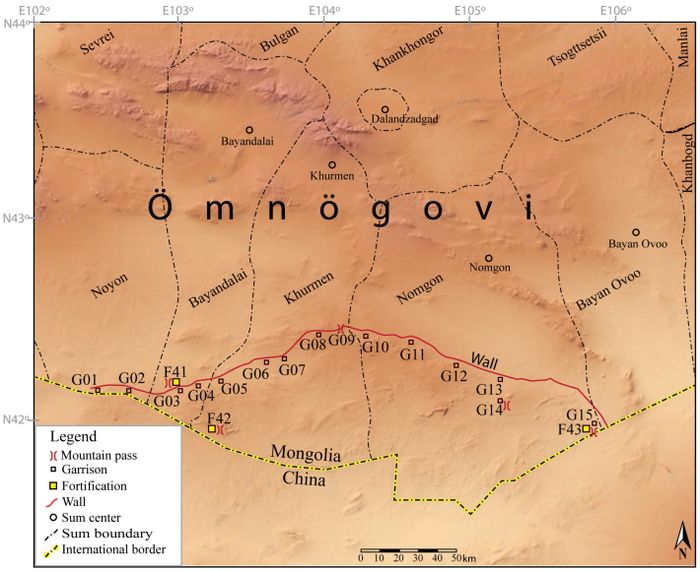
Perhaps, but I'll note that the pictures in the article show the region as being easily that extreme, and the words say this
It's not. The Gobi is filled with marginal seasonal grazing lands, though certain areas are more valuable than others. It's undergone additional desertification in recent centuries as well.
That's different in no way from what I stated above. If you want to tax people crossing the desert, you station the tax collectors at the oases all travelers must visit.
People in the Gobi, particularly the northern Gobi, don't always (or even usually) travel by way of journeys between oases. That style of travel is more characteristic of silk roads and the deserts to the southwest like the Taklamakan.
If you want to tax nomads showing up to buy tools, you station the tax collectors in the markets they must visit.
This wall doesn't run through market areas. The markets involved would have been farther south in the tangut heartland, southwest in the hexi corridor, or north in Mongolia proper. "Markets" is also a bit of a misleading term here because the Mongolian side of this trade would have been a diffuse network of nomadic groups rather than people inhabiting fixed cities on a landscape.
I'm not emphasizing this for pedantic reasons. This wall is generally thought to have been intended as a very literal manifestation of the boundaries of the state and this whole area is what we call a borderlands. Western xia itself is a bit of a borderland in its entirety, and probably found it pretty useful to lay out a very physical manifestation of their power everyone could see. That's not the only reason something like this would have been built, but it's a relevant one.
Medieval states were constantly negotiating the boundaries of power before everyone accepted the modern notion of statehood. Physical walls were a particularly popular way to make that point in what's now China.
And in both cases, there's not an alternative. You can't direct the people to go visit the tax collector; they won't follow your instructions. What would be in it for them?
The parts you're responding to were speaking more specifically about the mongol period, which I know more about. This particular borderland is a somewhat different place a couple centuries earlier.
But anyway, the mistake here is thinking in a modern transactional framework. That's not how (mongol-era) Mongolia worked. Hierarchy was based on personal loyalty networks. A vassal provided loyalty, which could include taxes. Disloyalty was swiftly punished if the lord could, or the loyalty arrangement was renegotiated to something more agreeable. If it sounds like a fragile way to run a continent-spanning empire, you've identified one of the issues the Mongols faced
Similar things existed outside Mongolia as well, but Wikipedia's going to be as good or better than what I know on the subject.