Bury me on the moon, preferably on the far side

22 pointsposted a year ago
by mr_tyzik

139 Comments

ck2

a year ago

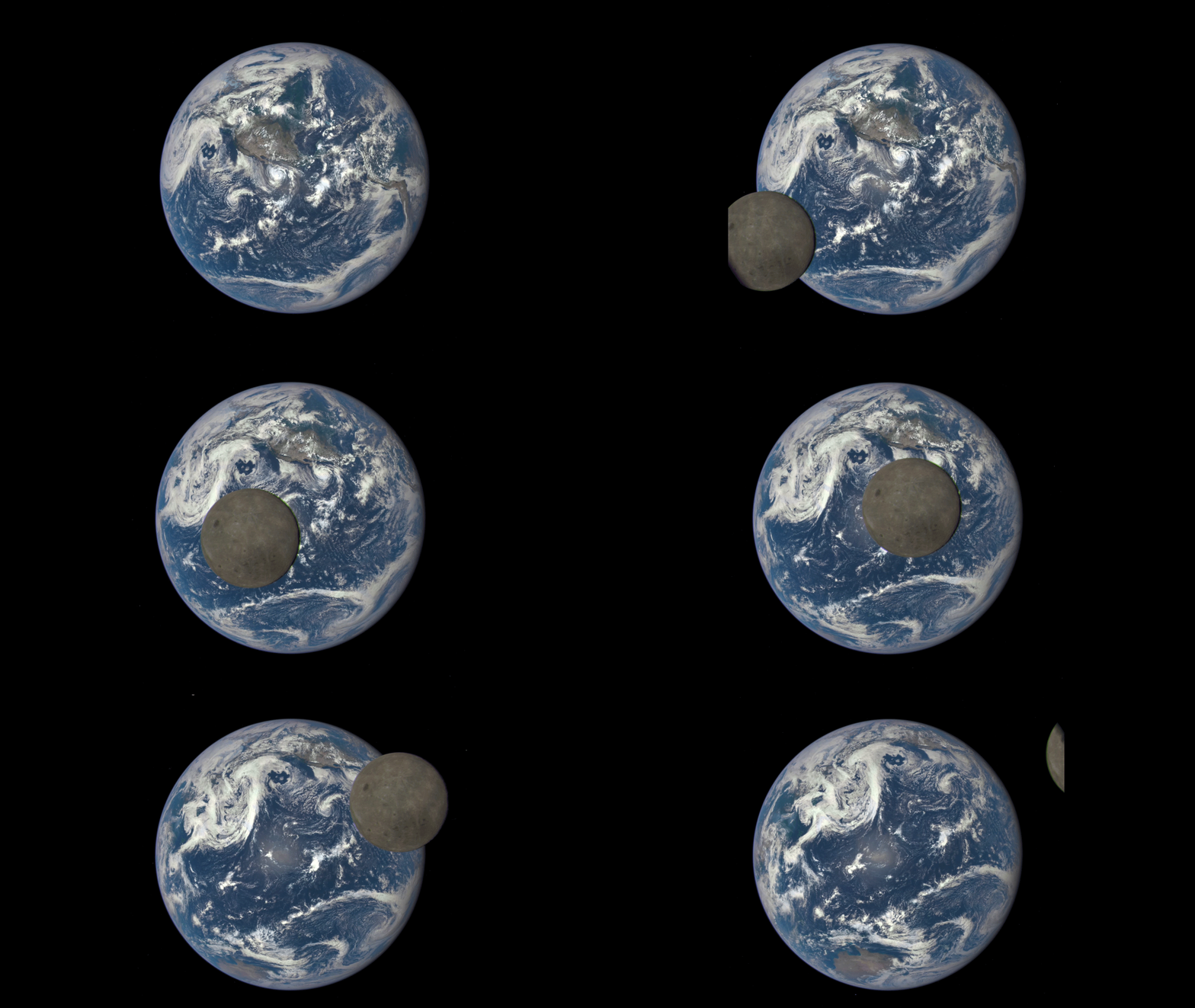
Vaguely related have you seen this amazing photo of the far side of the moon captured in 2015 by NASA Deep Space Climate Observatory satellite as it passed in front of Earth?

* https://assets.science.nasa.gov/dynamicimage/assets/science/...

* https://assets.science.nasa.gov/content/dam/science/psd/sola...

* https://www.nasa.gov/solar-system/from-a-million-miles-away-...

* https://science.nasa.gov/resource/from-a-million-miles-away-...

thrance

a year ago

How much carbon dioxide is released into the atmosphere for a single rocket launch? How much labor and natural resources does it cost?

I think it's extremely selfish to expect others to expend so much energy and time to carry your remains so far away, when you wouldn't know the difference.

I also think seeing night lights from a city on the moon would be pretty cool.

bryanlarsen

a year ago

> How much carbon dioxide is released into the atmosphere for a single rocket launch?

Approximately equivalent to a trans-pacific jet flight.

ANewFormation

a year ago

The interesting thing about this is that rockets can easily be net negative in terms of CO2 stuff.

One way is in the fuel itself. For instance the Space Shuttle main engine was powered by combustion generated from liquid hydrogen + liquid oxygen - the exhaust was literally water vapor.

A second interesting nuance is that any fuel burnt outside of Earth's atmosphere is a carbon reduction, so a hypothetical rocket that could get out of the atmosphere on 50% of its fuel would be net neutral/negative.

thrance

a year ago

How is that negative? The hydrogen still had to be extracted from purified water, the rocket still had to be designed, forged, moved, cooled, etc.

Also wouldn't the carbon dioxide burned outside of the atmosphere eventually comes back down? The nozzle is usually pointed towards the Earth, so unless the exhaust is on an escape trajectory it wouldn't be lost.

thrance

a year ago

Which is insane for carrying remains when a hearse would do the trick. If the sustainable carbon budget is around 2.5t per year per person, this is over 50 times that, for a dead guy.

delichon

a year ago

> I propose that we all agree to ban all permanent lunar development that is visible with the naked eye from Earth.

...with no proposal to weigh the value of the development against against the value of good taste or nebulously defined compassion. To suppose that no such development with greater value is possible betrays a poverty of imagination.

IMHO it is authoritarian to constrain the actions of others on the basis of taste and beauty. I don't dismiss their value, I just place it lower than the value of independent agency, as opposed to "you can't do that because I don't like how it looks." A better reason should be needed. That's true of putting a poster on the wall, let alone preemptively blocking huge communal projects.

generic92034

a year ago

> IMHO it is authoritarian to constrain the actions of others on the basis of taste and beauty.

Clearly, a lot of people feel differently in various settings. For example NIMBY groups, HOAs, landscape or monument protection laws. The list never stops, really.

zbrozek

a year ago

Yeah, and they ought to be told to stuff it. I don't know why they deserve all the pandering that they get.

Miraste

a year ago

How far would you take this? That rhetoric taken to its conclusion leads to travesties like destroying national parks to install oil wells and strip malls, a net negative for 99.999999% of humanity.

shortrounddev2

a year ago

It's not exactly about personal taste; it's about a kind of spiritual pollution. If we etched a big McDonalds advertisement on the moon, it wouldn't just be in poor taste, but it would irrevocably cheapen (destroy, even) something which has been constant throughout all of humanity's evolution. The moon is particularly important in a cultural sense because it's something shared by everybody. If we bulldozed Mount Fuji to put in some apartments, it would be a loss for humanity in general, but Japan in particular. Changing the moon could potentially redefine us as a species

Developing the near side of moon with cities would literally and figuratively change the way we look at the moon; it would be a cultural Rubicon which cannot be uncrossed, and so we need to be very careful with whatever solution we go with, because we can't go back

JumpCrisscross

a year ago

> If we etched a big McDonalds advertisement on the moon, it wouldn't just be in poor taste

We’re debating a problem outside the capability of human civilisation for the lifespans of everyone alive today.

s1artibartfast

a year ago

I generally agree, but dont think there is anything wrong with being authoritarian over ones own property.

I wouldnt accept the irrelevance of taste and beauty if someone were putting a poster on my wall.

This becomes more tricky when you consider community owned property.

happytoexplain

a year ago

You start off implying support for the idea of "weighing the value of the development against against the value of good taste", but then your second paragraph seems to imply the opposite extreme: That there can be no case (or vanishingly few) where we can justify the restriction of the destruction of nature/geography if it is purely aesthetic.

vacuity

a year ago

I think the author agrees on valuing agency, seeing as they call for agreement rather than forcing it on everyone. Unless you suppose that a populace and legislature can agree, but, say, a newborn in that territory has not given agreement. I think such matters are entirely orthogonal, and your remark about agency is disingenuous or not thought out. The matter at hand is whether agency directed towards beauty and compassion outweighs agency towards whatever values this development appeals to. The author ignores the latter, which I agree is folly, so I would like a more balanced discussion here.

For my part, I similarly value the aesthetics of an unblemished moon. I believe the development camp primarily values greed ("an inordinate desire to acquire or possess more than one needs") and I find that unbecoming. Note that I view the developments to be unnecessary (at least in the current context). It really is just aesthetics otherwise, for both camps.

hinkley

a year ago

If I build an ugly house that affects fifty people. If I build an ugly moon base that affects 8 billion people.

IncreasePosts

a year ago

Your ugly moon base would need to be how many thousands of square miles to be visible from earth?

hinkley

a year ago

I think you’re confusing a NASA base with inhabitation. Inhabitation means geometric structures, lights, and disturbance of the immediate environment.

What conversation do you think you’re in? You going to put cemeteries on the moon without people living there? How would that make sense just from the rocket equation?

JumpCrisscross

a year ago

> inhabitation means geometric structures, lights, and disturbance of the immediate environment

Most cities aren't visible from LEO in the day; none are, day or night, from the Moon with the "naked" eye.

We are centuries from building anything on the Moon visible to the naked eye. And given how often I've seen the shaded part of the Moon in pop culture coloured in with stars, I'm not sure most people would notice the lights from a major lunar city either.

hinkley

a year ago

On the moon any dust you kick up will travel much, much farther than on earth, and you could hardly build a moon civilization without mining regolith. It's practically crushed ore. With no atmosphere there's going to be less light attenuation (but also less diffusion).

The only discussions I can find about light from the moon being visible on earth, talk about whether we would ever be able to see light on the bright half of the moon and that seems to be pretty impossible. The other side is a lot less illumination. People in cities probably wouldn't see it. But rural people can see the milky way.

IncreasePosts

a year ago

Considering you can't see any of the "geometric structures, lights, and disturbances of the immediate environment" of the Earth from the moon, I don't really understand how you think humans could possibly do the opposite.

goatlover

a year ago

So an massive "ugly city" on the moon is what you meant? I don't think a cemetery on the dark side of the moon will be visible.

hinkley

a year ago

That’s the discussion we’re having. Near side vs far side.

s1artibartfast

a year ago

yeah, That is kinda their point. "affect" alone should not be the basis for law or regulation.

Lots of things "affect" others, but that does not generate an entitlement not to be affected. IF I choose to quit a job, that affects my employer. I chose not to date someone, they are affected. Neither of those are reason to restrict my choice.

WalterBright

a year ago

> so why not agree to leave it unmarred by any obvious act of humanity, forevermore?

How some people hate humanity. Personally, I'd love to see the lights from a lunar colony on the moon.

This reminds me of the people who don't want to "pollute" Mars. Sheesh, it's a dead rock. There is no environment to pollute. It could desperately use people on it, just like the moon.

The solar system is ours, and we can and should do what we want to it. Not cower in self-hatred and loathing.

vacuity

a year ago

Is it an act of hatred to say that humans shouldn't expend huge amounts of effort and energy to try to populate Mars so that humans can escape the very human act of polluting the Earth? When this human pollution kills millions a year and plenty of other organisms? Is it a celebration of humanity to continue buying chocolate or clothing or rugs, even if they are clearly the result of exploited or downright slave labor?

Or is it just that you suppose that we, as humans who have privilege and comfort, deserve to continue and expand those qualities? You "personally" want to see lights from the moon? You think Mars "desperately" needs habitation? I'm not sure how you're any less self-important about this topic than your opposition.

I'm not really sure what you mean when you say "humanity", because it sure doesn't seem like the same kind of "humanity" that MLK Jr. described. I'm sure there are plenty of people you could speak for. Don't presume that's everyone worth considering.

JumpCrisscross

a year ago

> we, as humans who have privilege and comfort, deserve to continue and expand those qualities

Cutting down forests for farms asserts a human privilege. Arguing for colonies on the Moon or Mars isn't asserting a human privilege, it's arguing for a biological one: the privilege the living should enjoy over the non-living.

vacuity

a year ago

Are you saying that farmland production is unnecessary (at least at its current rate) but spce colonies aren't? If your concern is that humans need the latter to live, shouldn't the former be justified too? Is the Earth too doomed for the former to work? I don't follow.

JumpCrisscross

a year ago

> Are you saying that farmland production is unnecessary (at least at its current rate) but spce colonies aren't?

When we cut down forests for farmland, we're saying our (human) need for that land supercedes the needs of the creatures living on it. That the needs of humans trump those of other living things. (While cute to debate, this isn't ever actually in doubt. Effective arguments for conservation, et cetera, come down to decidedly human systems of values and ethics.)

When we build a colony on the Moon, we aren't taking land from Moon people. That tabula rasa makes the previous discussion about humans versus other living things moot.

Instead, the practical trade-offs aren't about any inherent rights dead things have (they don't), but how it impacts life on Earth. In particular, for humans.

vacuity

a year ago

That makes a lot of sense. I acknowledge there is an asymmetry that favors Moon development. I think "while cute to debate philosophically" is itself an amusing stance, given you presuppose that humans come first even metaethically, but not the main point. My main gripe is that, if you think the farmland/Moon settlement must be done for human survival, why is human-human wealth redistribution not on the table? (If you don't, your motivation is just shallow greed.)

JumpCrisscross

a year ago

> given you presuppose that humans come first even metaethically

My metametaethical argument would be it's only humans debating the metaethics.

> if you think the farmland/Moon settlement must be done for human survival

I don't. To the extent there's a contender for necessary for human survival, it's farmland. This isn't a discussion about survival, it's about aesthetics.

> why is human-human wealth redistribution not on the table?

One, it's literally easier to colonise the Moon than do this on a global scale. Two, because that's a separate topic.

vacuity

a year ago

> My metametaethical argument would be it's only humans debating the metaethics.

After which you take it as given that humans come first even metaethically? You can't from-first-principles your way around it; even your metaethics must have some axiomatic basis. It's obviously the same with me, and not a matter of right or wrong, but not acknowledging it is wrong.

> This isn't a discussion about survival, it's about aesthetics.

I addressed this in my last sentence. So then ultimately it comes down to human privilege, just not at a specific part. Again, I'm utimately going off of aesthetics too. It's just that you should recognize that, and not make arguments that revolve around not recognizing it.

JumpCrisscross

a year ago

> even your metaethics must have some axiomatic basis

Sure. But that base is, for the present time, being set by humans. Not acknowledging that is naïve.

> ultimately it comes down to human privilege, just not at a specific part

How do you define human privilege?

When I've seen the term, it's been framed against non-human life. It thus doesn't make sense to assert human privilege against non-living entities. When one does, one isn't asserting a human privilege, but a privilege of the living. (Or more accurately, of the sentient. Those with agency.)

vacuity

a year ago

> But that base is, for the present time, being set by humans.

This itself requires explaining too. Axioms can't be justified except by axioms outside of their system, so you're still relying on something to place humans on top. It is something you may agree with, but I am not bound to it for my basic beliefs.

> When one does, one isn't asserting a human privilege, but a privilege of the living.

Sure. I am against any arguments put forth by living beings for lunar development in the way that humans have right now. I was under the impression that we all implicitly use "human" for succintness; do you personally see a difference in how another sapient being might make the argument, all else being equal?

JumpCrisscross

a year ago

> you're still relying on something to place humans on top. It is something you may agree with, but I am not bound to it for my basic beliefs

Whatever you bind yourself by, you're doing so as a human. That's my point. At the most meta level, our ethics and value systems are chosen by humans, whether they place humans at the centre of them or not.

> I am against any arguments put forth by living beings for lunar development in the way that humans have right now

Sure. Fine. This is common argument, if one I don't see finding purchase in our lifetimes.

> I was under the impression that we all implicitly use "human" for succintness; do you personally see a difference in how another sapient being might make the argument, all else being equal?

Humans means humans. Different sapient beings are irrelevant when we’re discussing a lifeless body.

jfactorial

a year ago

> When we build a colony on the Moon, we aren't taking land from Moon people

I think the key distinction in this discussion is your view that the Moon belongs to no people yet, versus the opposing view established by the Outer Space Treaty that the Moon belongs to all people.

JumpCrisscross

a year ago

> the Moon belongs to no people yet, versus the opposing view established by the Outer Space Treaty that the Moon belongs to all people

You're describing the Moon Treaty, which was never ratified [1]. It would have made the Moon the common heritage of all manking [2]. The Outer Space Treaty is far less restrictive [3].

And even if the Moon Treaty were in effect, it still wouldn't make lunar colonisation an assertion of human privilege. It would be an assertion of certain humans' privileges over others. But there is no non-human concern in play to any practical effect.

[1] https://en.wikipedia.org/wiki/Moon_Treaty#Provisions

[2] https://en.wikipedia.org/wiki/Common_heritage_of_humanity

[3] https://en.wikipedia.org/wiki/Outer_Space_Treaty#Provisions

jfactorial

a year ago

No, I'm describing the first bullet point of the Outer Space Treaty:

"The exploration and use of outer space shall be carried out for the benefit and in the interests of all countries and shall be the province of all mankind."

Outer space meaning the universe beyond Earth's atmosphere, and Province of all mankind meaning an area of special knowledge, interest, or responsibility belonging to all mankind. Perhaps others don't read it this way, but this is the meaning of my comment.

WalterBright

a year ago

Belonging to all people means the Tragedy of the Commons.

jfactorial

a year ago

Only if there is no policing of it. Natural preservation from mankind's industry is possible. It's quite a depressing thought that anything belonging to humanity is doomed.

goatlover

a year ago

Doubt MLK Jr had much to say about Mars colonization. Why would he be opposed to it as long as Martian settlers were treating each other equally?

I don't like the view that we shouldn't go to space as long as there are problems on Earth to fix. There are always problems to fix. It's an excuse to never explore space. There's no reason that going to Mars would prevent addressing pollution on Earth. I don't even see how they're related. If anything, trying to live on Mars would probably help us deal with climate change on Earth.

vacuity

a year ago

I invoked MLK Jr. in pointing to problems on Earth, including pollution, as an example of how we are not serving "humanity" in MLK Jr.'s spirit. I think your technology advancement argument is far-fetched, even though I acknowledge the historical basis. In part due to reasoning in another comment of mine:

> I would be (grudgingly) fine with populating Mars if I felt that we as a race were remotely trying our best to improve Earth. By opening up Mars, incentives are wrong and we will probably become even more lax.

user

a year ago

[deleted]

freejazz

a year ago

> I don't even see how they're related

You can't see how terraforming Mars and solving Earth's climate crisis could be related? And you want us to consider your opinions at all?

goatlover

a year ago

I don't care, but I did say it might in my last sentence.

user

a year ago

[deleted]

mulmen

a year ago

Colonizing the moon and improving life on Earth are not mutually exclusive pursuits. Both are possible and the space program has given us constant technological improvements to help improve life on Earth. We’re more likely to do both together than picking only one.

erik_seaberg

a year ago

Escaping pollution is not a reason for going. Creating habitable areas on/under Mars is clearly harder than maintaining habitable areas on/under Earth. We have people who are much more motivated to do it and we might learn more from it, though.

vacuity

a year ago

Granted, I overstated the escaping pollution part. It seems like people are not alarmed enough about climate change and pollution to believe extinction[0] will happen anytime soon. That would mainly be the motivation for rich people, and not just pollution but many other issues they are not interested in solving.

Frankly, the least selfish reason to go to Mars is to avoid extinction. Barring that, is it such a great thing for "humanity" to explore Mars for curiosity, commercial ventures, and leisure? Apparently many of the commenters here seem to extol things that can be great for "humanity" while lashing out at mentions of real issues not getting enough attention right now. I'll restate what I said: is it so important that we with privilege continue to have greater privilege? Or if you believe we can just fix these issues and get our space exploration too: do you really think that will happen with reasonable likelihood? The feel-good narrative of having our cake and eating it too is just too delectable.

And to those of you saying I would shut down everything for one cause, you're blatantly wrong. I'm saying we should focus on this cause and look to the remainder for things like space exploration. What we have in reality is focusing on things like space exploration and hoping. We are misallocating resources. Yes, perhaps we will get magical technology from the money currently going into it, or from space exploration. I ask you if you think the likelihood is reasonable. If you're here to talk about mere possibilities, don't complain when others bring up feasibility.

[0] Or just a lot of people dying, doesn't have to be nearly everyone.

erik_seaberg

a year ago

The resources are 0.004% of the population of one wealthy country, who devoted themselves to shaping about 400 tons of stainless steel. Nothing constructive comes of starving a project that size, certainly not the global carbon sequestration I'd like to see.

s1artibartfast

a year ago

Why not both populate Mars and improve earth? I dont think they are mutually exclusive.

freejazz

a year ago

One of those is actually an urgent need. The other one presupposes any utility at all, let alone the massive leap in technology required to solve the other problem.

JumpCrisscross

a year ago

> One of those is actually an urgent need

We're on Hacker News. Divide a population in two, tell one of them what they have to work on and let the other fuck around with whatever they fancy. Tell me you'd have any uncertainty around which will innovate more.

Like sure, it would be great if everyone dropped what they were doing to work on climate change. But we aren't and don't want to. You're never going to convince all of the engineers inspired by going to space to work on a slightly-better solar panel. But you may get a much-better panel by letting them force themselves to make one that works in deep space.

vacuity

a year ago

> But you may get a much-better panel by letting them force themselves to make one that works in deep space.

That "may" is doing a lot of work there, to the point I find it absurd. One of the bigger, more cohesive biases on Hacker News I see (understandably) is that technical solutions trump everything. I consider it wishful thinking.

JumpCrisscross

a year ago

> "may" is doing a lot of work there, to the point I find it absurd

Not really something you have to hypothesise about. Cordless tools, water-purification technologies, integrated circuits and all manner of imaging, navigation and battery technologies came out of the Apollo programme.

> more cohesive biases on Hacker News I see (understandably) is that technical solutions trump everything

Irrelevant to proving or disproving mutual exclusivity between "populat[ing] Mars and improv[ing] earth."

(Also, wrong. The Outer Space Treaty and failed Moon Treaty inspired significant portions of the UN Convention on the Law of the Seas, including the assertion that the seabed is the common heritage of mankind.)

vacuity

a year ago

JumpCrisscross

a year ago

I may be missing something, but I see zero overlap between space exploration and environmental concerns. They tap into completely different parts of our psyches. The first, exploration, is inherently optimistic. The second, preservation, is inherently risk averse. While there are idiots claiming we'll solve our climate troubles with space, the reality is they're orthogonal pursuits.

vacuity

a year ago

Indeed. I lost the plot from my original comment, so I'll try to refine it here. I had brought up pollution and exploitation, a broad survey of negative features of our civilization because I think people don't weigh positive and negative things remotely fairly. All things have a social/ideal (as in ideas) backing. Space exploration is positive and hopeful; throw money at it and there are plenty of people who would be enthusiastic to join in. Fixing the environment, the economic system, and other woes is negtive, large scale, and nigh intractable. In a perfect world, people would probably have enough time, resources, and innate motivation to work on many different things and advance them all. In reality, we seek bright, hopeful pursuits like space exploration and push aside the environment. My original criticism of Walter Bright's attitude is that it exemplifies how we as humans have poor psychological balance of issues. It's why throwing money at environmental causes isn't comparable to throwing money at space exploration: we simply have far less collective will to actually fix the environment, especially not with corporate propaganda that shifts the blame and whatnot.

You're right that these pursuits are entirely orthogonal. Unfortunately, whether or not space exploration is in the picture, we are far less enthusiastic about doing what actually matters to fix the environment and whatnot. It's just that I myself only realized this imbalance from seeing Walter Bright's blatant positivity on space exploration. I will maintain that, not only is the negative pursuit a nightmare to work on by itself, but introducing the positive pursuit will be a psychological distraction, like how some people scoff at negative effects of capitalism and focus on the positives. Because we love feel-good stories and gravitate to them.

JumpCrisscross

a year ago

> not only is the negative pursuit a nightmare to work on by itself, but introducing the positive pursuit will be a psychological distraction

You can’t distract someone who isn’t in the room. I’ll admit to tuning out a lot of climate catastrophism because it just doesn’t hold my attention. I know the outlines of the situation; it doesn’t strike me as productive to obsess over it. (Or more accurately, it isn’t fun.)

> we love feel-good stories and gravitate to them

There are people who like feel-good stories and people who like catastrophism. I’m arguing you’re never competing for one against the other.

It isn’t a coïncidence that the feel-good sectors of the climate movement, EVs and solar energy, have so much overlap with space start-ups.

s1artibartfast

a year ago

Sure, but why do you think that matters unless the two are in major competition?

freejazz

a year ago

Because one is an urgent need, the other isn't and also presupposes a solution to the first problem. Perhaps you can explain why this doesn't matter.

s1artibartfast

a year ago

I dont see that way at all. Space exploration in no way hampers or restricts our ability to improve earth. The two can be done in parallel.

Do you think that all non-urgent activities should/must be halted until the earth is improved?

freejazz

a year ago

I didn't say they couldn't be done in parallel.

>Do you think that all non-urgent activities should/must be halted until the earth is improved?

No, I'm not sure how that follows at all.

s1artibartfast

a year ago

I asked why not do both, and you responded that "One of those is actually an urgent need".

If you arent arguing against doing them in parallel, what point are you trying to make.

If you agree they can both be done in parallel, and dont think we should wait, what is your objection?

vacuity

a year ago

> in no way hampers or restricts

Except for the logistics, such as funding, brain drain, social attention/PR. Frankly, I don't think we could "improve Earth" effectively without major restructuring of power, resources, social attitudes, etc., even if massive amounts of resources were thrown at it. People would rather work on space exploration because it's more exciting and hopeful.

s1artibartfast

a year ago

This is classic zero sum thinking. A dollar more for space is not a dollar less for the environment, and one more aerospace engineer is not one less environmentalist.

You might as well argue for a global ban on dancing or fun because it is a distraction from improving the earth.

vacuity

a year ago

So are you saying that when random billionaire #38 puts in $5 million to space ventures, they're willing to also give $5 million to the environment? Although just throwing money at the environmental issues is a lot less effective than powerful people, like probably those billionaires, reforming industrial practices and whatnot. Like eliminating disposable plastic bags. Positive-sum games aren't always accurate either. The issue with always-upward economic and technological thinking is that, if (when?) the bubble bursts, we realize that growth can't come out of nowhere. Even if it's just a matter of psychological motivation and not money, it turns out that people can't just focus on twenty causes effectively.

JumpCrisscross

a year ago

> when random billionaire #38 puts in $5 million to space ventures, they're willing to also give $5 million to the environment

It was never going to the environment. It was going into space ventures or into some consumer play. There is practically zero competition between space and environmental concerns. (To the extent environmental concerns compete for resources, it's with discretionary social services. Similar donor bases. Similar line items in most national budgets.)

The engineers working on rockets wouldn't pivot to environmental sciences if we closed off space. Some would go to defence. Most would go to random other areas, likely those that pay well, like finance and that consumer play the aforementioned billionaire funded.

> people can't just focus on twenty causes effectively

We're investing more into crypto than we are into space.

vacuity

a year ago

I would be (grudgingly) fine with populating Mars if I felt that we as a race were remotely trying our best to improve Earth. By opening up Mars, incentives are wrong and we will probably become even more lax.

JumpCrisscross

a year ago

> By opening up Mars, incentives are wrong and we will probably become even more lax

The history of conquest on Earth shows no such example. If anything, given a choice, humans will happily push the unsavoury to the periphery. I'd much rather e.g. risky biological, chemical and nuclear research happen on the Moon or Mars than Earth.

The honest truth is our first colonies on Mars will be Jamestowns. Unlike the Jamestown in our past, however, this one's horrors will be broadcast real time. The deadliness of space almost promises that we'll be keenly reminded of how special our safe harbor. Not that we'll forget it.

s1artibartfast

a year ago

Why do you thinking settling mars would have any impact on our efforts to improve earth?

What are the incentives that are wrong with Mars?

vacuity

a year ago

My belief is that many people will think "Oh good! A safe harbor where we can fix our mistakes!" My problems with this: 1) Is everyone going to Mars in a reasonable time frame, or are people going to be left behind? Permanently? 2) Are we actually going to fix the Earth? Let's assume many people will be there for a while longer. 3) Are we going to not wreck Mars?

s1artibartfast

a year ago

#1 That is an extremely dumb thought to project on everyone else. Mars isn't an a replacement for earth, and wont support even a tiny fraction of the population in the foreseeable future. Why do you believe people will think this?

#2 I hope we fix earth, but we either will or wont completely independent of Mars policy. Again, I dont see how they are related. Is the idea to prevent Mars activity as a motivating punishment (e.g. Birthday parties are cancelled until you clean your room)?

#3 What does "wrecking Mars" mean? What is a good Mars and what is a bad Mars?

vacuity

a year ago

To 3, I'll vaguely say "like how we are wrecking the Earth". To 1 and 2, I think you have a far more optimistic view of the technical and social aspects of this issue than I do. Dangerously so. Enough people look at Musk and others talking about Mars, or "believe in the technological revolution", or don't care about the Earth, that fixing the issues on Earth is a very urgent matter with not enough mindshare.

s1artibartfast

a year ago

waging war and trying to destroy people's hopes and dreams is a cynical, toxic, failing strategy for environmentalism.

It communicates that environmentalism cant maintain mindshare based on its own merit, and must obstruct and tear down other goals. Unfortunately, this alienates anyone one who holds values on par with environmentalism.

vacuity

a year ago

https://news.ycombinator.com/item?id=42300388

Reposting another of my comments to summarize my thoughts. Mainly read the last paragraph in your case. I think you are too optimistic. It may be the case that environmentalism can't organically get enough mindshare now, and we're waiting on a miracle. But I would say I have a far more balanced view of the situation, especially since mitigating negatives is "pessimistic" by nature, and it is not an agenda I push for so much as something people must either accept or deny.

WalterBright

a year ago

I did not suggest otherwise.

s1artibartfast

a year ago

I was responding to vacuity, not you. They hold the position that Mars activities should not take place until we fix earth, if ever.

WalterBright

a year ago

I don't see where you inferred these questions from my statement.

fsckboy

a year ago

human pollution kills millions a year? the only thing reducing the human population is decreased desire to have children by people who can afford them. Otherwise, more people are born, live longer, and die than ever before.

vacuity

a year ago

> Air pollution accounted for 8.1 million deaths globally in 2021 [0]

> In 2019, air pollution caused about 6.7 million deaths. Of these, almost 85% are attributable to noncommunicable diseases (NCDs), including ischemic heart disease, stroke, lung cancer, asthma, chronic obstructive pulmonary disease (COPD), and diabetes. This makes air pollution the second leading cause of NCDs globally after tobacco. [1]

[0] https://www.unicef.org/press-releases/air-pollution-accounte... [1] https://www.who.int/news/item/25-06-2024-what-are-health-con...

fsckboy

a year ago

my point was that all of the activities that we humans engage in are the activities that create the pollution;

but they are also the activities that extend our life expectancies. You can't separate them.

Claiming that pollution is killing without point out the benefits of what is creating the pollution is lying. Industrialization created the world we all enjoy, the largest population of humans enjoying their lives at the same time as have ever lived. It is the essence of intellectual vacuuity to miss that.

vacuity

a year ago

> Industrialization created the world we all enjoy, the largest population of humans enjoying their lives at the same time as have ever lived.

It is indeed true that we have unprecedented life quality among more people than ever. It is also very true that industrialization has played a gigantic part in that. However, from one line of history does not come them all. We do not know that this exact path of industrialization was or continues to be necessary. If, in an alternate history, there were less humans with very high quality of life for longer and then they discovered less polluting forms of industry to reach this point, were they worse off? Are you saying we are already minimizing pollution to the level necessary for progress, or quickly working on it? If you're trying to justify the current level of pollution with the current level of progress, you have a lot of explaining to do. Cutting down plastic bag usage alone would probably be high impact for reducing pollution/environmental harm and low impact on impeding progress.

user

a year ago

[deleted]

mulmen

a year ago

An unborn hypothetical baby is not a human death.

JumpCrisscross

a year ago

> it's a dead rock. There is no environment to pollute

I used to share this view until I read Kim Stanley Robinson's Red Mars. There is aesthetic value to preserving Mars in its pristine form, within reason, if only so future generations can enjoy it.

That doesn't mean full space NIMBY, as this article suggets. But it does argue against being cavalier about an alien landscape simply because it's lifeless.

goatlover

a year ago

Would future generations enjoy pristine Mars or colonized Mars more? In the trilogy, Mars does get converted to a blue planet people can live out in the open on just like Earth. Wouldn't that be more enjoyable? Seems like it is for most people in the book. The pristine Mars defenders are considered radicals who lose out.

The only constant in life is change. The future will be different. If Mars is worth colonizing, we'll colonize it.

JumpCrisscross

a year ago

> The pristine Mars defenders are considered radicals who lose out

The pristine Mars everywhere forever advocates are considered radicals and lose out. If I remember correctly, Mars is terraformed in a way that leaves parts of it as unchanged as possible, e.g. the extra-atmospheric peaks of Olympus Mons.

WalterBright

a year ago

Terran life is not a stain that must be confined to Earth. We may be the only life in the universe.

fsckboy

a year ago

that aesthetic value of preservation exists basically in every choice we make. Or maybe we can stop believing the ancient superstitions that consider us not to be part of nature.

itishappy

a year ago

Would you consider NYC as a candidate for a new national park?

> National parks are designated for their natural beauty, unique geological features, diverse ecosystems, and recreational opportunities, typically "because of some outstanding scenic feature or natural phenomena."

Fits the bill, don't it?

JumpCrisscross

a year ago

> Would you consider NYC as a candidate for a new national park?

Have you seen our zoning and construction codes? It might actually be simpler to erect a structure in a national park.

JumpCrisscross

a year ago

> maybe we can stop believing the ancient superstitions that consider us not to be part of nature

What part of any argument in this thread requires this?

Also, being part of something doesn't mean you can't also be distinct from it, for the most part.

fsckboy

a year ago

the comment I replied to, and the comment he was replying to. Both are talking about the entropy humans hasten being somehow different from the entropy that is occuring without humans.

freejazz

a year ago

> desperately

I don't think those floating rocks have any urgent needs at all.

jfactorial

a year ago

I don't hate humanity but I'm firmly on the side that says the lit side of the moon should be left untouched from here on out. The night sky belongs to all of Earth's inhabitants. None of us has any right to decorate the moon anymore than a technocrat with the means could claim the right to make all the oceans glow.

If we do allow building on the lit lunar surface though, props to the first telescope company to build a sign that says "You'd be able to read this better with a Celestron."

WalterBright

a year ago

> I'm firmly on the side that says the lit side of the moon should be left untouched from here on out

I'm firmly opposed to your proposal. Having lit cities on the moon does not impinge in any way life on earth.

Are you also firmly opposed to airplanes?

jfactorial

a year ago

I'm opposed to airplanes flying in the airspace of a country whose people have outlawed them for whatever reason.

Do you propose any one group can have the right to put whatever they want into the sky of every human on Earth?

> does not impinge in any way life on earth

A good portion of the life on Earth looks up at the Moon, often with magnification. Treating it like a nature preserve would be a gift to all posterity and they would praise us for it. Treating it like another resource to harveest will ultimately mean covering it in colonies and forever changing the face of an astral body that has remained virtually untouched for all of our species' history. Presuming to utilize it for industry or colonization is so short sighted a view I can't believe anyone harbors the thought.

skibz

a year ago

I think a more charitable interpretation of the suggestion you're quoting would be the opposite: how some people love nature.

As for Mars, suggesting that it is merely a "dead rock" with "no environment" grossly oversimplifies its geology. It's a seismically active planet with an atmosphere.

WalterBright

a year ago

A dead rock means no life.

> It's a seismically active planet with an atmosphere.

It's still a dead rock. There's nothing sacred about it.

olddustytrail

a year ago

You have no idea whether Mars is a dead rock or not. Even if it now is, you have no idea whether it used to be alive or not.

So no, we shouldn't just dump random crap on Mars based on your ignorance.

WalterBright

a year ago

> You have no idea whether Mars is a dead rock or not.

Sure we do. It's a dead rock. All investigations have turned up nothing.

> you have no idea whether it used to be alive or not.

Scientists have given up on it being alive. They're reduced to looking for evidence of ancient life.

user

a year ago

[deleted]

giraffe_lady

a year ago

Manifest destiny but with secular scientism this time.

JumpCrisscross

a year ago

> Manifest destiny but with secular scientism this time

Manifest destiny without pre-existing sapient life.

Like, the problem with manifest destiny wasn't the expansion. Nobody is running around decrying the Polynesians for the deigning to exist on more than one island. Primordial humans weren't monsters for leaving Africa.

giraffe_lady

a year ago

The problem with manifest destiny was that based on the perceived exceptional character or origin of a specific group, their expansion was considered both just and inevitable.

Reread Mr Bright's post I'm responding to and hopefully it's clear why I find it alarming. Do you think he'd want to stop if we discover life out there? What mechanism would there even be to stop once there's an economic incentive not to?

There are some abominations in our history and it's our responsibility to sincerely repent and learn to avoid repeating them. So far we're simply saying it's different this time.

vacuity

a year ago

Sure, if humans will not needlessly harm any sapient life, I think there would be a lot less reasonable complaints around. Whether on Mars or on Earth, let's do that, shall we? Oh wait...now I see the longstanding problem with conquest and "might makes right". Sounds to me like we'll have an acceptable Mars civilization...for a bit. Or is it fine if they aren't pre-existing life?

JumpCrisscross

a year ago

> let's do that, shall we? Oh wait...now I see the longstanding problem with conquest

That it's irrelevant to this conversation? Conquest means conquering. To conquer means to take possession of a foreign land by force [1]. There are no Moon Men our rovers are waging war with. Lunar colonisation is manifest destiny in the way my dog peeing on a fence post is. (Practically speaking, less so.)

> we'll have an acceptable Mars civilization...for a bit. Or is it fine if they aren't pre-existing life?

Making nonsense arguments doesn't exactly advance your point.

[1] https://dictionary.cambridge.org/us/dictionary/english/conqu...

vacuity

a year ago

> Conquest means conquering.

I'm aware. I see it as analogous, though. Clearly many people would feel entitled to Mars whether or not there are pre-existing beings to wrest control from. The narrative feels the same: "we could do it and there's nothing wrong in doing it, so we did it and no one can complain". I only have further objections if there are pre-existing beings involved.

> Making nonsense arguments doesn't exactly advance your point.

You seem to be saying that manifest destiny that doesn't harm pre-existing life is fine. Let's say I agree to that (which I don't, above). To take it to its logical conclusion, you and I seem to agree that harming (sapient) life needlessly is bad. I pointed out that humans are, uh, bad at following that rule. True, that doesn't indict Mars colonization specifically. Also true, I have a bone to pick with how humans do things in general, which I think is even more pertinent. But we were already on the general-human-things tack by dicussing manifest destiny.

JumpCrisscross

a year ago

> whether or not there are pre-existing beings to wrest control from

Maybe, maybe not. I question the relevance of a moot hypothetical.

> seem to be saying that manifest destiny that doesn't harm pre-existing life is fine

I'm saying if there is nothing living--let alone sapient--is harmed, it's not analogous to Manifest Destiny in a fundamental way. We have no cultural memory of colonising terra nova. So we're analogising to conquest, which I'm arguing is reductive.

This is closer to the first people to leave the African continent. Or first humans to get on boats and colonise North America and the Pacific Islands. Something motivated those people into the unknown, and while an element of that is preserved in Manifest Destiny, it's--I'd argue--in a corrupted form.

goatlover

a year ago

Or we beat grabby aliens to the punch.

giraffe_lady

a year ago

You can take care of the monster under my child's bed while you're at it.

goatlover

a year ago

Or you could recognize the possibility that space might be treated as territory to be developed by more advanced intelligences that we could run into someday. There is a paper as a solution to the Fermi Paradox and YT videos under the term "grabby aliens".

giraffe_lady

a year ago

I recognize the possibility I just don't accept it as a justification for a rerun of manifest destiny.

itishappy

a year ago

Humanity as the great filter. A dark version of The Culture. Solid sci-fi premise!

user

a year ago

[deleted]

user

a year ago

[deleted]

itishappy

a year ago

I personally think it would be amazing to visit the stars, but I'm also disappointed that human development currently makes it hard to even see them. My children will be unable to view the Milky Way with their eyes like I have. Is it "hating humanity" to mourn this loss a little, to want to preserve something like it for future generations?

It feels a bit like natural parks to me. Of course they contain resources! We can tear all the trees out and strip mine the land, but I'm glad we don't! They're pretty in ways the lit Coca-Cola billboard that replaces them can't imitate. I'm honestly a bit depressed to hear this preservation framed as "self-hatred" and "loathing."

Also, we should be super freakin' sure that these rocks are actually devoid of life before we start moving all our stuff in (and the recent asteroid sample contamination shows we move in hard and fast). I don't think we're anywhere near as certain about this as you imply, and it would suck to burry the evidence for abiogenesis before we understand it.

> There is no environment to pollute.

The moon has an environment. "We towed it outside the environment" was a joke!

JumpCrisscross

a year ago

> Is it "hating humanity" to mourn this loss a little, to want to preserve something like it for future generations?

It strikes me as naively presumptuous more than hateful. We don't have the capability, today, to ruin a celestial body by any reasonable defintion of those terms. Maybe we figure out what we can do and what's over there before we loop in the space NIMBYs.

> it would suck to burry the evidence for abiogenesis before we understand it

What threshold of sureness would you propose for what amount of activity? Even massive (1mm+) colonisation wouldn't ruin evidence planet-wide.

itishappy

a year ago

> We don't have the capability, today, to ruin a celestial body by any reasonable definition of those terms.

I don't think we all agree here. The author seems to think that lights would be inappropriate, and Native American tribes have claimed that burials and even human waste desecrates the moon. I'm of a somewhat different mind, I think seeing lights would be neat, but I can't justify blasting the eye off the man-in-the-moon to make it easier to roll the lunar megatrucks in easier.

> What threshold of sureness would you propose for what amount of activity?

Great question. I see this as an argument for cautious incremental progress rather than immediate resource extraction. I'd actually agree that a small human settlement focused on samples and surveys is a logical next step here. We're just so much more efficient than single-purpose robots. I would just urge caution.

JumpCrisscross

a year ago

> author seems to think that lights would be inappropriate

If they're "visible with the naked eye from Earth." From what we can tell, no lights on Earth are visible from the Moon. So sure, when MGM is developing the Luxor Mare Imbrium, we can talk.

> Native American tribes have claimed that burials and even human waste desecrates the moon

With all due respect to the Navajo Nation, I'm putting this one the wrong side of reasonable. (It's remarkably close to the extraterritorial projection of ownership and demand for control that cost them their lands in the first place.)

itishappy

a year ago

> From what we can tell, no lights on Earth are visible from the Moon.

Wait, really? That's surprising to me!

> With all due respect to the Navajo Nation, I'm putting this one the wrong side of reasonable.

Totally fair, and I tend to agree. My point is that not everyone does. I'm sure there's reasonable compromise. To bring it back to my earlier example, we do actually mine national parks (at least the UK does), we're just careful with our approach. I hope this type of approach would suit the author.

https://en.wikipedia.org/wiki/Woodsmith_Mine

JumpCrisscross

a year ago

> Wait, really? That's surprising to me!

Yup [1]! (To put it in context, Earthlight on the Moon [apparent magnitude -17.7] is brighter than the full Moon on Earth [-11s]. Maybe during a lunar eclipse?)

[1] https://space.stackexchange.com/questions/38922/could-apollo...

itishappy

a year ago

Fascinating, thanks! The author's standards may be more permissive than expected... We might be able to build whole cities without impacting the view from Earth!

ktahG

a year ago

[flagged]

Simon_ORourke

a year ago

It's all well and good to be buried on the moon, but hopefully the author's descendants are not left with the tab for the funeral.

BobAliceInATree

a year ago

We're all left with the tab, that tab being the enormous amount of greenhouse gases it takes to lift even a gram of matter into space. Maybe there will be one day in the far future when we've reversed climate change and reached an equilibrium, we can safely bury people on the moon, but let's not start it now.

mquander

a year ago

This is inaccurate because if you take the high end of the Falcon 9 per-launch emissions estimates discussed in this thread (about 28k metric tons equivalent of CO2) and divide by the payload size (about 17 metric tons) then each gram of matter lifted into space would be taking about 1.5 kilograms of CO2-equivalent emissions, which is a small amount instead of an enormous amount.

https://news.ycombinator.com/item?id=41519623

BobAliceInATree

a year ago

For 1-gram of material, that's a lot, now that we just shattered 1.5ºC global temperate gain, especially for something pointless.

bryanrasmussen

a year ago

There is no far side of the moon, really. Matter of fact, from a cosmic perspective it's pretty nearby. The only thing that makes it look far is that we're so small.

function_seven

a year ago

The moon has two sides from our vantage. The near side is the one you see, the far side is the one you don't. It has nothing to do with our distance from the object, just the orientation of that object.

bryanrasmussen

a year ago

you're probably not familiar with Pink Floyd then.

function_seven

a year ago

Well I thought I was somewhat, but that didn't ring a bell. I take my well-ackshually comment back :)

bryanrasmussen

a year ago

I tend to be somewhat abstruse in references at times, it's a play on the "there is no dark side of the moon, really" quote.